Map of France showing where the Hugo arms are recorded
The Hugo arms were recorded in Lorraine, c. 1535.
Lorraine sat on the border between France and the German lands, and border country bred soldiers. Families here held small estates and served in arms, and a fighting man was exactly the sort who carried a shield of his own.
This is where the arms were entered in the register. Families often moved to other parts of the country, so the same name can turn up in more than one region.
The body that granted and recorded arms in France in this period.
Francis I of France
Sovereign of the period
Francis I of France
1515–1547
Reigning in France when the Hugo arms are first recorded.
How Arms Worked in France
In France, a coat of arms was a mark of honor that passed down through the male line to all legitimate descendants. Families often used the same shield without changes to show their shared heritage. If a branch wanted to stand out, they could add a small mark to their shield to show their specific place in the family tree.
Granting authority
The Juge d'armes de France acted as the official authority that regulated and verified coats of arms across the country.
How they got arms
Families typically inherited their arms from ancestors, though they could also receive them through royal grants or by proving their noble status.
Where arms were recorded
Coats of arms were officially recorded in the Armorial Général de France, which began its main collection in the year 1696.
The family's standing
Recorded among the armigerous families of Lorraine.
Origin & History of the Hugo Family in France
The surname Hugo finds its roots in the Germanic name Hugh, which translates to mind or intellect. By the time the family was firmly established in the Lorraine region of France in 1535, the name had already evolved from a personal given name into a hereditary surname. During this period, Lorraine served as a cultural crossroads between the French and German-speaking worlds, which allowed families like the Hugos to integrate into the local administrative and social structures. As the name spread through the eastern provinces of France, it became associated with families who often held positions as local officials or skilled craftsmen. The transition from a simple first name to a family name reflects the broader historical shift in Europe where people began using surnames to distinguish themselves in growing communities. Because the family was present in Lorraine during the sixteenth century, they were part of a region known for its strong traditions and its unique position within the Holy Roman Empire before it was fully incorporated into the French kingdom.
Coat of Arms & Family Crest Details
Symbols on this shield
anchorHope, and steadfastness in trouble
Colours
Gold (Or)Means: Generosity
Black (Sable)Means: Constancy
Historical info
Source
J. B. Rietstap, Armorial Général, Gouda: G. B. van Goor Zonen, 1884–87
Blazon (the actual original written record)
“D'or à une sirène au nat., les cheveux épars, cour. d'or, tenant de sa main dextre une ancre renv. de sa., la sen. appuyée sur sa hanche, nageant dans une eau au nat. C.: la sirène iss. (sans queue). L.: d'or et d'azur.”
SwitzerlandBâle, c. 1745
Digital archive packCoat of arms PNG, gold border print PDF, vector SVG and the certificate of authenticity. Sent to your email in minutes.
Map of Switzerland showing where the Hugo arms are recorded
The Hugo arms were recorded in Bâle, c. 1745.
This is where the arms were entered in the register. Families often moved to other parts of the country, so the same name can turn up in more than one region.
The body that granted and recorded arms in Switzerland in this period.
How Arms Worked in Switzerland
In Switzerland, coats of arms were not restricted to the nobility and were often adopted by common citizens and families. These symbols were passed down through generations to show family identity. When branches of a family grew, they often changed small details of the design to distinguish their own line from the original group.
Granting authority
Cantonal and civic authorities managed the use of coats of arms within their specific regions and local jurisdictions.
How they got arms
Families typically assumed their own coats of arms based on local custom rather than receiving them from a central monarch.
Where arms were recorded
Arms were recorded in various cantonal and civic registers starting from the fourteenth century throughout the Swiss region.
The family's standing
Recorded among the armigerous families of Switzerland.
Origin & History of the Hugo Family in Switzerland
The family name Hugo has deep roots in the cultural landscape of Switzerland, particularly within the historic city of Basel. By the mid-eighteenth century, records confirm that members of the Hugo family were well-established residents of Basel as early as 1745. During this period, the city served as a vital hub for trade and intellectual exchange, allowing families like the Hugos to integrate into the local urban structure. The name itself is of Germanic origin, derived from the word for mind or spirit, which suggests a long history of association with scholarship and civic life. As the family grew within the Swiss cantons, they became part of the steady development of Basel’s middle class, contributing to the professional and social fabric of the region during the Enlightenment era. Their presence in the city archives highlights a legacy of stability and long-term residency that helped shape their identity within the Swiss Confederation.
Coat of Arms & Family Crest Details
Symbols on this shield
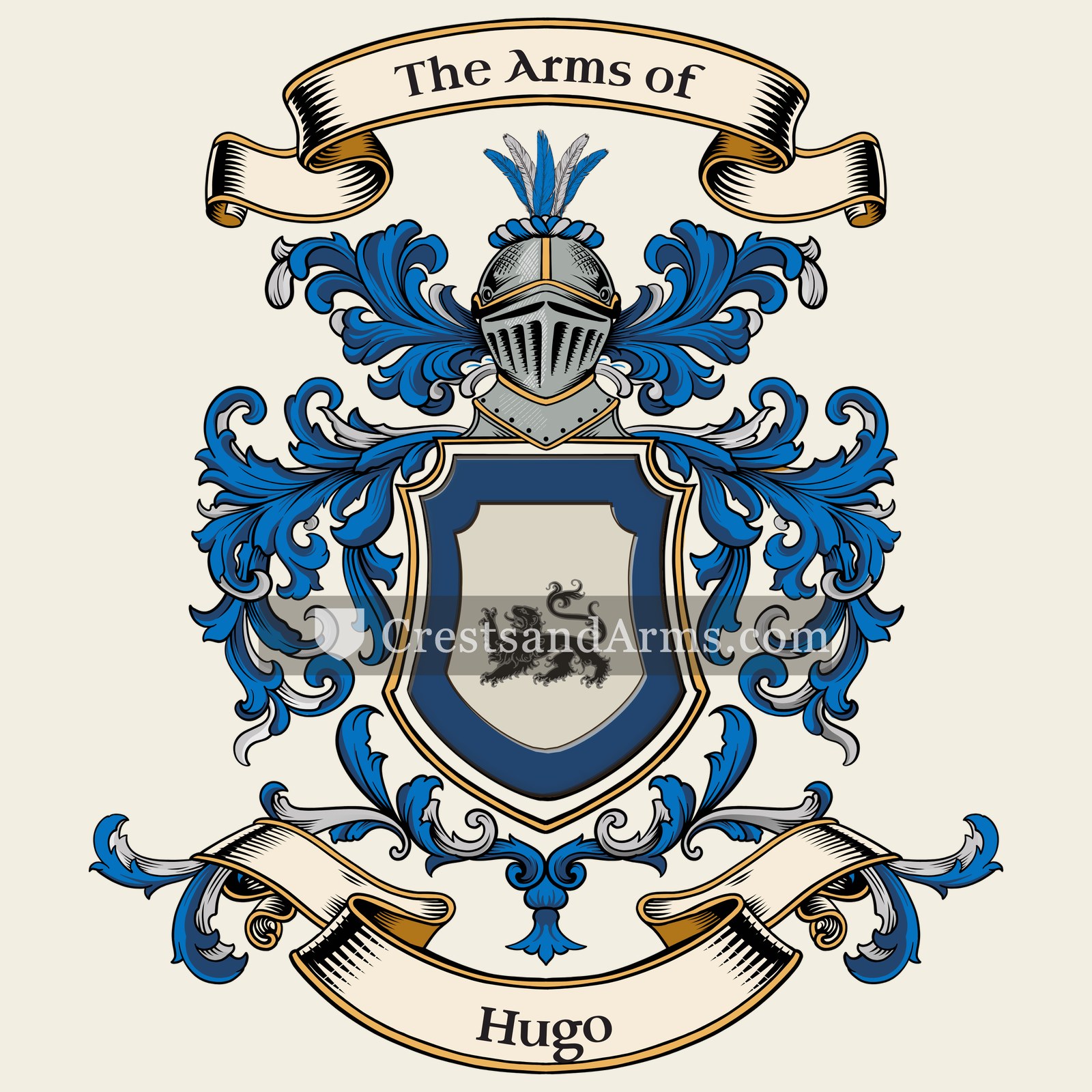
bordureA difference between branches of one family
lionCourage, strength and royalty
Colours
Silver (Argent)Means: Peace and sincerity
Blue (Azure)Means: Loyalty and truth
Black (Sable)Means: Constancy
Historical info
Source
Sir Bernard Burke, The General Armory of England, Scotland, Ireland and Wales, London: Harrison & Sons, 1884
Blazon (the actual original written record)
“Ar. a lion ramp. sa. crowned or, a bordure az”
Englandc. 1620
Digital archive packCoat of arms PNG, gold border print PDF, vector SVG and the certificate of authenticity. Sent to your email in minutes.
Map of England showing where the Hugo arms are recorded
The Hugo arms were recorded in England, c. 1620.
Arms such as these were typically recorded in York.
Yorkshire is the largest of the English counties, and it held more gentry families than any other. Land there was split among a great many households rather than a few, so a great many of them carried arms.
This is where the arms were entered in the register. Families often moved to other parts of the country, so the same name can turn up in more than one region.
The body that granted and recorded arms in England in this period.
James VI and I
Sovereign of the period
James VI and I
1603–1625
Reigning in France when the Hugo arms are first recorded.
How Arms Worked in England
English heraldry allowed arms to be shared by all legitimate descendants of the original owner. These symbols were treated as personal property that moved through the generations to all children. While the eldest son kept the original design, other family members could use the same shield without needing to change it or register their own unique versions.
Granting authority
The College of Arms in London has regulated the use of coats of arms throughout England and Wales since 1484.
How they got arms
Families typically obtained their coats of arms through a formal grant from the Crown or by proving their ancient right to them.
Where arms were recorded
All official coats of arms are recorded in the registers kept at the College of Arms, which date back to the fifteenth century.
The family's standing
Recorded among the armigerous families of England.
Origin & History of the Hugo Family in England
The surname Hugo is rooted in the Germanic name Hugh, which means heart, mind, or spirit. While the name existed in various forms across Europe for centuries, its presence in England became more defined following the Norman Conquest. By the early seventeenth century, the family had established a notable foothold in the historic city of York. Records from 1620 confirm that members of the Hugo family were active residents in this northern hub during a time of significant social and economic change. Living in York placed the family at the center of a major religious and administrative capital, where they likely participated in the local trade and civic life that defined the city during the reign of King James I. This early documented presence suggests that the Hugo family was well-integrated into the fabric of English society long before the modern era.
Related Branches & Arms
Root word
Hug
A Germanic element meaning heart, mind, or spirit.
This name
HugoRefers to a person of great intellect, bright spirit, or sharp mind.
also spelled
Hugoo
Hugoe
Hugon
Hugue
Documented Sources
J. B. Rietstap, Armorial Général, Gouda: G. B. van Goor Zonen, 1884–87
Dauzat, Albert. Dictionnaire étymologique des noms de famille et prénoms de France. 1951
Morlet, Marie-Thérèse. Dictionnaire étymologique des noms de famille. 1991
Digital archive packCoat of arms PNG, gold border print PDF, vector SVG and the certificate of authenticity. Sent to your email in minutes.


 chiefAuthority, wisdom and dominion
 fessThe military belt, and readiness to serve
 martletA younger son, who must win his own land
 chiefAuthority, wisdom and dominion
 fessThe military belt, and readiness to serve
 martletA younger son, who must win his own land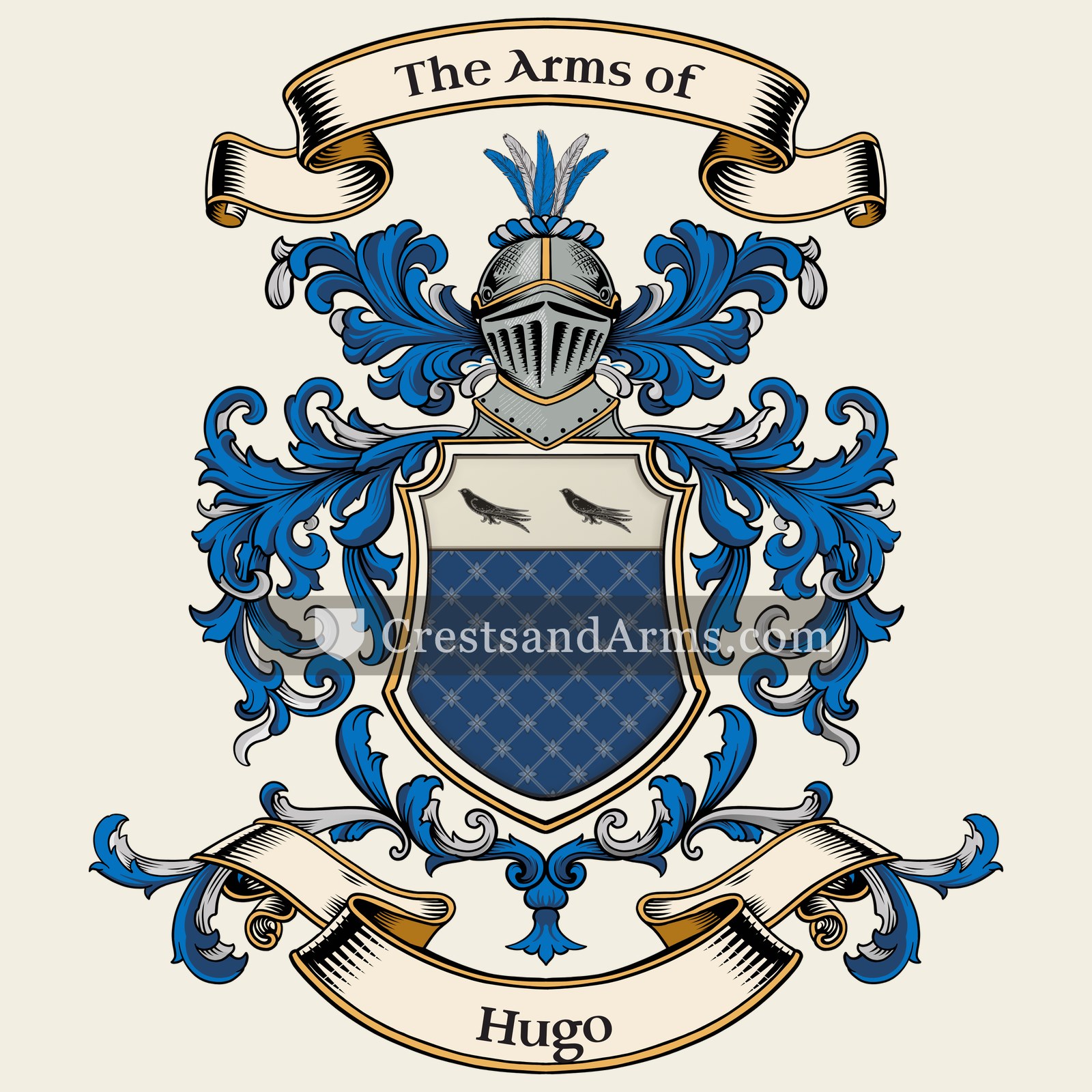


 anchorHope, and steadfastness in trouble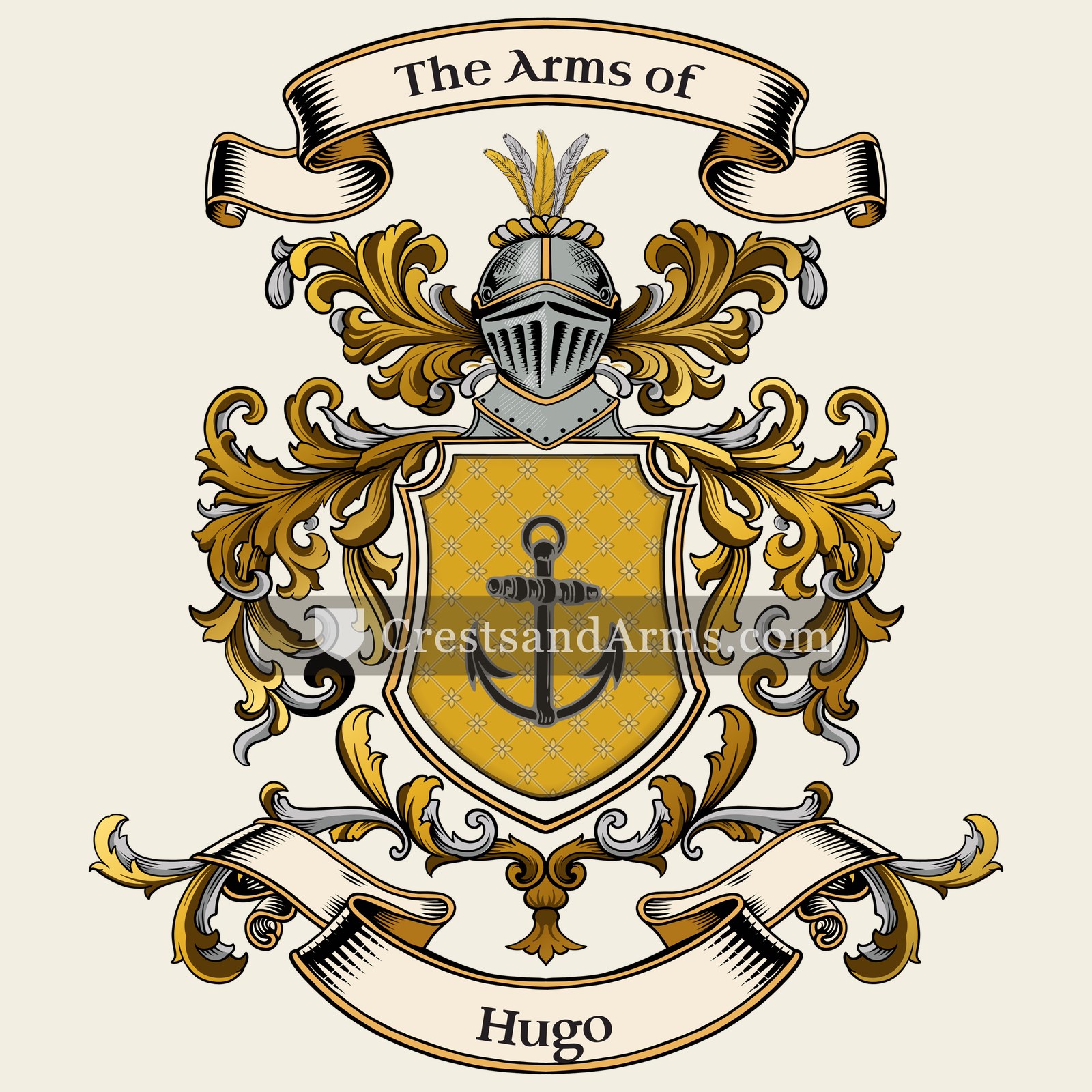

 bordureA difference between branches of one family
 lionCourage, strength and royalty