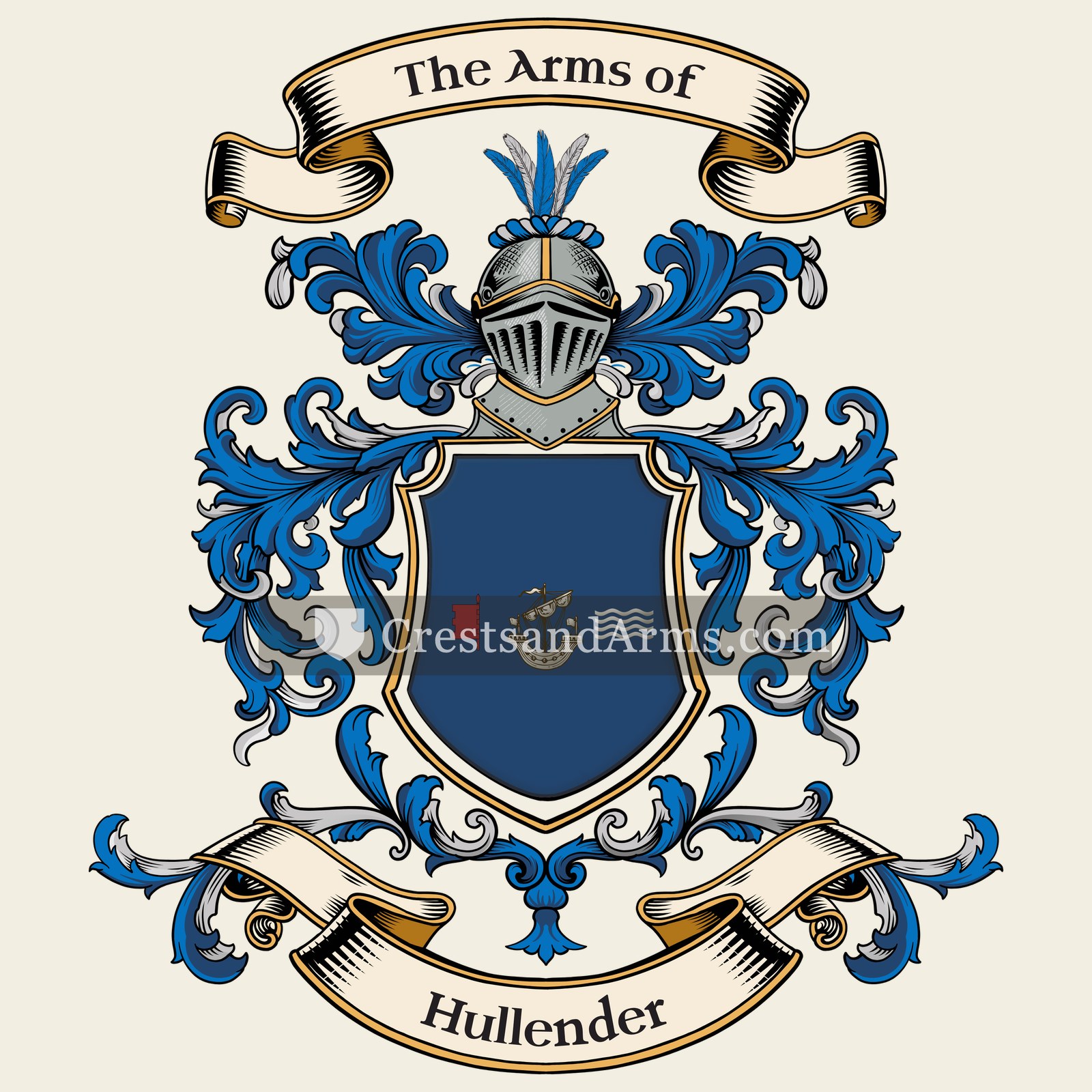
A record of documented arms, meaning and origin, researched for the Hullender family of Austria.
Reg. 4658 · Austrian, G–I
Coat of Arms & Family Crest Details
Symbols on this shield
shipEnterprise, and a great voyage undertaken
flag / pennantA command held, and a following kept
riverThe bounds of a land, and life carried through it
Colours
Blue (Azure)Means: Loyalty and truth
Red (Gules)Means: Military strength
Silver (Argent)Means: Peace and sincerity
Historical info
Source
J. B. Rietstap, Armorial Général, Gouda: G. B. van Goor Zonen, 1884–87
Blazon (the actual original written record)
“D'azur à un navire sous voiles, au nat., pavillonné de gu., flottant sur une eau d'arg. C.: une voile rayée de gu. et d'arg., attachée à une verge en pal. L.: à dextre d'arg. et d'azur, à sen. d'arg. et de gu.”
AustriaVienne, c. 1772
Digital archive packCoat of arms PNG, gold border print PDF, vector SVG and the certificate of authenticity. Sent to your email in minutes.
Map of Austria showing where the Hullender arms are recorded
The Hullender arms were recorded in Vienne, c. 1772.
This is where the arms were entered in the register. Families often moved to other parts of the country, so the same name can turn up in more than one region.
Region
Vienne
Town
Vienne
First recorded
1772
Granting Authority for the Hullender Arms
Imperial and Royal chancery
Sodacan · CC BY-SA 3.0
The body that granted and recorded arms in Austria in this period.
Joseph II, Holy Roman Emperor
Sovereign of the period
Joseph II, Holy Roman Emperor
1765–1790
Reigning in Austria when the Hullender arms are first recorded.
How Arms Worked in Austria
Austrian coats of arms were often linked directly to noble titles granted by the Emperor. These symbols belonged to the entire family line rather than just one individual. When a family grew, new branches kept the original design without needing to change it. This system allowed all members of a noble house to share the same identity across many generations.
Granting authority
The Imperial and Royal chancery managed all heraldic matters and controlled the official granting of arms throughout the Austrian lands.
How they got arms
Families typically received their arms through a formal imperial decree that often accompanied the elevation of a person to noble status.
Where arms were recorded
Official records of these grants were kept in the Imperial Register of Nobility which began its formal documentation process in 1453.
The family's standing
Recorded among the armigerous families of Austria.
Origin & History of the Hullender Family in Austria
The Hullender family name is deeply connected to the historical landscape of the Vienne department in western France. By the year 1772, records confirm that members of the family were well-established residents in this region. The name likely evolved from local geographic markers or occupational descriptions common to the French countryside during the eighteenth century. As families in this area often lived in small, tight-knit rural communities, the Hullenders were likely involved in the agricultural traditions that defined the local economy of the Poitou province. Over time, the family name served as a way to track lineage and property ownership within the parish registers of the era. These early ancestors helped shape the cultural identity of their local villages before later generations began to migrate to new regions.
Related Branches & Arms
Root word
Holländer
A person originating from the region of Holland or the Netherlands.
This name
HullenderAn occupational or habitational surname denoting an immigrant or trader from the Dutch territories.
also spelled
Hollander
Holender
Documented Sources
J. B. Rietstap, Armorial Général, Gouda: G. B. van Goor Zonen, 1884–87
Archives départementales de la Vienne, Registres paroissiaux et d'état civil
Digital archive packCoat of arms PNG, gold border print PDF, vector SVG and the certificate of authenticity. Sent to your email in minutes.


 shipEnterprise, and a great voyage undertaken
 flag / pennantA command held, and a following kept
 riverThe bounds of a land, and life carried through it
 shipEnterprise, and a great voyage undertaken
 flag / pennantA command held, and a following kept
 riverThe bounds of a land, and life carried through it