A record of documented arms, meaning and origin, researched for the Hume family lines. Documented in 3 countries.
Reg. 1875 · French, G–I
Coat of Arms & Family Crest Details
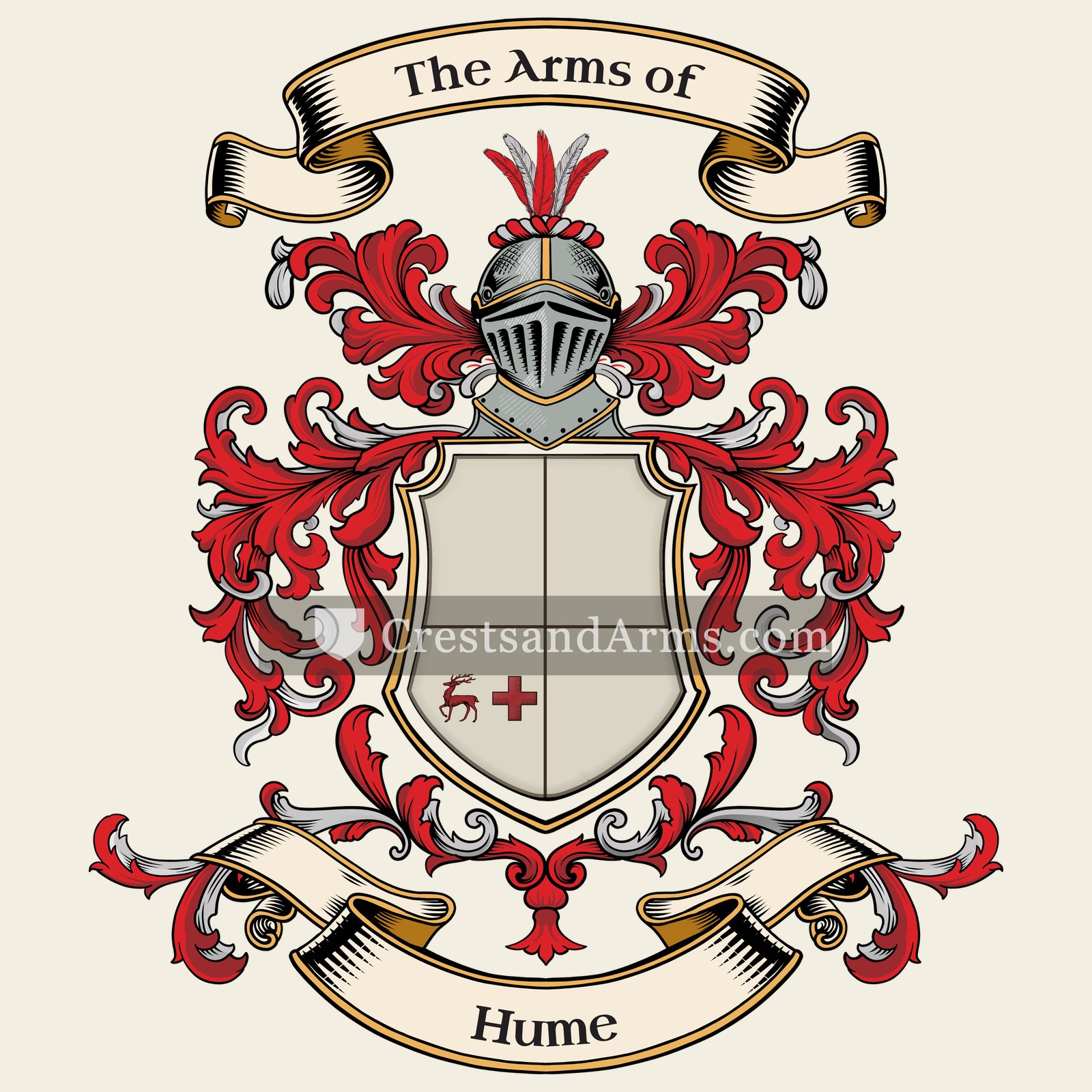
Symbols on this shield
cross symbolChristian faith and service
lionCourage, strength and royalty
parrotEloquence, and travel in distant lands
Colours
Silver (Argent)Means: Peace and sincerity
Green (Vert)Means: Hope
Black (Sable)Means: Constancy
Historical info
Source
J. B. Rietstap, Armorial Général, Gouda: G. B. van Goor Zonen, 1884–87
Blazon (the actual original written record)
“Ec.: aux 1 et 4 c.-éc.: a. et d. de sin. au lion d'arg., arm. et lamp. de gu. (Hume); b. et c. d'arg. à trois perroquets de sin., bq. et m. de gu. (Pepdie); au 2 d'arg. à trois piles engr. de gu. (Polwarth); au 3 d'arg. à la croix engr. de sa. (Sinclair). Sur le tout d'arg. à une orange tigée et feuillée au nat., la tige en bas, sommée d'une couronne royale d'or (concession du roi Guillaume III.) C.: un bras arm., brandissant un sabre et iss. d'un coeur humain, le tout au nat. S.: deux lions reg. d'arg., arm. et lamp. de gu. D.: FIDES PROBATA CORONAT.”
Francec. 1725
Digital archive packCoat of arms PNG, gold border print PDF, vector SVG and the certificate of authenticity. Sent to your email in minutes.
Map of France showing where the Hume arms are recorded
The Hume arms were recorded in France, c. 1725.
Arms such as these were typically recorded in Bretagne.
More families held coats of arms in Bretagne than anywhere else in France. The land was divided into many small estates rather than a few large ones, so far more households counted as gentry, and each needed a shield of its own to be told apart.
This is where the arms were entered in the register. Families often moved to other parts of the country, so the same name can turn up in more than one region.
The body that granted and recorded arms in France in this period.
Louis XV of France
Sovereign of the period
Louis XV of France
1715–1774
Reigning in France when the Hume arms are first recorded.
How Arms Worked in France
In France, a coat of arms was a mark of honor that passed down through the male line to all legitimate descendants. Families often used the same shield without changes to show their shared heritage. If a branch wanted to stand out, they could add a small mark to their shield to show their specific place in the family tree.
Granting authority
The Juge d'armes de France acted as the official authority that regulated and verified coats of arms across the country.
How they got arms
Families typically inherited their arms from ancestors, though they could also receive them through royal grants or by proving their noble status.
Where arms were recorded
Coats of arms were officially recorded in the Armorial Général de France, which began its main collection in the year 1696.
The family's standing
Recorded among the armigerous families of France.
Origin & History of the Hume Family in France
The history of the Hume family in France is deeply connected to the coastal region of Bretagne, where records confirm their presence by 1725. While the name is often associated with Scottish origins, its appearance in French parish registers suggests that members of the family integrated into local society during the early eighteenth century. During this period, Bretagne served as a vital hub for trade and maritime activity, which likely influenced the movement of families across the English Channel. These early settlers often transitioned into local administrative or merchant roles, blending their ancestral identity with the customs of their new home. By establishing roots in the towns of this province, the family became part of the long-standing cultural exchange between France and the British Isles. Their presence in these official records provides a clear window into how families migrated and adapted to life in a new country during the Enlightenment era.
Coat of Arms & Family Crest Details
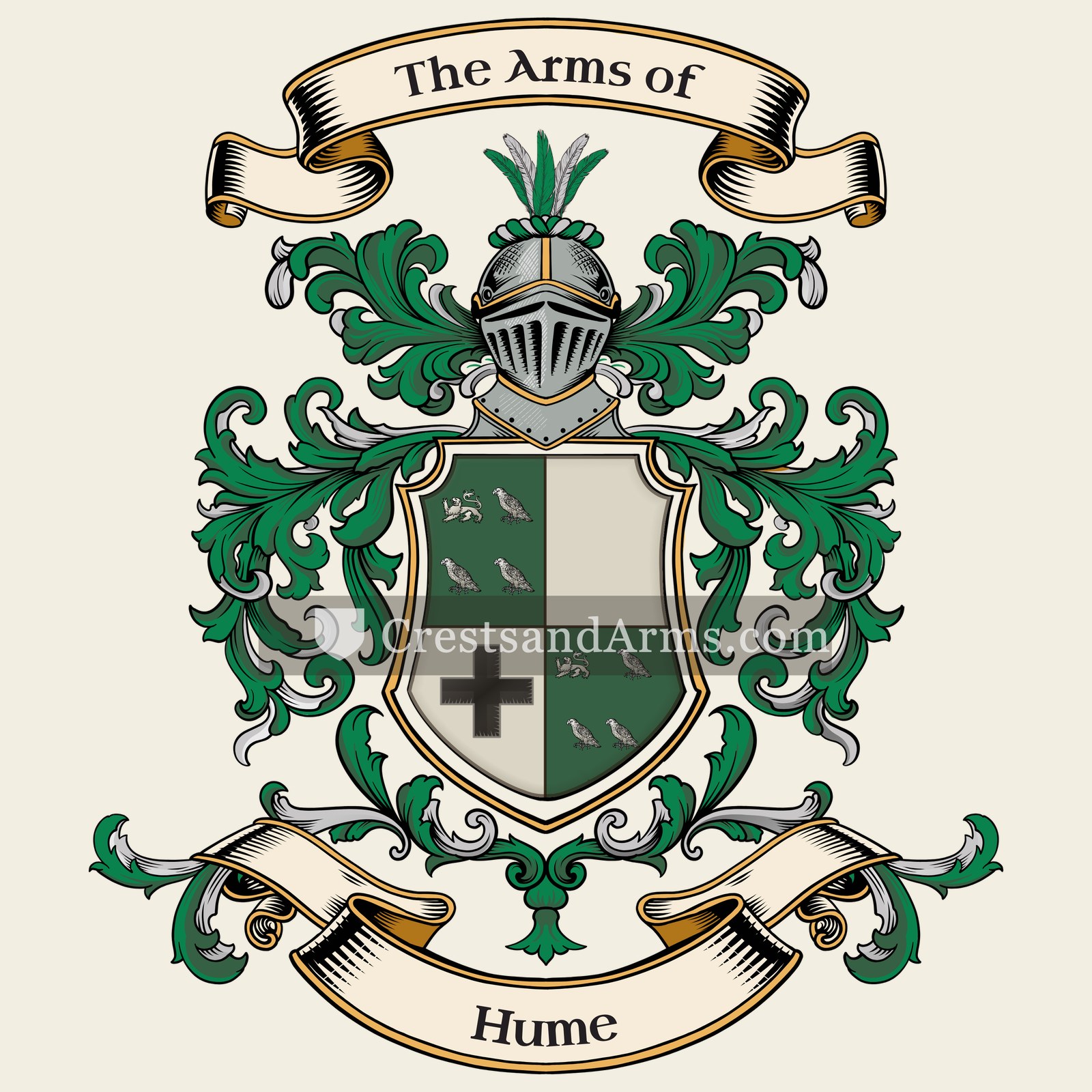
Symbols on this shield
chevronProtection, and faithful service completed
saltireResolution, and St Andrew's cross
lionCourage, strength and royalty
trefoilPerpetuity, and the Trinity
fleur de lisPurity, light, and the sixth son
hunting horn stringedOne who delights in the chase
Colours
Green (Vert)Means: Hope
Black (Sable)Means: Constancy
Silver (Argent)Means: Peace and sincerity
Red (Gules)Means: Military strength
Historical info
Source
Sir Bernard Burke, The General Armory of England, Scotland, Ireland and Wales, London: Harrison & Sons, 1884
Blazon (the actual original written record)
“Quarterly, 1st, vert a lion ramp. ar., for HUME; 2nd, sa. a chev. engr. betw. three trefoils ar., for LOFTUS; 3rd, gyronny of eight ar. and sa. a saltire engr. betw. four fleurs-de-lis, the ends converging to the centre all counterchanged, also for LOFTUS; 4th, or, a chev. gu. betw. three buglehorns sa. stringed az., for CREWKERN. On an escutcheon of pretence the arms of HUME, Bart., of Castle-Hume, as above. Crest and Motto same as LOFTUS, Earl of Ely”
Irelandc. 1736
Digital archive packCoat of arms PNG, gold border print PDF, vector SVG and the certificate of authenticity. Sent to your email in minutes.
Map of Ireland showing where the Hume arms are recorded
The Hume arms were recorded in Ireland, c. 1736.
Arms such as these were typically recorded in Dublin.
Dublin was the seat of government in Ireland and the place where grants were sought and recorded. Families with business at the castle or the courts settled nearby, and settling there put their arms on record.
This is where the arms were entered in the register. Families often moved to other parts of the country, so the same name can turn up in more than one region.
The body that granted and recorded arms in Ireland in this period.
George II of Great Britain
Sovereign of the period
George II of Great Britain
1727–1760
Reigning in France when the Hume arms are first recorded.
How Arms Worked in Ireland
The Ulster King of Arms granted coats of arms to individuals who proved their social standing and good character. These symbols were typically inherited by all legitimate descendants of the original holder. If a family branch wanted a unique look, they could apply for a specific change to their design through the office to ensure their identity remained distinct.
Granting authority
The Ulster King of Arms acted as the official body that regulated and issued all coats of arms throughout Ireland.
How they got arms
Families obtained their arms through formal grants issued by the office after proving their eligibility and paying the required fees.
Where arms were recorded
All official grants were recorded in the registers held by the Ulster King of Arms starting from the year 1552.
The family's standing
Recorded among the armigerous families of Ireland.
Origin & History of the Hume Family in Ireland
The history of the Hume name in Ireland is closely tied to the movement of families across the Irish Sea during the eighteenth century. While the name has deep roots in the Scottish Borders, members of the family were firmly established in Dublin by 1736. During this period, Dublin served as a bustling center of trade and administration, attracting ambitious individuals who sought new opportunities in the growing capital. These early settlers often integrated into the professional and social life of the city, contributing to the local economy and urban development. By settling in Dublin, the Hume family became part of the complex social fabric of Ireland, marking the beginning of a long presence in the region that spanned generations of merchants, landowners, and public figures.
Coat of Arms & Family Crest Details
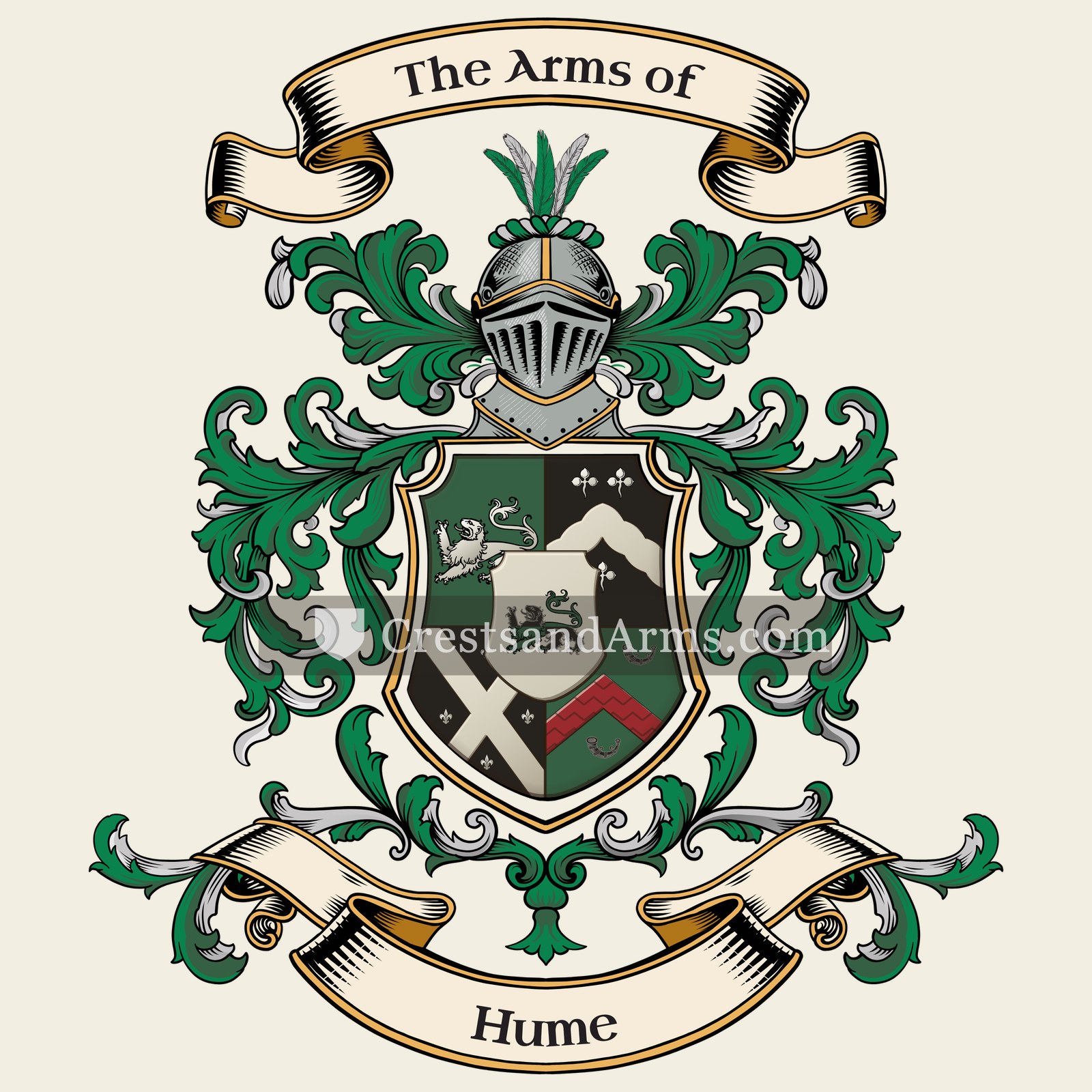
Symbols on this shield
cross symbolChristian faith and service
stagPeace and harmony, and one who will not fight unprovoked
Colours
Silver (Argent)Means: Peace and sincerity
Red (Gules)Means: Military strength
Historical info
Source
Sir Bernard Burke, The General Armory of England, Scotland, Ireland and Wales, London: Harrison & Sons, 1884
Blazon (the actual original written record)
“Quarterly, 1st and 4th, as NINEWELLS; 2nd, PEPDIE; 3rd, ar. a stag's head erased gu. betw. the attires a cross crosslet fitchée of the last, for CAIRNCROSS”
EdinburghWhitfield · Edinburgh, c. 1748
Digital archive packCoat of arms PNG, gold border print PDF, vector SVG and the certificate of authenticity. Sent to your email in minutes.
Map of Scotland showing where the Hume arms are recorded
The Hume arms were recorded in Edinburgh, c. 1748.
Edinburgh was the seat of Scotland's government, its courts and its heralds. Families with business there settled nearby, and being close to where arms were recorded is exactly why so many of them appear.
This is where the arms were entered in the register. Families often moved to other parts of the country, so the same name can turn up in more than one region.
The body that granted and recorded arms in Scotland in this period.
George II of Great Britain
Sovereign of the period
George II of Great Britain
1727–1760
Reigning in France when the Hume arms are first recorded.
How Arms Worked in Scotland
Scottish heraldry is unique because it treats a coat of arms as a piece of personal property protected by law. Only one person can own a specific design at any given time. When a family grows, the head keeps the original shield while other relatives must apply for their own distinct version with slight changes to prove their specific identity.
Granting authority
The Court of the Lord Lyon acts as the official body that regulates and controls all heraldic matters throughout Scotland.
How they got arms
Individuals obtain a legal right to their arms through a formal petition process that confirms their identity and family connection.
Where arms were recorded
All valid coats of arms are officially entered into the Public Register of All Arms and Bearings starting from 1672.
The family's standing
Recorded among the armigerous families of Edinburgh.
Origin & History of the Hume Family in Scotland
The surname Hume is deeply rooted in the history of the Scottish Borders, originating from the lands of Home in Berwickshire. The family rose to prominence during the Middle Ages as powerful landowners who played a significant role in the defense of the Scottish realm against northern invasions. By the mid-eighteenth century, the name had spread well beyond its rural origins, becoming well-established in the intellectual and social circles of Edinburgh. Records from 1748 confirm that members of the family were active participants in the vibrant urban life of the capital during the Scottish Enlightenment. This transition from border lords to city residents reflects the broader movement of Scottish families toward professional and academic life during that era. The name remains a testament to a lineage that evolved alongside the shifting political and cultural landscape of Scotland.
Hume Meaning & Related Branches
Root word
Hulm
Old Norse term for a small island or a river meadow.
This name
HumeA topographic name for someone who lived near a river meadow or an islet.
also spelled
Humea
Humeau
Hyoom
Hoom
Home
Related arms
Bentincksimilar arms
Campbell-McIversimilar arms
Elliotsimilar arms
Homevariant spelling
Documented Sources
J. B. Rietstap, Armorial Général, Gouda: G. B. van Goor Zonen, 1884–87
Archives départementales du Finistère, Registres paroissiaux et d'état civil
Archives départementales d'Ille-et-Vilaine, Série B: Cours et juridictions
Le Moyne de La Borderie, Arthur, Histoire de Bretagne, 1896
Digital archive packCoat of arms PNG, gold border print PDF, vector SVG and the certificate of authenticity. Sent to your email in minutes.


 cross symbolChristian faith and service
 lionCourage, strength and royalty
 parrotEloquence, and travel in distant lands
 cross symbolChristian faith and service
 lionCourage, strength and royalty
 parrotEloquence, and travel in distant lands


 chevronProtection, and faithful service completed
 saltireResolution, and St Andrew's cross
 trefoilPerpetuity, and the Trinity
 fleur de lisPurity, light, and the sixth son
 hunting horn stringedOne who delights in the chase


 stagPeace and harmony, and one who will not fight unprovoked