Map of Wales showing where the Huntley arms are recorded
The Huntley arms were recorded in Monmouth, c. 1647.
Monmouthshire lay on the Welsh border, where land was held in return for military service. Families were expected to arm and to fight, and fighting households carried shields of their own.
This is where the arms were entered in the register. Families often moved to other parts of the country, so the same name can turn up in more than one region.
The body that granted and recorded arms in Wales in this period.
Charles I of England
Sovereign of the period
Charles I of England
1625–1649
Reigning in Wales when the Huntley arms are first recorded.
How Arms Worked in Wales
English heraldry allowed arms to be shared by all legitimate descendants of the original owner. These symbols were treated as personal property that moved through the generations to all children. While the eldest son kept the original design, other family members could use the same shield without needing to change it or register their own unique versions.
Granting authority
The College of Arms in London has regulated the use of coats of arms throughout England and Wales since 1484.
How they got arms
Families typically obtained their coats of arms through a formal grant from the Crown or by proving their ancient right to them.
Where arms were recorded
All official coats of arms are recorded in the registers kept at the College of Arms, which date back to the fifteenth century.
The family's standing
Recorded among the armigerous families of Monmouth.
Origin & History of the Huntley Family in Wales
The surname Huntley has deep roots in the borderlands between England and Wales, particularly within the historic county of Monmouthshire. While the name is often associated with English origins, families bearing this name established a significant presence in Monmouth by the mid-seventeenth century. Records from 1647 confirm that members of the Huntley family were active participants in the local community during a period of intense political and social upheaval. These early settlers likely navigated the unique cultural landscape of the Welsh Marches, where English administrative practices frequently blended with traditional Welsh customs. By maintaining a foothold in Monmouth, the family became part of the long history of migration and settlement that defined the border region for generations. Their presence in the area during this time suggests they were well-integrated into the local economy and social structures of the seventeenth-century town.
Coat of Arms & Family Crest Details
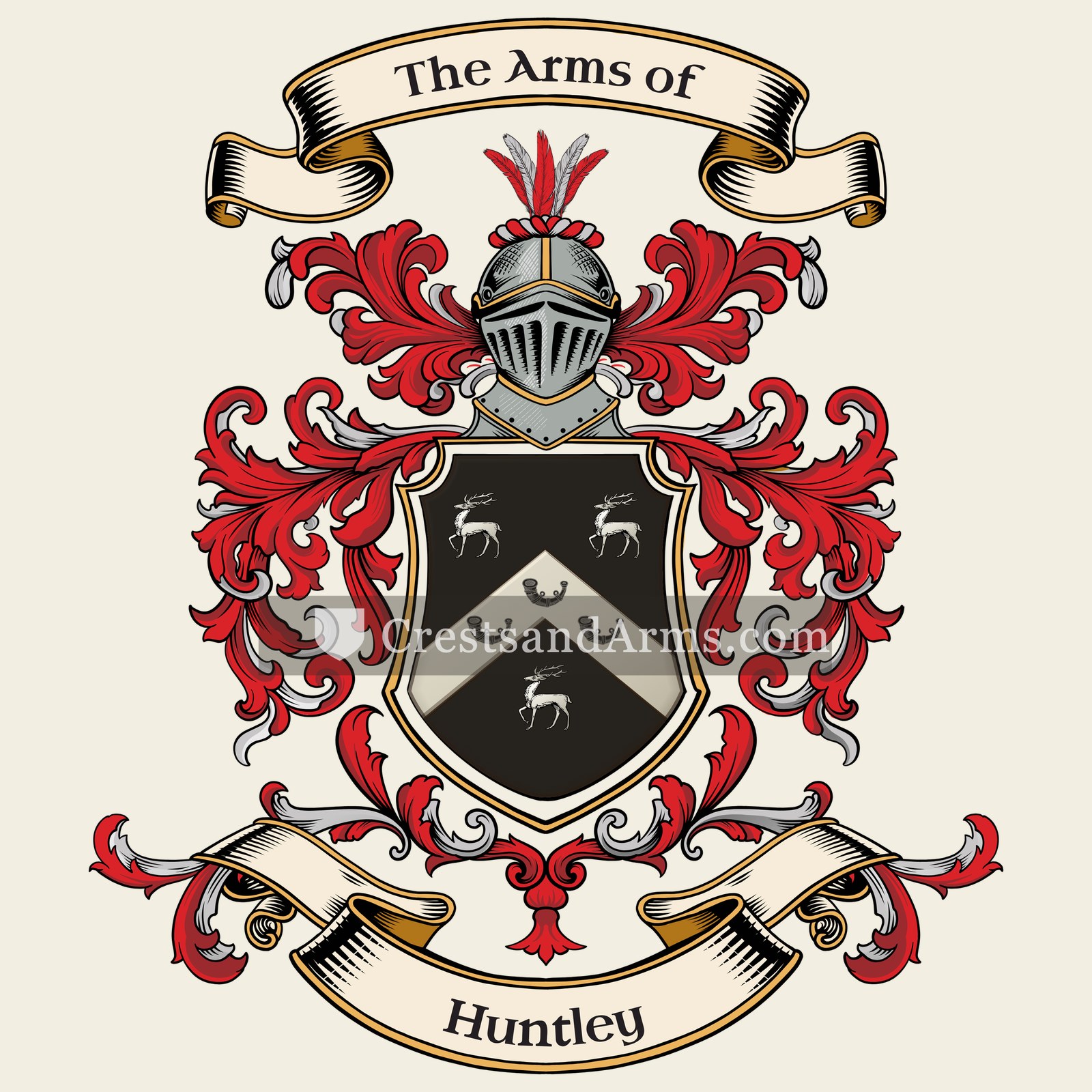
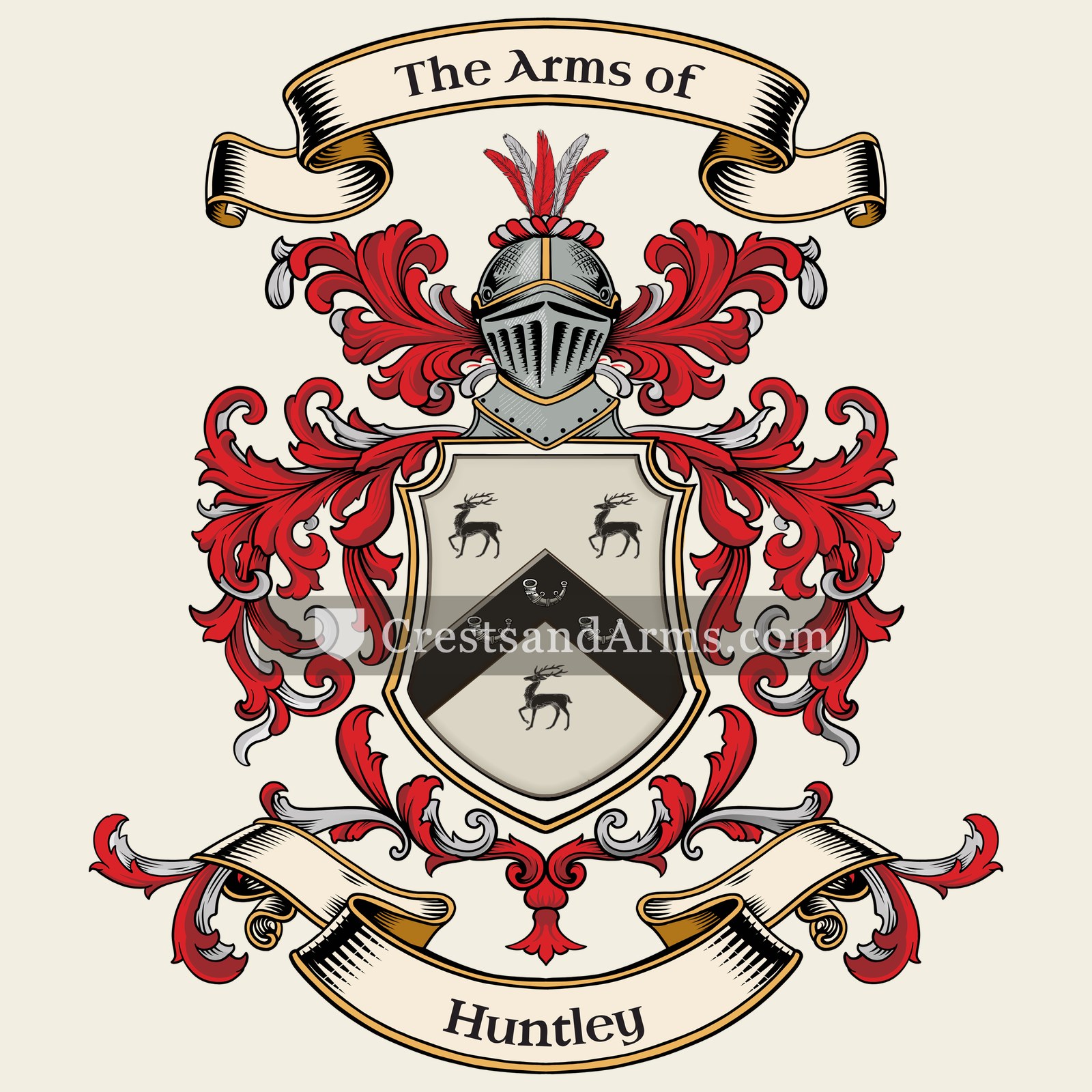
Symbols on this shield
chevronProtection, and faithful service completed
stagPeace and harmony, and one who will not fight unprovoked
hunting horn stringedOne who delights in the chase
Colours
Silver (Argent)Means: Peace and sincerity
Black (Sable)Means: Constancy
Historical info
Source
Sir Bernard Burke, The General Armory of England, Scotland, Ireland and Wales, London: Harrison & Sons, 1884
Blazon (the actual original written record)
“Ar. on a chev. betw. three stags' heads erased sa. as many buglehorns stringed of the field”
GloucesterBoxwell · Gloucester, c. 1620
Digital archive packCoat of arms PNG, gold border print PDF, vector SVG and the certificate of authenticity. Sent to your email in minutes.
Map of England showing where the Huntley arms are recorded
The Huntley arms were recorded in Gloucester, c. 1620.
Gloucestershire had good farmland, a cloth trade in its valleys and a river carrying goods to Bristol. All three made money, and money bought the estates that brought arms with them.
This is where the arms were entered in the register. Families often moved to other parts of the country, so the same name can turn up in more than one region.
The body that granted and recorded arms in England in this period.
James VI and I
Sovereign of the period
James VI and I
1603–1625
Reigning in Wales when the Huntley arms are first recorded.
How Arms Worked in England
English heraldry allowed arms to be shared by all legitimate descendants of the original owner. These symbols were treated as personal property that moved through the generations to all children. While the eldest son kept the original design, other family members could use the same shield without needing to change it or register their own unique versions.
Granting authority
The College of Arms in London has regulated the use of coats of arms throughout England and Wales since 1484.
How they got arms
Families typically obtained their coats of arms through a formal grant from the Crown or by proving their ancient right to them.
Where arms were recorded
All official coats of arms are recorded in the registers kept at the College of Arms, which date back to the fifteenth century.
The family's standing
Recorded among the armigerous families of Gloucester.
Origin & History of the Huntley Family in England
The surname Huntley is a locative name, meaning it originally identified people who lived near a specific meadow or clearing used for hunting. While the name appears in various parts of England, the branch of the family established in Gloucester by 1620 reflects a long tradition of English settlers who were deeply rooted in the local landscape. During the early seventeenth century, families in this region were often involved in the wool trade or local governance, which allowed them to build stable lives in the Severn Valley. As these individuals moved through the social structures of the time, they helped solidify the name within the county records of Gloucestershire. By the time the family was firmly documented in the early 1600s, they were part of a growing class of citizens who contributed to the agricultural and civic development of their home territory.
Related Branches & Arms
Root word
Hunt-leah
A hunting clearing or a meadow used for hunting purposes.
This name
HuntleyDerived from Old English elements referring to a woodland clearing specifically associated with hunting activities.
also spelled
Huntly
Huntleigh
Huntlee
Related arms
Mayhughsimilar arms
Huntly, Marquess ofvariant spelling
Bagecroftrecorded with Huntley, same area
Documented Sources
Sir Bernard Burke, The General Armory of England, Scotland, Ireland and Wales, London: Harrison & Sons, 1884
Bradney, Joseph, A History of Monmouthshire from the Coming of the Normans into Wales down to the Present Time, 1904
The National Archives, State Papers Domestic, Charles I, 1647
Gwent Archives, Monmouth Borough Records, 1647
Digital archive packCoat of arms PNG, gold border print PDF, vector SVG and the certificate of authenticity. Sent to your email in minutes.


 chevronProtection, and faithful service completed
 stagPeace and harmony, and one who will not fight unprovoked
 hunting horn stringedOne who delights in the chase
 chevronProtection, and faithful service completed
 stagPeace and harmony, and one who will not fight unprovoked
 hunting horn stringedOne who delights in the chase