A record of documented arms, meaning and origin, researched for the Hurford family lines. Documented in 2 countries.
Reg. 7403 · German, G–I
Coat of Arms & Family Crest Details
Symbols on this shield
bendDefence, and the scarf of a commander
knightChivalry and service in arms
lionCourage, strength and royalty
mulletThe third son, and a divine quality from above
Colours
Silver (Argent)Means: Peace and sincerity
Red (Gules)Means: Military strength
Gold (Or)Means: Generosity
Black (Sable)Means: Constancy
Historical info
Source
J. B. Rietstap, Armorial Général, Gouda: G. B. van Goor Zonen, 1884–87
Blazon (the actual original written record)
“Parti: au 1 coupé: a. d'arg. au lion de sa.; b. d'or à la barre de sa., ch. d'une étoile du champ; au 2 de gu. à un homme, arm. de toutes pièces d'arg., la visière levée, tenant de sa main dextre levée un marteau d'armes du même. Cq. cour. C.: un lion iss. d'or, la tête sommée d'une étoile du même; entre un vol, l'aile dextre d'or, ch. d'une barre de sa. surch. d'une étoile d'or, l'aile sen. de gu. ch. d'une bande d'arg. surch. d'une étoile d'or. L.: à dextre d'arg., d'or et de sa., à sen. d'arg. et de gu.”
SilesiaSilesia, c. 1645
Digital archive packCoat of arms PNG, gold border print PDF, vector SVG and the certificate of authenticity. Sent to your email in minutes.
Map of Germany showing where the Hurford arms are recorded
The Hurford arms were recorded in Silesia, c. 1645.
Silesia was farming country in the east of the German lands, held in large estates by families who stayed put for generations. Owning land was what entitled a family to arms, so the region fills a good deal of the register.
This is where the arms were entered in the register. Families often moved to other parts of the country, so the same name can turn up in more than one region.
The body that granted and recorded arms in Germany in this period.
Ferdinand III, Holy Roman Emperor
Sovereign of the period
Ferdinand III, Holy Roman Emperor
1637–1657
Reigning in Germany when the Hurford arms are first recorded.
How Arms Worked in Germany
In the Holy Roman Empire, coats of arms were often granted to individuals by the Emperor or his representatives. These arms were then passed down through the generations to all legitimate descendants of the original holder. Younger branches of a family usually kept the same shield design without needing to change it, as the arms belonged to the entire lineage.
Granting authority
The Holy Roman Emperor held the sole power to grant new coats of arms throughout his vast imperial territories.
How they got arms
Families typically obtained their coats of arms through a formal imperial grant or by proving their noble status to the authorities.
Where arms were recorded
These grants were officially recorded in the Imperial Chancery registers, which began keeping formal records of such honors during the Middle Ages.
The family's standing
Recorded among the armigerous families of Silesia.
Origin & History of the Hurford Family in Germany
The roots of the Hurford family in Germany are tied to the complex social landscape of the seventeenth century, specifically within the region of Silesia. By 1645, members of the family were established in this area, which was then a crossroads of shifting borders and cultural influences between Central and Eastern Europe. During this period, the Thirty Years' War had caused significant upheaval, forcing many families to relocate or adapt to new administrative structures. The Hurford name likely functioned as a descriptor for individuals living near a specific river crossing or a ford, which was a common way to identify people before fixed surnames became mandatory. As these early ancestors navigated life in Silesia, they were part of a resilient population that maintained local traditions despite the political instability of the era. Their presence in the region highlights the historical movement of families who sought stability in the fertile lands of the Oder River basin during a time of great transition.
Coat of Arms & Family Crest Details
Symbols on this shield
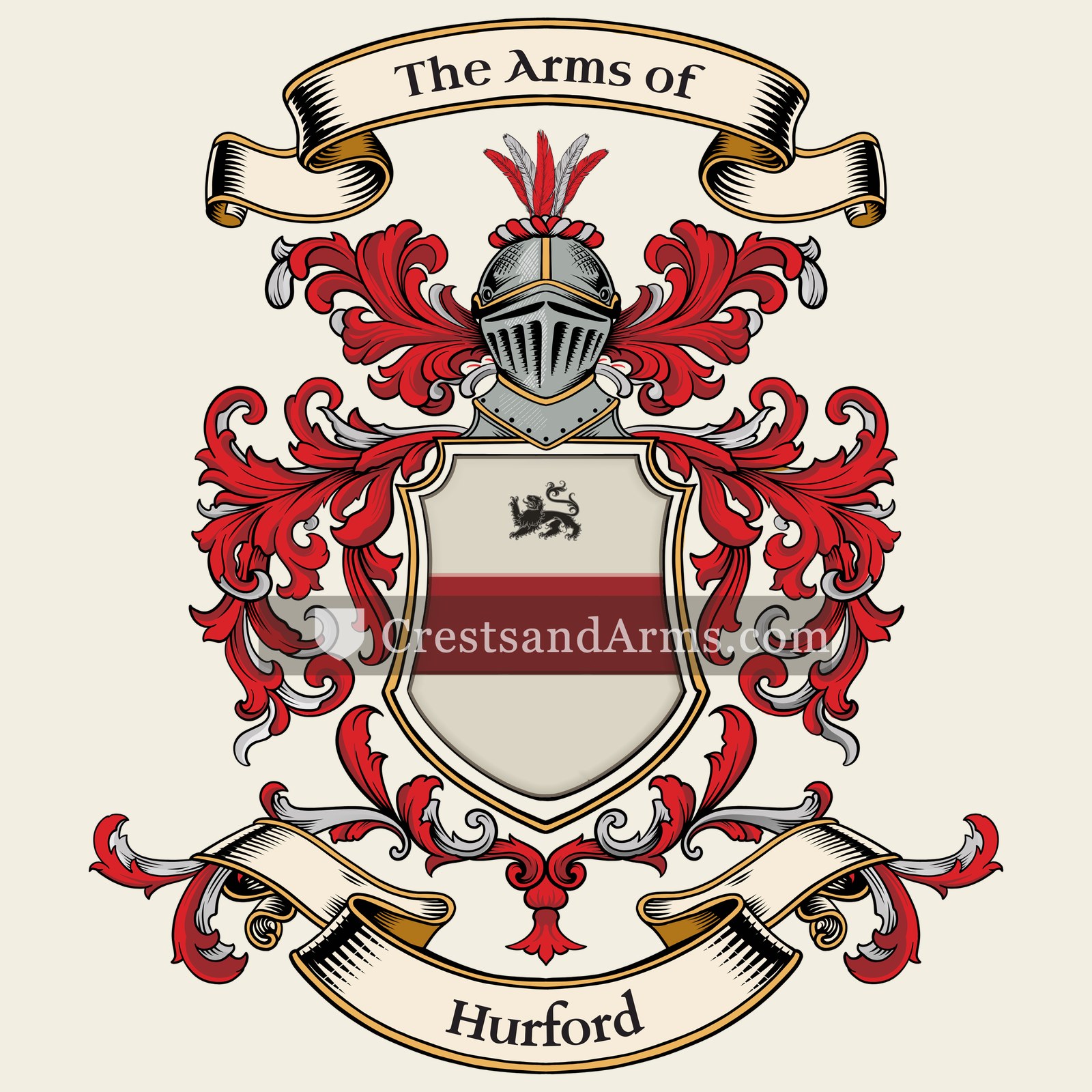
fessThe military belt, and readiness to serve
lionCourage, strength and royalty
Colours
Silver (Argent)Means: Peace and sincerity
Red (Gules)Means: Military strength
Black (Sable)Means: Constancy
Historical info
Source
Sir Bernard Burke, The General Armory of England, Scotland, Ireland and Wales, London: Harrison & Sons, 1884
Blazon (the actual original written record)
“Ar. a fess lozengy gu. a lion pass. guard. in chief sa”
DevonDevon, c. 1620
Digital archive packCoat of arms PNG, gold border print PDF, vector SVG and the certificate of authenticity. Sent to your email in minutes.
Map of England showing where the Hurford arms are recorded
The Hurford arms were recorded in Devon, c. 1620.
Devon was a county of small manors and seafaring families. Its gentry were spread thickly across the countryside, and money made at sea often bought an estate, which in turn brought a coat of arms.
This is where the arms were entered in the register. Families often moved to other parts of the country, so the same name can turn up in more than one region.
The body that granted and recorded arms in England in this period.
James VI and I
Sovereign of the period
James VI and I
1603–1625
Reigning in Germany when the Hurford arms are first recorded.
How Arms Worked in England
English heraldry allowed arms to be shared by all legitimate descendants of the original owner. These symbols were treated as personal property that moved through the generations to all children. While the eldest son kept the original design, other family members could use the same shield without needing to change it or register their own unique versions.
Granting authority
The College of Arms in London has regulated the use of coats of arms throughout England and Wales since 1484.
How they got arms
Families typically obtained their coats of arms through a formal grant from the Crown or by proving their ancient right to them.
Where arms were recorded
All official coats of arms are recorded in the registers kept at the College of Arms, which date back to the fifteenth century.
The family's standing
Recorded among the armigerous families of Devon.
Origin & History of the Hurford Family in England
The family name Hurford originated in the southwest of England, with deep roots firmly established in the county of Devon by the early seventeenth century. Etymologically, the name is classified as a locational surname, likely derived from an Old English term describing a ford situated near a wood or a clearing. During the 1600s, families bearing this name were often tied to the rural landscape of the West Country, where they worked as farmers or tradespeople within small parish communities. By 1620, records confirm that the Hurfords were well-integrated into the social fabric of Devon, living through a period of significant agricultural transition and local development. These early ancestors helped shape the regional identity of the area, leaving behind a legacy that is preserved in local parish registers and land documents from that era.
Related Branches & Arms
Root word
Hurt-ford
A river crossing located near a wooded or forested area.
This name
HurfordDerived from a topographic location referring to a ford situated by a wood or forest.
also spelled
Herfort
Herfurd
Harford
Hereford
Documented Sources
J. B. Rietstap, Armorial Général, Gouda: G. B. van Goor Zonen, 1884–87


 bendDefence, and the scarf of a commander
 knightChivalry and service in arms
 lionCourage, strength and royalty
 mulletThe third son, and a divine quality from above
 bendDefence, and the scarf of a commander
 knightChivalry and service in arms
 lionCourage, strength and royalty
 mulletThe third son, and a divine quality from above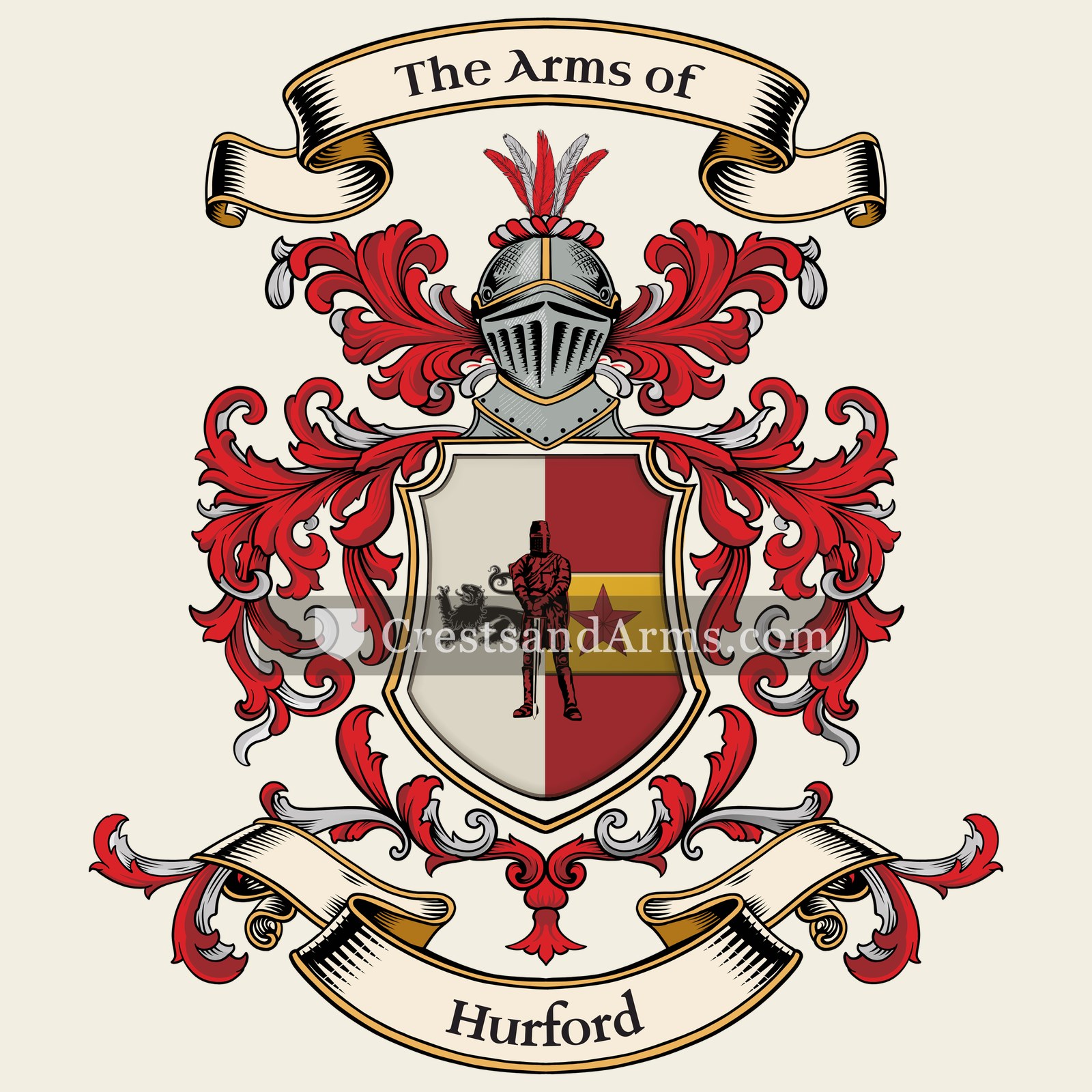


 fessThe military belt, and readiness to serve