Map of Netherlands showing where the Huss arms are recorded
The Huss arms were recorded in Guelders, c. 1815.
Guelders was river country in the east of the Netherlands, held by families whose estates sat along the water. Land there stayed in the same hands for generations, and long tenure is what fills a register of arms.
This is where the arms were entered in the register. Families often moved to other parts of the country, so the same name can turn up in more than one region.
Region
Guelders
First recorded
1815
Granting Authority for the Huss Arms
Hoge Raad van Adel
Photograph made by me · CC BY-SA 3.0
The body that granted and recorded arms in Netherlands in this period.
William I of the Netherlands
Sovereign of the period
William I of the Netherlands
1815–1840
Reigning in Netherlands when the Huss arms are first recorded.
How Arms Worked in Netherlands
In the Netherlands, coats of arms were often used by noble families and those who held specific public offices. These arms were passed down through the generations to legitimate descendants. Younger branches of a family usually kept the original design without needing to add special marks. This system ensured that the family identity remained clear and consistent over many years.
Granting authority
The Hoge Raad van Adel is the official body that regulates and manages noble titles and coats of arms in the Netherlands.
How they got arms
Families typically obtained their coats of arms through official royal grants or by proving their long-standing historical use of the symbols.
Where arms were recorded
Coats of arms are officially recorded in the registers held by the Hoge Raad van Adel, which began its work in 1814.
The family's standing
Recorded among the armigerous families of Guelders.
Origin & History of the Huss Family in Netherlands
The family name Huss has deep roots in the historical region of Guelders, a territory in the eastern Netherlands that served as a vital crossroads for trade and migration. By the early 19th century, records confirm that members of the family were well-established in this area, which had recently transitioned from a French-controlled department into the newly formed Kingdom of the Netherlands in 1815. The name itself likely originated as a descriptive term or a shortened form of a longer Germanic name, reflecting the common naming patterns of the Low Countries during the transition from feudal society to a centralized state. As residents of Guelders, the early Huss family lived in a region defined by its distinct local identity and its strategic position between the Dutch heartland and the German border. This location suggests that the family was part of a mobile population that navigated the complex social and political changes occurring across Europe during the Napoleonic era. Their presence in the official civil registers of 1815 marks a period when the Dutch government began standardizing surnames, helping to solidify the family identity as it is known today.
Coat of Arms & Family Crest Details
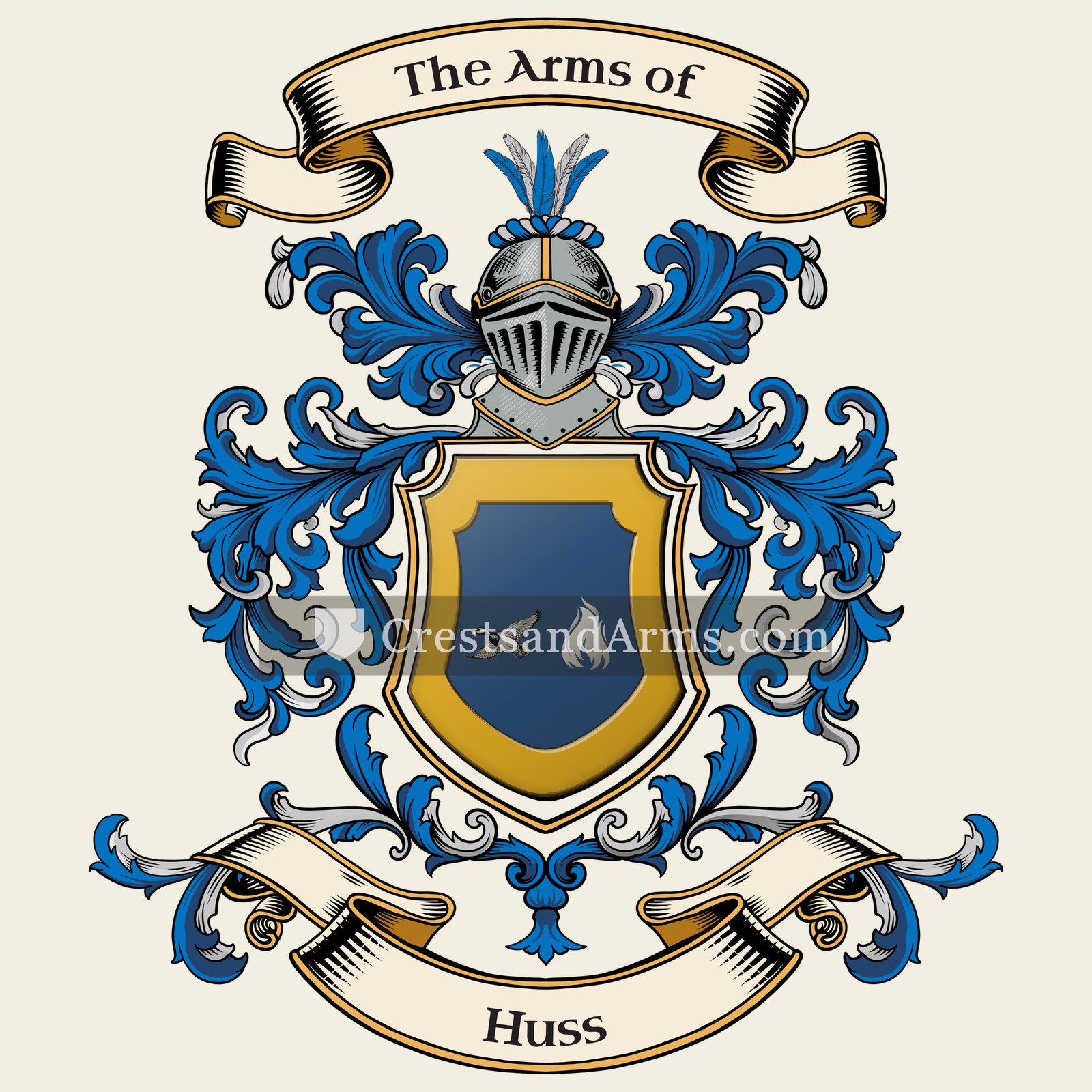
Symbols on this shield
duckResourcefulness on land and water
fireZeal and purification
Colours
Blue (Azure)Means: Loyalty and truth
Gold (Or)Means: Generosity
Silver (Argent)Means: Peace and sincerity
Historical info
Source
J. B. Rietstap, Armorial Général, Gouda: G. B. van Goor Zonen, 1884–87
Blazon (the actual original written record)
“D'azur à une oie d'arg., posée dans un feu de tisons au nat.; l'écu bordé d'or. Cq. cour. C.: l'oie.”
Germanyc. 1702
Digital archive packCoat of arms PNG, gold border print PDF, vector SVG and the certificate of authenticity. Sent to your email in minutes.
Map of Germany showing where the Huss arms are recorded
The Huss arms were recorded in Germany, c. 1702.
Arms such as these were typically recorded in Bavaria.
Bavaria was a country of old landed families and walled market towns. Estates passed down the same line for centuries, and both the landowners and the leading townsmen kept arms, which is why so many Bavarian names sit in the registers.
This is where the arms were entered in the register. Families often moved to other parts of the country, so the same name can turn up in more than one region.
The body that granted and recorded arms in Germany in this period.
Leopold I, Holy Roman Emperor
Sovereign of the period
Leopold I, Holy Roman Emperor
1658–1705
Reigning in Netherlands when the Huss arms are first recorded.
How Arms Worked in Germany
In the Holy Roman Empire, coats of arms were often granted to individuals by the Emperor or his representatives. These arms were then passed down through the generations to all legitimate descendants of the original holder. Younger branches of a family usually kept the same shield design without needing to change it, as the arms belonged to the entire lineage.
Granting authority
The Holy Roman Emperor held the sole power to grant new coats of arms throughout his vast imperial territories.
How they got arms
Families typically obtained their coats of arms through a formal imperial grant or by proving their noble status to the authorities.
Where arms were recorded
These grants were officially recorded in the Imperial Chancery registers, which began keeping formal records of such honors during the Middle Ages.
The family's standing
Recorded among the armigerous families of Germany.
Origin & History of the Huss Family in Germany
The surname Huss has deep roots in the German-speaking regions of Central Europe, where it likely originated as a descriptive nickname or a shortened form of a given name. By the early 18th century, the family was well-established in the Bavarian region, a time when many families were deeply tied to the local agricultural and village life of the Holy Roman Empire. During this period, the name was often recorded in local church registers as families moved through the changing landscapes of southern Germany. These early ancestors were part of a society defined by strict social structures and the influence of the church, which kept meticulous records of births and marriages. As the family grew within Bavaria, they became part of the regional history that helped shape the customs and traditions of the area. This history reflects the broader movement of people across German lands during the transition into the modern era.
Related Branches & Arms
Root word
Huss
Derived from the Middle High German word for house or dwelling.
This name
HussAn occupational or topographic name referring to someone who lived in or worked at a house.
also spelled
Husse
Husss
Husz
Hus
Related arms
Husvariant spelling
Husevariant spelling
Documented Sources
J. B. Rietstap, Armorial Général, Gouda: G. B. van Goor Zonen, 1884–87
Gelders Archief, Burgerlijke Stand Gelderland (1815)
Beekman, A. A., Geschiedenis van de Nederlanden, 1920
Panhuysen, L., Het ontstaan van Nederland, 2013
Digital archive packCoat of arms PNG, gold border print PDF, vector SVG and the certificate of authenticity. Sent to your email in minutes.


 fessThe military belt, and readiness to serve
 fessThe military belt, and readiness to serve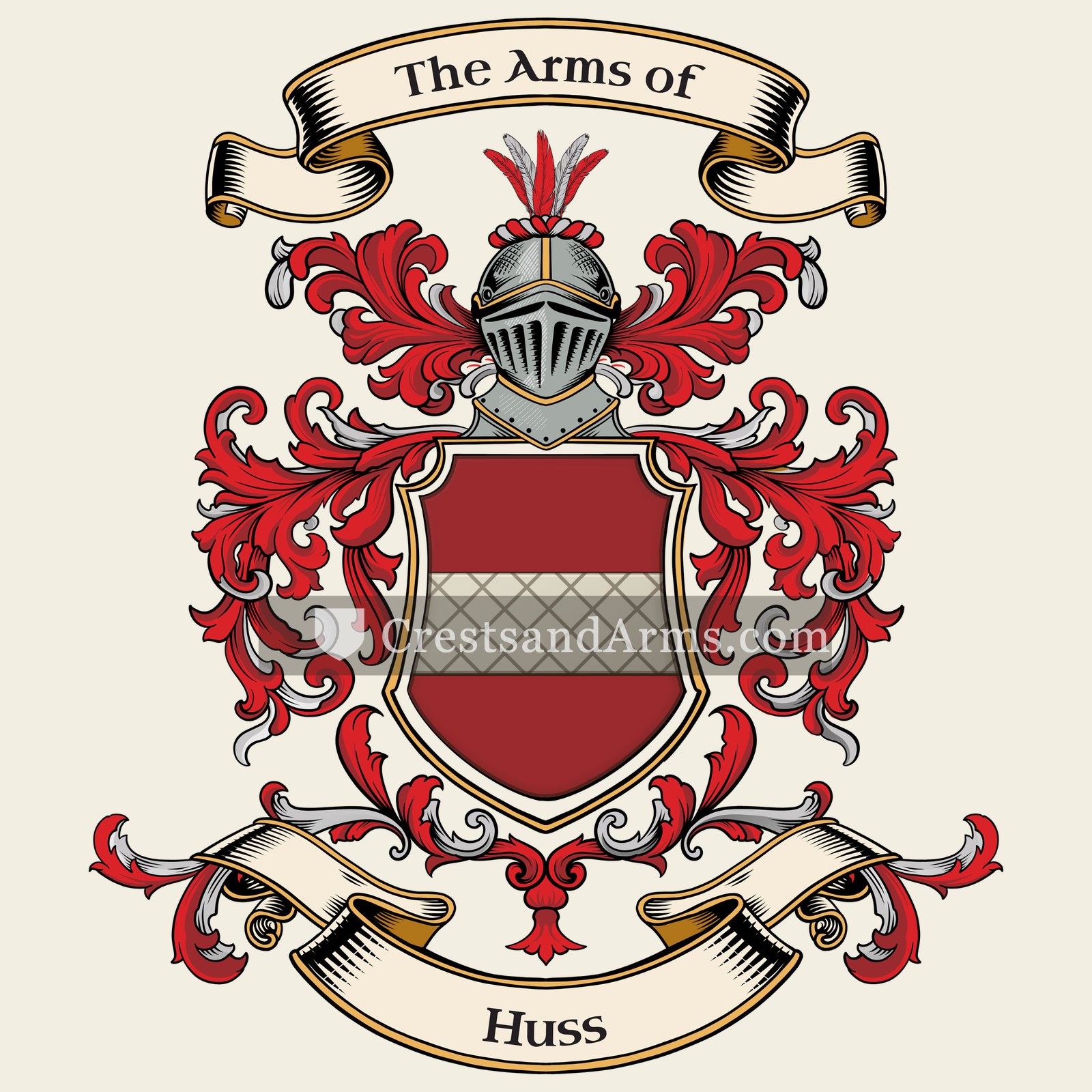


 duckResourcefulness on land and water
 fireZeal and purification