Map of France showing where the Hussell arms are recorded
The Hussell arms were recorded in Berry, c. 1663.
Berry was central French farming country, quiet and long-settled. Its estates were modest and stayed in the same hands for centuries, and steady landholding of that kind is exactly what puts a name into the heraldic records.
This is where the arms were entered in the register. Families often moved to other parts of the country, so the same name can turn up in more than one region.
The body that granted and recorded arms in France in this period.
Louis XIV of France
Sovereign of the period
Louis XIV of France
1643–1715
Reigning in France when the Hussell arms are first recorded.
How Arms Worked in France
In France, a coat of arms was a mark of honor that passed down through the male line to all legitimate descendants. Families often used the same shield without changes to show their shared heritage. If a branch wanted to stand out, they could add a small mark to their shield to show their specific place in the family tree.
Granting authority
The Juge d'armes de France acted as the official authority that regulated and verified coats of arms across the country.
How they got arms
Families typically inherited their arms from ancestors, though they could also receive them through royal grants or by proving their noble status.
Where arms were recorded
Coats of arms were officially recorded in the Armorial Général de France, which began its main collection in the year 1696.
The family's standing
Recorded among the armigerous families of Berry.
Origin & History of the Hussell Family in France
The family name Hussell traces its roots to the rural landscapes of southwestern England, with documented evidence placing members of the family in the parish of Berry Pomeroy, Devon, as early as 1663. During the seventeenth century, individuals bearing this name were typically part of the agrarian working class, living in small villages where they likely worked as farmers, laborers, or skilled tradespeople. The name itself is thought to be a variation of older occupational or locational surnames that shifted in spelling as families moved between neighboring parishes. By settling in the rolling hills of Devon, the early Hussells became deeply integrated into the local community, participating in the parish life that defined the social structure of the era. Their presence in the regional records of the time highlights a family that remained rooted in the English countryside for generations, contributing to the local economy and the steady development of rural life in the West Country.
Related Branches & Arms
Root word
Houssel
A diminutive form of the Germanic name Hugo meaning heart or mind.
This name
HussellA surname originating from Old French denoting a person with a small or humble stature.
also spelled
Hussel
Hisel
Documented Sources
J. B. Rietstap, Armorial Général, Gouda: G. B. van Goor Zonen, 1884–87
Devon Archives and Local Studies Service, Berry Pomeroy Parish Registers, 1663
Reaney, P.H., A Dictionary of English Surnames, 1991
Digital archive packCoat of arms PNG, gold border print PDF, vector SVG and the certificate of authenticity. Sent to your email in minutes.


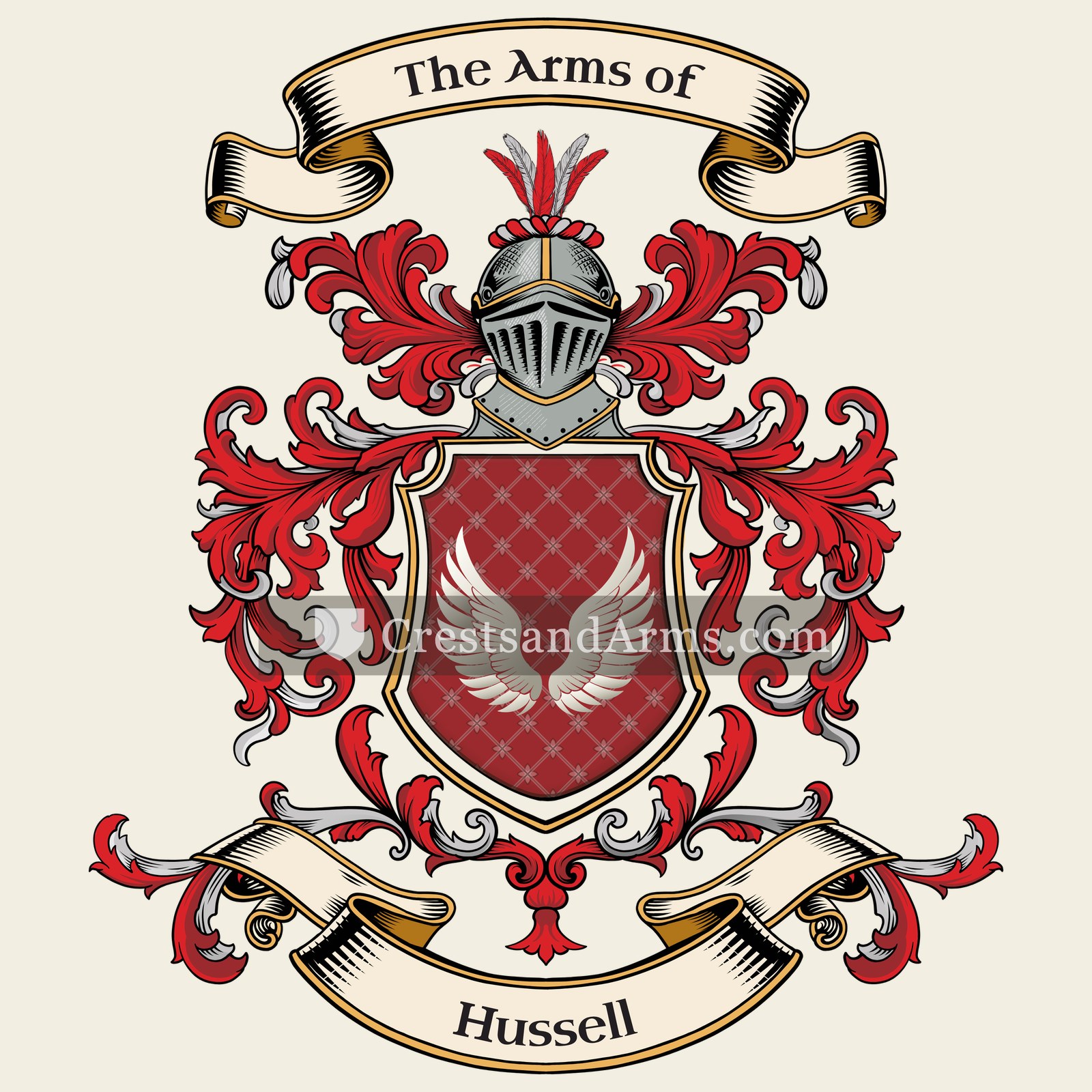
 vol / wingsSwiftness and protection
 vol / wingsSwiftness and protection