Map of England showing where the Hywel arms are recorded
The Hywel arms were recorded in Norfolk, c. 1620.
Norfolk grew rich on wool and grain, and its wealth was spread among many middling families rather than a few great ones. Households of that kind bought land and took arms, and the county holds a large share of English names.
This is where the arms were entered in the register. Families often moved to other parts of the country, so the same name can turn up in more than one region.
The body that granted and recorded arms in England in this period.
James VI and I
Sovereign of the period
James VI and I
1603–1625
Reigning in England when the Hywel arms are first recorded.
How Arms Worked in England
English heraldry allowed arms to be shared by all legitimate descendants of the original owner. These symbols were treated as personal property that moved through the generations to all children. While the eldest son kept the original design, other family members could use the same shield without needing to change it or register their own unique versions.
Granting authority
The College of Arms in London has regulated the use of coats of arms throughout England and Wales since 1484.
How they got arms
Families typically obtained their coats of arms through a formal grant from the Crown or by proving their ancient right to them.
Where arms were recorded
All official coats of arms are recorded in the registers kept at the College of Arms, which date back to the fifteenth century.
The family's standing
Recorded among the armigerous families of Norfolk.
Origin & History of the Hywel Family in England
The surname Hywel originates from the ancient Welsh personal name meaning eminent or conspicuous. It gained prominence through the legacy of Hywel Dda, a tenth-century ruler who is famously remembered for codifying the laws of Wales. While the name is deeply rooted in Welsh history, members of the family eventually migrated eastward into England. By the year 1620, records confirm that the family had established a presence in the county of Norfolk. This movement was likely part of a broader trend of families relocating for trade, agricultural opportunities, or social advancement during the early seventeenth century. Once settled in Norfolk, the family integrated into the local community, transitioning from their Welsh linguistic origins to the cultural landscape of East Anglia.
Related Branches & Arms
Root word
Hywel
Derived from the Old Welsh word meaning eminent or conspicuous.
This name
HywelA traditional Welsh name signifying someone who is distinguished, notable, or highly visible.
also spelled
Haywill
Heywell
Haywalle
Documented Sources
Sir Bernard Burke, The General Armory of England, Scotland, Ireland and Wales, London: Harrison & Sons, 1884
Charles, B. G., The Place-Names of Pembrokeshire, 1992
Morgan, T. J. and Morgan, P., Welsh Surnames, 1985
The National Archives, State Papers Domestic, James I, 1620
Norfolk Record Office, Parish Register Transcripts, 1620
Digital archive packCoat of arms PNG, gold border print PDF, vector SVG and the certificate of authenticity. Sent to your email in minutes.


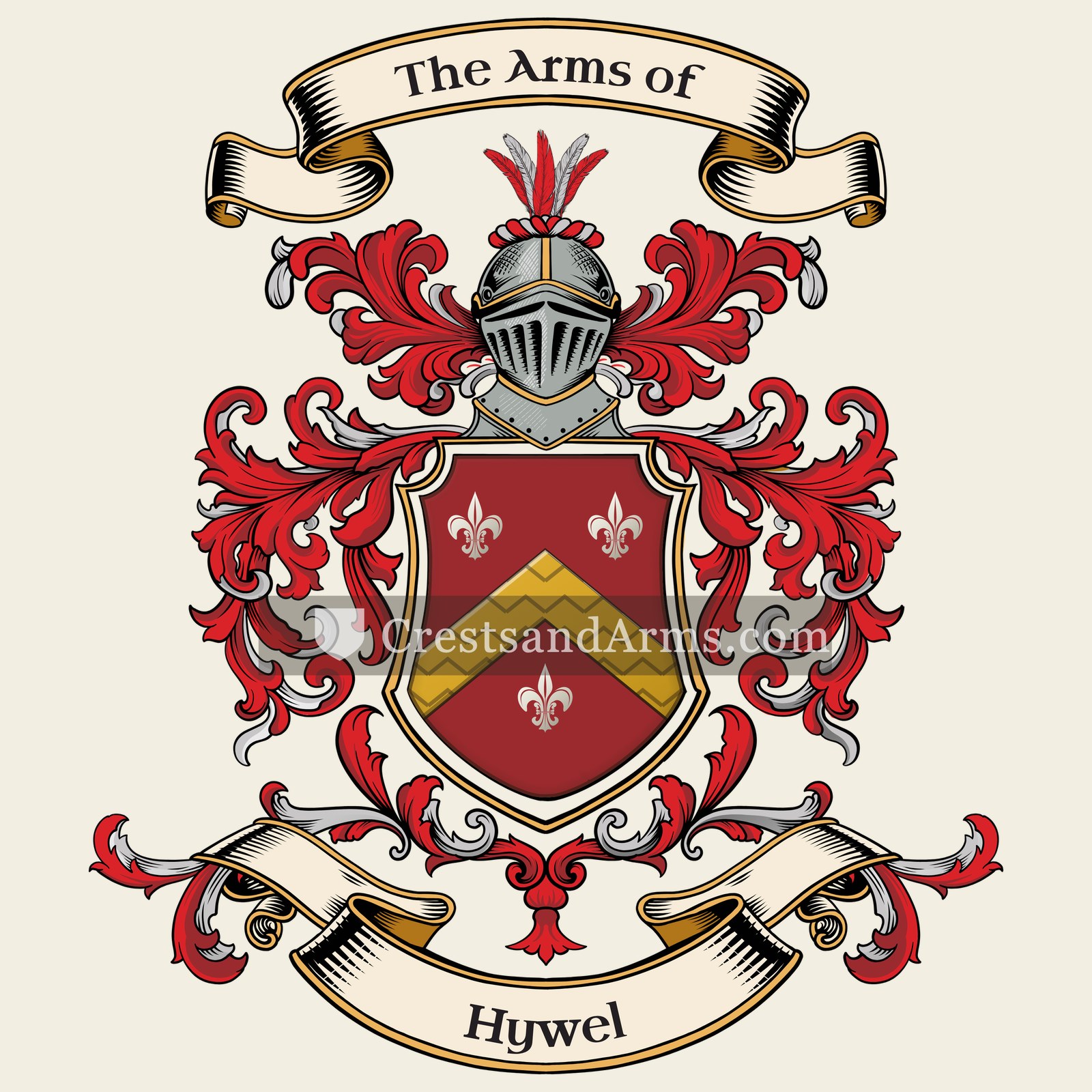
 chevronProtection, and faithful service completed
 fleur de lisPurity, light, and the sixth son
 chevronProtection, and faithful service completed
 fleur de lisPurity, light, and the sixth son