A record of documented arms, meaning and origin, researched for the Ingram family lines. Documented in 3 countries.
Reg. 3260 · German, G–I
Coat of Arms & Family Crest Details
Symbols on this shield
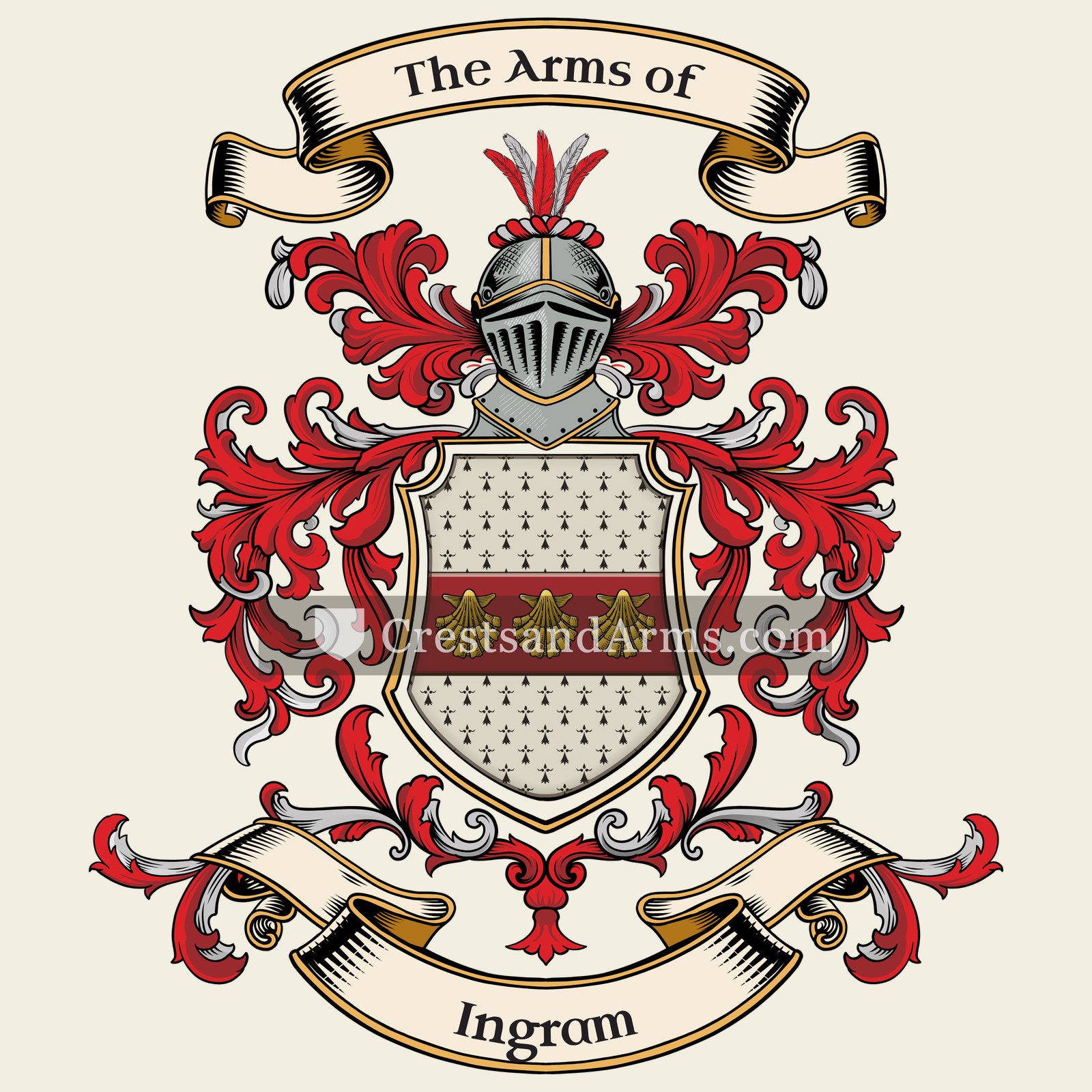
fessThe military belt, and readiness to serve
escallopThe pilgrim's shell, and a long journey made
Colours
ErmineMeans: Dignity
Red (Gules)Means: Military strength
Gold (Or)Means: Generosity
Historical info
Source
J. B. Rietstap, Armorial Général, Gouda: G. B. van Goor Zonen, 1884–87
Blazon (the actual original written record)
“D'herm. à la fasce de gu., ch. de trois coquilles d'or. C.: un coq au nat. S.: à dextre un griffon éc. de gu. et d'arg.; à sen. une antelope d'arg., accornée, crinée et onglée d'or, coll. d'une couronne de gu.”
Germanyc. 1661
Digital archive packCoat of arms PNG, gold border print PDF, vector SVG and the certificate of authenticity. Sent to your email in minutes.
Map of Germany showing where the Ingram arms are recorded
The Ingram arms were recorded in Germany, c. 1661.
Arms such as these were typically recorded in Bavaria.
Bavaria was a country of old landed families and walled market towns. Estates passed down the same line for centuries, and both the landowners and the leading townsmen kept arms, which is why so many Bavarian names sit in the registers.
This is where the arms were entered in the register. Families often moved to other parts of the country, so the same name can turn up in more than one region.
The body that granted and recorded arms in Germany in this period.
Leopold I, Holy Roman Emperor
Sovereign of the period
Leopold I, Holy Roman Emperor
1658–1705
Reigning in Germany when the Ingram arms are first recorded.
How Arms Worked in Germany
In the Holy Roman Empire, coats of arms were often granted to individuals by the Emperor or his representatives. These arms were then passed down through the generations to all legitimate descendants of the original holder. Younger branches of a family usually kept the same shield design without needing to change it, as the arms belonged to the entire lineage.
Granting authority
The Holy Roman Emperor held the sole power to grant new coats of arms throughout his vast imperial territories.
How they got arms
Families typically obtained their coats of arms through a formal imperial grant or by proving their noble status to the authorities.
Where arms were recorded
These grants were officially recorded in the Imperial Chancery registers, which began keeping formal records of such honors during the Middle Ages.
The family's standing
Recorded among the armigerous families of Germany.
Origin & History of the Ingram Family in Germany
The name Ingram traces its roots in Germany to the ancient Germanic personal name Ingelram, which combines the name of the god Ing with the word for raven. This name became popular across central Europe during the Middle Ages as families sought to honor traditional linguistic heritage. By the mid-seventeenth century, records confirm that members of the Ingram family were established in the region of Bavaria. Life in Bavaria during 1661 was defined by the difficult period of reconstruction following the Thirty Years' War. Families like the Ingrams were often involved in local agriculture or trade as communities worked to rebuild their villages and stabilize the economy. Over time, the name evolved from its original form as a personal identifier into a stable family surname that was passed down through generations of Bavarians.
Coat of Arms & Family Crest Details
Symbols on this shield
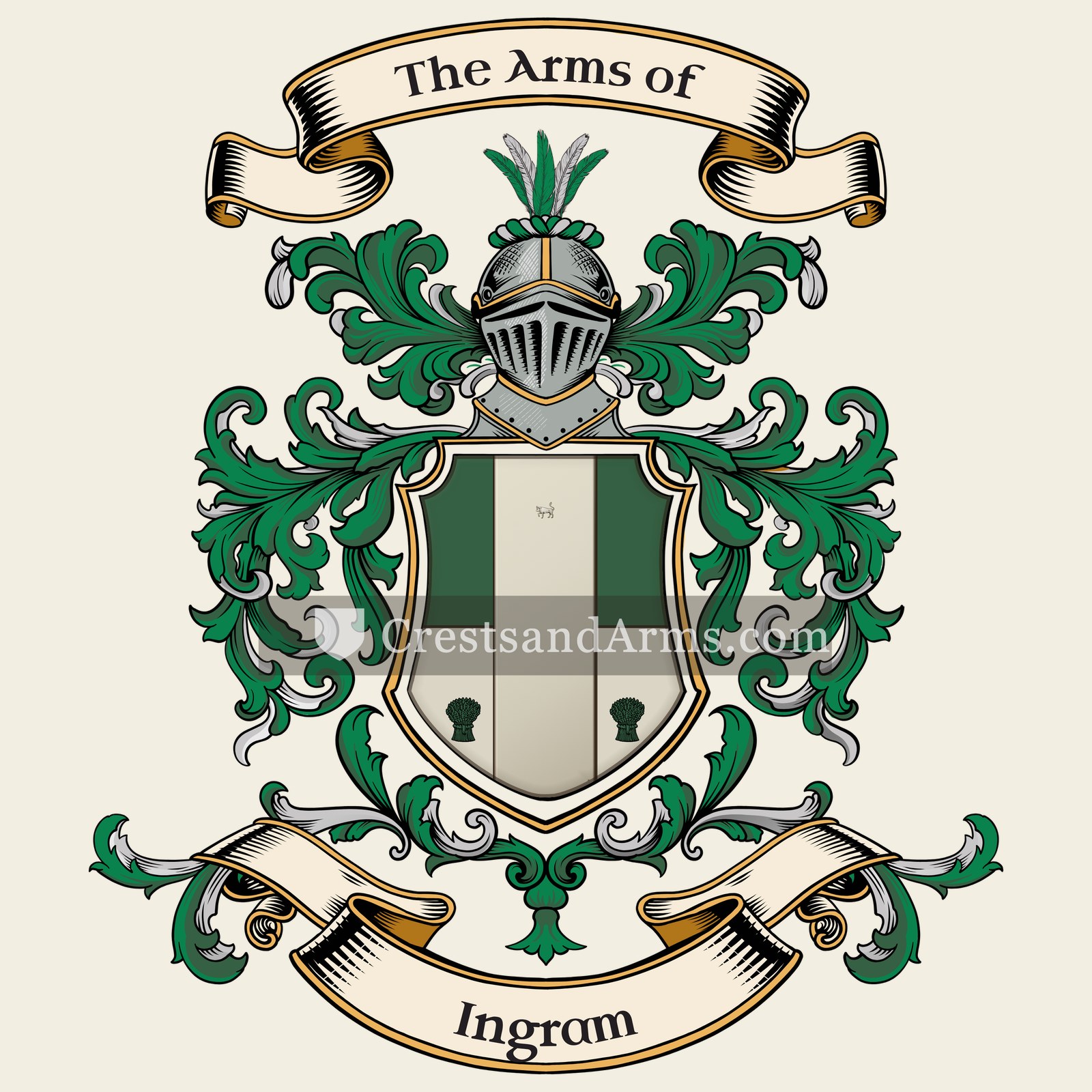
paleMilitary strength, and a fortified defence
bullValour and generosity
wheatsheafPlenty, and the harvest of one's own labour
Colours
Green (Vert)Means: Hope
Silver (Argent)Means: Peace and sincerity
Historical info
Source
Sir Bernard Burke, The General Armory of England, Scotland, Ireland and Wales, London: Harrison & Sons, 1884
Blazon (the actual original written record)
“Per fesse vert and ar. a pale, in chief a bull's head erased, and in base two garbs all counterchanged”
Scotlandc. 1748
Digital archive packCoat of arms PNG, gold border print PDF, vector SVG and the certificate of authenticity. Sent to your email in minutes.
Map of Scotland showing where the Ingram arms are recorded
The Ingram arms were recorded in Scotland, c. 1748.
Arms such as these were typically recorded in Edinburgh.
Edinburgh was the seat of Scotland's government, its courts and its heralds. Families with business there settled nearby, and being close to where arms were recorded is exactly why so many of them appear.
This is where the arms were entered in the register. Families often moved to other parts of the country, so the same name can turn up in more than one region.
The body that granted and recorded arms in Scotland in this period.
George II of Great Britain
Sovereign of the period
George II of Great Britain
1727–1760
Reigning in Germany when the Ingram arms are first recorded.
How Arms Worked in Scotland
Scottish heraldry is unique because it treats a coat of arms as a piece of personal property protected by law. Only one person can own a specific design at any given time. When a family grows, the head keeps the original shield while other relatives must apply for their own distinct version with slight changes to prove their specific identity.
Granting authority
The Court of the Lord Lyon acts as the official body that regulates and controls all heraldic matters throughout Scotland.
How they got arms
Individuals obtain a legal right to their arms through a formal petition process that confirms their identity and family connection.
Where arms were recorded
All valid coats of arms are officially entered into the Public Register of All Arms and Bearings starting from 1672.
The family's standing
Recorded among the armigerous families of Scotland.
Origin & History of the Ingram Family in Scotland
The name Ingram has deep roots in Scotland, where it evolved from an ancient Germanic personal name meaning raven. By the middle of the eighteenth century, the family was well established in the capital city of Edinburgh. Records from 1748 confirm that members of the family were active participants in the urban life of the city during a time of significant social and economic change. As the Scottish Enlightenment began to flourish, families like the Ingrams contributed to the growing professional and merchant classes that defined Edinburgh’s identity. While the name originated from much older roots, its presence in the mid-1700s marks a period when the family was firmly integrated into the civic and administrative structures of the Scottish Lowlands. This era provided a stable foundation for the family to grow alongside the rapid modernization of Scottish society.
Coat of Arms & Family Crest Details
Symbols on this shield
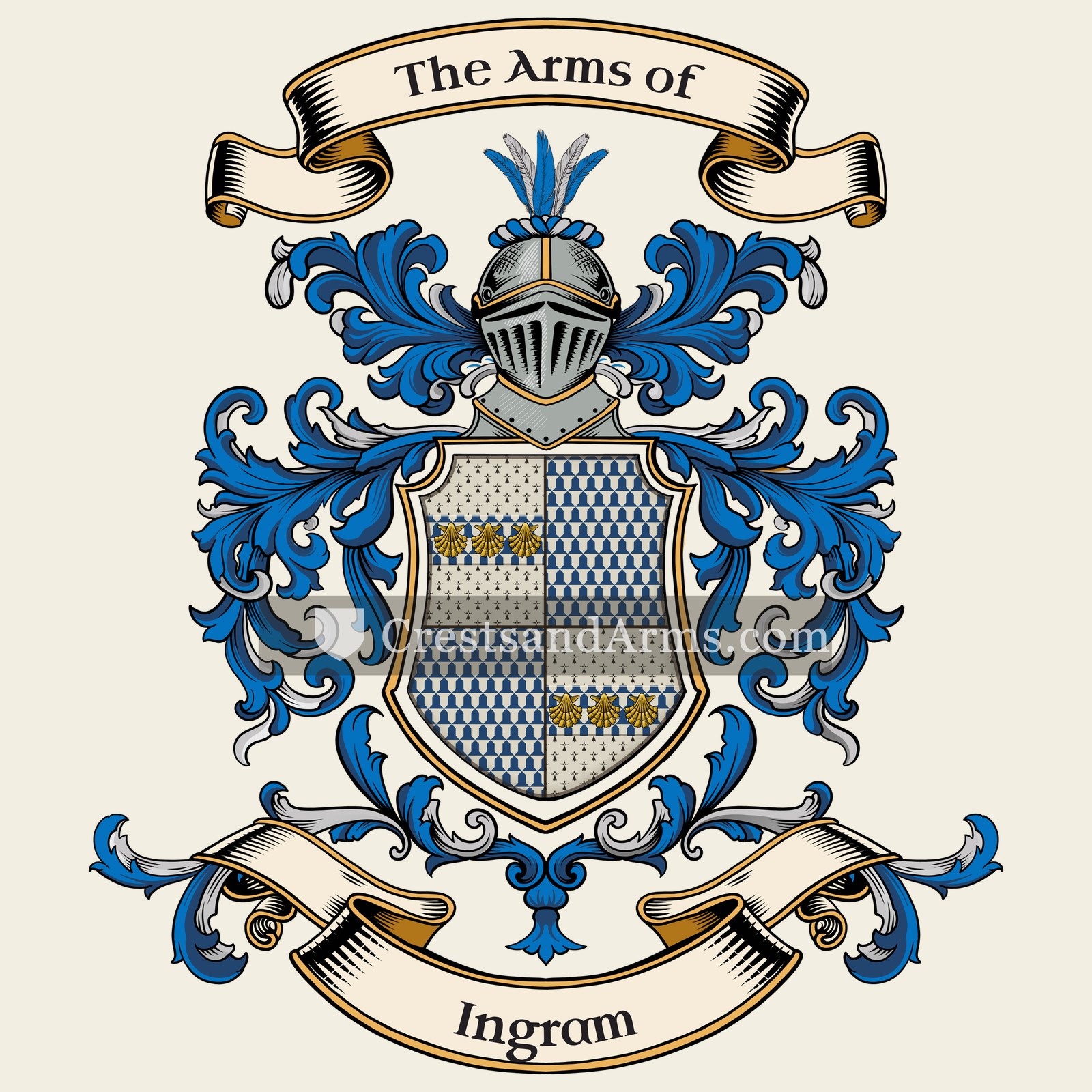
fessThe military belt, and readiness to serve
escallopThe pilgrim's shell, and a long journey made
Colours
ErmineMeans: Dignity
VairMeans: Protection
Red (Gules)Means: Military strength
Gold (Or)Means: Generosity
Historical info
Source
Sir Bernard Burke, The General Armory of England, Scotland, Ireland and Wales, London: Harrison & Sons, 1884
Blazon (the actual original written record)
“Quarterly, 1st and 4th, erm. on a fesse gu. three escallops or, for INGRAM; 2nd and 3rd, vairé ar. and sa., for MEYNELL”
YorkTemple Newsom · York, c. 1620
Digital archive packCoat of arms PNG, gold border print PDF, vector SVG and the certificate of authenticity. Sent to your email in minutes.
Map of England showing where the Ingram arms are recorded
The Ingram arms were recorded in York, c. 1620.
Yorkshire is the largest of the English counties, and it held more gentry families than any other. Land there was split among a great many households rather than a few, so a great many of them carried arms.
This is where the arms were entered in the register. Families often moved to other parts of the country, so the same name can turn up in more than one region.
The body that granted and recorded arms in England in this period.
James VI and I
Sovereign of the period
James VI and I
1603–1625
Reigning in Germany when the Ingram arms are first recorded.
How Arms Worked in England
English heraldry allowed arms to be shared by all legitimate descendants of the original owner. These symbols were treated as personal property that moved through the generations to all children. While the eldest son kept the original design, other family members could use the same shield without needing to change it or register their own unique versions.
Granting authority
The College of Arms in London has regulated the use of coats of arms throughout England and Wales since 1484.
How they got arms
Families typically obtained their coats of arms through a formal grant from the Crown or by proving their ancient right to them.
Where arms were recorded
All official coats of arms are recorded in the registers kept at the College of Arms, which date back to the fifteenth century.
The family's standing
Recorded among the armigerous families of York.
Origin & History of the Ingram Family in England
The surname Ingram originates from the ancient Germanic personal name Ingelram, which combines the name of the Norse god Ing with the word for raven. Following the Norman Conquest of 1066, this name became popular among the nobility and eventually evolved into a hereditary surname as families began to settle in specific regions. By the early 17th century, the Ingram family had established a notable presence in the city of York. Records from 1620 show members of the family participating in the civic and social life of this historic northern hub. During this period, York served as a major center for trade and administration, and families like the Ingrams often held positions that connected them to the local merchant classes or the regional government. This transition from a personal name to a family identifier reflects the broader social changes in England as people moved from being known by their individual deeds to being recognized by their ancestral lineage.
Ingram Meaning & Related Branches
Root word
Ing
The name of a Germanic fertility god associated with the Ingvaeones tribe.
This name
IngramDerived from the name of the god Ing combined with the word for raven.
also spelled
Yngram
Ingramson
Ingraham
Ingerham
Related arms
Ingaramvariant spelling
Ingerhamvariant spelling
Cuthbertrecorded with Ingram, same area
Fithierecorded with Ingram, same area
Documented Sources
J. B. Rietstap, Armorial Général, Gouda: G. B. van Goor Zonen, 1884–87
Bahlow, Hans, Deutsches Namenlexikon: Familien- und Vornamen nach Ursprung und Sinn erklärt, 1967


 fessThe military belt, and readiness to serve
 escallopThe pilgrim's shell, and a long journey made
 fessThe military belt, and readiness to serve
 escallopThe pilgrim's shell, and a long journey made


 paleMilitary strength, and a fortified defence
 bullValour and generosity
 wheatsheafPlenty, and the harvest of one's own labour