Map of Britain showing where the Ireland arms are recorded
The Ireland arms were recorded in Irl, c. 1700.
Arms such as these were typically recorded in Kent.
Kent sits between London and the short crossing to Europe, and the trade passing through made it wealthy. Merchant families bought land with that money, and it was landowners who took coats of arms.
This is where the arms were entered in the register. Families often moved to other parts of the country, so the same name can turn up in more than one region.
The body that granted and recorded arms in Britain in this period.
William III of England
Sovereign of the period
William III of England
1694–1702
Reigning in Britain when the Ireland arms are first recorded.
How Arms Worked in Britain
English heraldry allowed arms to be shared by all legitimate descendants of the original owner. These symbols were treated as personal property that moved through the generations to all children. While the eldest son kept the original design, other family members could use the same shield without needing to change it or register their own unique versions.
Granting authority
The College of Arms in London has regulated the use of coats of arms throughout England and Wales since 1484.
How they got arms
Families typically obtained their coats of arms through a formal grant from the Crown or by proving their ancient right to them.
Where arms were recorded
All official coats of arms are recorded in the registers kept at the College of Arms, which date back to the fifteenth century.
The family's standing
Recorded among the armigerous families of Britain.
Origin & History of the Ireland Family in Britain
The surname Ireland originated as a locative name, which was a common way for people in medieval Britain to identify themselves based on where they lived or traveled. It was often given to individuals who had returned to England after spending time in Ireland or to those who had strong trade connections across the Irish Sea. By the time members of the family were documented in Kent during the early 1700s, the name had been established in various parts of the British Isles for several centuries. During this era, families in Kent were often involved in local agriculture, maritime trade, or the burgeoning industries of the southeast. Because surnames were becoming fixed and hereditary by this period, the presence of the Ireland name in Kent suggests that the family had successfully integrated into the local community and established a stable presence within the regional economy.
Coat of Arms & Family Crest Details
Symbols on this shield
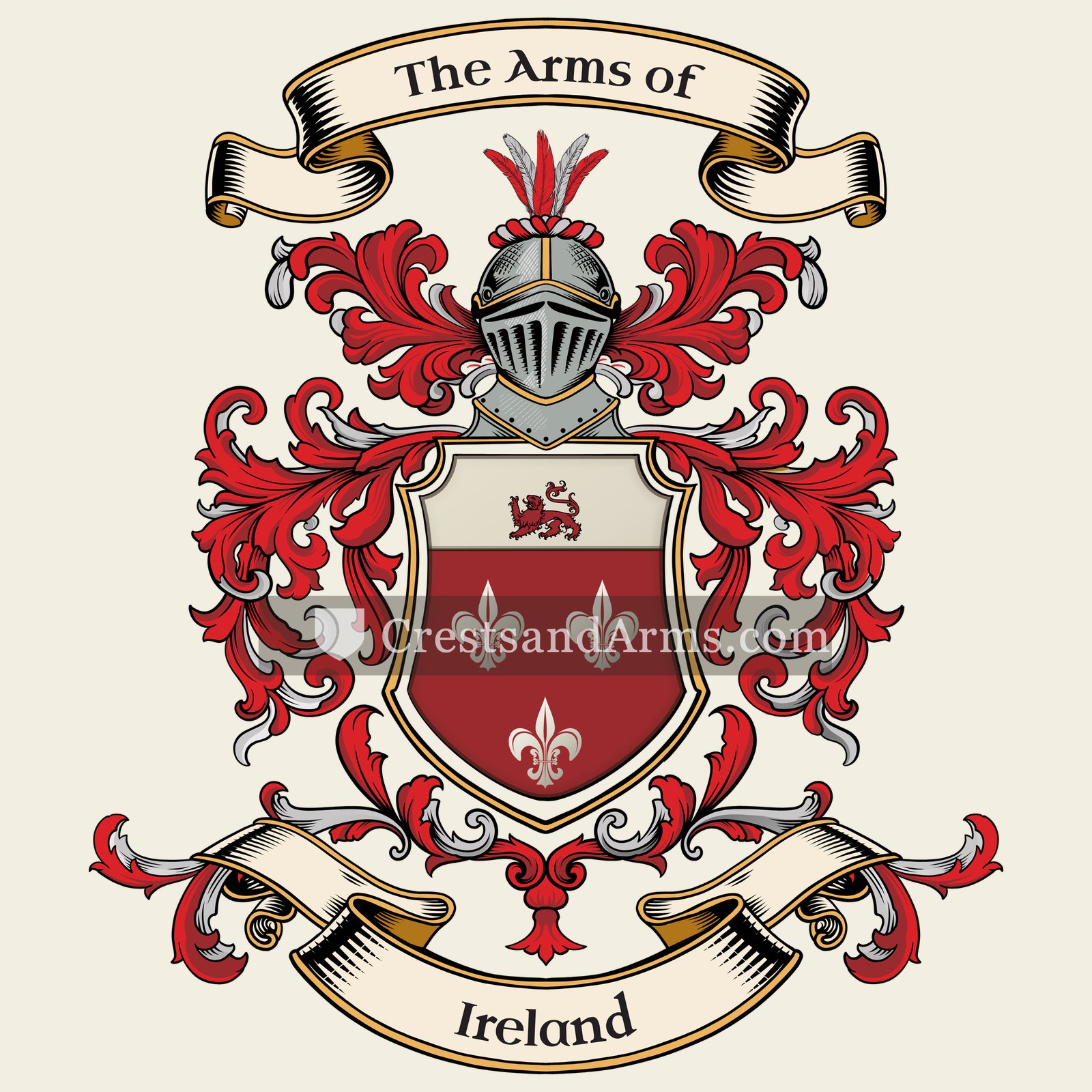
chiefAuthority, wisdom and dominion
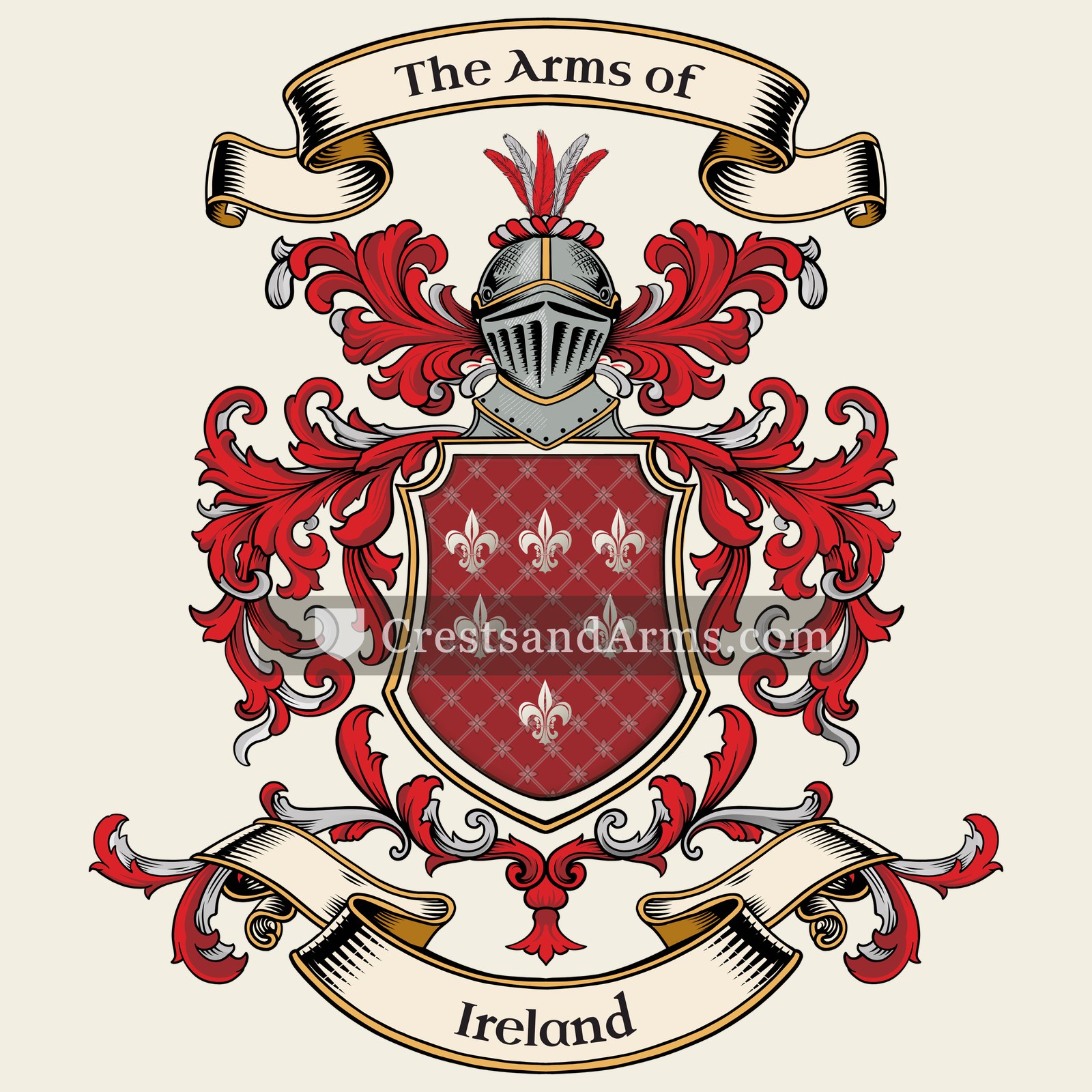
fleur de lisPurity, light, and the sixth son
lionCourage, strength and royalty
Colours
Red (Gules)Means: Military strength
Silver (Argent)Means: Peace and sincerity
Historical info
Source
Sir Bernard Burke, The General Armory of England, Scotland, Ireland and Wales, London: Harrison & Sons, 1884
Blazon (the actual original written record)
“Gu. three fleurs-de-lis ar. on a chief indented of the last a lion pass. of the first”
SalopSalop, c. 1601
Digital archive packCoat of arms PNG, gold border print PDF, vector SVG and the certificate of authenticity. Sent to your email in minutes.
Map of England showing where the Ireland arms are recorded
The Ireland arms were recorded in Salop, c. 1601.
Shropshire lay on the Welsh border, and border country needed men who could fight. Families held their land in return for service, and service in arms is what a coat of arms was originally for.
This is where the arms were entered in the register. Families often moved to other parts of the country, so the same name can turn up in more than one region.
The body that granted and recorded arms in England in this period.
Elizabeth I of England
Sovereign of the period
Elizabeth I of England
1558–1603
Reigning in Britain when the Ireland arms are first recorded.
How Arms Worked in England
English heraldry allowed arms to be shared by all legitimate descendants of the original owner. These symbols were treated as personal property that moved through the generations to all children. While the eldest son kept the original design, other family members could use the same shield without needing to change it or register their own unique versions.
Granting authority
The College of Arms in London has regulated the use of coats of arms throughout England and Wales since 1484.
How they got arms
Families typically obtained their coats of arms through a formal grant from the Crown or by proving their ancient right to them.
Where arms were recorded
All official coats of arms are recorded in the registers kept at the College of Arms, which date back to the fifteenth century.
The family's standing
Recorded among the armigerous families of Salop.
Origin & History of the Ireland Family in England
The surname Ireland originated as a locative name, which was a common way for people in medieval England to identify themselves based on where they had traveled or lived. By the time the name appeared in the historical records of Salop, now known as Shropshire, in 1601, it had already been established in various parts of the country for several centuries. Families bearing this name were often associated with trade, land management, or local administration, reflecting the movement of people across the British Isles during the Middle Ages. In the context of Shropshire, the presence of the Ireland family suggests they were part of the local gentry or merchant class who played a role in the social and economic life of the region. Because surnames were not strictly regulated in early modern England, the name served as a practical link to a person’s origins or their connections to the neighboring island, helping to distinguish them within their local community.
Coat of Arms & Family Crest Details
Symbols on this shield
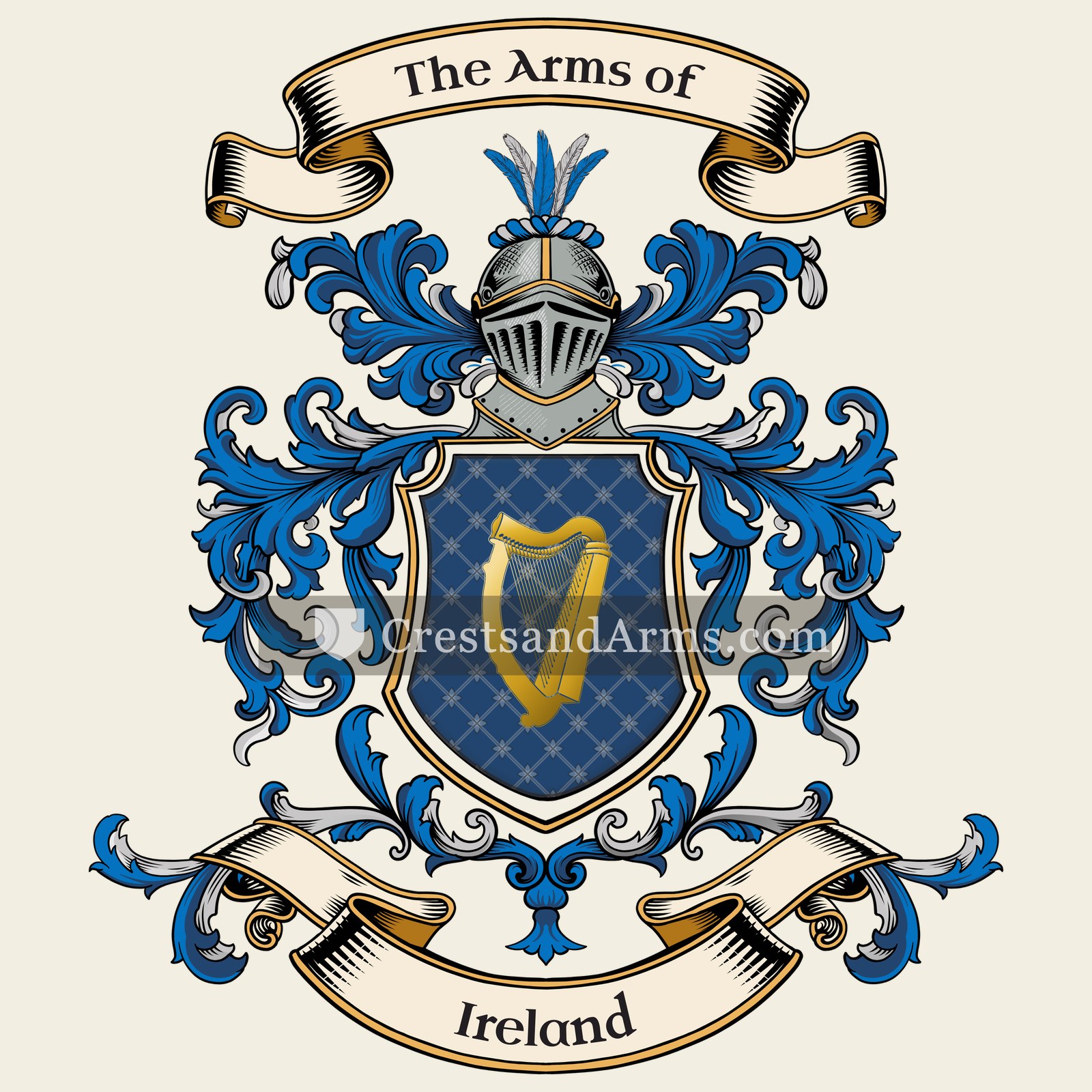
harpWell-tuned governance and love of music
Colours
Blue (Azure)Means: Loyalty and truth
Gold (Or)Means: Generosity
Historical info
Source
Sir Bernard Burke, The General Armory of England, Scotland, Ireland and Wales, London: Harrison & Sons, 1884
Blazon (the actual original written record)
“Az. a harp or, stringed ar. The ancient arms of the kingdom after the invasion of 1172 were, "Az. three crowns or." This was the coat of St. Edmund, and it is possible the Anglo-Norman invaders, who were arrayed under the banners of St. George and St. Edmund, introduced the bearings of the latter saint as the ensigns of their new conquest. When Richard II. created ROBERT DE VERE, Earl of Oxford, Duke of Ireland, he gave him as a coat of augmentation the arms of Ireland, viz., "Az. three crowns or." Henry VIII. relinquished the old arms for the "harp" when he declared himself King of Ireland, from an apprehension, it is said, that the three crowns might be taken for the triple tiara of the Pope. Since James I. introduced the arms of Ireland among the quarterings of the Royal achievement, the bearing has been "Az. a harp or, stringed ar." From a MS. in the handwriting of Sir William Le Neve, Clarenceux, it appears on the authority of Sir William Segar, Garter, that "Ye three crowns are ye antient arms of Ireland, the harp but an ancient badge," and "In ye tyme of Edward ye IVth a commission being to enquire the arms of Ireland it was returned yt ye 3 crownes were the armes." The same bearing appears on the reverse of ancient Irish coins. Another ancient coat, as recorded in Ulster's Office, is, Sa. a king sitting on his throne cross-legged, holding in his right hand a lilly or”
Irelandc. 1172
Digital archive packCoat of arms PNG, gold border print PDF, vector SVG and the certificate of authenticity. Sent to your email in minutes.
Map of Ireland showing where the Ireland arms are recorded
The Ireland arms were recorded in Ireland, c. 1172.
Arms such as these were typically recorded in Dublin.
Dublin was the seat of government in Ireland and the place where grants were sought and recorded. Families with business at the castle or the courts settled nearby, and settling there put their arms on record.
This is where the arms were entered in the register. Families often moved to other parts of the country, so the same name can turn up in more than one region.
The body that granted and recorded arms in Ireland in this period.
Henry II of England
Sovereign of the period
Henry II of England
1154–1189
Reigning in Britain when the Ireland arms are first recorded.
How Arms Worked in Ireland
The Ulster King of Arms granted coats of arms to individuals who proved their social standing and good character. These symbols were typically inherited by all legitimate descendants of the original holder. If a family branch wanted a unique look, they could apply for a specific change to their design through the office to ensure their identity remained distinct.
Granting authority
The Ulster King of Arms acted as the official body that regulated and issued all coats of arms throughout Ireland.
How they got arms
Families obtained their arms through formal grants issued by the office after proving their eligibility and paying the required fees.
Where arms were recorded
All official grants were recorded in the registers held by the Ulster King of Arms starting from the year 1552.
The family's standing
Recorded among the armigerous families of Ireland.
Origin & History of the Ireland Family in Ireland
The family name Ireland emerged as a descriptive identifier for individuals who traveled between the island of Ireland and Great Britain during the medieval period. Records confirm that members of this family were present in Dublin as early as 1172, a time that coincides with the arrival of Anglo-Norman forces in the city. During this era, surnames were often adopted to reflect a person’s place of origin or their frequent travel routes. Because the name identifies the bearer with the land itself, it suggests that early family members were likely merchants, soldiers, or administrators who moved across the Irish Sea. By establishing themselves in Dublin during the twelfth century, the family became part of the shifting social landscape that defined the city as a center for trade and governance. Over time, the name transitioned from a simple geographic description into a permanent hereditary surname that documented the family's deep historical connection to the capital.
Ireland Meaning & Related Branches
Root word
Iar
Old Irish term for west or western land.
This name
IrelandRefers to a person who originated from the island of Ireland.
also spelled
Irelan
Irland
Eirland
Related arms
Irlandvariant spelling
Borough de Baseldonrecorded with Ireland, same area
Heygate de Southendrecorded with Ireland, same area
Carterrecorded with Ireland, same area
Documented Sources
J. B. Rietstap, Armorial Général, Gouda: G. B. van Goor Zonen, 1884–87
Bardsley, Charles Wareing, A Dictionary of English and Welsh Surnames, 1901
Reaney, P.H., A Dictionary of British Surnames, 1958
The National Archives, Kent Quarter Sessions and other records of the Justices of the Peace, Q/S
Digital archive packCoat of arms PNG, gold border print PDF, vector SVG and the certificate of authenticity. Sent to your email in minutes.


 fleur de lisPurity, light, and the sixth son
 fleur de lisPurity, light, and the sixth son


 chiefAuthority, wisdom and dominion
 lionCourage, strength and royalty

 harpWell-tuned governance and love of music