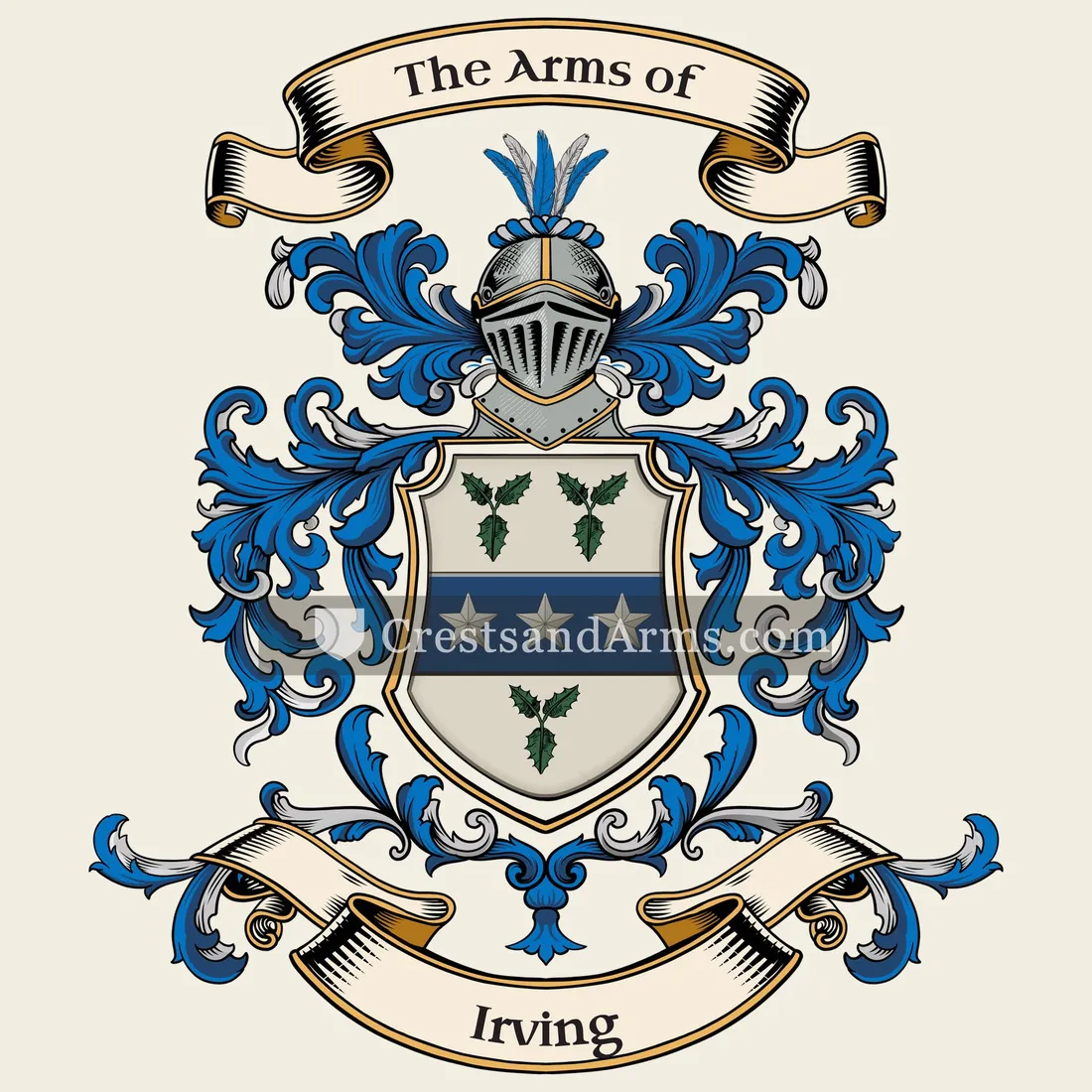
A record of documented arms, meaning and origin, researched for the Irving family lines. Documented in 3 countries.
Reg. 4531 · Swedish, G–I
Meaning of the Irving family crest colors & symbols
Symbols on this shield
leafHappiness and abundance
Colours
Silver (Argent)Means: Peace and sincerity
Gold (Or)Means: Generosity
Green (Vert)Means: Hope
Historical info
Source
J. B. Rietstap, Armorial Général, Gouda: G. B. van Goor Zonen, 1884–87
Blazon (the actual original written record)
“D'arg. à trois touffes de trois feuilles de sin. chacune; l'écu bordé d'or. Brl. d'arg. et d'azur. C.: l'un des meubles de l'écu. L.: d'arg. et d'azur.”
Swedenc. 1648
Digital archive packCoat of arms PNG, gold border print PDF, vector SVG and the certificate of authenticity. Sent to your email in minutes.
Map of Sweden showing where the Irving arms are recorded
The Irving arms were recorded in Sweden, c. 1648.
Arms such as these were typically recorded in Stockholm.
Stockholm held the Swedish court and the House of Nobility, where every noble family's arms were entered and kept. Families ennobled for service registered there, which is why so many are recorded around the city.
This is where the arms were entered in the register. Families often moved to other parts of the country, so the same name can turn up in more than one region.
The body that granted and recorded arms in Sweden in this period.
Christina of Sweden
Sovereign of the period
Christina of Sweden
1632–1654
Reigning in Sweden when the Irving arms are first recorded.
How Arms Worked in Sweden
In Sweden, a coat of arms belonged to a noble family as a whole rather than just one individual. These arms were passed down through the generations to all legitimate descendants. Younger branches of the family used the same shield without needing to change it. This system ensured that the entire lineage shared the same identity and status under the law.
Granting authority
The Riddarhuset, or House of Nobility, regulated all noble coats of arms in Sweden under royal authority.
How they got arms
Families received their coats of arms through royal grants of nobility which were then officially registered with the House.
Where arms were recorded
Coats of arms were officially recorded in the Swedish House of Nobility register starting in the year 1626.
The family's standing
Recorded among the armigerous families of Sweden.
Origin & History of the Irving Family in Sweden
The Irving family name established a notable presence in Sweden by the middle of the seventeenth century, specifically appearing in Stockholm records by 1648. During this era, Sweden was a major European power, and the capital city served as a magnet for skilled professionals and merchants from across the North Sea. The family likely arrived as part of the broader movement of Scottish individuals who sought new opportunities in the Swedish administration, military, or trade sectors during the reign of Queen Christina. These early settlers often integrated into the local urban society by adapting their surnames to fit the phonetic patterns of the Swedish language while maintaining their distinct ancestral identity. Their presence in Stockholm during this pivotal time suggests they were part of a sophisticated network of expatriates who contributed to the city's growth as a center of international commerce and diplomacy.
Meaning of the Irving family crest colors & symbols
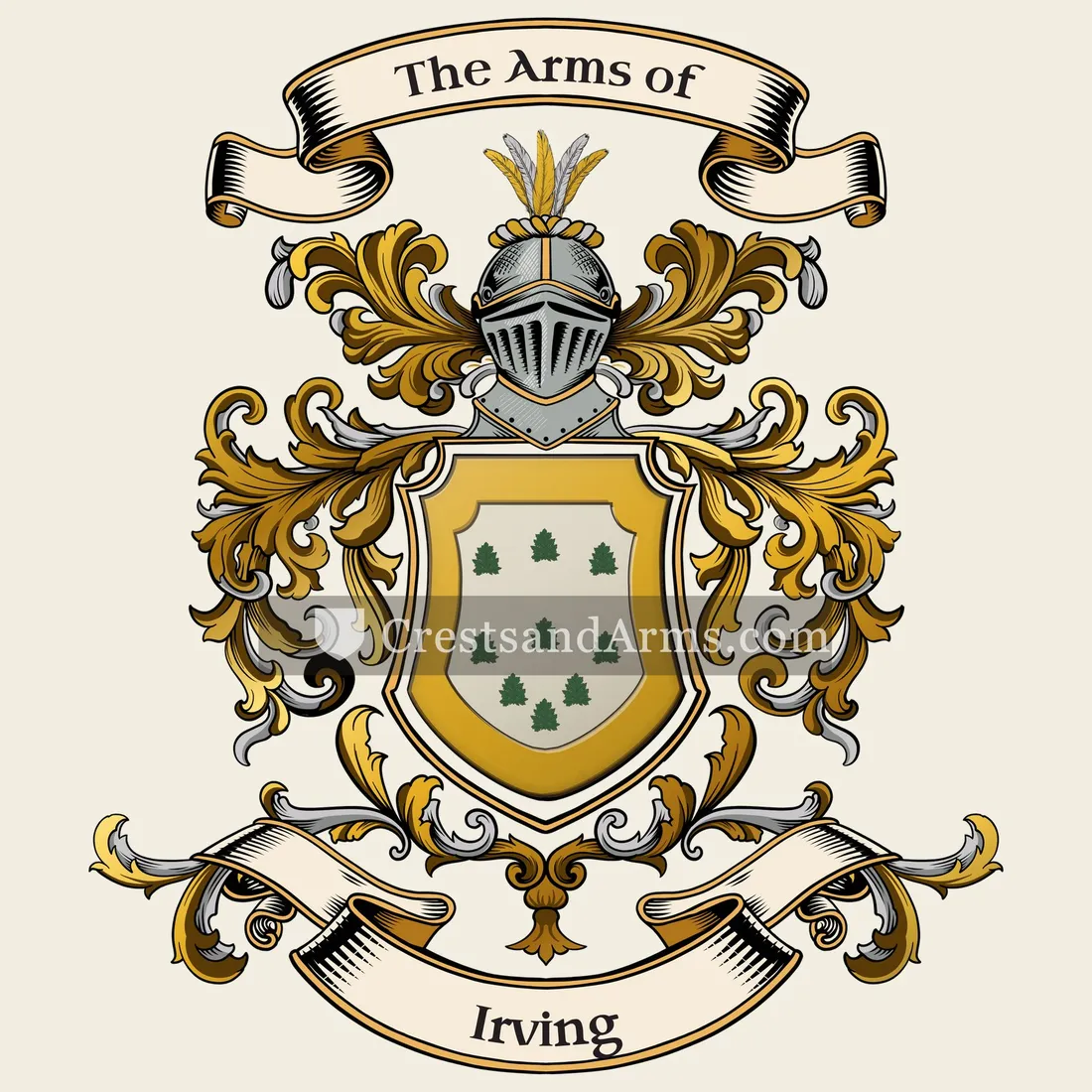
Symbols on this shield
martletA younger son, who must win his own land
hollyTruth, and protection through winter
Colours
Silver (Argent)Means: Peace and sincerity
Red (Gules)Means: Military strength
Green (Vert)Means: Hope
Historical info
Source
J. B. Rietstap, Armorial Général, Gouda: G. B. van Goor Zonen, 1884–87
Blazon (the actual original written record)
“D'arg. à un martinet de gu., acc. de trois feuilles de houx de sin., les tiges en bas. C.: 1° un chapeau de gu., retr. d'herm., environné d'une couronne de chêne d'or; 2° un bras, arm. au nat., la main de carn. tenant deux feuilles de houx de sin.”
Britainc. 1809
Digital archive packCoat of arms PNG, gold border print PDF, vector SVG and the certificate of authenticity. Sent to your email in minutes.
Map of Britain showing where the Irving arms are recorded
The Irving arms were recorded in Britain, c. 1809.
Arms such as these were typically recorded in Kent.
Kent sits between London and the short crossing to Europe, and the trade passing through made it wealthy. Merchant families bought land with that money, and it was landowners who took coats of arms.
This is where the arms were entered in the register. Families often moved to other parts of the country, so the same name can turn up in more than one region.
The body that granted and recorded arms in Britain in this period.
George III of Great Britain
Sovereign of the period
George III of Great Britain
1801–1820
Reigning in Sweden when the Irving arms are first recorded.
How Arms Worked in Britain
English heraldry allowed arms to be shared by all legitimate descendants of the original owner. These symbols were treated as personal property that moved through the generations to all children. While the eldest son kept the original design, other family members could use the same shield without needing to change it or register their own unique versions.
Granting authority
The College of Arms in London has regulated the use of coats of arms throughout England and Wales since 1484.
How they got arms
Families typically obtained their coats of arms through a formal grant from the Crown or by proving their ancient right to them.
Where arms were recorded
All official coats of arms are recorded in the registers kept at the College of Arms, which date back to the fifteenth century.
The family's standing
Recorded among the armigerous families of Britain.
Origin & History of the Irving Family in Britain
The name Irving is rooted in the ancient regions of the Scottish Borders, where it evolved from the Gaelic name Eirbhin. Over many centuries, families bearing this name established themselves across the northern territories of Britain, often associated with the lands near the River Esk in Dumfriesshire. As the population shifted and moved southward for trade and employment, the name became more widespread throughout England. By the early nineteenth century, records confirm that members of the Irving family had settled in the county of Kent. This migration reflects the broader historical trend of families moving from rural northern ancestral homes toward the industrial and agricultural hubs of the south during the Georgian era. These early residents in Kent were part of a long lineage that transitioned from the rugged landscapes of the north to the fertile fields of the English countryside.
Meaning of the Irving family crest colors & symbols
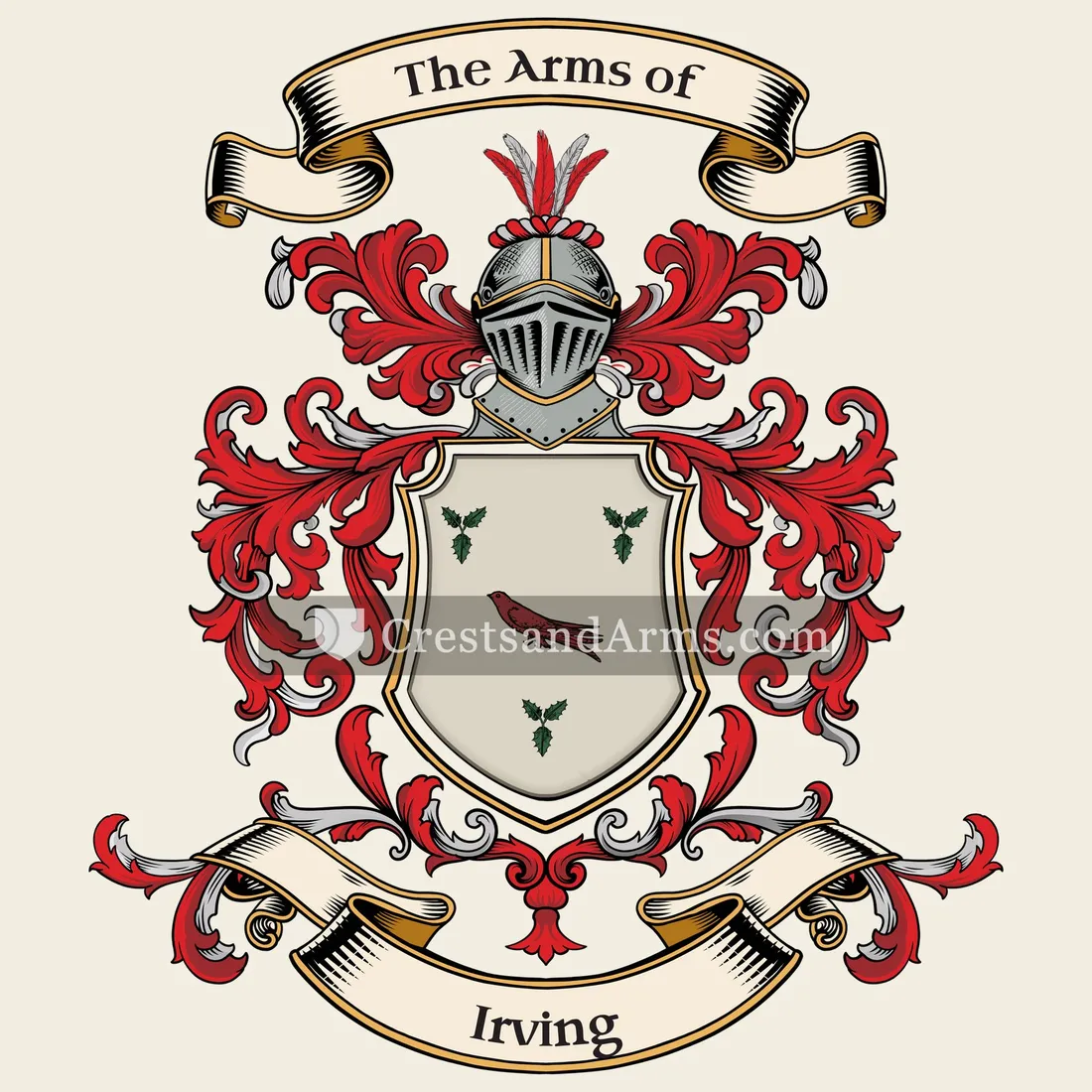
Symbols on this shield
fessThe military belt, and readiness to serve
hollyTruth, and protection through winter
mulletThe third son, and a divine quality from above
Colours
Silver (Argent)Means: Peace and sincerity
Blue (Azure)Means: Loyalty and truth
Green (Vert)Means: Hope
Historical info
Source
Sir Bernard Burke, The General Armory of England, Scotland, Ireland and Wales, London: Harrison & Sons, 1884
Blazon (the actual original written record)
“Ar. on a fess az. betw. three small sheaves of holly, each containing as many leaves vert, banded gu. three mullets of the first”
LanarkNewton · Lanark, c. 1748
Digital archive packCoat of arms PNG, gold border print PDF, vector SVG and the certificate of authenticity. Sent to your email in minutes.
Map of Scotland showing where the Irving arms are recorded
The Irving arms were recorded in Lanark, c. 1748.
Lanarkshire ran along the upper Clyde, farming country with coal beneath it. Its landed families were long-established, and long establishment is what brought them into the register.
This is where the arms were entered in the register. Families often moved to other parts of the country, so the same name can turn up in more than one region.
The body that granted and recorded arms in Scotland in this period.
George II of Great Britain
Sovereign of the period
George II of Great Britain
1727–1760
Reigning in Sweden when the Irving arms are first recorded.
How Arms Worked in Scotland
Scottish heraldry is unique because it treats a coat of arms as a piece of personal property protected by law. Only one person can own a specific design at any given time. When a family grows, the head keeps the original shield while other relatives must apply for their own distinct version with slight changes to prove their specific identity.
Granting authority
The Court of the Lord Lyon acts as the official body that regulates and controls all heraldic matters throughout Scotland.
How they got arms
Individuals obtain a legal right to their arms through a formal petition process that confirms their identity and family connection.
Where arms were recorded
All valid coats of arms are officially entered into the Public Register of All Arms and Bearings starting from 1672.
The family's standing
Recorded among the armigerous families of Lanark.
Origin & History of the Irving Family in Scotland
The history of the Irving name in Scotland is deeply rooted in the rugged landscapes of the Scottish Borders and the southwestern regions. While the name is often associated with ancient clans, its presence in Lanark by 1748 highlights how families moved and established themselves in growing trade centers during the eighteenth century. The name itself is thought to be locational, likely derived from the lands of Irving in Dumfriesshire or the river Irvine in Ayrshire. Over many generations, members of the family transitioned from rural life to the developing urban environments of the Scottish Lowlands. By the mid-1700s, families like those in Lanark were part of a broader shift toward settled community life, contributing to the local economy and social fabric of the region. This movement reflects the typical path of many Scottish families who sought new opportunities in the bustling towns of the era.
Irving Meaning & Related Branches
Root word
Iwar
Old Norse name derived from elements meaning yew tree and warrior.
This name
IrvingA locational or patronymic surname signifying a descendant of the yew-bow warrior.
also spelled
Irvin
Irvine
Irwin
Irwyn
Related arms
Irvinevariant spelling
Irwinvariant spelling
Brucerecorded with Irving, same area
Dunbarrecorded with Irving, same area
Documented Sources
J. B. Rietstap, Armorial Général, Gouda: G. B. van Goor Zonen, 1884–87
Fisher, Thomas A., The Scots in Sweden: Being a Contribution Towards the History of the Scot Abroad, 1907
Riksarkivet (National Archives of Sweden), Biographica: Irving, släkt
Stockholms stadsarkiv (Stockholm City Archives), Borgarlängder 1648
Digital archive packCoat of arms PNG, gold border print PDF, vector SVG and the certificate of authenticity. Sent to your email in minutes.


 leafHappiness and abundance
 leafHappiness and abundance


 martletA younger son, who must win his own land
 hollyTruth, and protection through winter


 fessThe military belt, and readiness to serve
 mulletThe third son, and a divine quality from above