Map of England showing where the Iseman arms are recorded
The Iseman arms were recorded in Essex, c. 1572.
Essex lay close enough to London for City money to buy land there. Merchants who prospered moved out to estates within a day's ride, and a new landowner almost always wanted arms to go with the ground.
This is where the arms were entered in the register. Families often moved to other parts of the country, so the same name can turn up in more than one region.
The body that granted and recorded arms in England in this period.
Elizabeth I of England
Sovereign of the period
Elizabeth I of England
1558–1603
Reigning in England when the Iseman arms are first recorded.
How Arms Worked in England
English heraldry allowed arms to be shared by all legitimate descendants of the original owner. These symbols were treated as personal property that moved through the generations to all children. While the eldest son kept the original design, other family members could use the same shield without needing to change it or register their own unique versions.
Granting authority
The College of Arms in London has regulated the use of coats of arms throughout England and Wales since 1484.
How they got arms
Families typically obtained their coats of arms through a formal grant from the Crown or by proving their ancient right to them.
Where arms were recorded
All official coats of arms are recorded in the registers kept at the College of Arms, which date back to the fifteenth century.
The family's standing
Recorded among the armigerous families of Essex.
Origin & History of the Iseman Family in England
The Iseman family name carries a history rooted in the rural landscapes of sixteenth-century England. By 1572, records confirm that members of the family were established in the county of Essex, a region known for its rich agricultural traditions and proximity to London. During this era, surnames were often tied to a person’s occupation, location, or a descriptive nickname, and the name likely evolved from local linguistic roots common to the East Anglian region. Families like the Isemans were typically part of the yeoman class, which consisted of independent farmers who played a vital role in the local economy and community structure. Living in Essex during the reign of Elizabeth I, these early ancestors would have navigated a period of significant social change and religious transition, helping to shape the foundations of the family lineage that persisted through the centuries.
Coat of Arms & Family Crest Details
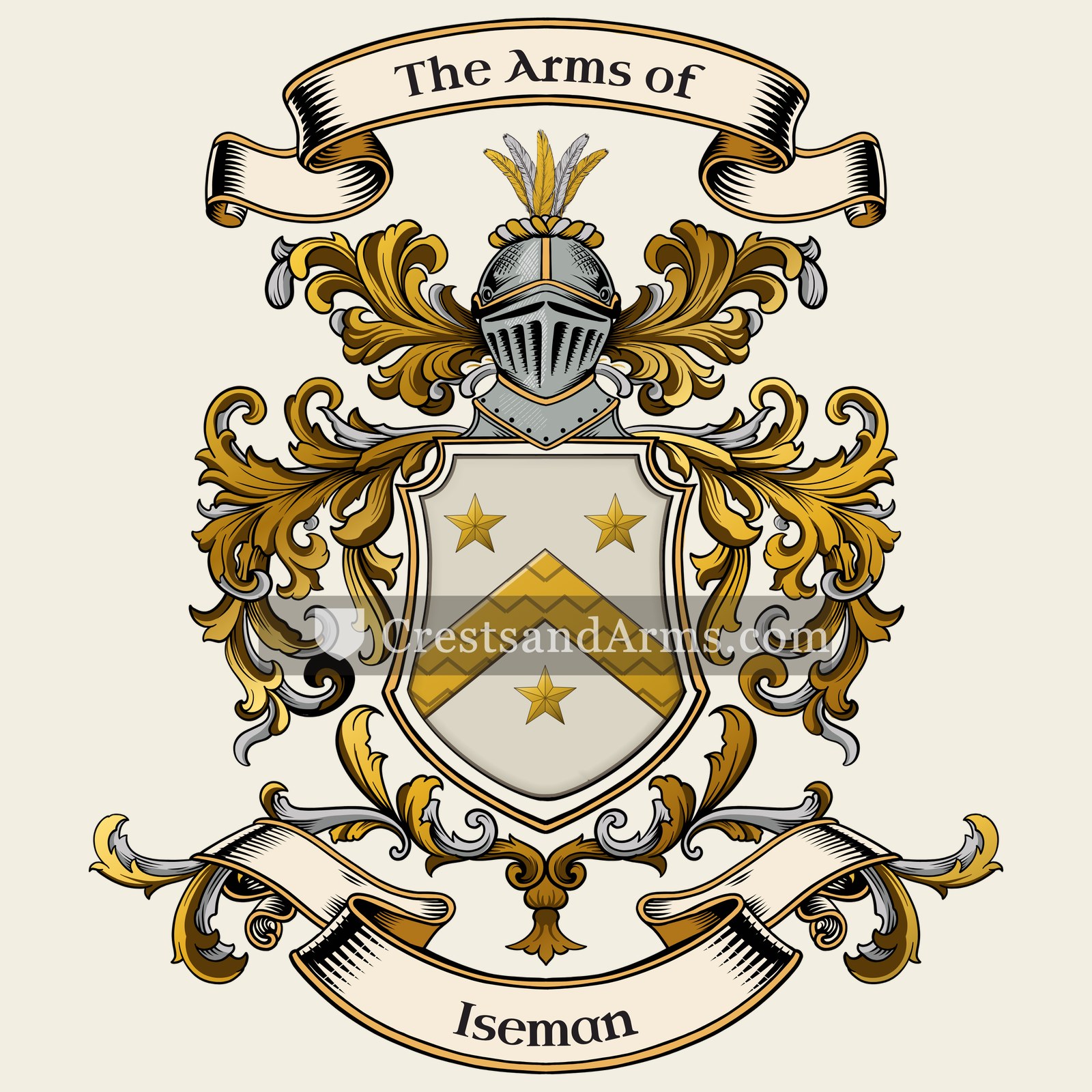
Symbols on this shield
chevronProtection, and faithful service completed
mulletThe third son, and a divine quality from above
Colours
Silver (Argent)Means: Peace and sincerity
Gold (Or)Means: Generosity
Historical info
Source
Sir Bernard Burke, The General Armory of England, Scotland, Ireland and Wales, London: Harrison & Sons, 1884
Blazon (the actual original written record)
“Ar. a chev. betw. three stars of eight points wavy or”
Scotlandc. 1748
Digital archive packCoat of arms PNG, gold border print PDF, vector SVG and the certificate of authenticity. Sent to your email in minutes.
Map of Scotland showing where the Iseman arms are recorded
The Iseman arms were recorded in Scotland, c. 1748.
Arms such as these were typically recorded in Edinburgh.
Edinburgh was the seat of Scotland's government, its courts and its heralds. Families with business there settled nearby, and being close to where arms were recorded is exactly why so many of them appear.
This is where the arms were entered in the register. Families often moved to other parts of the country, so the same name can turn up in more than one region.
The body that granted and recorded arms in Scotland in this period.
George II of Great Britain
Sovereign of the period
George II of Great Britain
1727–1760
Reigning in England when the Iseman arms are first recorded.
How Arms Worked in Scotland
Scottish heraldry is unique because it treats a coat of arms as a piece of personal property protected by law. Only one person can own a specific design at any given time. When a family grows, the head keeps the original shield while other relatives must apply for their own distinct version with slight changes to prove their specific identity.
Granting authority
The Court of the Lord Lyon acts as the official body that regulates and controls all heraldic matters throughout Scotland.
How they got arms
Individuals obtain a legal right to their arms through a formal petition process that confirms their identity and family connection.
Where arms were recorded
All valid coats of arms are officially entered into the Public Register of All Arms and Bearings starting from 1672.
The family's standing
Recorded among the armigerous families of Scotland.
Origin & History of the Iseman Family in Scotland
The family name Iseman traces its roots in Scotland to the mid-eighteenth century, with documented evidence placing members of the family in Edinburgh by 1748. During this era, Edinburgh was a city undergoing rapid transformation as the Scottish Enlightenment began to reshape its intellectual and social landscape. Families living in the capital at this time often participated in the city’s growing trade networks and its expanding professional classes. While the name itself suggests a connection to Germanic or Northern European linguistic origins, its presence in Scotland reflects the broader history of migration and integration that defined urban life in the eighteenth century. By establishing themselves in a major center of commerce and law, early Iseman family members were positioned to contribute to the evolving identity of a city that served as the heart of Scottish culture and industry.
Related Branches & Arms
Root word
Isen
Old Germanic word for iron or a strong, metallic material.
This name
IsemanA person who worked with iron or a man of iron-like strength.
also spelled
Wysman
Wyseman
Wysmanne
Documented Sources
Sir Bernard Burke, The General Armory of England, Scotland, Ireland and Wales, London: Harrison & Sons, 1884
Reaney, P.H., A Dictionary of British Surnames, 1958
Emmison, F.G., Elizabethan Life: Home, Work and Land, 1976
Essex Record Office, Quarter Sessions Rolls (Q/SR)
The National Archives, Prerogative Court of Canterbury Wills (PROB 11)
Digital archive packCoat of arms PNG, gold border print PDF, vector SVG and the certificate of authenticity. Sent to your email in minutes.


 paleMilitary strength, and a fortified defence
 chevronProtection, and faithful service completed
 chiefAuthority, wisdom and dominion
 ermineDignity and rank
 dragonA most valiant defender of treasure
 lanceKnightly service and the tilt
 paleMilitary strength, and a fortified defence
 chevronProtection, and faithful service completed
 chiefAuthority, wisdom and dominion
 ermineDignity and rank
 dragonA most valiant defender of treasure
 lanceKnightly service and the tilt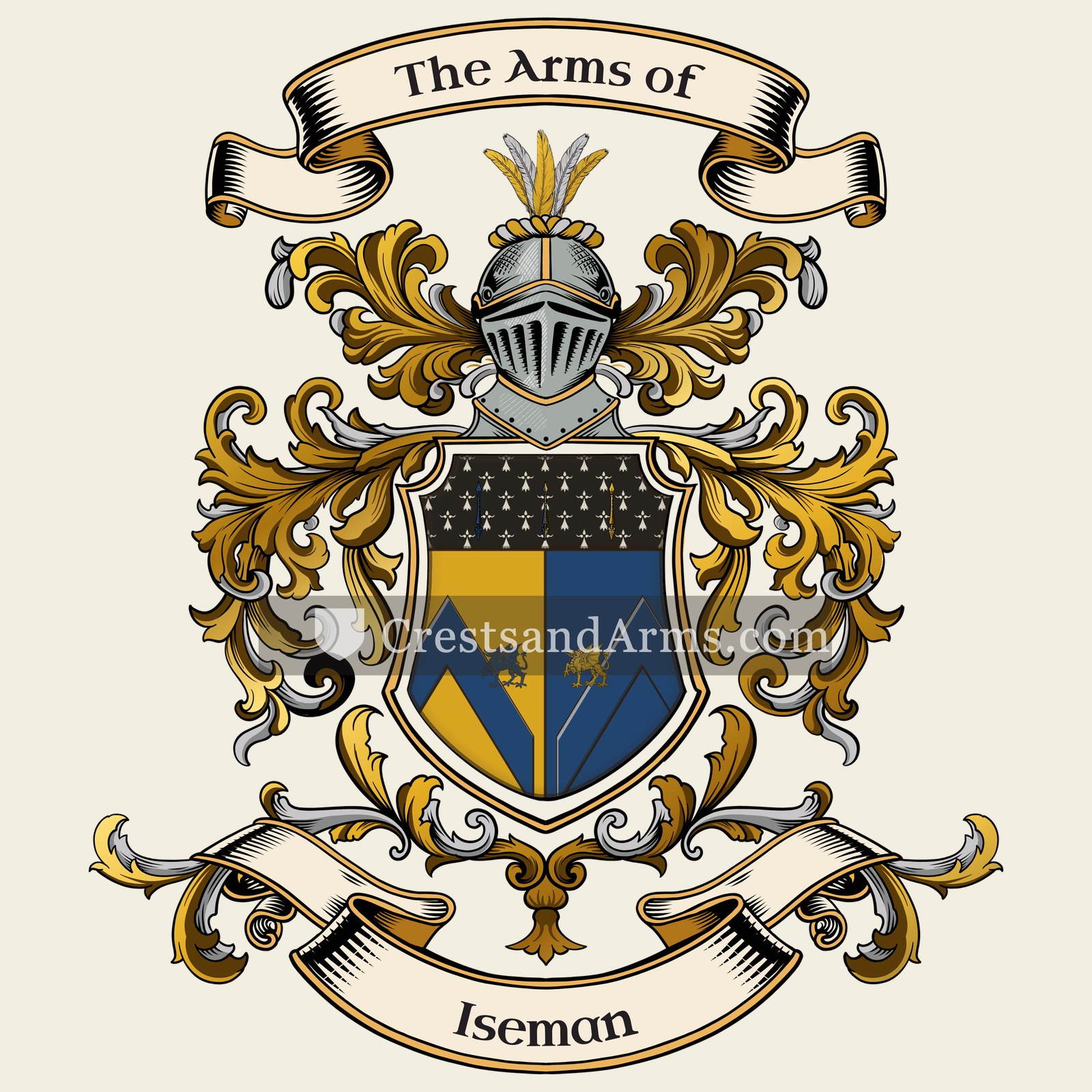


 mulletThe third son, and a divine quality from above