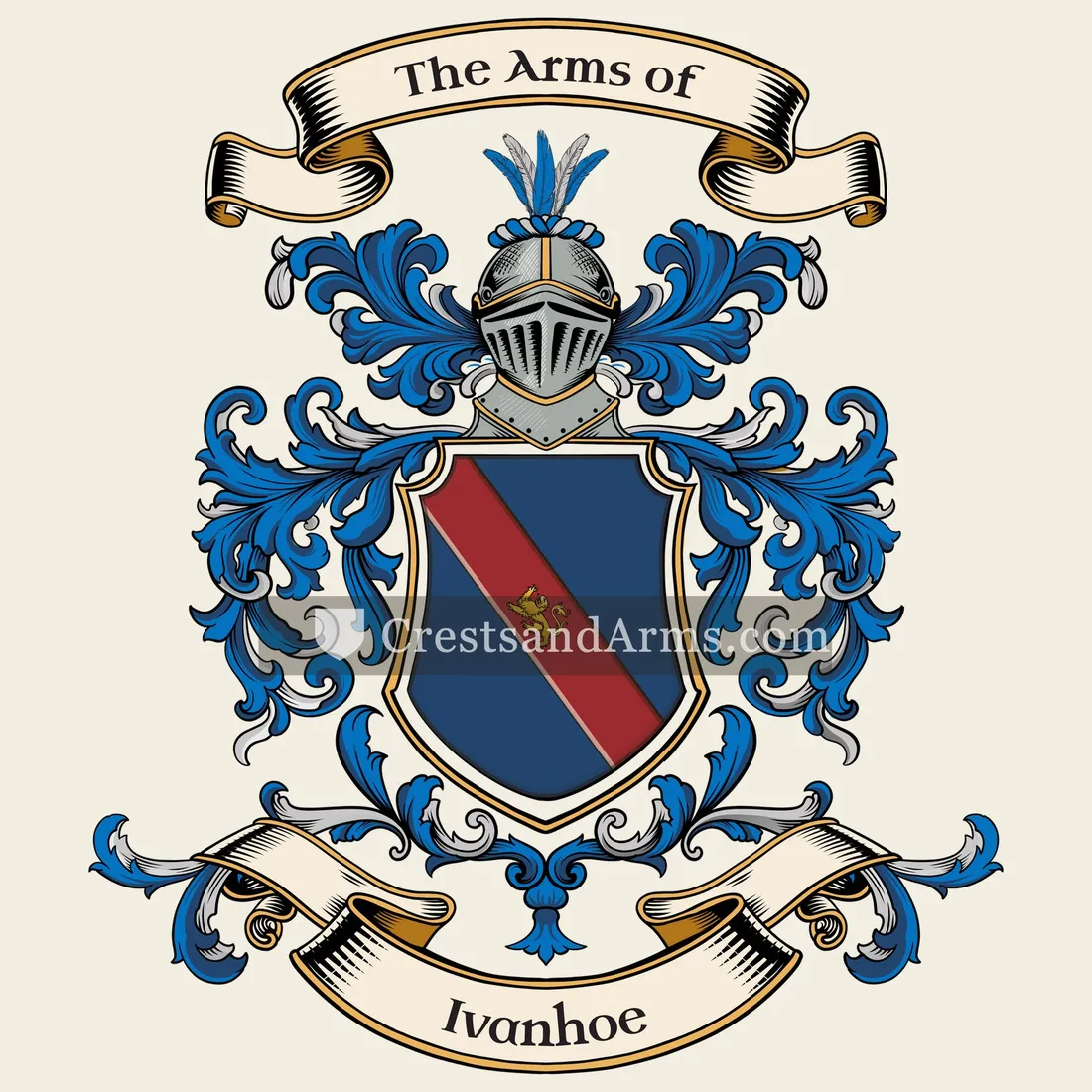
A record of documented arms, meaning and origin, researched for the Ivanhoe family of Italy.
Reg. 1174 · Italian, G–I
Meaning of the Ivanhoe family crest colors & symbols
Symbols on this shield
bendDefence, and the scarf of a commander
lionCourage, strength and royalty
Colours
Blue (Azure)Means: Loyalty and truth
Red (Gules)Means: Military strength
Gold (Or)Means: Generosity
Historical info
Source
J. B. Rietstap, Armorial Général, Gouda: G. B. van Goor Zonen, 1884–87
Blazon (the actual original written record)
“D'azur au lion d'or; à la bande de gu., br. sur le tout (ou: D'azur au léopard lionné d'or, à la bande de gu., br. sur le tout, posant les pieds de devant sur ladite bande). Cq. cour. C.: le lion, iss. L. d'or et d'azur.”
DalmatiaDalmatia, c. 1775
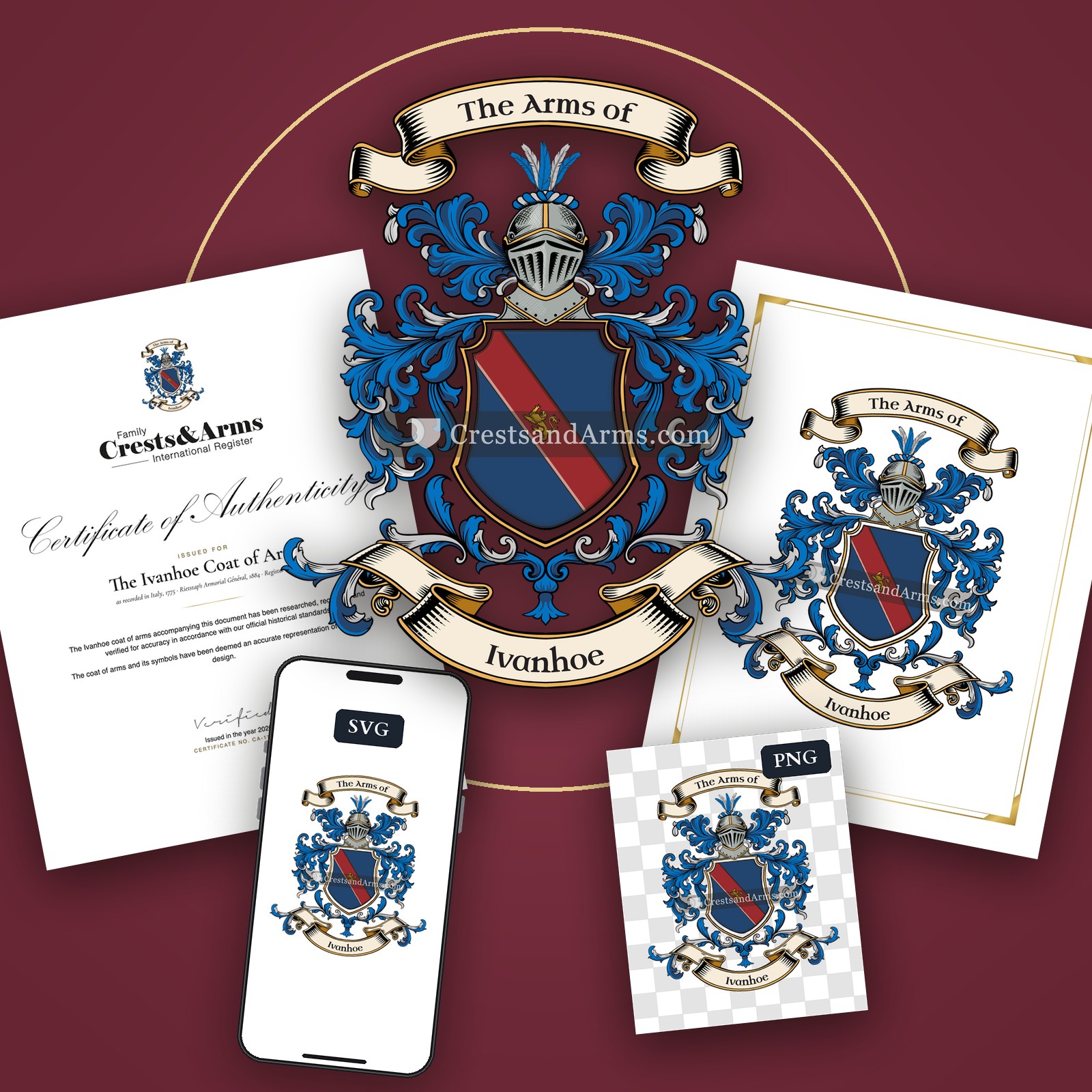
Digital archive packCoat of arms PNG, gold border print PDF, vector SVG and the certificate of authenticity. Sent to your email in minutes.
Map of Italy showing where the Ivanhoe arms are recorded
The Ivanhoe arms were recorded in Dalmatia, c. 1775.
Dalmatia was a string of walled towns along the Adriatic coast, each with its own leading families. Sea trade made them wealthy, and the towns kept lists of the houses entitled to arms.
This is where the arms were entered in the register. Families often moved to other parts of the country, so the same name can turn up in more than one region.
The body that granted and recorded arms in Italy in this period.
Alvise Giovanni Mocenigo
Sovereign of the period
Alvise Giovanni Mocenigo
1763–1778
Reigning in Italy when the Ivanhoe arms are first recorded.
How Arms Worked in Italy
In the Italian states, coats of arms were often used by noble families to show their status and history. These symbols were passed down through the generations to all legitimate male descendants. Younger branches of a family usually kept the original design but sometimes added small changes to distinguish their specific line from the main branch.
Granting authority
Various local rulers and city governments controlled the use of coats of arms across the different Italian states.
How they got arms
Families often assumed their own arms or received them as official grants from local lords, popes, or city councils.
Where arms were recorded
Arms were recorded in local city archives or private family books rather than in one single national register.
The family's standing
Recorded among the armigerous families of Dalmatia.
Origin & History of the Ivanhoe Family in Italy
The surname Ivanhoe is deeply connected to the historical landscape of the Dalmatian coast, where records confirm the family was well-established by 1775. The name itself is rooted in the Slavic tradition, likely evolving from the name Ivan, which is the regional equivalent of John. During the eighteenth century, families in this region often lived in port cities or mountainous inland villages, navigating the complex political shifts between the Venetian Republic and the Austro-Hungarian Empire. The Ivanhoe family likely functioned as part of the local merchant or landowning class, which allowed them to maintain records and property during a time of significant transition. While the name later gained fame through literature, its true origins lie in the daily lives of people living along the Adriatic Sea, where they contributed to the unique cultural blend of Mediterranean and Balkan traditions.
Ivanhoe Meaning & Related Branches
Root word
Iohannes
Hebrew origin meaning God is gracious.
This name
IvanhoeA literary surname derived from a place name meaning John's hill or field.
also spelled
Ivaneoh
Ivaneoe
Ivane
Ivanyo
Documented Sources
J. B. Rietstap, Armorial Général, Gouda: G. B. van Goor Zonen, 1884–87
Fine, John V.A., The Late Medieval Balkans: A Critical Survey from the Late Twelfth Century to the Ottoman Conquest, 1987
State Archives in Zadar (Državni arhiv u Zadru), Fond obitelji i pojedinaca (Family and Individual Papers), 1750–1800
Roglić, Josip, Dalmacija: Prostor, ljudi, život (Dalmatia: Space, People, Life), 1970
Digital archive packCoat of arms PNG, gold border print PDF, vector SVG and the certificate of authenticity. Sent to your email in minutes.


 bendDefence, and the scarf of a commander
 lionCourage, strength and royalty
 bendDefence, and the scarf of a commander
 lionCourage, strength and royalty