Map of France showing where the Jacob arms are recorded
The Jacob arms were recorded in Lorraine, c. 1572.
Lorraine sat on the border between France and the German lands, and border country bred soldiers. Families here held small estates and served in arms, and a fighting man was exactly the sort who carried a shield of his own.
This is where the arms were entered in the register. Families often moved to other parts of the country, so the same name can turn up in more than one region.
The body that granted and recorded arms in France in this period.
Charles IX of France
Sovereign of the period
Charles IX of France
1560–1574
Reigning in France when the Jacob arms are first recorded.
How Arms Worked in France
In France, a coat of arms was a mark of honor that passed down through the male line to all legitimate descendants. Families often used the same shield without changes to show their shared heritage. If a branch wanted to stand out, they could add a small mark to their shield to show their specific place in the family tree.
Granting authority
The Juge d'armes de France acted as the official authority that regulated and verified coats of arms across the country.
How they got arms
Families typically inherited their arms from ancestors, though they could also receive them through royal grants or by proving their noble status.
Where arms were recorded
Coats of arms were officially recorded in the Armorial Général de France, which began its main collection in the year 1696.
The family's standing
Recorded among the armigerous families of Lorraine.
Origin & History of the Jacob Family in France
The name Jacob traces its roots to the ancient Hebrew name Yaakov, which eventually spread across Europe through religious traditions. By the late sixteenth century, the family established a notable presence in the Lorraine region of France. During this period, Lorraine served as a cultural crossroads between the French and German-speaking worlds, making it a dynamic place for families to settle and grow. The year 1572 was a time of significant social and political tension in France, yet records confirm that members of the Jacob family were already rooted in this territory. Living in Lorraine meant that these early ancestors navigated a landscape shaped by shifting borders and the influence of the Holy Roman Empire. As they integrated into local society, they likely worked as tradespeople or farmers, contributing to the development of the region during the Renaissance. Their presence in this area reflects the broader movement of families who sought stability and community in the heart of Europe during a transformative era of history.
Coat of Arms & Family Crest Details
Symbols on this shield
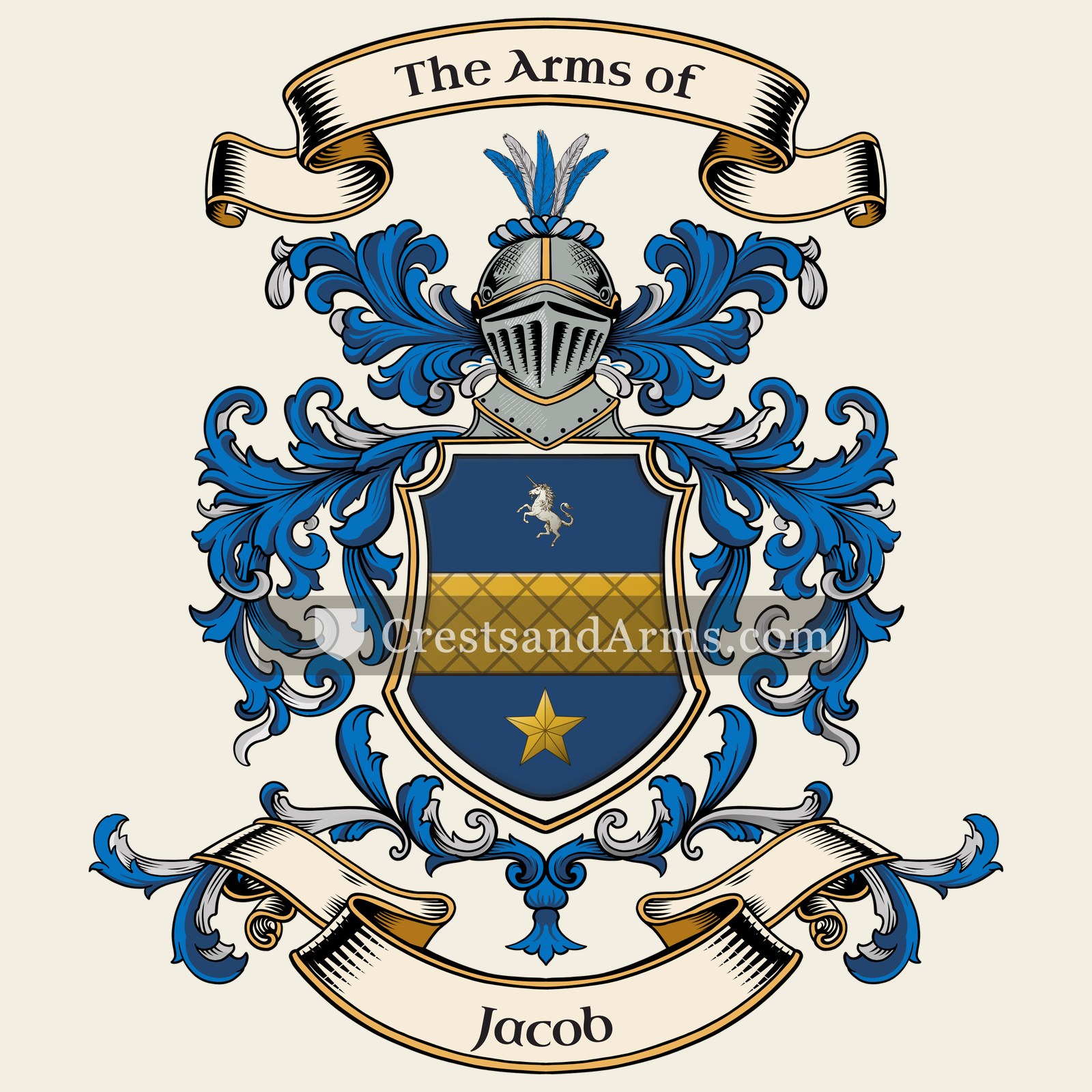
cupFaith, office, and a trust discharged
Colours
Gold (Or)Means: Generosity
Red (Gules)Means: Military strength
Historical info
Source
J. B. Rietstap, Armorial Général, Gouda: G. B. van Goor Zonen, 1884–87
Blazon (the actual original written record)
“D'or à trois coupes couvertes de gu.”
Netherlandsc. 1815
Digital archive packCoat of arms PNG, gold border print PDF, vector SVG and the certificate of authenticity. Sent to your email in minutes.
Map of Netherlands showing where the Jacob arms are recorded
The Jacob arms were recorded in Netherlands, c. 1815.
Arms such as these were typically recorded in Friesland.
Friesland was low, wet country on the northern coast of the Netherlands, farmed by families who had held the same land for centuries. Free landholders were unusually common there, and a free landholder could carry arms.
This is where the arms were entered in the register. Families often moved to other parts of the country, so the same name can turn up in more than one region.
Region
Friesland
First recorded
1815
Granting Authority for the Jacob Arms
Hoge Raad van Adel
Photograph made by me · CC BY-SA 3.0
The body that granted and recorded arms in Netherlands in this period.
William I of the Netherlands
Sovereign of the period
William I of the Netherlands
1815–1840
Reigning in France when the Jacob arms are first recorded.
How Arms Worked in Netherlands
In the Netherlands, coats of arms were often used by noble families and those who held specific public offices. These arms were passed down through the generations to legitimate descendants. Younger branches of a family usually kept the original design without needing to add special marks. This system ensured that the family identity remained clear and consistent over many years.
Granting authority
The Hoge Raad van Adel is the official body that regulates and manages noble titles and coats of arms in the Netherlands.
How they got arms
Families typically obtained their coats of arms through official royal grants or by proving their long-standing historical use of the symbols.
Where arms were recorded
Coats of arms are officially recorded in the registers held by the Hoge Raad van Adel, which began its work in 1814.
The family's standing
Recorded among the armigerous families of Netherlands.
Origin & History of the Jacob Family in Netherlands
The family name Jacob traces its roots to the ancient Hebrew name Yaakov, which eventually spread across Europe through religious traditions. In the Netherlands, surnames became mandatory in the early nineteenth century due to new government regulations. Before this period, most people in the region used patronymics, which meant a person’s last name was simply their father’s first name followed by a suffix. By the time official records began documenting the family in Friesland in 1815, the name Jacob had transitioned from a father’s given name into a permanent family surname. This shift reflects the broader social changes occurring in the Dutch provinces as the population moved toward standardized record-keeping. The presence of the family in Friesland during this era suggests they were part of the local community as the Netherlands modernized its civil registration systems.
Coat of Arms & Family Crest Details
Symbols on this shield
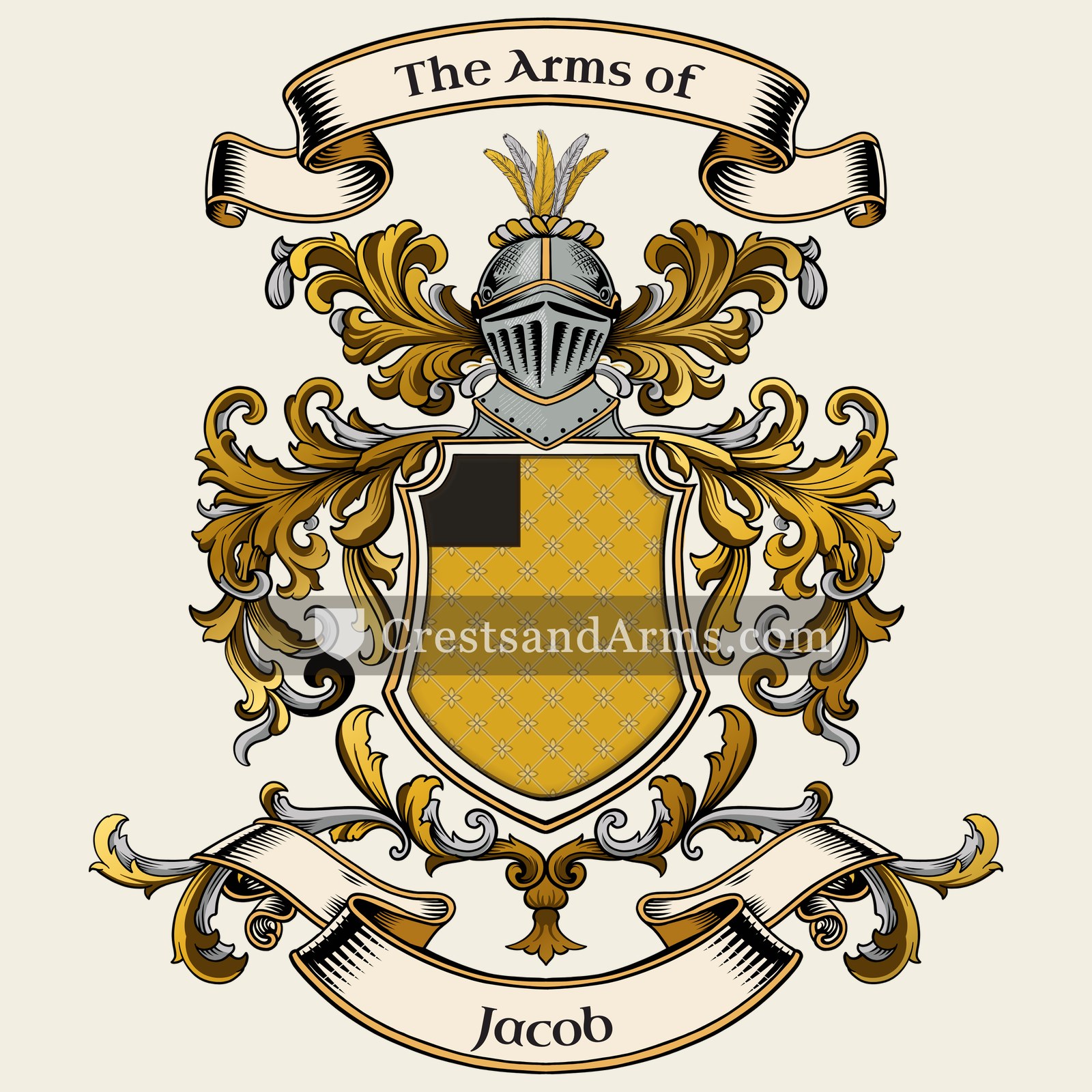
cantonA mark of honour granted by the sovereign
Colours
Gold (Or)Means: Generosity
Black (Sable)Means: Constancy
Historical info
Source
Sir Bernard Burke, The General Armory of England, Scotland, Ireland and Wales, London: Harrison & Sons, 1884
Blazon (the actual original written record)
“Or, on a canton sa. an heraldic tiger's head erased of the field, langued gu”
WiltsSybil · Wilts, c. 1573
Digital archive packCoat of arms PNG, gold border print PDF, vector SVG and the certificate of authenticity. Sent to your email in minutes.
Map of England showing where the Jacob arms are recorded
The Jacob arms were recorded in Wilts, c. 1573.
Wiltshire was sheep country, and wool made money steadily for hundreds of years. Families who made it bought manors on the downs, and holding a manor was the usual reason to take arms.
This is where the arms were entered in the register. Families often moved to other parts of the country, so the same name can turn up in more than one region.
The body that granted and recorded arms in England in this period.
Elizabeth I of England
Sovereign of the period
Elizabeth I of England
1558–1603
Reigning in France when the Jacob arms are first recorded.
How Arms Worked in England
English heraldry allowed arms to be shared by all legitimate descendants of the original owner. These symbols were treated as personal property that moved through the generations to all children. While the eldest son kept the original design, other family members could use the same shield without needing to change it or register their own unique versions.
Granting authority
The College of Arms in London has regulated the use of coats of arms throughout England and Wales since 1484.
How they got arms
Families typically obtained their coats of arms through a formal grant from the Crown or by proving their ancient right to them.
Where arms were recorded
All official coats of arms are recorded in the registers kept at the College of Arms, which date back to the fifteenth century.
The family's standing
Recorded among the armigerous families of Wilts.
Origin & History of the Jacob Family in England
The surname Jacob traces its roots to the ancient Hebrew name Yaakov, which became popular across Europe due to the widespread influence of the Bible. In England, the name began as a personal name before evolving into a hereditary surname during the Middle Ages. By the time the name was firmly established in Wiltshire by 1573, it had become a common way to identify families who lived in rural farming communities. These early ancestors were likely yeomen or tenant farmers who contributed to the local economy of the English countryside. As the name spread through parish records and legal documents, it became a stable marker of identity for families living in the West Country. This transition from a simple given name to a permanent family name reflects the broader social changes occurring in England as people began to settle in specific regions for generations.
Jacob Meaning & Related Branches
Root word
Yaakov
Hebrew for to follow or to be at the heel
This name
JacobSupplanter or one who follows, derived from the biblical patriarch Jacob
also spelled
Jakob
Jacobson
Related arms
Alexanderrecorded with Jacob, same area
Broadriprecorded with Jacob, same area
Caryrecorded with Jacob, same area
Goldtraprecorded with Jacob, same area
Documented Sources
J. B. Rietstap, Armorial Général, Gouda: G. B. van Goor Zonen, 1884–87
Bastien, Jean-Pierre. Les familles de Lorraine au XVIe siècle. 1988
Archives départementales de Meurthe-et-Moselle. Registres paroissiaux et d'état civil, Series E
Martin, Robert. Histoire de la province de Lorraine. 1995
Digital archive packCoat of arms PNG, gold border print PDF, vector SVG and the certificate of authenticity. Sent to your email in minutes.


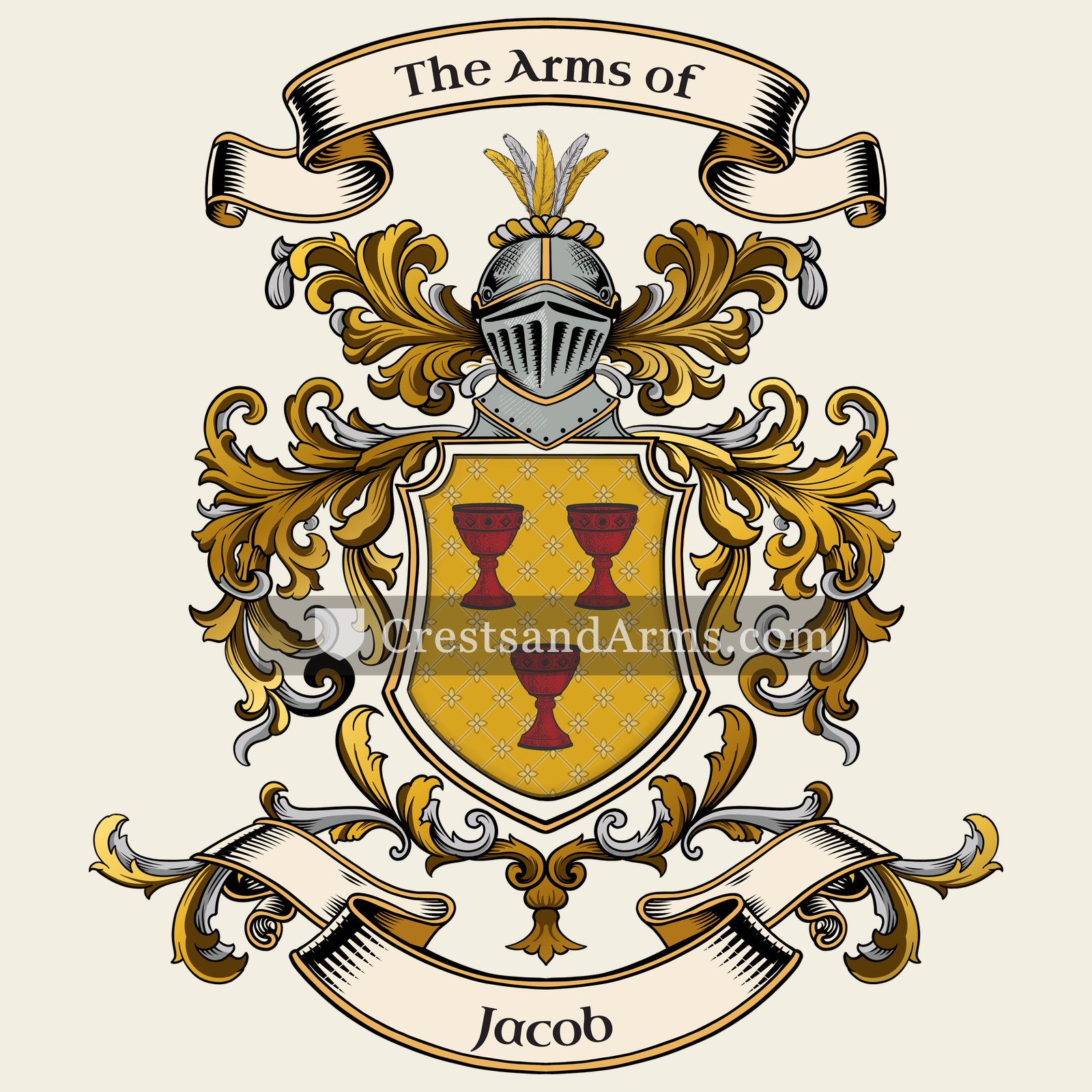
 fessThe military belt, and readiness to serve
 unicornPurity, and extreme courage in defence of honour
 mulletThe third son, and a divine quality from above
 fessThe military belt, and readiness to serve
 unicornPurity, and extreme courage in defence of honour
 mulletThe third son, and a divine quality from above


 cupFaith, office, and a trust discharged


 cantonA mark of honour granted by the sovereign