Map of France showing where the Jacobo arms are recorded
The Jacobo arms were recorded in Lorraine, c. 1572.
Lorraine sat on the border between France and the German lands, and border country bred soldiers. Families here held small estates and served in arms, and a fighting man was exactly the sort who carried a shield of his own.
This is where the arms were entered in the register. Families often moved to other parts of the country, so the same name can turn up in more than one region.
The body that granted and recorded arms in France in this period.
Charles IX of France
Sovereign of the period
Charles IX of France
1560–1574
Reigning in France when the Jacobo arms are first recorded.
How Arms Worked in France
In France, a coat of arms was a mark of honor that passed down through the male line to all legitimate descendants. Families often used the same shield without changes to show their shared heritage. If a branch wanted to stand out, they could add a small mark to their shield to show their specific place in the family tree.
Granting authority
The Juge d'armes de France acted as the official authority that regulated and verified coats of arms across the country.
How they got arms
Families typically inherited their arms from ancestors, though they could also receive them through royal grants or by proving their noble status.
Where arms were recorded
Coats of arms were officially recorded in the Armorial Général de France, which began its main collection in the year 1696.
The family's standing
Recorded among the armigerous families of Lorraine.
Origin & History of the Jacobo Family in France
The family name Jacobo has deep roots in the Lorraine region of France, where records confirm members of the family were established by 1572. During this period, Lorraine was a crossroads of European culture and served as a vital link between the Holy Roman Empire and the French kingdom. Families living in this area often experienced the shifting borders and religious tensions that defined the late sixteenth century. The name itself is a variation of the Hebrew name Jacob, which gained widespread popularity across Europe as a given name before evolving into a hereditary surname. By settling in Lorraine, the early members of the Jacobo family became part of a complex social landscape characterized by distinct regional customs and the transition from feudal traditions to more centralized governance. Their presence in this specific province suggests they were likely involved in the agricultural or merchant activities that sustained the local economy during the turbulent years of the French Wars of Religion.
Meaning of the Jacobo family crest colors & symbols
Symbols on this shield
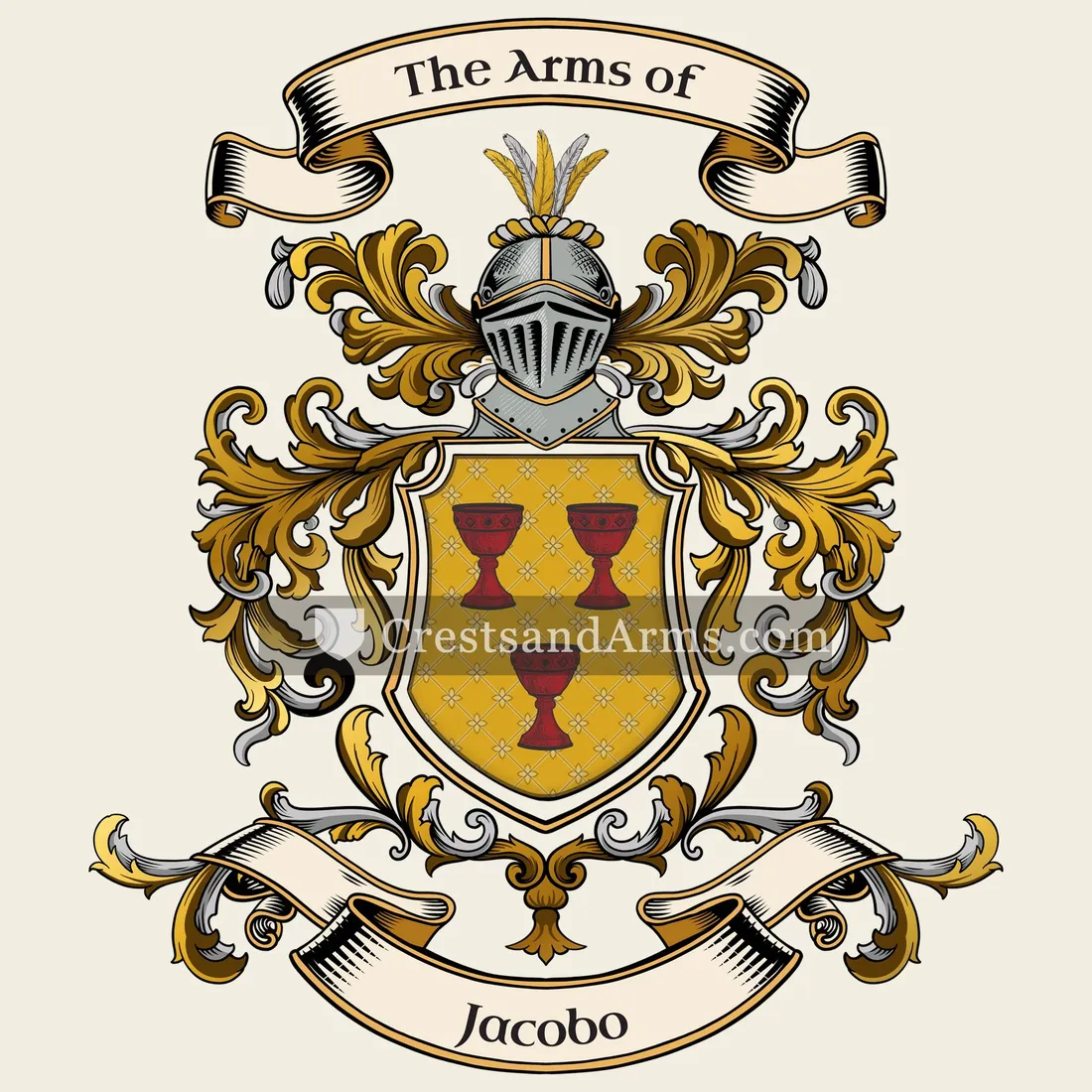
cupFaith, office, and a trust discharged
Colours
Gold (Or)Means: Generosity
Red (Gules)Means: Military strength
Historical info
Source
J. B. Rietstap, Armorial Général, Gouda: G. B. van Goor Zonen, 1884–87
Blazon (the actual original written record)
“D'or à trois coupes couvertes de gu.”
Netherlandsc. 1815
Digital archive packCoat of arms PNG, gold border print PDF, vector SVG and the certificate of authenticity. Sent to your email in minutes.
Map of Netherlands showing where the Jacobo arms are recorded
The Jacobo arms were recorded in Netherlands, c. 1815.
Arms such as these were typically recorded in Friesland.
Friesland was low, wet country on the northern coast of the Netherlands, farmed by families who had held the same land for centuries. Free landholders were unusually common there, and a free landholder could carry arms.
This is where the arms were entered in the register. Families often moved to other parts of the country, so the same name can turn up in more than one region.
Region
Friesland
First recorded
1815
Granting Authority for the Jacobo Arms
Hoge Raad van Adel
Photograph made by me · CC BY-SA 3.0
The body that granted and recorded arms in Netherlands in this period.
William I of the Netherlands
Sovereign of the period
William I of the Netherlands
1815–1840
Reigning in France when the Jacobo arms are first recorded.
How Arms Worked in Netherlands
In the Netherlands, coats of arms were often used by noble families and those who held specific public offices. These arms were passed down through the generations to legitimate descendants. Younger branches of a family usually kept the original design without needing to add special marks. This system ensured that the family identity remained clear and consistent over many years.
Granting authority
The Hoge Raad van Adel is the official body that regulates and manages noble titles and coats of arms in the Netherlands.
How they got arms
Families typically obtained their coats of arms through official royal grants or by proving their long-standing historical use of the symbols.
Where arms were recorded
Coats of arms are officially recorded in the registers held by the Hoge Raad van Adel, which began its work in 1814.
The family's standing
Recorded among the armigerous families of Netherlands.
Origin & History of the Jacobo Family in Netherlands
The surname Jacobo carries a distinct history that reflects the naming customs of the Netherlands during the early nineteenth century. While the name is often associated with Mediterranean roots, its presence in the northern province of Friesland by 1815 highlights the complex way families adopted permanent surnames during the Napoleonic era. In 1811, the French administration under Napoleon Bonaparte mandated that all Dutch citizens register a formal family name to improve tax collection and military conscription. Many families in Friesland chose names that honored religious traditions or ancestral figures, and Jacobo likely emerged as a localized variation of the name Jacob. By the time official civil records were firmly established in the region around 1815, families using this name were already integrated into the social and agricultural fabric of Frisian village life. This transition from traditional patronymic naming, where a person was simply known by their father's first name, to a fixed surname like Jacobo marks a pivotal moment in the family's documented history within the Dutch state.
Meaning of the Jacobo family crest colors & symbols
Symbols on this shield
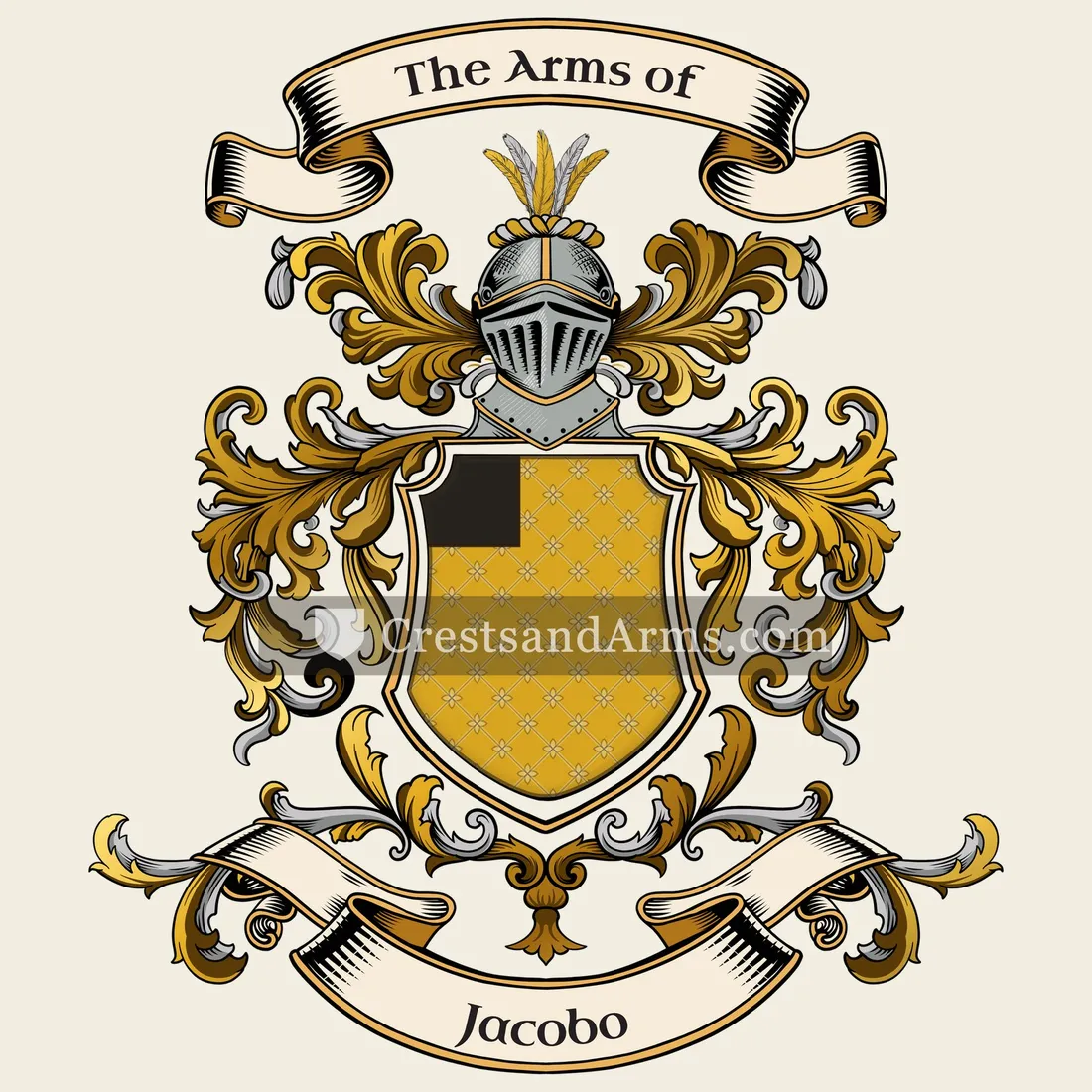
cantonA mark of honour granted by the sovereign
Colours
Gold (Or)Means: Generosity
Black (Sable)Means: Constancy
Historical info
Source
Sir Bernard Burke, The General Armory of England, Scotland, Ireland and Wales, London: Harrison & Sons, 1884
Blazon (the actual original written record)
“Or, on a canton sa. an heraldic tiger's head erased of the field, langued gu”
WiltsSybil · Wilts, c. 1573
Digital archive packCoat of arms PNG, gold border print PDF, vector SVG and the certificate of authenticity. Sent to your email in minutes.
Map of England showing where the Jacobo arms are recorded
The Jacobo arms were recorded in Wilts, c. 1573.
Wiltshire was sheep country, and wool made money steadily for hundreds of years. Families who made it bought manors on the downs, and holding a manor was the usual reason to take arms.
This is where the arms were entered in the register. Families often moved to other parts of the country, so the same name can turn up in more than one region.
The body that granted and recorded arms in England in this period.
Elizabeth I of England
Sovereign of the period
Elizabeth I of England
1558–1603
Reigning in France when the Jacobo arms are first recorded.
How Arms Worked in England
English heraldry allowed arms to be shared by all legitimate descendants of the original owner. These symbols were treated as personal property that moved through the generations to all children. While the eldest son kept the original design, other family members could use the same shield without needing to change it or register their own unique versions.
Granting authority
The College of Arms in London has regulated the use of coats of arms throughout England and Wales since 1484.
How they got arms
Families typically obtained their coats of arms through a formal grant from the Crown or by proving their ancient right to them.
Where arms were recorded
All official coats of arms are recorded in the registers kept at the College of Arms, which date back to the fifteenth century.
The family's standing
Recorded among the armigerous families of Wilts.
Origin & History of the Jacobo Family in England
The surname Jacobo serves as a linguistic variation of the name Jacob, which traces its roots back to the Hebrew name Yaakov. While the name is often associated with Mediterranean regions, historical records confirm that families bearing this name were established in the English county of Wiltshire as early as 1573. During the late sixteenth century, England was undergoing significant social changes, and the presence of such families in rural areas like Wiltshire suggests they were likely involved in the local agricultural economy or the thriving wool trade that defined the region at the time. Because surnames were still becoming standardized during this period, the spelling Jacobo likely reflected a specific regional pronunciation or a connection to continental European naming traditions that had migrated to England. These early settlers lived through a time of religious transition and economic growth, contributing to the local community fabric long before the name became more widely dispersed across the British Isles.
Jacobo Meaning & Related Branches
Root word
Yaakov
Hebrew name meaning to follow or to be at the heel.
This name
JacoboDerived from the Latin Iacobus, signifying the supplanter or one who follows.
also spelled
Jakob
Jacobson
Documented Sources
J. B. Rietstap, Armorial Général, Gouda: G. B. van Goor Zonen, 1884–87
Bastien, Jean-Pierre, Histoire de la Lorraine, 1998
Cabourdin, Guy, La vie quotidienne en Lorraine au XVIe siècle, 1984
Archives départementales de Meurthe-et-Moselle, Série B: Cours et juridictions (Chambre des comptes de Lorraine)
Archives départementales de la Moselle, Série G: Clergé séculier (Registres paroissiaux et état civil ancien)
Digital archive packCoat of arms PNG, gold border print PDF, vector SVG and the certificate of authenticity. Sent to your email in minutes.


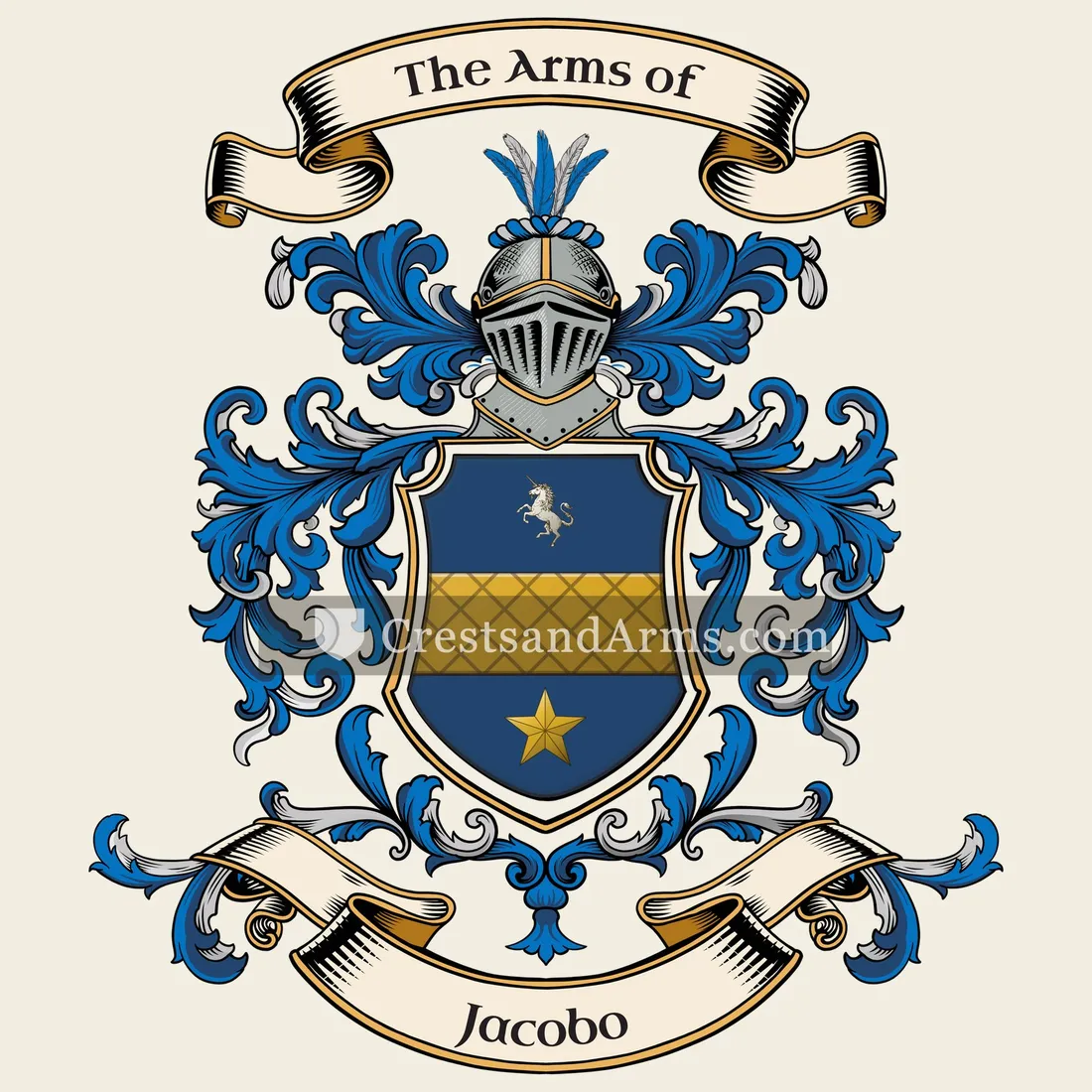
 fessThe military belt, and readiness to serve
 unicornPurity, and extreme courage in defence of honour
 mulletThe third son, and a divine quality from above
 fessThe military belt, and readiness to serve
 unicornPurity, and extreme courage in defence of honour
 mulletThe third son, and a divine quality from above


 cupFaith, office, and a trust discharged


 cantonA mark of honour granted by the sovereign