Map of Netherlands showing where the Jacobsen arms are recorded
The Jacobsen arms were recorded in Middelbourg, c. 1815.
This is where the arms were entered in the register. Families often moved to other parts of the country, so the same name can turn up in more than one region.
Region
Middelbourg
Town
Middelbourg
First recorded
1815
Granting Authority for the Jacobsen Arms
Hoge Raad van Adel
Photograph made by me · CC BY-SA 3.0
The body that granted and recorded arms in Netherlands in this period.
William I of the Netherlands
Sovereign of the period
William I of the Netherlands
1815–1840
Reigning in Netherlands when the Jacobsen arms are first recorded.
How Arms Worked in Netherlands
In the Netherlands, coats of arms were often used by noble families and those who held specific public offices. These arms were passed down through the generations to legitimate descendants. Younger branches of a family usually kept the original design without needing to add special marks. This system ensured that the family identity remained clear and consistent over many years.
Granting authority
The Hoge Raad van Adel is the official body that regulates and manages noble titles and coats of arms in the Netherlands.
How they got arms
Families typically obtained their coats of arms through official royal grants or by proving their long-standing historical use of the symbols.
Where arms were recorded
Coats of arms are officially recorded in the registers held by the Hoge Raad van Adel, which began its work in 1814.
The family's standing
Recorded among the armigerous families of Netherlands.
Origin & History of the Jacobsen Family in Netherlands
The surname Jacobsen follows a naming tradition known as a patronymic, which means it was originally formed by combining a father’s given name with a suffix indicating descent. In the context of the Netherlands, the name translates literally to "son of Jacob." While the name has deep roots across Northern Europe, its presence in the historic city of Middelburg by 1815 reflects the family's integration into the bustling maritime and merchant culture of the Zeeland province. During this period, the Netherlands was transitioning through significant political changes following the Napoleonic era, and the formal registration of surnames became increasingly standardized through civil records. Families like the Jacobsens in Middelburg were often part of the urban middle class, contributing to the local economy as the city served as a vital hub for trade and regional administration. By settling in a major port city, the family likely participated in the vibrant social and economic life that defined the Dutch coastal provinces during the early nineteenth century.
Coat of Arms & Family Crest Details
Symbols on this shield
roseThe seventh son, and beauty with grace
mulletThe third son, and a divine quality from above
Colours
Gold (Or)Means: Generosity
Blue (Azure)Means: Loyalty and truth
Silver (Argent)Means: Peace and sincerity
Red (Gules)Means: Military strength
Historical info
Source
J. B. Rietstap, Armorial Général, Gouda: G. B. van Goor Zonen, 1884–87
Blazon (the actual original written record)
“Tiercé en fasce: au 1 d'or à deux roses de gu.; au 2 d'azur plein; au 3 d'arg. à une étoile de gu. S.: un griffon à dextre.”
BelgiumBruges, c. 1737
Digital archive packCoat of arms PNG, gold border print PDF, vector SVG and the certificate of authenticity. Sent to your email in minutes.
Map of Belgium showing where the Jacobsen arms are recorded
The Jacobsen arms were recorded in Bruges, c. 1737.
This is where the arms were entered in the register. Families often moved to other parts of the country, so the same name can turn up in more than one region.
The body that granted and recorded arms in Belgium in this period.
Charles VI, Holy Roman Emperor
Sovereign of the period
Charles VI, Holy Roman Emperor
1711–1740
Reigning in Netherlands when the Jacobsen arms are first recorded.
How Arms Worked in Belgium
In Belgium, a coat of arms is considered personal property that is passed down through the male line to legitimate descendants. Families often use the same shield design across generations to show their shared heritage. If a branch of the family wants to change the design, they must apply for an official update to their specific version of the arms.
Granting authority
The Conseil héraldique is the official body that regulates and approves all coats of arms in Belgium.
How they got arms
Families obtain their coats of arms through formal royal grants or by confirming their historical right to use existing designs.
Where arms were recorded
All approved coats of arms are officially recorded in the public registers of the Conseil héraldique since 1844.
The family's standing
Recorded among the armigerous families of Belgium.
Origin & History of the Jacobsen Family in Belgium
The family name Jacobsen originated as a patronymic, meaning it was formed by adding "son" to the given name Jacob to identify a person as the child of a man named Jacob. While this naming convention is most commonly associated with Scandinavian and Northern European cultures, the presence of the Jacobsen family in the city of Bruges by 1737 highlights the movement of people across the North Sea region during the eighteenth century. At that time, Bruges was a significant center for trade and commerce, attracting merchants and skilled workers from various maritime nations. Families like the Jacobsens often settled in these bustling urban hubs to take advantage of the active port economy and the growing opportunities in international exchange. By establishing themselves in this historic Flemish city, the early members of the family integrated into a society that valued both local tradition and the contributions of those who arrived from abroad. Their presence in the city records serves as a testament to the long history of migration that shaped the diverse population of Belgium.
Coat of Arms & Family Crest Details
Symbols on this shield
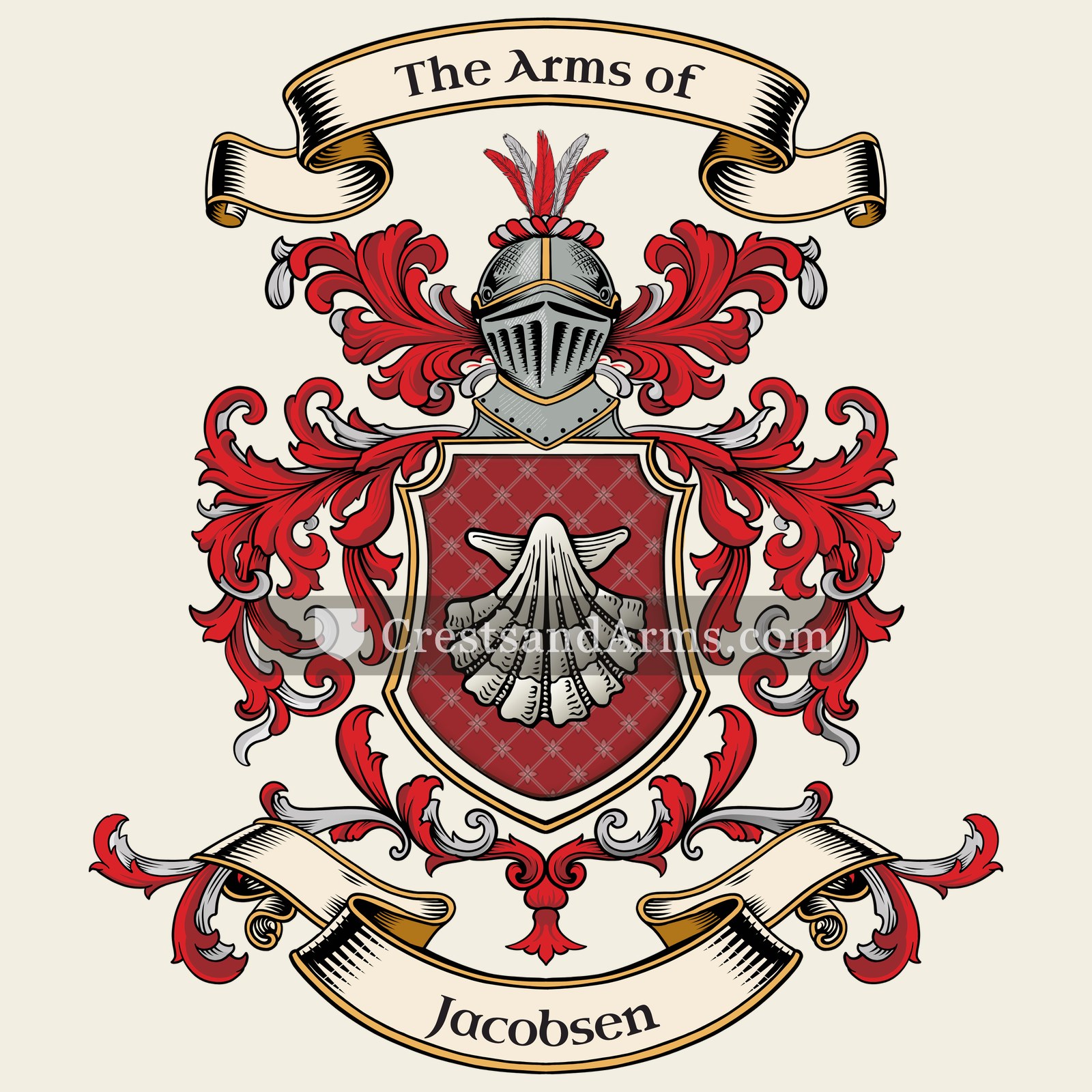
escallopThe pilgrim's shell, and a long journey made
Colours
Red (Gules)Means: Military strength
Silver (Argent)Means: Peace and sincerity
Historical info
Source
J. B. Rietstap, Armorial Général, Gouda: G. B. van Goor Zonen, 1884–87
Blazon (the actual original written record)
“De gu. à une coquille d'arg., posée en bande.”
Denmarkc. 1722
Digital archive packCoat of arms PNG, gold border print PDF, vector SVG and the certificate of authenticity. Sent to your email in minutes.
Map of Denmark showing where the Jacobsen arms are recorded
The Jacobsen arms were recorded in Denmark, c. 1722.
Arms such as these were typically recorded in Sjaælland.
Zealand held the Danish court, the crown's offices and Copenhagen itself. Families who served the king kept estates within reach of it, and royal service was the ordinary route to a coat of arms.
This is where the arms were entered in the register. Families often moved to other parts of the country, so the same name can turn up in more than one region.
The body that granted and recorded arms in Denmark in this period.
Frederik IV of Denmark
Sovereign of the period
Frederik IV of Denmark
1699–1730
Reigning in Netherlands when the Jacobsen arms are first recorded.
How Arms Worked in Denmark
Danish heraldry during this period was closely tied to noble status and royal favor rather than being open to all citizens. Arms were typically granted by the monarch to individuals, and these symbols were then shared by all members of the noble house. If a family line died out, the right to use those specific arms ended with them.
Granting authority
The Danish royal chancery held the power to issue and regulate official coats of arms for the kingdom.
How they got arms
Families usually received their arms through a formal royal grant that confirmed their noble status and rights.
Where arms were recorded
These grants were officially recorded in the Danish Royal Chancery records starting in the sixteenth century.
The family's standing
Recorded among the armigerous families of Denmark.
Origin & History of the Jacobsen Family in Denmark
The surname Jacobsen is a classic example of a patronymic naming system, which was the standard way of identifying people in Denmark for many centuries. The name literally means son of Jacob, indicating that the first person to use it was the son of a man named Jacob. By the time your ancestors were recorded living on the island of Sjælland in 1722, Denmark was in the process of transitioning from these fluid, shifting surnames to permanent family names. During this period, most rural families were tied to the land through the feudal system, and their lives were closely documented in local church registers. Because the name was based on a father's given name, it was very common for the surname to change with every new generation. Your family members in 1722 were part of a society where these names were used to distinguish individuals within small farming communities, reflecting a deep connection to the local parish and the agricultural traditions of the Danish landscape.
Related Branches & Arms
Root word
Jacob
Derived from the Hebrew name Yaakov meaning to follow or supplant.
This name
JacobsenA patronymic surname meaning son of Jacob.
also spelled
Jakobsen
Jacobson
Documented Sources
J. B. Rietstap, Armorial Général, Gouda: G. B. van Goor Zonen, 1884–87
Zeeuws Archief, Burgerlijke Stand Zeeland (1796-1994)
Zeeuws Archief, Bevolkingsregister Middelburg
Meertens, P.J., De betekenis van de Nederlandse familienamen, 1959
Van Driel, A., Middelburg: Een stad in beweging, 1990
Digital archive packCoat of arms PNG, gold border print PDF, vector SVG and the certificate of authenticity. Sent to your email in minutes.


 stagPeace and harmony, and one who will not fight unprovoked
 stagPeace and harmony, and one who will not fight unprovoked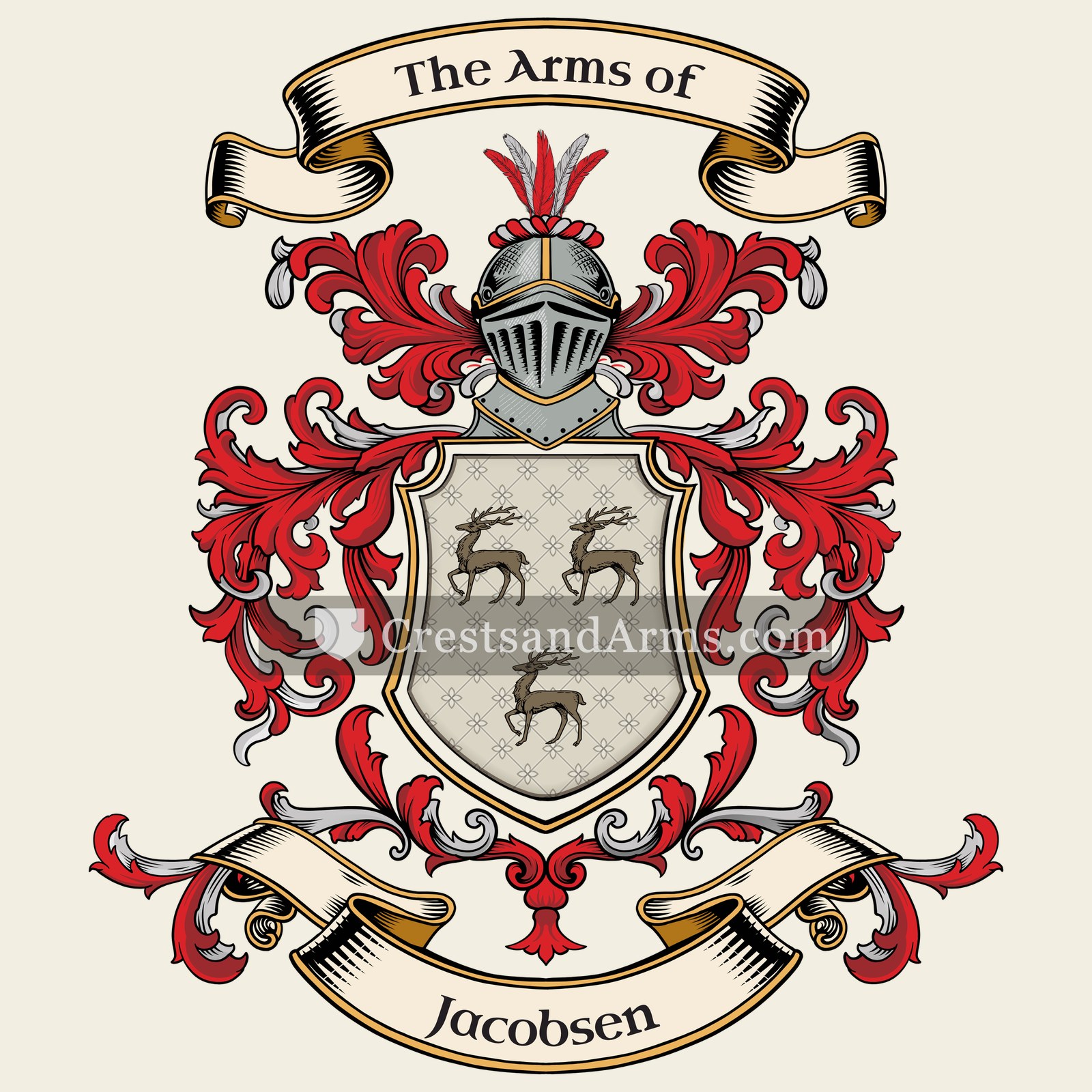


 roseThe seventh son, and beauty with grace
 mulletThe third son, and a divine quality from above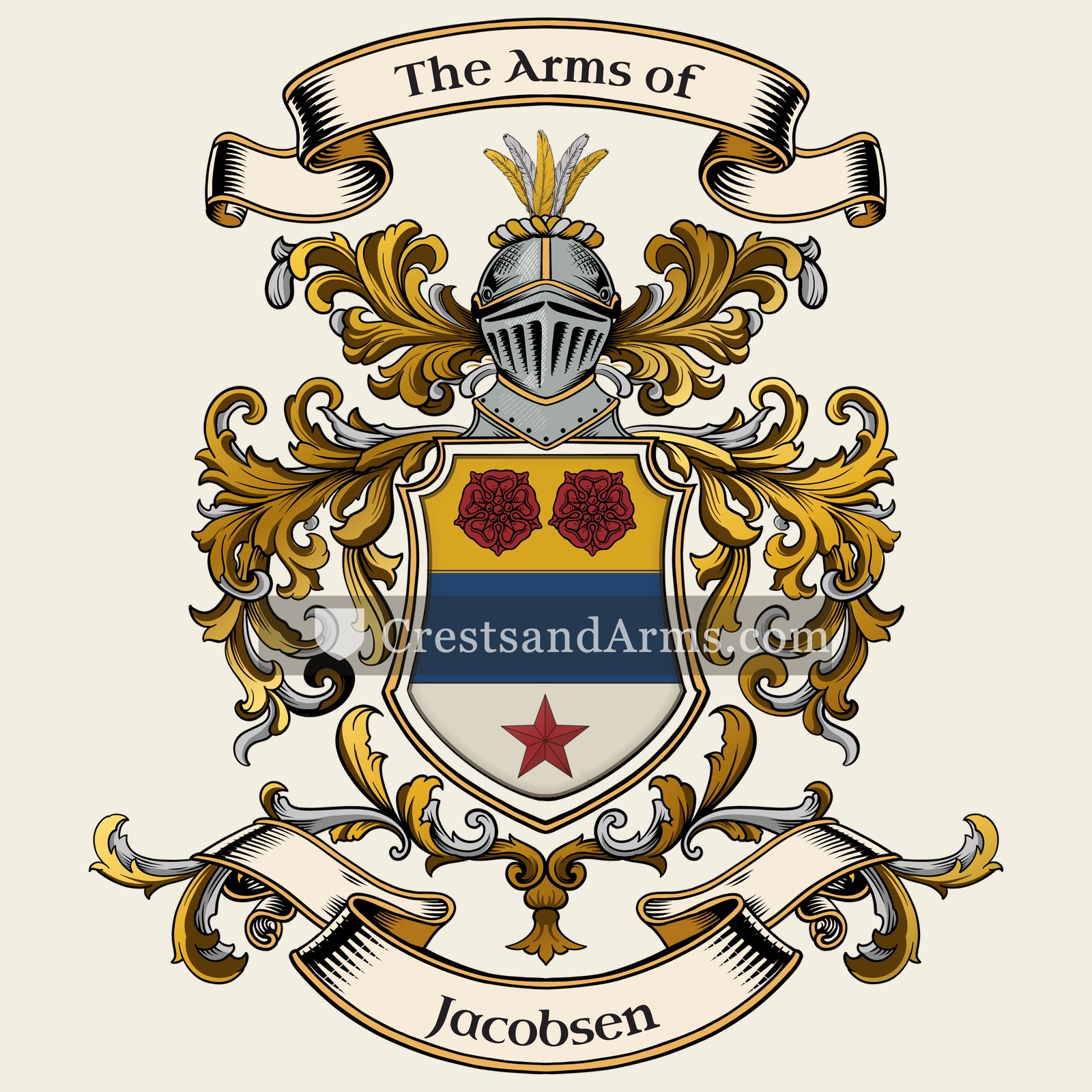


 escallopThe pilgrim's shell, and a long journey made