Map of France showing where the James arms are recorded
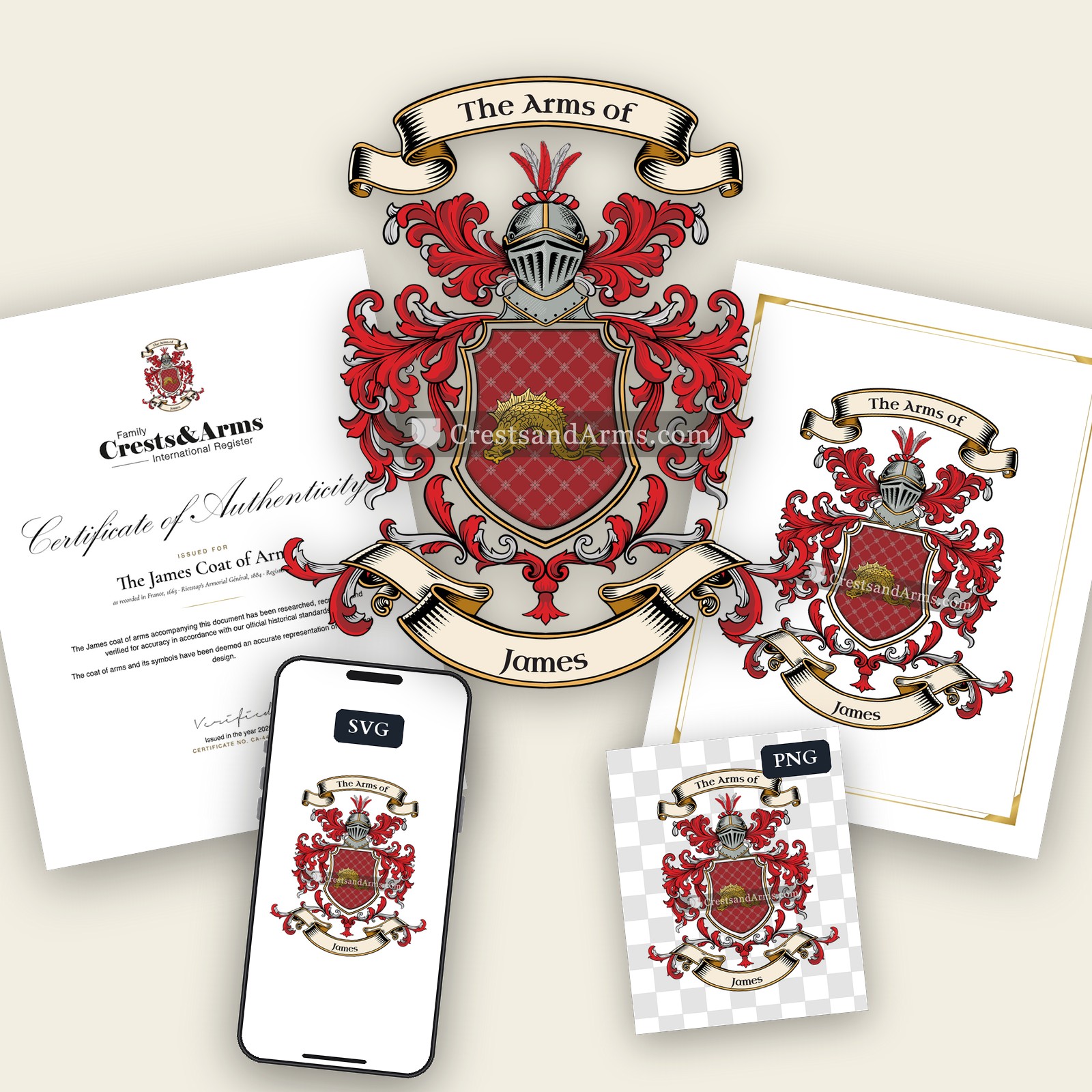
The James arms were recorded in Poitou, c. 1663.
Poitou was western French farming country, divided among a large number of small landed families. Its gentry were numerous and modest, and even a small estate was enough to justify a shield.
This is where the arms were entered in the register. Families often moved to other parts of the country, so the same name can turn up in more than one region.
The body that granted and recorded arms in France in this period.
Louis XIV of France
Sovereign of the period
Louis XIV of France
1643–1715
Reigning in France when the James arms are first recorded.
How Arms Worked in France
In France, a coat of arms was a mark of honor that passed down through the male line to all legitimate descendants. Families often used the same shield without changes to show their shared heritage. If a branch wanted to stand out, they could add a small mark to their shield to show their specific place in the family tree.
Granting authority
The Juge d'armes de France acted as the official authority that regulated and verified coats of arms across the country.
How they got arms
Families typically inherited their arms from ancestors, though they could also receive them through royal grants or by proving their noble status.
Where arms were recorded
Coats of arms were officially recorded in the Armorial Général de France, which began its main collection in the year 1696.
The family's standing
Recorded among the armigerous families of Poitou.
Origin & History of the James Family in France
The family name James traces its roots in France to the ancient province of Poitou, where records confirm the presence of family members as early as 1663. The name itself is a variation of the Hebrew name Jacob, which evolved through the Latin form Iacomus and the Old French form Gemmes or James. In the seventeenth century, families in the Poitou region often lived in rural communities centered around agriculture and local trade. During this period, the region was a hub of religious and social change, which influenced how families moved and recorded their identities in parish registers. By establishing themselves in Poitou, these early ancestors became part of a long tradition of French lineage that eventually spread across Europe and beyond. The persistence of the name in regional documents highlights the family's integration into the local society of western France during a time of significant historical transition.
Coat of Arms & Family Crest Details
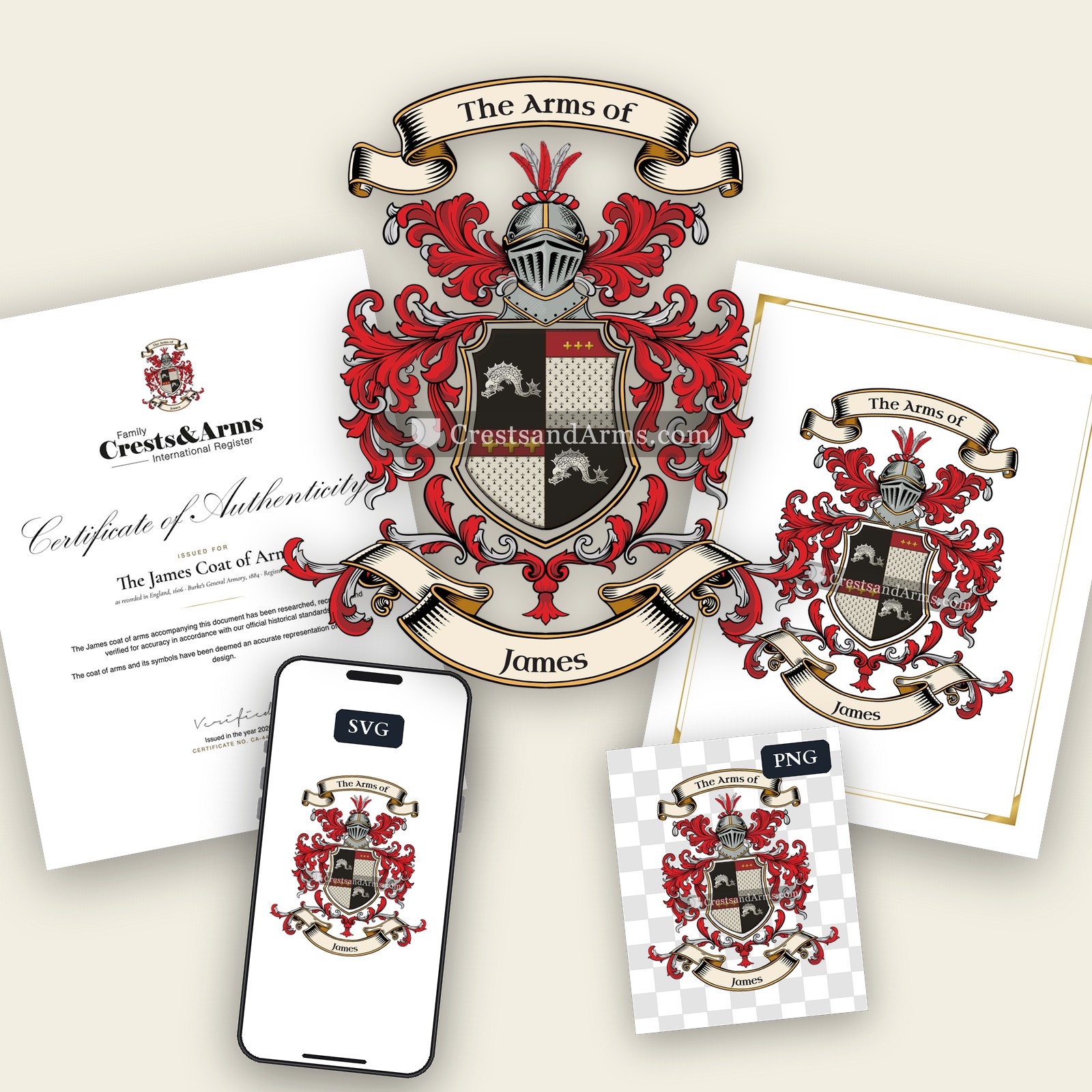
Symbols on this shield
chiefAuthority, wisdom and dominion
cross symbolChristian faith and service
dolphinSwiftness, charity and love
Colours
Black (Sable)Means: Constancy
ErmineMeans: Dignity
Red (Gules)Means: Military strength
Silver (Argent)Means: Peace and sincerity
Gold (Or)Means: Generosity
Historical info
Source
Sir Bernard Burke, The General Armory of England, Scotland, Ireland and Wales, London: Harrison & Sons, 1884
Blazon (the actual original written record)
“Quarterly, 1st and 4th, sa. a dolphin embowed ar.; 2nd and 3rd, erm. on a chief gu. three crosses crosslet or”
DurhamWashington · Durham, c. 1606
Digital archive packCoat of arms PNG, gold border print PDF, vector SVG and the certificate of authenticity. Sent to your email in minutes.
Map of England showing where the James arms are recorded
The James arms were recorded in Durham, c. 1606.
Durham was governed by its bishop rather than the crown for most of its history, with its own courts and its own landed class. That separate world produced a tight group of families, nearly all of whom held arms.
This is where the arms were entered in the register. Families often moved to other parts of the country, so the same name can turn up in more than one region.
The body that granted and recorded arms in England in this period.
James VI and I
Sovereign of the period
James VI and I
1603–1625
Reigning in France when the James arms are first recorded.
How Arms Worked in England
English heraldry allowed arms to be shared by all legitimate descendants of the original owner. These symbols were treated as personal property that moved through the generations to all children. While the eldest son kept the original design, other family members could use the same shield without needing to change it or register their own unique versions.
Granting authority
The College of Arms in London has regulated the use of coats of arms throughout England and Wales since 1484.
How they got arms
Families typically obtained their coats of arms through a formal grant from the Crown or by proving their ancient right to them.
Where arms were recorded
All official coats of arms are recorded in the registers kept at the College of Arms, which date back to the fifteenth century.
The family's standing
Recorded among the armigerous families of Durham.
Origin & History of the James Family in England
The surname James is a patronymic name, which means it originated from the given name of a father or ancestor. It is derived from the Hebrew name Yaakov, which evolved through the Latin form Iacomus and the Old French form James. In England, the name became popular following the Norman Conquest, as it was associated with Saint James the Apostle. By the early 17th century, the family had established a notable presence in the northern region of Durham. Records from 1606 confirm that members of the James family were living and working in this area during the reign of King James I. At that time, families often settled in specific counties for generations, working in local trades or agriculture. This geographical stability helped the name transition from a simple identifier of a father to a permanent family surname that was passed down through the centuries.
Coat of Arms & Family Crest Details
Symbols on this shield
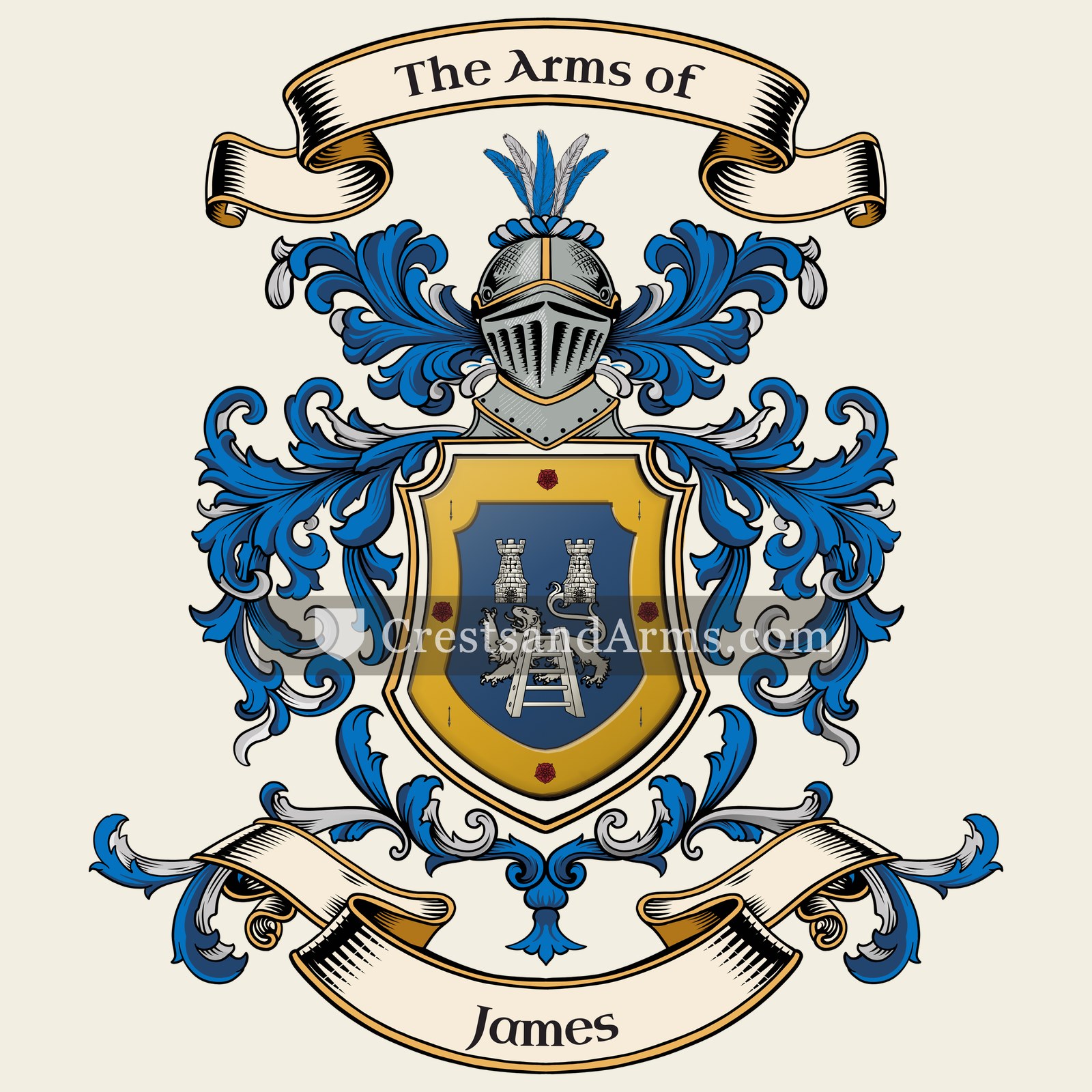
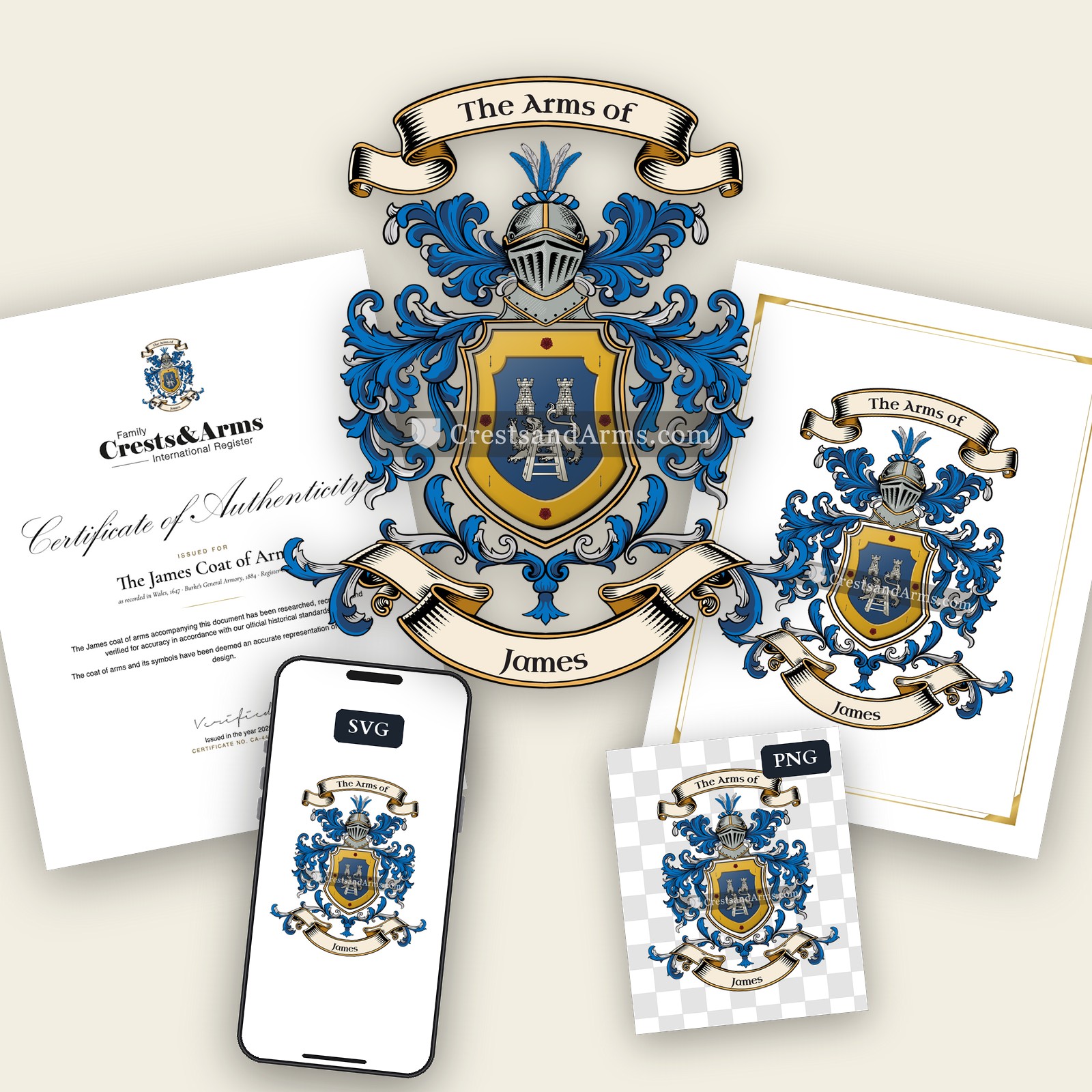
bordureA difference between branches of one family
lionCourage, strength and royalty
towerGrandeur and solidity, and a stronghold defended
ladderAmbition, and a fearless assault
roseThe seventh son, and beauty with grace
lanceKnightly service and the tilt
Colours
Blue (Azure)Means: Loyalty and truth
Gold (Or)Means: Generosity
Silver (Argent)Means: Peace and sincerity
Red (Gules)Means: Military strength
Black (Sable)Means: Constancy
Historical info
Source
Sir Bernard Burke, The General Armory of England, Scotland, Ireland and Wales, London: Harrison & Sons, 1884
Blazon (the actual original written record)
“Az. a lion ramp. betw. two castles triple-towered in chief and a scaling-ladder in base ar. a bordure or, charged with four roses gu. and as many spear heads alternately sa”
RadnorPresteign · Radnor, c. 1647
Digital archive packCoat of arms PNG, gold border print PDF, vector SVG and the certificate of authenticity. Sent to your email in minutes.
Map of Wales showing where the James arms are recorded
The James arms were recorded in Radnor, c. 1647.
Radnorshire was empty mid-Welsh hill country, the least populated county in Wales. Its few landed families held their ground for centuries, and long holding brought arms.
This is where the arms were entered in the register. Families often moved to other parts of the country, so the same name can turn up in more than one region.
The body that granted and recorded arms in Wales in this period.
Charles I of England
Sovereign of the period
Charles I of England
1625–1649
Reigning in France when the James arms are first recorded.
How Arms Worked in Wales
English heraldry allowed arms to be shared by all legitimate descendants of the original owner. These symbols were treated as personal property that moved through the generations to all children. While the eldest son kept the original design, other family members could use the same shield without needing to change it or register their own unique versions.
Granting authority
The College of Arms in London has regulated the use of coats of arms throughout England and Wales since 1484.
How they got arms
Families typically obtained their coats of arms through a formal grant from the Crown or by proving their ancient right to them.
Where arms were recorded
All official coats of arms are recorded in the registers kept at the College of Arms, which date back to the fifteenth century.
The family's standing
Recorded among the armigerous families of Radnor.
Origin & History of the James Family in Wales
The surname James originated as a patronymic, meaning it was derived from the given name of a father or ancestor. In the context of Wales, the name became established as families moved away from the traditional Welsh naming system of using "ap" to denote lineage. By the mid-seventeenth century, the name was well-rooted in the border regions, particularly in the county of Radnor. Records from 1647 confirm that families bearing the name James were active participants in the social and legal life of this area during a time of significant political upheaval in Britain. These early settlers were likely farmers or tradespeople who helped shape the local community. As the name became fixed as a permanent surname, it served as a lasting link to the linguistic and cultural shifts occurring across the Welsh Marches during the seventeenth century.
James Meaning & Related Branches
Root word
Iacobus
Latin form of the Hebrew name Yaakov meaning may God protect.
This name
JamesDerived from the Hebrew name Yaakov, traditionally interpreted as supplanter or holder of the heel.
also spelled
Jame
Jamess
Jamese
Jamieson
Jamison
Related arms
Adamssame arms
Barrowcourtsame arms
Jamevariant spelling
Jamiesonvariant spelling
Documented Sources
J. B. Rietstap, Armorial Général, Gouda: G. B. van Goor Zonen, 1884–87
Archives départementales de la Vienne, Registres paroissiaux et d'état civil de la commune de Poitiers
Dauzat, Albert, Dictionnaire étymologique des noms et prénoms de France, 1951
Morlet, Marie-Thérèse, Dictionnaire étymologique des noms de famille, 1991
Digital archive packCoat of arms PNG, gold border print PDF, vector SVG and the certificate of authenticity. Sent to your email in minutes.


 dolphinSwiftness, charity and love
 dolphinSwiftness, charity and love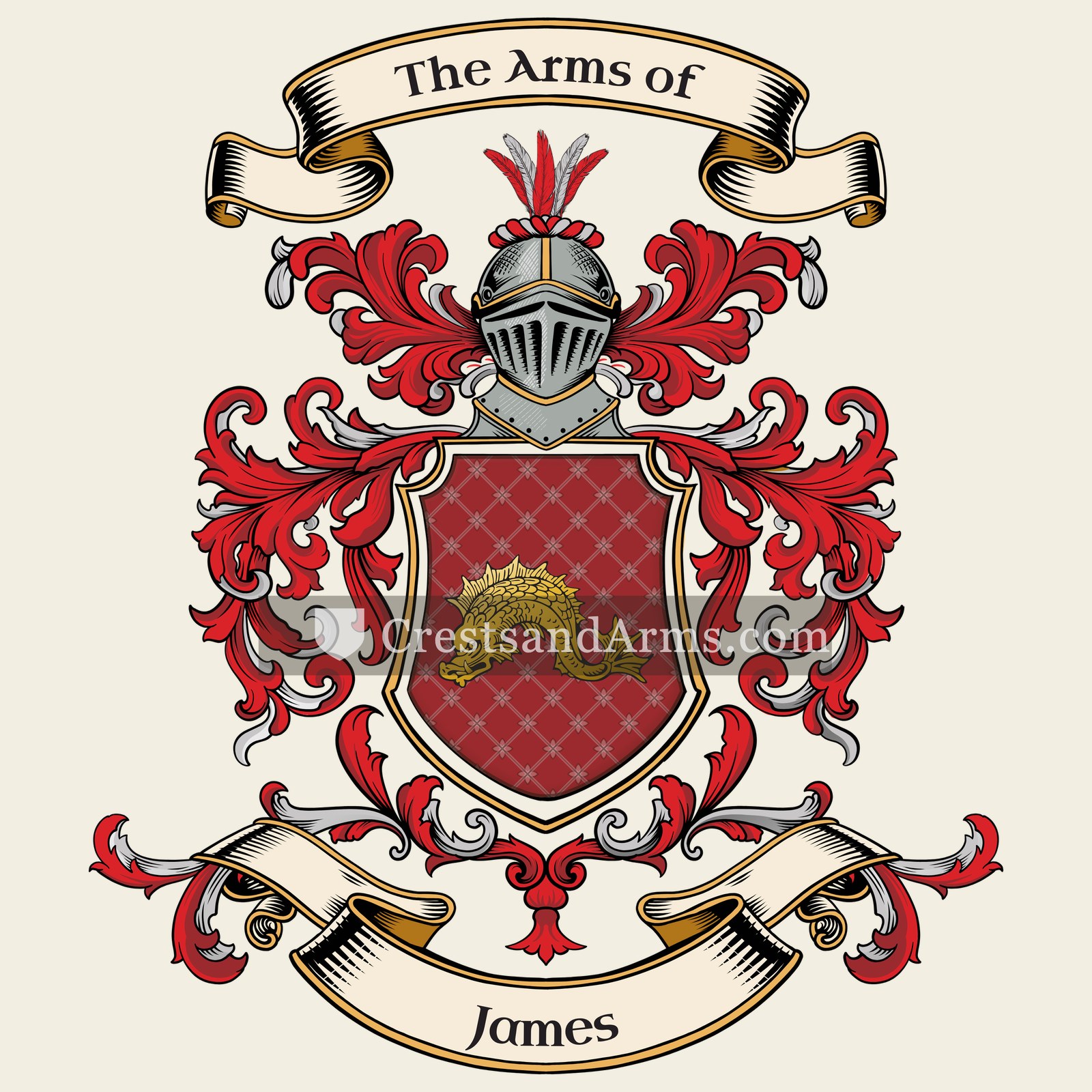


 chiefAuthority, wisdom and dominion
 cross symbolChristian faith and service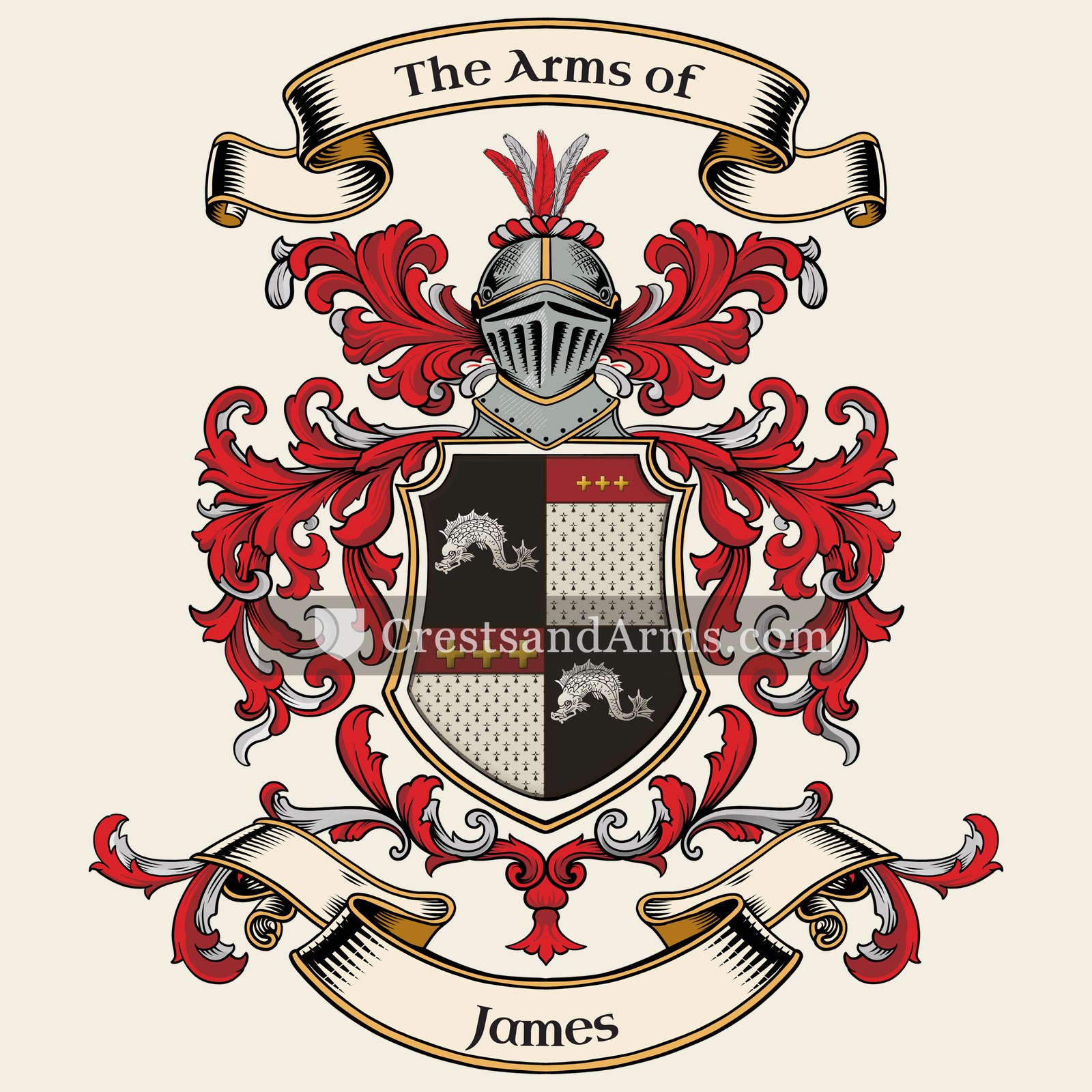


 bordureA difference between branches of one family
 lionCourage, strength and royalty
 towerGrandeur and solidity, and a stronghold defended
 ladderAmbition, and a fearless assault
 roseThe seventh son, and beauty with grace
 lanceKnightly service and the tilt