Map of Germany showing where the Janson arms are recorded
The Janson arms were recorded in Germany, c. 1838.
Arms such as these were typically recorded in Bavaria.
Bavaria was a country of old landed families and walled market towns. Estates passed down the same line for centuries, and both the landowners and the leading townsmen kept arms, which is why so many Bavarian names sit in the registers.
This is where the arms were entered in the register. Families often moved to other parts of the country, so the same name can turn up in more than one region.
The body that granted and recorded arms in Germany in this period.
Frederick William III of Prussia
Sovereign of the period
Frederick William III of Prussia
1797–1840
Reigning in Germany when the Janson arms are first recorded.
How Arms Worked in Germany
Prussian heraldry was strictly tied to social rank and noble status rather than being a free choice for every citizen. These symbols were treated as permanent family property that moved through the generations to all legitimate heirs. If a family branch wanted to change their design to stand out, they had to apply for official permission to alter their specific version of the shield.
Granting authority
The Prussian Heroldsamt acted as the central state office that managed and strictly controlled all noble titles and coats of arms.
How they got arms
Families usually obtained their arms through formal royal grants or by proving their long-standing noble status to the state authorities.
Where arms were recorded
All official coats of arms were kept in the rolls of the Prussian Heroldsamt, which functioned from 1706 until 1918.
The family's standing
Recorded among the armigerous families of Germany.
Origin & History of the Janson Family in Germany
The surname Janson is a patronymic name, which means it was originally created to identify a person as the son of Jan, a common northern variant of the name John. While the name has deep roots across Northern Europe, its presence in the southern German region of Bavaria by 1838 reflects the historical movement of families across the German states. During the early 19th century, Bavaria was undergoing significant social and economic changes following the Napoleonic Wars. Families like the Jansons often lived in agricultural or trade-focused communities where surnames were becoming more standardized for tax and census purposes. By the time records confirm the family in Bavaria in 1838, the name had transitioned from a simple description of ancestry into a permanent family identifier that linked individuals to their local parish and regional government. This period marked a time when many families began to settle more permanently in specific towns, allowing the name to become a recognized part of the local social fabric.
Meaning of the Janson family crest colors & symbols
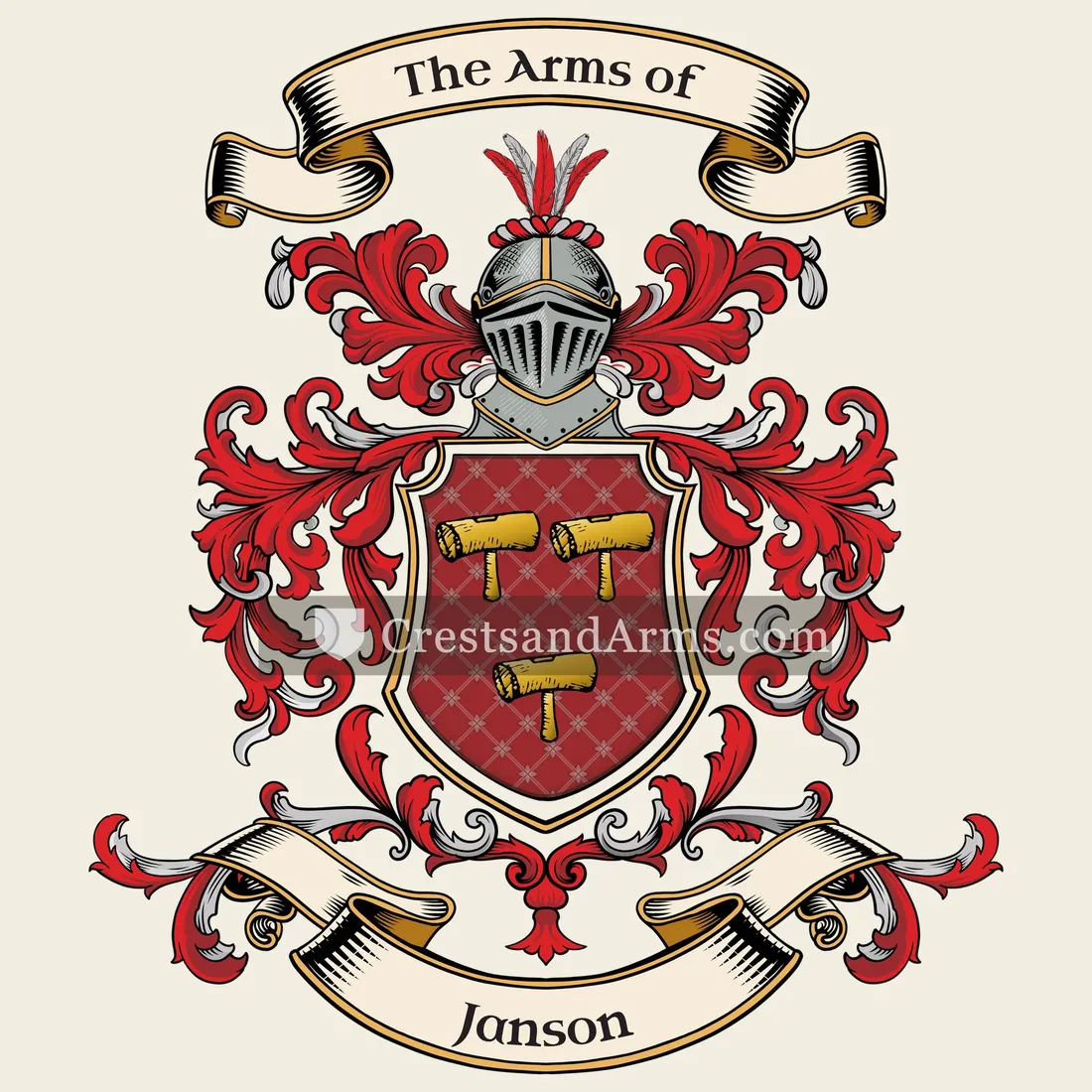
Symbols on this shield
hammerHonest labour, and the smith's craft
Colours
Red (Gules)Means: Military strength
Gold (Or)Means: Generosity
Historical info
Source
J. B. Rietstap, Armorial Général, Gouda: G. B. van Goor Zonen, 1884–87
Blazon (the actual original written record)
“De gu. à trois maillets penchés d'or.”
Netherlandsc. 1815
Digital archive packCoat of arms PNG, gold border print PDF, vector SVG and the certificate of authenticity. Sent to your email in minutes.
Map of Netherlands showing where the Janson arms are recorded
The Janson arms were recorded in Netherlands, c. 1815.
Arms such as these were typically recorded in Friesland.
Friesland was low, wet country on the northern coast of the Netherlands, farmed by families who had held the same land for centuries. Free landholders were unusually common there, and a free landholder could carry arms.
This is where the arms were entered in the register. Families often moved to other parts of the country, so the same name can turn up in more than one region.
Region
Friesland
First recorded
1815
Granting Authority for the Janson Arms
Hoge Raad van Adel
Photograph made by me · CC BY-SA 3.0
The body that granted and recorded arms in Netherlands in this period.
William I of the Netherlands
Sovereign of the period
William I of the Netherlands
1815–1840
Reigning in Germany when the Janson arms are first recorded.
How Arms Worked in Netherlands
In the Netherlands, coats of arms were often used by noble families and those who held specific public offices. These arms were passed down through the generations to legitimate descendants. Younger branches of a family usually kept the original design without needing to add special marks. This system ensured that the family identity remained clear and consistent over many years.
Granting authority
The Hoge Raad van Adel is the official body that regulates and manages noble titles and coats of arms in the Netherlands.
How they got arms
Families typically obtained their coats of arms through official royal grants or by proving their long-standing historical use of the symbols.
Where arms were recorded
Coats of arms are officially recorded in the registers held by the Hoge Raad van Adel, which began its work in 1814.
The family's standing
Recorded among the armigerous families of Netherlands.
Origin & History of the Janson Family in Netherlands
The surname Janson is a patronymic name, which means it was originally created to identify a person as the son of Jan. In the Netherlands, this naming tradition became common as families sought to distinguish themselves within their local communities. By the early 19th century, the name was firmly established in the northern province of Friesland. During this period, the Dutch government began to formalize civil registration, requiring families to adopt fixed surnames for official record-keeping. Because Friesland had a unique cultural and linguistic history compared to the rest of the country, families there often maintained strong ties to their local regions while adapting to these new national naming laws. The presence of the Janson name in 1815 suggests that the family was already well-integrated into the social fabric of the Frisian countryside during a time of significant administrative change in the Netherlands.
Meaning of the Janson family crest colors & symbols
Symbols on this shield
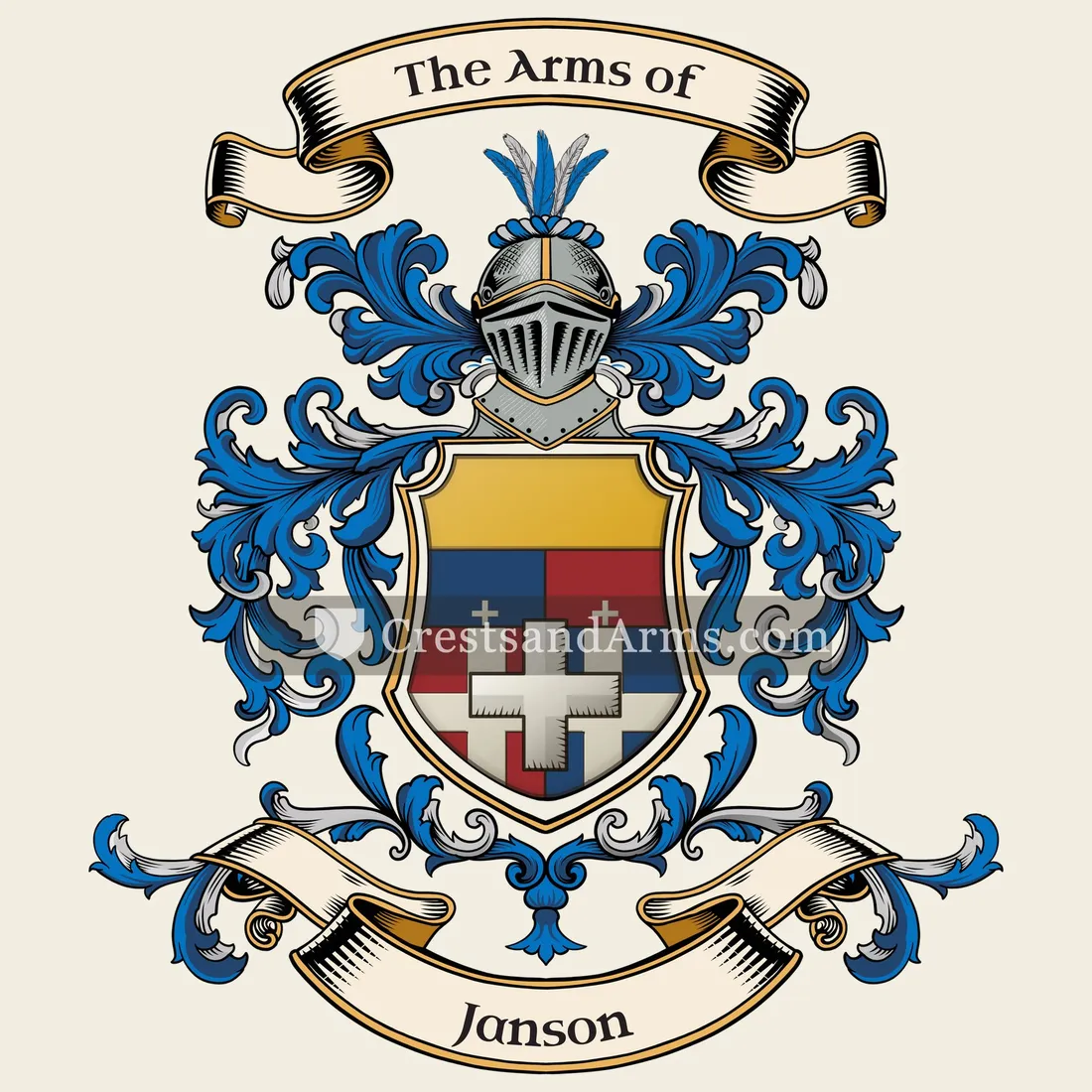
cross symbolChristian faith and service
chiefAuthority, wisdom and dominion
Colours
Blue (Azure)Means: Loyalty and truth
Red (Gules)Means: Military strength
Gold (Or)Means: Generosity
Silver (Argent)Means: Peace and sincerity
Historical info
Source
Sir Bernard Burke, The General Armory of England, Scotland, Ireland and Wales, London: Harrison & Sons, 1884
Blazon (the actual original written record)
“Quarterly, az. and gu. a cross patonce and a chief or”
KentKent, c. 1605
Digital archive packCoat of arms PNG, gold border print PDF, vector SVG and the certificate of authenticity. Sent to your email in minutes.
Map of England showing where the Janson arms are recorded
The Janson arms were recorded in Kent, c. 1605.
Kent sits between London and the short crossing to Europe, and the trade passing through made it wealthy. Merchant families bought land with that money, and it was landowners who took coats of arms.
This is where the arms were entered in the register. Families often moved to other parts of the country, so the same name can turn up in more than one region.
The body that granted and recorded arms in England in this period.
James VI and I
Sovereign of the period
James VI and I
1603–1625
Reigning in Germany when the Janson arms are first recorded.
How Arms Worked in England
English heraldry allowed arms to be shared by all legitimate descendants of the original owner. These symbols were treated as personal property that moved through the generations to all children. While the eldest son kept the original design, other family members could use the same shield without needing to change it or register their own unique versions.
Granting authority
The College of Arms in London has regulated the use of coats of arms throughout England and Wales since 1484.
How they got arms
Families typically obtained their coats of arms through a formal grant from the Crown or by proving their ancient right to them.
Where arms were recorded
All official coats of arms are recorded in the registers kept at the College of Arms, which date back to the fifteenth century.
The family's standing
Recorded among the armigerous families of Kent.
Origin & History of the Janson Family in England
The surname Janson is a patronymic name, which means it originated as a way to identify a person as the son of Jan or John. While the name has roots across Northern Europe, its presence in England became more established during the early seventeenth century. Records confirm that members of the Janson family were living in the county of Kent by 1605. During this period, Kent served as a vital gateway for trade and migration between England and the continent. Families like the Jansons often arrived in these coastal regions due to shifting economic opportunities or religious movements occurring in the Low Countries. As these settlers integrated into English society, the spelling of the name often stabilized, helping the family establish deep roots in local parishes and agricultural communities throughout the region.
Janson Meaning & Related Branches
Root word
Johannes
God is gracious
This name
JansonA patronymic surname meaning son of Jan or son of John.
also spelled
Jansson
Jansonn
Jansone
Jansonne
Jansen
Related arms
I'Ansonsame arms
Jansenvariant spelling
Janssenvariant spelling
Ashleyrecorded with Janson, same area
Documented Sources
J. B. Rietstap, Armorial Général, Gouda: G. B. van Goor Zonen, 1884–87
Bahlow, Hans, Deutsches Namenlexikon: Familien- und Vornamen nach Ursprung und Sinn erklärt, 1967
Bayerisches Hauptstaatsarchiv, Regierungsakten der Kreise, 1838
Gottschald, Max, Deutsche Namenkunde: Unsere Familiennamen, 1954
Digital archive packCoat of arms PNG, gold border print PDF, vector SVG and the certificate of authenticity. Sent to your email in minutes.


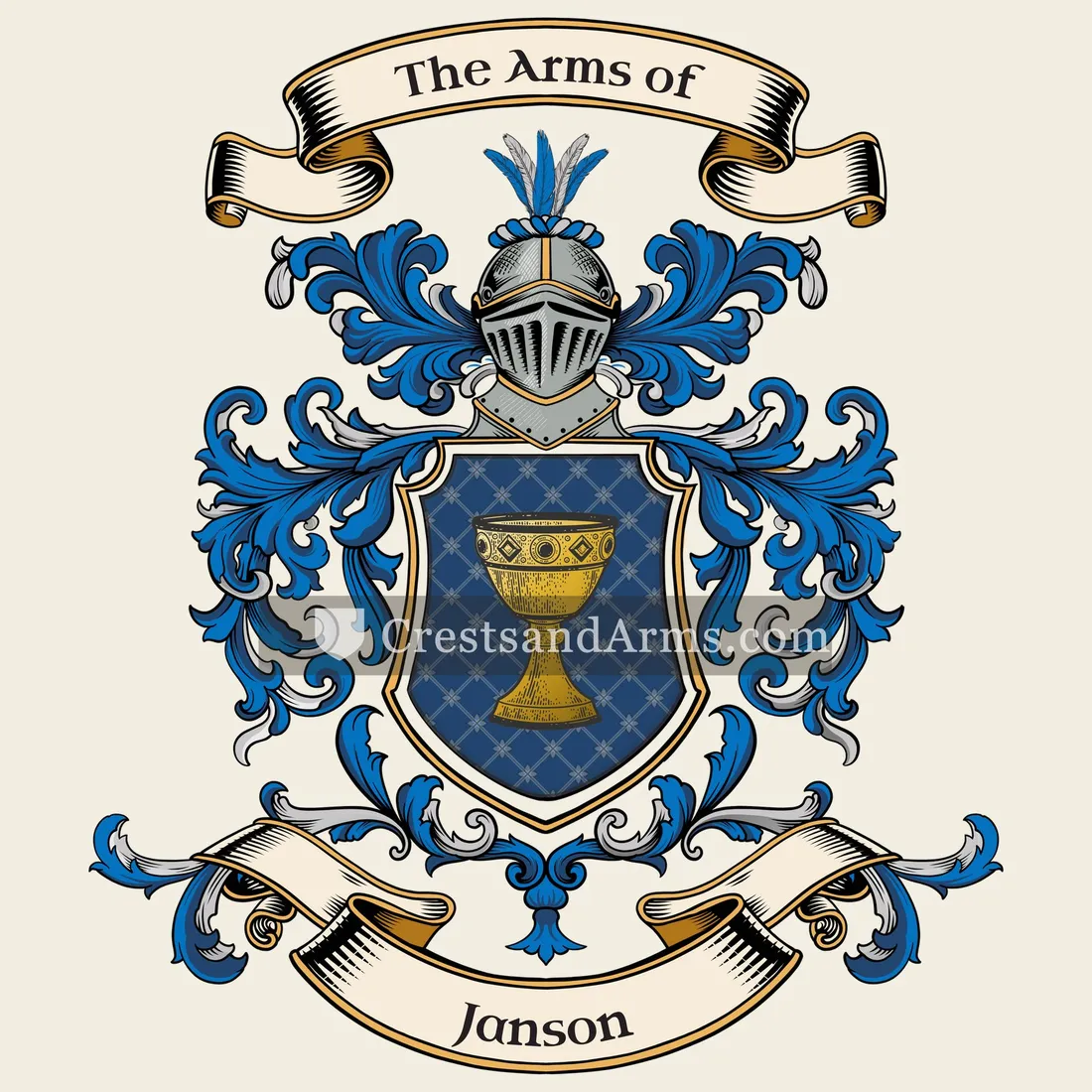
 cupFaith, office, and a trust discharged
 cupFaith, office, and a trust discharged


 hammerHonest labour, and the smith's craft


 cross symbolChristian faith and service
 chiefAuthority, wisdom and dominion