Map of Belgium showing where the Japp arms are recorded
The Japp arms were recorded in Belgium, c. 1737.
Arms such as these were typically recorded in Brabant.
Brabant lay at the heart of the Low Countries, where the trade routes met. Its towns were wealthy and its landowners many, and both kinds of family kept arms, which is why the region is so heavily represented.
This is where the arms were entered in the register. Families often moved to other parts of the country, so the same name can turn up in more than one region.
The body that granted and recorded arms in Belgium in this period.
Charles VI, Holy Roman Emperor
Sovereign of the period
Charles VI, Holy Roman Emperor
1711–1740
Reigning in Belgium when the Japp arms are first recorded.
How Arms Worked in Belgium
In Belgium, a coat of arms is considered personal property that is passed down through the male line to legitimate descendants. Families often use the same shield design across generations to show their shared heritage. If a branch of the family wants to change the design, they must apply for an official update to their specific version of the arms.
Granting authority
The Conseil héraldique is the official body that regulates and approves all coats of arms in Belgium.
How they got arms
Families obtain their coats of arms through formal royal grants or by confirming their historical right to use existing designs.
Where arms were recorded
All approved coats of arms are officially recorded in the public registers of the Conseil héraldique since 1844.
The family's standing
Recorded among the armigerous families of Belgium.
Origin & History of the Japp Family in Belgium
The family name Japp has roots that trace back to the historic Duchy of Brabant, a region that spans parts of modern-day Belgium. By 1737, records confirm that members of the family were already established within this area, which was then under the control of the Austrian Habsburgs. During this period, Brabant was a bustling center of trade and agriculture, and families like the Japps often lived in rural or semi-urban communities where they were likely involved in local commerce or skilled labor. The name itself is believed to be a variation of older Germanic or Dutch naming traditions, often serving as a short form for names like Jacob. As the family navigated the social and economic shifts of the eighteenth century, they became part of the long-standing cultural fabric of the Low Countries. Their presence in the region during this time highlights how families often remained rooted in specific provinces for generations, contributing to the local history of the Belgian landscape long before the country became an independent nation.
Meaning of the Japp family crest colors & symbols
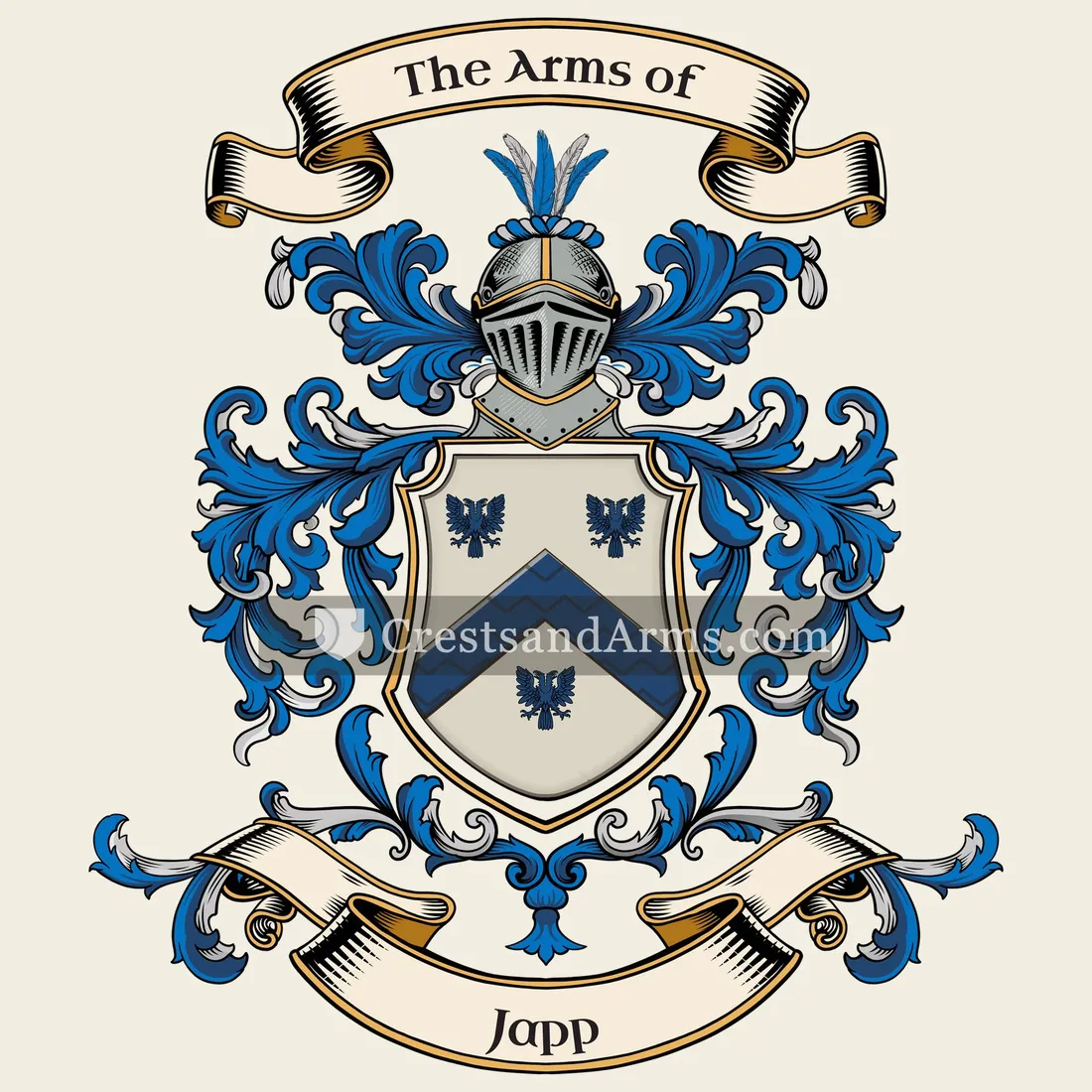
Symbols on this shield
chevronProtection, and faithful service completed
eagleNobility, strength and a keen mind
Colours
Silver (Argent)Means: Peace and sincerity
Blue (Azure)Means: Loyalty and truth
Historical info
Source
Sir Bernard Burke, The General Armory of England, Scotland, Ireland and Wales, London: Harrison & Sons, 1884
Blazon (the actual original written record)
“Ar. a chev. betw. three eagles' heads erased az”
Englandc. 1620
Digital archive packCoat of arms PNG, gold border print PDF, vector SVG and the certificate of authenticity. Sent to your email in minutes.
Map of England showing where the Japp arms are recorded
The Japp arms were recorded in England, c. 1620.
Arms such as these were typically recorded in York.
Yorkshire is the largest of the English counties, and it held more gentry families than any other. Land there was split among a great many households rather than a few, so a great many of them carried arms.
This is where the arms were entered in the register. Families often moved to other parts of the country, so the same name can turn up in more than one region.
The body that granted and recorded arms in England in this period.
James VI and I
Sovereign of the period
James VI and I
1603–1625
Reigning in Belgium when the Japp arms are first recorded.
How Arms Worked in England
English heraldry allowed arms to be shared by all legitimate descendants of the original owner. These symbols were treated as personal property that moved through the generations to all children. While the eldest son kept the original design, other family members could use the same shield without needing to change it or register their own unique versions.
Granting authority
The College of Arms in London has regulated the use of coats of arms throughout England and Wales since 1484.
How they got arms
Families typically obtained their coats of arms through a formal grant from the Crown or by proving their ancient right to them.
Where arms were recorded
All official coats of arms are recorded in the registers kept at the College of Arms, which date back to the fifteenth century.
The family's standing
Recorded among the armigerous families of England.
Origin & History of the Japp Family in England
The family name Japp has roots that stretch back to the northern regions of England, with a documented presence in the historic city of York by the year 1620. During the seventeenth century, York was a bustling center of trade and religious activity, providing a stable environment for families to establish their lives and livelihoods. The name itself is often classified as a patronymic or a nickname, likely evolving from regional dialects or shortened versions of older given names common in the area. As the family settled into the local community, they participated in the typical life of a provincial English city, navigating the economic shifts and social changes of the Stuart era. By remaining in the north, the early members of the Japp family contributed to the long-standing demographic history of Yorkshire, leaving behind a legacy that is tied to the development of the region.
Japp Meaning & Related Branches
Root word
Jacobus
Latin form of the Hebrew name meaning supplanter or holder of heel.
This name
JappA diminutive or patronymic form derived from the personal name Jacob.
also spelled
Juppe
Jupph
Juppp
Juppee
Jup
Documented Sources
J. B. Rietstap, Armorial Général, Gouda: G. B. van Goor Zonen, 1884–87
State Archives in Belgium (Rijksarchief), Parochieregisters: Brabant
State Archives in Belgium (Rijksarchief), Registers van de Burgerlijke Stand
Debrabandere, Frans, Woordenboek van de familienamen in België en Noord-Frankrijk, 2003
Leys, O., De familienamen in de Brabantse steden, 1974
Digital archive packCoat of arms PNG, gold border print PDF, vector SVG and the certificate of authenticity. Sent to your email in minutes.


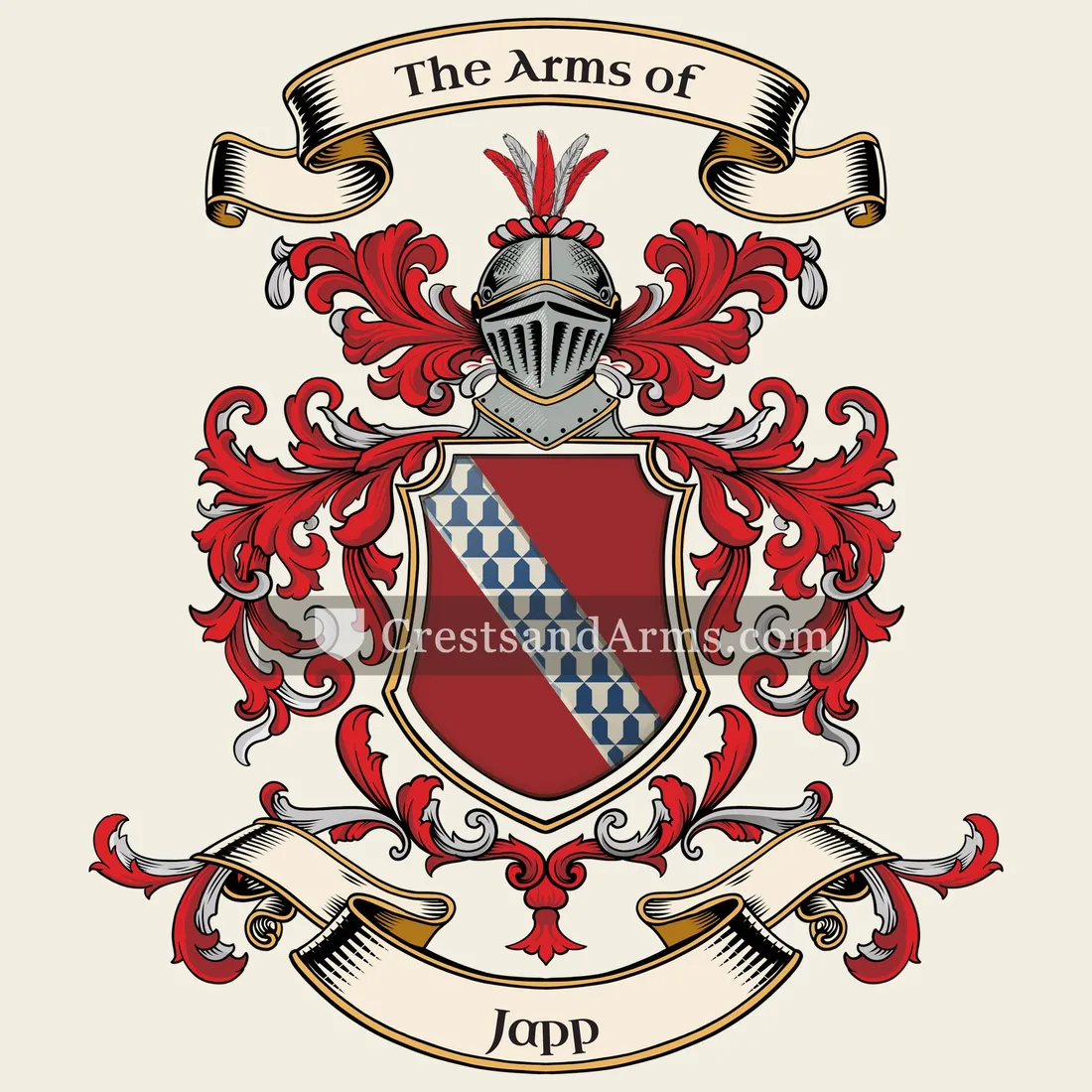
 bendDefence, and the scarf of a commander
 bendDefence, and the scarf of a commander


 chevronProtection, and faithful service completed
 eagleNobility, strength and a keen mind