Map of Italy showing where the Jara arms are recorded
The Jara arms were recorded in Verone, c. 1775.
This is where the arms were entered in the register. Families often moved to other parts of the country, so the same name can turn up in more than one region.
The body that granted and recorded arms in Italy in this period.
Alvise Giovanni Mocenigo
Sovereign of the period
Alvise Giovanni Mocenigo
1763–1778
Reigning in Italy when the Jara arms are first recorded.
How Arms Worked in Italy
In the Italian states, coats of arms were often used by noble families to show their status and history. These symbols were passed down through the generations to all legitimate male descendants. Younger branches of a family usually kept the original design but sometimes added small changes to distinguish their specific line from the main branch.
Granting authority
Various local rulers and city governments controlled the use of coats of arms across the different Italian states.
How they got arms
Families often assumed their own arms or received them as official grants from local lords, popes, or city councils.
Where arms were recorded
Arms were recorded in local city archives or private family books rather than in one single national register.
The family's standing
Recorded among the armigerous families of Italy.
Origin & History of the Jara Family in Italy
The surname Jara has deep roots in the Iberian Peninsula, where it is often associated with the Spanish word for the rockrose shrub. This plant is common in the rocky landscapes of Spain, suggesting that early ancestors may have lived near these distinctive bushes or in areas where they grew in abundance. By the year 1775, records confirm that members of the family were established in the region of Verone. During this period, families often moved across borders to seek new opportunities in agriculture or trade. The presence of the Jara family in Verone highlights their role as part of the broader migration patterns that shaped European communities in the eighteenth century. As they settled into this area, they integrated into the local social structure and contributed to the development of the region through their daily labor and community involvement.
Jara Meaning & Related Branches
Root word
Gara
A term referring to a rocky or stony place.
This name
JaraDerived from a topographic location indicating someone who lived near rocky terrain.
also spelled
Giarra
Jara
Jiarah
Documented Sources
J. B. Rietstap, Armorial Général, Gouda: G. B. van Goor Zonen, 1884–87
Moll, Francesc de Borja. Els llinatges catalans: Catalunya, País Valencià, Illes Balears. 1959
Albaigès i Olivart, Josep Maria. El gran libro de los apellidos. 2009
Archivo Histórico Nacional. Sección Nobleza, Protocolos Notariales de Verone. 1775
Digital archive packCoat of arms PNG, gold border print PDF, vector SVG and the certificate of authenticity. Sent to your email in minutes.


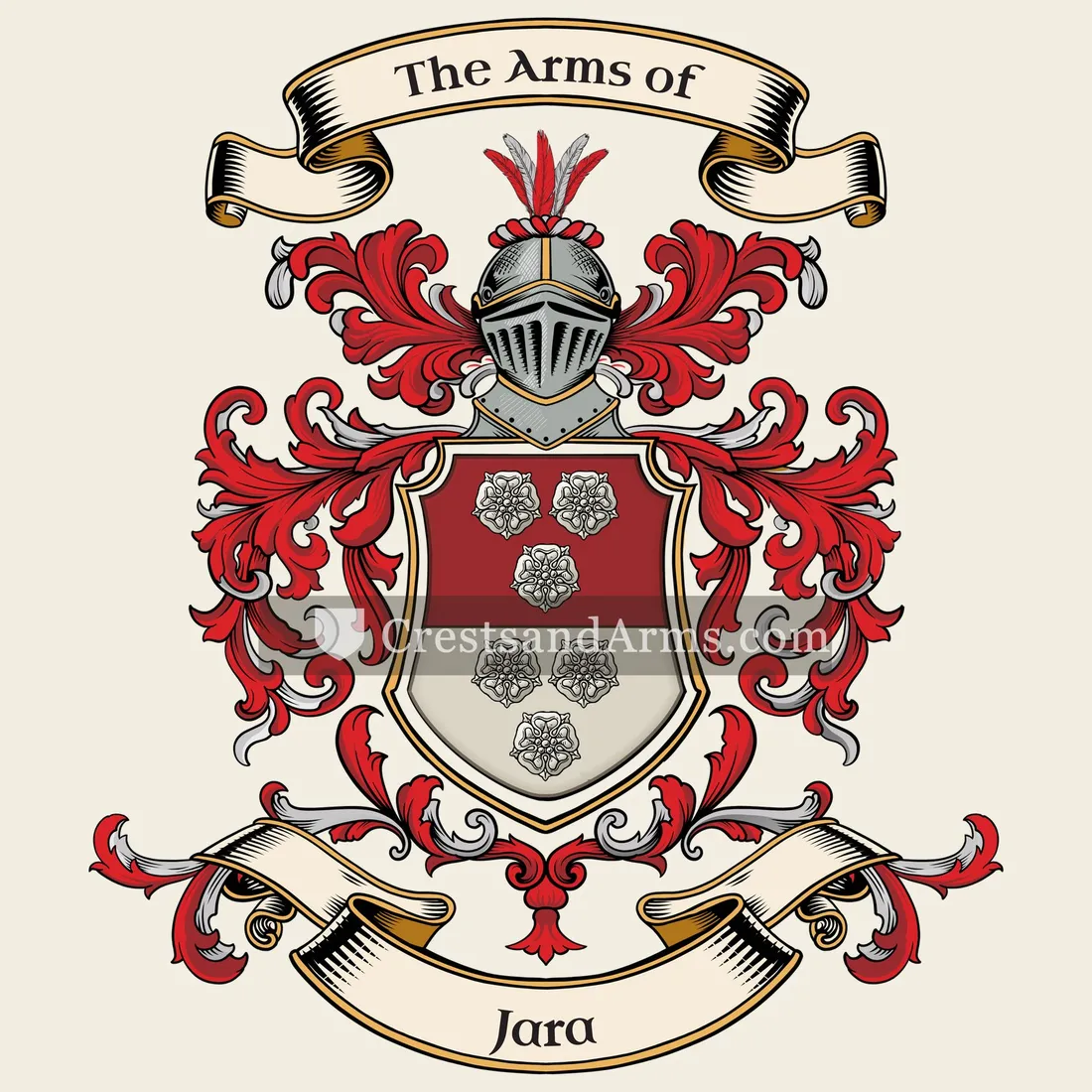
 roseThe seventh son, and beauty with grace
 roseThe seventh son, and beauty with grace