Map of France showing where the Jardine arms are recorded
The Jardine arms were recorded in Provence, c. 1663.
Provence was old country, with towns dating to the Romans and families who traced their land back nearly as far. Its gentry were many and long-settled, and long settlement is what fills a register.
This is where the arms were entered in the register. Families often moved to other parts of the country, so the same name can turn up in more than one region.
The body that granted and recorded arms in France in this period.
Louis XIV of France
Sovereign of the period
Louis XIV of France
1643–1715
Reigning in France when the Jardine arms are first recorded.
How Arms Worked in France
In France, a coat of arms was a mark of honor that passed down through the male line to all legitimate descendants. Families often used the same shield without changes to show their shared heritage. If a branch wanted to stand out, they could add a small mark to their shield to show their specific place in the family tree.
Granting authority
The Juge d'armes de France acted as the official authority that regulated and verified coats of arms across the country.
How they got arms
Families typically inherited their arms from ancestors, though they could also receive them through royal grants or by proving their noble status.
Where arms were recorded
Coats of arms were officially recorded in the Armorial Général de France, which began its main collection in the year 1696.
The family's standing
Recorded among the armigerous families of Provence.
Origin & History of the Jardine Family in France
The family name Jardine finds its historical roots in the lush landscapes of southern France, where the name evolved from the Old French word *jardin*, meaning garden. By the year 1663, records confirm that members of the family were firmly established in the Provence region. During this era, the name likely served as a topographical identifier for those who lived near or tended to the formal gardens and orchards that defined the local estates. As the family grew, their presence in Provence became intertwined with the agricultural and social life of the Mediterranean countryside. This connection to the land suggests that the early Jardines were often involved in the cultivation of the region’s famous vineyards and olive groves. Over time, the name transitioned from a simple description of a person’s surroundings into a formal surname that traveled across borders as family members moved beyond their ancestral home.
Coat of Arms & Family Crest Details
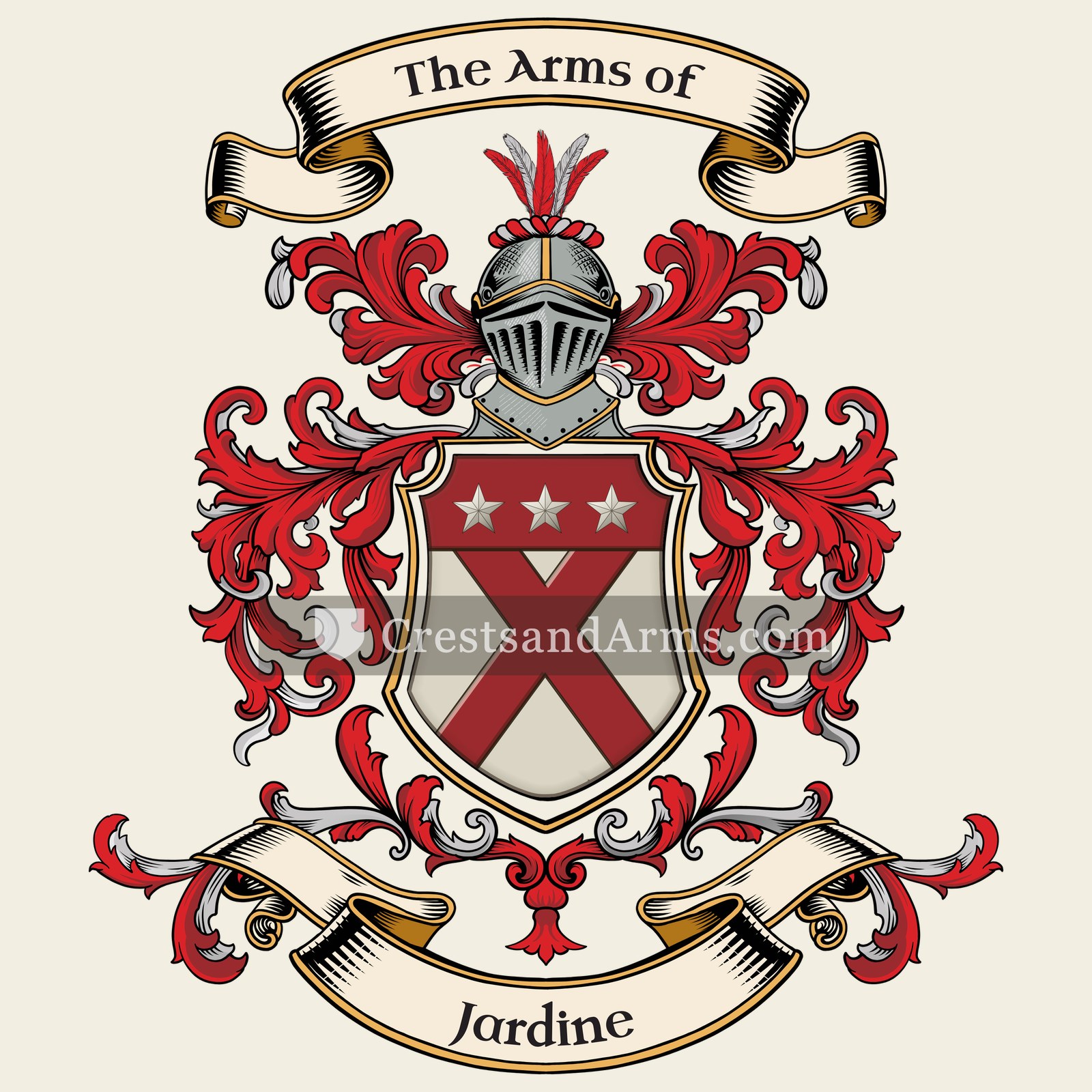
Symbols on this shield
saltireResolution, and St Andrew's cross
chiefAuthority, wisdom and dominion
mulletThe third son, and a divine quality from above
Colours
Silver (Argent)Means: Peace and sincerity
Red (Gules)Means: Military strength
Historical info
Source
Sir Bernard Burke, The General Armory of England, Scotland, Ireland and Wales, London: Harrison & Sons, 1884
Blazon (the actual original written record)
“Ar. a saltire and chief gu. the last charged with three mullets of the field”
DumfriesApplegirth · Dumfries, c. 1672
Digital archive packCoat of arms PNG, gold border print PDF, vector SVG and the certificate of authenticity. Sent to your email in minutes.
Map of Scotland showing where the Jardine arms are recorded
The Jardine arms were recorded in Dumfries, c. 1672.
Dumfriesshire was Scottish border country facing England across a disputed line. Families held their land in return for defending it, and a defending household carried a shield.
This is where the arms were entered in the register. Families often moved to other parts of the country, so the same name can turn up in more than one region.
The body that granted and recorded arms in Scotland in this period.
Charles II of England
Sovereign of the period
Charles II of England
1660–1685
Reigning in France when the Jardine arms are first recorded.
How Arms Worked in Scotland
Scottish heraldry is unique because it treats a coat of arms as a piece of personal property protected by law. Only one person can own a specific design at any given time. When a family grows, the head keeps the original shield while other relatives must apply for their own distinct version with slight changes to prove their specific identity.
Granting authority
The Court of the Lord Lyon acts as the official body that regulates and controls all heraldic matters throughout Scotland.
How they got arms
Individuals obtain a legal right to their arms through a formal petition process that confirms their identity and family connection.
Where arms were recorded
All valid coats of arms are officially entered into the Public Register of All Arms and Bearings starting from 1672.
The family's standing
Recorded among the armigerous families of Dumfries.
Origin & History of the Jardine Family in Scotland
The Jardine family name has deep roots in the rugged landscape of the Scottish Borders, particularly within the region of Dumfriesshire. By the late 17th century, the family was well-established in Dumfries, where they played an active role in the local community and legal life. The name itself is thought to have originated from the French word jardin, which means garden. It is likely that the first people to carry the name were gardeners or caretakers for the estates of powerful noble families during the medieval period. As the family grew in prominence, they became deeply connected to the turbulent history of the borderlands, often navigating the complex political shifts between Scotland and England. Their presence in 1672 marks a time when the family had already transitioned from their early roots into a respected lineage that contributed to the development of the Dumfries area for generations.
Jardine Meaning & Related Branches
Root word
jardin
A piece of enclosed ground used for cultivation.
This name
JardineAn occupational surname for a gardener or someone who lived near a garden.
also spelled
Jardin
Jardinn
Jardinee
Jardyn
Jarden
Related arms
Jardenvariant spelling
Documented Sources
J. B. Rietstap, Armorial Général, Gouda: G. B. van Goor Zonen, 1884–87
Archives départementales des Bouches-du-Rhône, Registres paroissiaux et d'état civil
Archives départementales du Vaucluse, Série E, État civil et registres paroissiaux
Dauzat, Albert, Dictionnaire étymologique des noms de famille et prénoms de France, 1951
Morlet, Marie-Thérèse, Dictionnaire étymologique des noms de famille, 1991
Digital archive packCoat of arms PNG, gold border print PDF, vector SVG and the certificate of authenticity. Sent to your email in minutes.





 saltireResolution, and St Andrew's cross
 chiefAuthority, wisdom and dominion
 mulletThe third son, and a divine quality from above