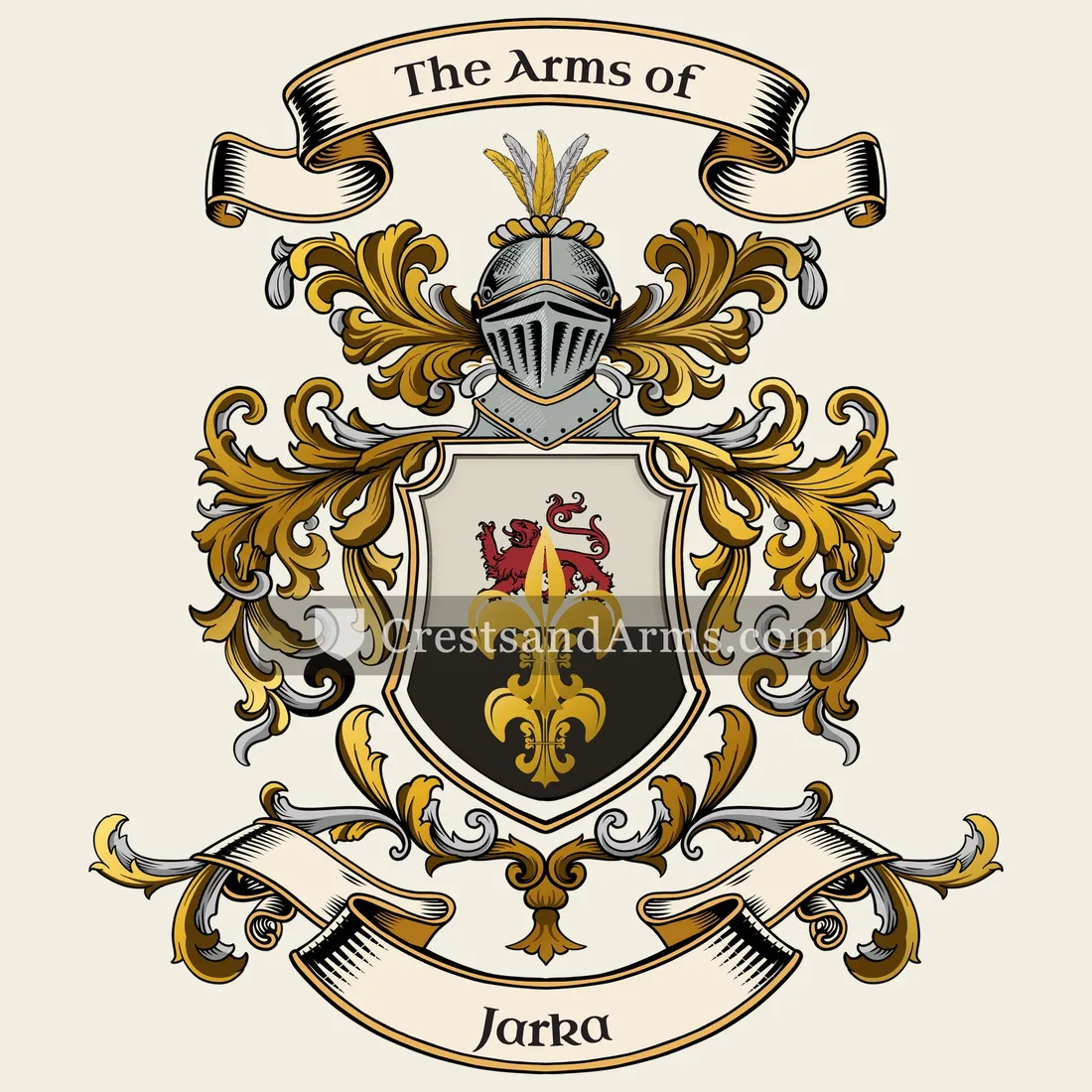
A record of documented arms, meaning and origin, researched for the Jarka family of Germany.
Reg. 5605 · German, J–L
Meaning of the Jarka family crest colors & symbols
Symbols on this shield
fleur de lisPurity, light, and the sixth son
lionCourage, strength and royalty
Colours
Silver (Argent)Means: Peace and sincerity
Black (Sable)Means: Constancy
Gold (Or)Means: Generosity
Red (Gules)Means: Military strength
Historical info
Source
J. B. Rietstap, Armorial Général, Gouda: G. B. van Goor Zonen, 1884–87
Blazon (the actual original written record)
“Coupé: au 1 parti: a. d'arg. au lion de gu.; b. de sa. à une fleur-de-lis d'or; au 2 de gu. a une fleur-de-lis d'or. C.: à dextre une demi-fleur-de-lis d'or, défaillante à sen.; et à sen. un demi-vol de sa. L.: à dextre d'arg. et de gu., à sen. d'or et de sa.”
PomeraniaPomerania, c. 1765
Digital archive packCoat of arms PNG, gold border print PDF, vector SVG and the certificate of authenticity. Sent to your email in minutes.
Map of Germany showing where the Jarka arms are recorded
The Jarka arms were recorded in Pomerania, c. 1765.
Pomerania was flat farming country on the Baltic coast, held in large estates by a small number of families. They kept their land for generations, and generations of landholding is what fills the registers.
This is where the arms were entered in the register. Families often moved to other parts of the country, so the same name can turn up in more than one region.
The body that granted and recorded arms in Germany in this period.
Francis I, Holy Roman Emperor
Sovereign of the period
Francis I, Holy Roman Emperor
1745–1765
Reigning in Germany when the Jarka arms are first recorded.
How Arms Worked in Germany
In the Holy Roman Empire, coats of arms were often granted to individuals by the Emperor or his representatives. These arms were then passed down through the generations to all legitimate descendants of the original holder. Younger branches of a family usually kept the same shield design without needing to change it, as the arms belonged to the entire lineage.
Granting authority
The Holy Roman Emperor held the sole power to grant new coats of arms throughout his vast imperial territories.
How they got arms
Families typically obtained their coats of arms through a formal imperial grant or by proving their noble status to the authorities.
Where arms were recorded
These grants were officially recorded in the Imperial Chancery registers, which began keeping formal records of such honors during the Middle Ages.
The family's standing
Recorded among the armigerous families of Pomerania.
Origin & History of the Jarka Family in Germany
The surname Jarka finds its historical roots among the Slavic populations of Central Europe, specifically within the region of Pomerania. By the mid-eighteenth century, records confirm that families bearing this name were established in the area, likely working as farmers or tradespeople in the rural landscape. The name itself is thought to be a diminutive form of names starting with the Slavic root "Jar," which is associated with the concept of spring or youthful vigor. During the 1765 period, these families were part of a complex social structure in the Prussian-controlled territories where they maintained local traditions while adapting to the administrative changes of the time. As the family grew, they became deeply integrated into the agricultural life of the Pomeranian plains, contributing to the local community through generations of steady labor and regional migration.
Jarka Meaning & Related Branches
Root word
Jaroslav
Derived from Slavic elements meaning fierce or strong and glory.
This name
JarkaA diminutive form originating from Slavic regions, often associated with strength, spring, or glory.
also spelled
Jareck
Jareke
Jarekk
Yarek
Documented Sources
J. B. Rietstap, Armorial Général, Gouda: G. B. van Goor Zonen, 1884–87
Geheimes Staatsarchiv Preußischer Kulturbesitz, II. Hauptabteilung General-Direktorium, Ostpreußische Folianten
Archiwum Państwowe w Szczecinie, Akta miasta Szczecina
Brückner, Alexander, Słownik etymologiczny języka polskiego, 1927
Heintze, Albert, Die deutschen Familiennamen: geschichtlich, geographisch, sprachlich, 1903
Digital archive packCoat of arms PNG, gold border print PDF, vector SVG and the certificate of authenticity. Sent to your email in minutes.


 fleur de lisPurity, light, and the sixth son
 lionCourage, strength and royalty
 fleur de lisPurity, light, and the sixth son
 lionCourage, strength and royalty