Map of England showing where the Jarrard arms are recorded
The Jarrard arms were recorded in Lancaster, c. 1567.
Lancashire was divided among a great many small landed families, more than most northern counties. Estates were passed down whole rather than split up, so the same names hold the same ground for centuries in the records.
This is where the arms were entered in the register. Families often moved to other parts of the country, so the same name can turn up in more than one region.
The body that granted and recorded arms in England in this period.
Elizabeth I of England
Sovereign of the period
Elizabeth I of England
1558–1603
Reigning in England when the Jarrard arms are first recorded.
How Arms Worked in England
English heraldry allowed arms to be shared by all legitimate descendants of the original owner. These symbols were treated as personal property that moved through the generations to all children. While the eldest son kept the original design, other family members could use the same shield without needing to change it or register their own unique versions.
Granting authority
The College of Arms in London has regulated the use of coats of arms throughout England and Wales since 1484.
How they got arms
Families typically obtained their coats of arms through a formal grant from the Crown or by proving their ancient right to them.
Where arms were recorded
All official coats of arms are recorded in the registers kept at the College of Arms, which date back to the fifteenth century.
The family's standing
Recorded among the armigerous families of Lancaster.
Origin & History of the Jarrard Family in England
The surname Jarrard has deep roots in the northern English county of Lancashire, where records confirm family members were established by at least 1567. The name likely evolved as a variation of the Old French name Gerard, which was brought to England following the Norman Conquest and eventually became a common given name. Over several generations, the name shifted from a personal identifier to a hereditary surname as families became more settled in specific parishes. During the sixteenth century, individuals bearing this name were often part of the growing merchant or yeoman classes who helped shape the local economy of the Lancaster region. As the family expanded, they became part of the social fabric of the area, leaving their mark in local church registers and land records that tracked the lives of ordinary citizens during the Tudor period.
Coat of Arms & Family Crest Details
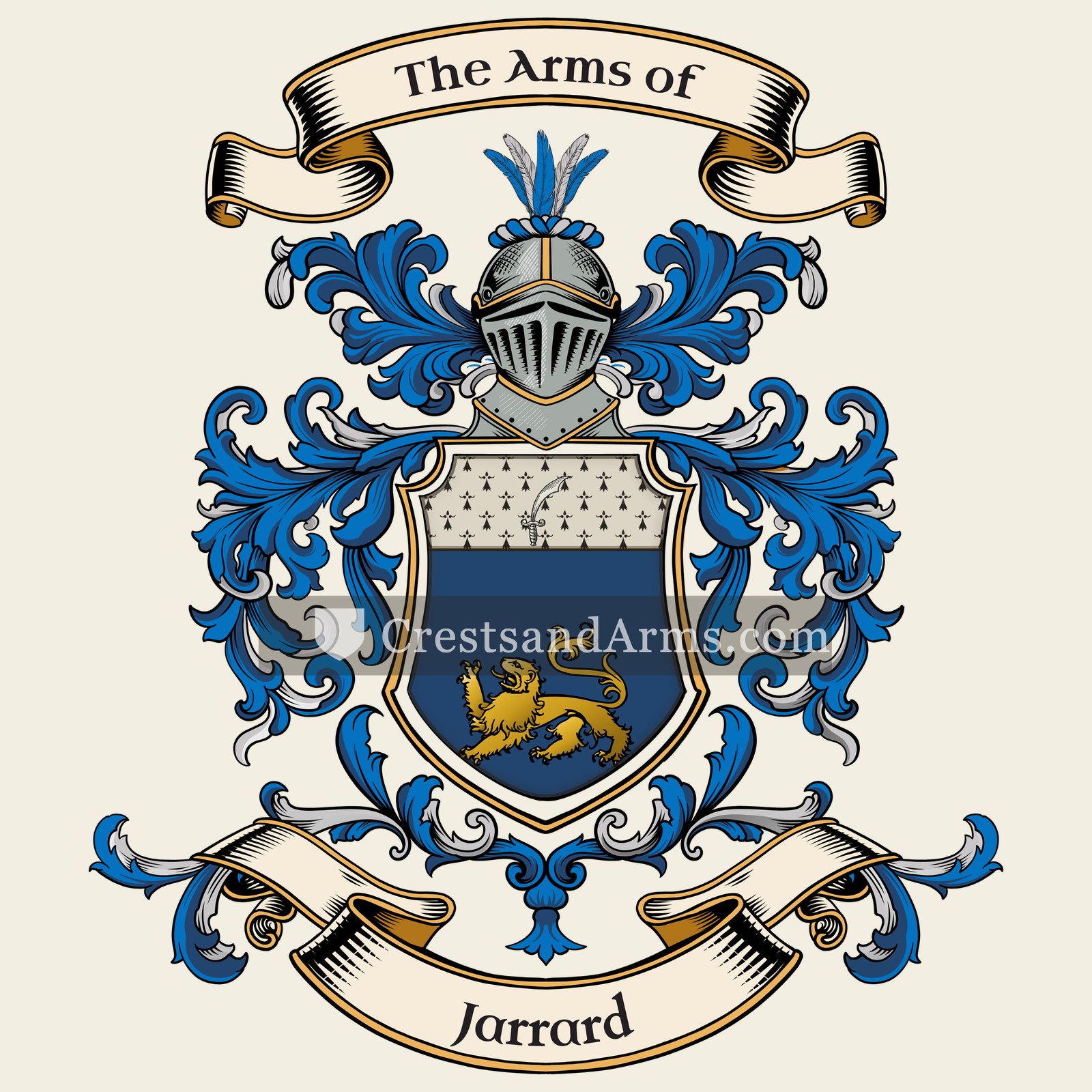
Symbols on this shield
chiefAuthority, wisdom and dominion
lionCourage, strength and royalty
swordJustice, and military honour
Colours
Blue (Azure)Means: Loyalty and truth
ErmineMeans: Dignity
Gold (Or)Means: Generosity
Historical info
Source
Sir Bernard Burke, The General Armory of England, Scotland, Ireland and Wales, London: Harrison & Sons, 1884
Blazon (the actual original written record)
“Az. a lion ramp. or, on a chief embattled erm. a falchion in bend sinister ppr. hited and pommelled or, surmounted by the Punja (one of the insignia borne before the Emperor Shah Allum) saltireways also ppr”
LanarkRochsoles · Lanark, c. 1807
Digital archive packCoat of arms PNG, gold border print PDF, vector SVG and the certificate of authenticity. Sent to your email in minutes.
Map of Scotland showing where the Jarrard arms are recorded
The Jarrard arms were recorded in Lanark, c. 1807.
Lanarkshire ran along the upper Clyde, farming country with coal beneath it. Its landed families were long-established, and long establishment is what brought them into the register.
This is where the arms were entered in the register. Families often moved to other parts of the country, so the same name can turn up in more than one region.
The body that granted and recorded arms in Scotland in this period.
George III of Great Britain
Sovereign of the period
George III of Great Britain
1801–1820
Reigning in England when the Jarrard arms are first recorded.
How Arms Worked in Scotland
Scottish heraldry is unique because it treats a coat of arms as a piece of personal property protected by law. Only one person can own a specific design at any given time. When a family grows, the head keeps the original shield while other relatives must apply for their own distinct version with slight changes to prove their specific identity.
Granting authority
The Court of the Lord Lyon acts as the official body that regulates and controls all heraldic matters throughout Scotland.
How they got arms
Individuals obtain a legal right to their arms through a formal petition process that confirms their identity and family connection.
Where arms were recorded
All valid coats of arms are officially entered into the Public Register of All Arms and Bearings starting from 1672.
The family's standing
Recorded among the armigerous families of Lanark.
Origin & History of the Jarrard Family in Scotland
The surname Jarrard has deep roots that connect to the rugged landscape of Scotland, particularly within the historic county of Lanark. By the early 19th century, records confirm that families bearing this name were well-established in the region by 1807. During this era, Lanark was a center of industrial growth and agricultural transition, which likely influenced the daily lives and occupations of those living there. The name itself is thought to be a variation of older occupational or baptismal names that evolved as families moved through the Scottish Lowlands. While the specific origins of the name remain tied to the linguistic shifts of the time, the presence of the Jarrard family in Lanark suggests they were part of the hardworking communities that built the local economy. These early ancestors lived through a period of significant social change, helping to define the local identity of the area for generations to come.
Related Branches & Arms
Root word
Gerhard
Derived from Germanic elements meaning spear and hardy or brave.
This name
JarrardAn English patronymic surname signifying a descendant of one who is brave with a spear.
also spelled
Gerart
Jerard
Garrett
Jarrard
Documented Sources
Sir Bernard Burke, The General Armory of England, Scotland, Ireland and Wales, London: Harrison & Sons, 1884
Farrer, William and Brownbill, John, The Victoria History of the County of Lancaster, 1906
Lancashire Archives, Lancaster St Mary Parish Registers, PR 3052
Digital archive packCoat of arms PNG, gold border print PDF, vector SVG and the certificate of authenticity. Sent to your email in minutes.


 lionCourage, strength and royalty
 crescentHonour by the sovereign, and the second son
 lionCourage, strength and royalty
 crescentHonour by the sovereign, and the second son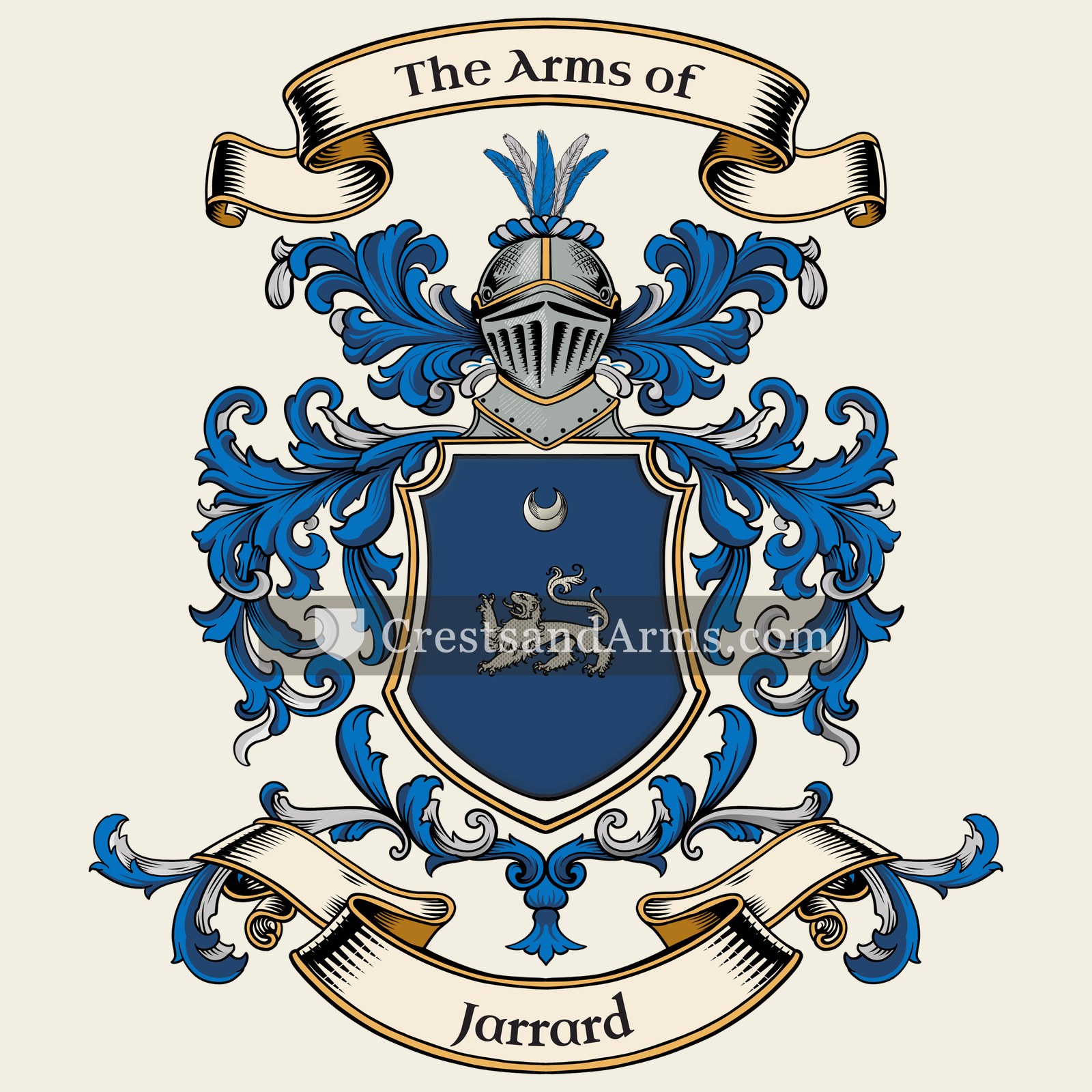


 chiefAuthority, wisdom and dominion
 swordJustice, and military honour