Map of France showing where the Jay arms are recorded
The Jay arms were recorded in France, c. 1663.
Arms such as these were typically recorded in Bretagne.
More families held coats of arms in Bretagne than anywhere else in France. The land was divided into many small estates rather than a few large ones, so far more households counted as gentry, and each needed a shield of its own to be told apart.
This is where the arms were entered in the register. Families often moved to other parts of the country, so the same name can turn up in more than one region.
The body that granted and recorded arms in France in this period.
Louis XIV of France
Sovereign of the period
Louis XIV of France
1643–1715
Reigning in France when the Jay arms are first recorded.
How Arms Worked in France
In France, a coat of arms was a mark of honor that passed down through the male line to all legitimate descendants. Families often used the same shield without changes to show their shared heritage. If a branch wanted to stand out, they could add a small mark to their shield to show their specific place in the family tree.
Granting authority
The Juge d'armes de France acted as the official authority that regulated and verified coats of arms across the country.
How they got arms
Families typically inherited their arms from ancestors, though they could also receive them through royal grants or by proving their noble status.
Where arms were recorded
Coats of arms were officially recorded in the Armorial Général de France, which began its main collection in the year 1696.
The family's standing
Recorded among the armigerous families of France.
Origin & History of the Jay Family in France
The surname Jay carries deep roots within the historical landscape of France, particularly in the western region of Brittany. By the middle of the seventeenth century, records confirm that families bearing this name were well-established in the Breton countryside. The name itself likely evolved from older linguistic traditions, potentially serving as a descriptive nickname or a variation of local occupational titles common to the rural populations of the time. During the year 1663, the presence of the Jay family in Brittany suggests they were part of the hardworking agrarian society that defined the province. These early ancestors lived through a period of significant social change in France, as the crown sought to centralize power and standardize record-keeping across the various provinces. Because the name appears in parish registers and regional documents from this era, it is clear that the family was integrated into the local community life, participating in the religious and civil milestones that were recorded by the church and state officials of the seventeenth century.
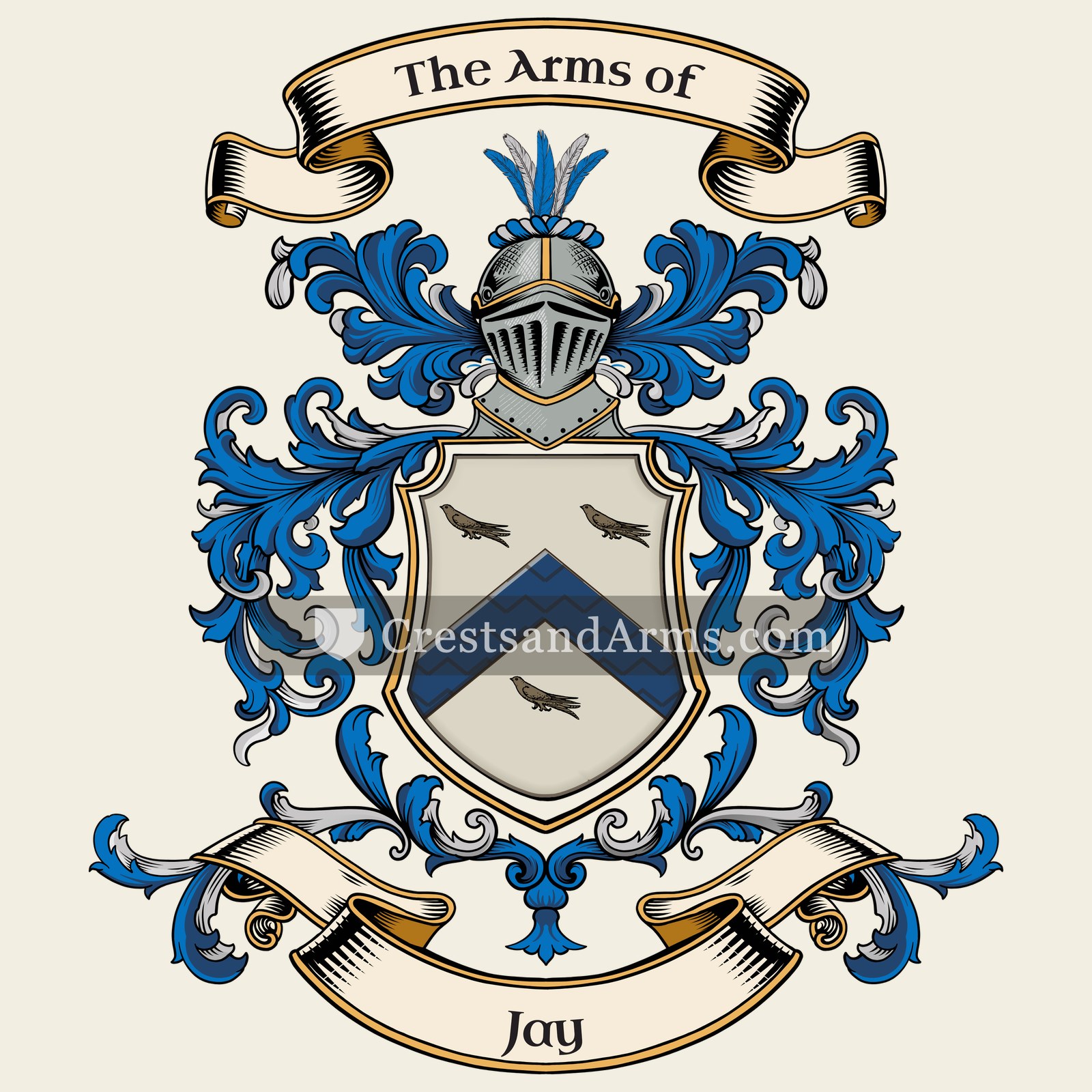
Coat of Arms & Family Crest Details
Symbols on this shield
chevronProtection, and faithful service completed
martletA younger son, who must win his own land
Colours
Silver (Argent)Means: Peace and sincerity
Blue (Azure)Means: Loyalty and truth
Historical info
Source
Sir Bernard Burke, The General Armory of England, Scotland, Ireland and Wales, London: Harrison & Sons, 1884
Blazon (the actual original written record)
“Ar. a chev. az. betw. three jays ppr”
DevonDevon, c. 1620
Digital archive packCoat of arms PNG, gold border print PDF, vector SVG and the certificate of authenticity. Sent to your email in minutes.
Map of England showing where the Jay arms are recorded
The Jay arms were recorded in Devon, c. 1620.
Devon was a county of small manors and seafaring families. Its gentry were spread thickly across the countryside, and money made at sea often bought an estate, which in turn brought a coat of arms.
This is where the arms were entered in the register. Families often moved to other parts of the country, so the same name can turn up in more than one region.
The body that granted and recorded arms in England in this period.
James VI and I
Sovereign of the period
James VI and I
1603–1625
Reigning in France when the Jay arms are first recorded.
How Arms Worked in England
English heraldry allowed arms to be shared by all legitimate descendants of the original owner. These symbols were treated as personal property that moved through the generations to all children. While the eldest son kept the original design, other family members could use the same shield without needing to change it or register their own unique versions.
Granting authority
The College of Arms in London has regulated the use of coats of arms throughout England and Wales since 1484.
How they got arms
Families typically obtained their coats of arms through a formal grant from the Crown or by proving their ancient right to them.
Where arms were recorded
All official coats of arms are recorded in the registers kept at the College of Arms, which date back to the fifteenth century.
The family's standing
Recorded among the armigerous families of Devon.
Origin & History of the Jay Family in England
The surname Jay has deep roots in the English landscape, particularly within the southwestern county of Devon. By the early 17th century, families bearing this name were already well-established in the region, living as part of the local agrarian society. The name itself is thought to have originated as a nickname, likely derived from the colorful and talkative bird known as the jay. In medieval England, it was common for people to be given names based on their personality traits or physical habits, and someone who was particularly lively or vocal might have been called by this avian moniker. As the name passed from one generation to the next, it transitioned from a simple descriptor into a formal family identifier. By the year 1620, the Jay family was a recognized part of the Devon community, contributing to the local workforce and the social fabric of the English countryside during a time of significant transition.
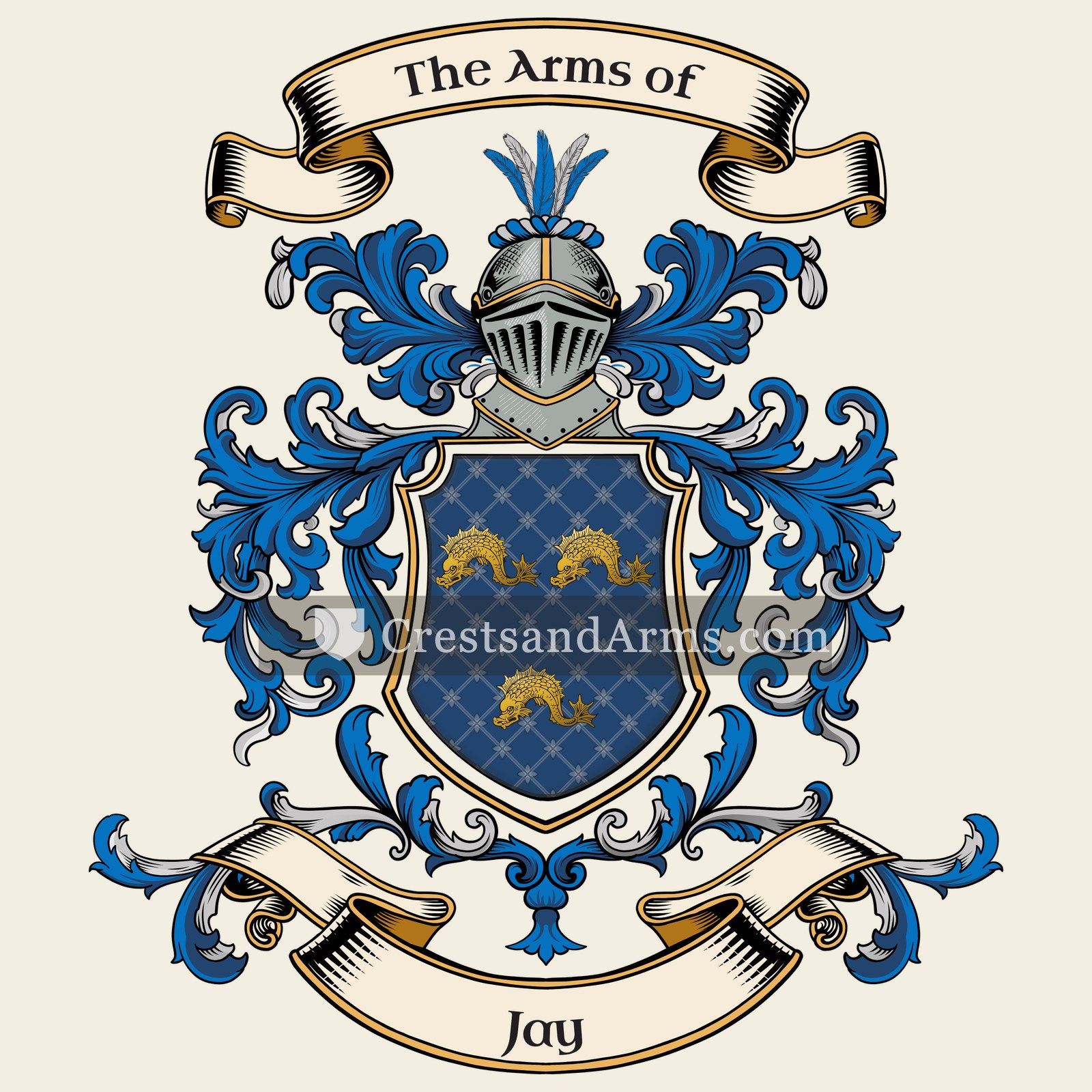
Coat of Arms & Family Crest Details
Symbols on this shield
dolphinSwiftness, charity and love
Colours
Blue (Azure)Means: Loyalty and truth
Gold (Or)Means: Generosity
Historical info
Source
Sir Bernard Burke, The General Armory of England, Scotland, Ireland and Wales, London: Harrison & Sons, 1884
Blazon (the actual original written record)
“Az. three dolphins naiant or”
Scotlandc. 1748
Digital archive packCoat of arms PNG, gold border print PDF, vector SVG and the certificate of authenticity. Sent to your email in minutes.
Map of Scotland showing where the Jay arms are recorded
The Jay arms were recorded in Scotland, c. 1748.
Arms such as these were typically recorded in Edinburgh.
Edinburgh was the seat of Scotland's government, its courts and its heralds. Families with business there settled nearby, and being close to where arms were recorded is exactly why so many of them appear.
This is where the arms were entered in the register. Families often moved to other parts of the country, so the same name can turn up in more than one region.
The body that granted and recorded arms in Scotland in this period.
George II of Great Britain
Sovereign of the period
George II of Great Britain
1727–1760
Reigning in France when the Jay arms are first recorded.
How Arms Worked in Scotland
Scottish heraldry is unique because it treats a coat of arms as a piece of personal property protected by law. Only one person can own a specific design at any given time. When a family grows, the head keeps the original shield while other relatives must apply for their own distinct version with slight changes to prove their specific identity.
Granting authority
The Court of the Lord Lyon acts as the official body that regulates and controls all heraldic matters throughout Scotland.
How they got arms
Individuals obtain a legal right to their arms through a formal petition process that confirms their identity and family connection.
Where arms were recorded
All valid coats of arms are officially entered into the Public Register of All Arms and Bearings starting from 1672.
The family's standing
Recorded among the armigerous families of Scotland.
Origin & History of the Jay Family in Scotland
The history of the Jay family in Scotland is deeply rooted in the urban development of Edinburgh during the mid-eighteenth century. By 1748, records confirm that members of the family were established residents within the city, a time when Edinburgh was transitioning from a cramped medieval capital into a center of Enlightenment thought. The name itself likely originated as a nickname derived from the colorful bird, often used in medieval times to describe someone who was talkative or dressed in bright clothing. As these individuals settled in Scotland, they integrated into the local trade and professional networks that defined the city’s growing economy. While the family name is not traditionally Scottish in origin, those living in Edinburgh during this era contributed to the social fabric of the capital as it expanded beyond its ancient walls. Their presence in the city archives during this period suggests they were part of the steady migration of families who helped shape the modern character of Scottish urban life.
Jay Meaning & Related Branches
Root word
Gaius
A Latin personal name of uncertain etymological origin.
This name
JayDerived from the Old French word for a jay bird, often used as a nickname for a chatterer.
also spelled
Jaye
Jey
Yay
Related arms
Aslack, Aslake, or Aslokerecorded with Jay, same area
Bartonrecorded with Jay, same area
Lathburyrecorded with Jay, same area
Prestwichrecorded with Jay, same area
Documented Sources
J. B. Rietstap, Armorial Général, Gouda: G. B. van Goor Zonen, 1884–87
Archives départementales d’Ille-et-Vilaine, Registres paroissiaux et d'état civil, 1663
Dauzat, Albert, Dictionnaire étymologique des noms de famille et prénoms de France, 1951
Morlet, Marie-Thérèse, Dictionnaire étymologique des noms de famille, 1991
Digital archive packCoat of arms PNG, gold border print PDF, vector SVG and the certificate of authenticity. Sent to your email in minutes.


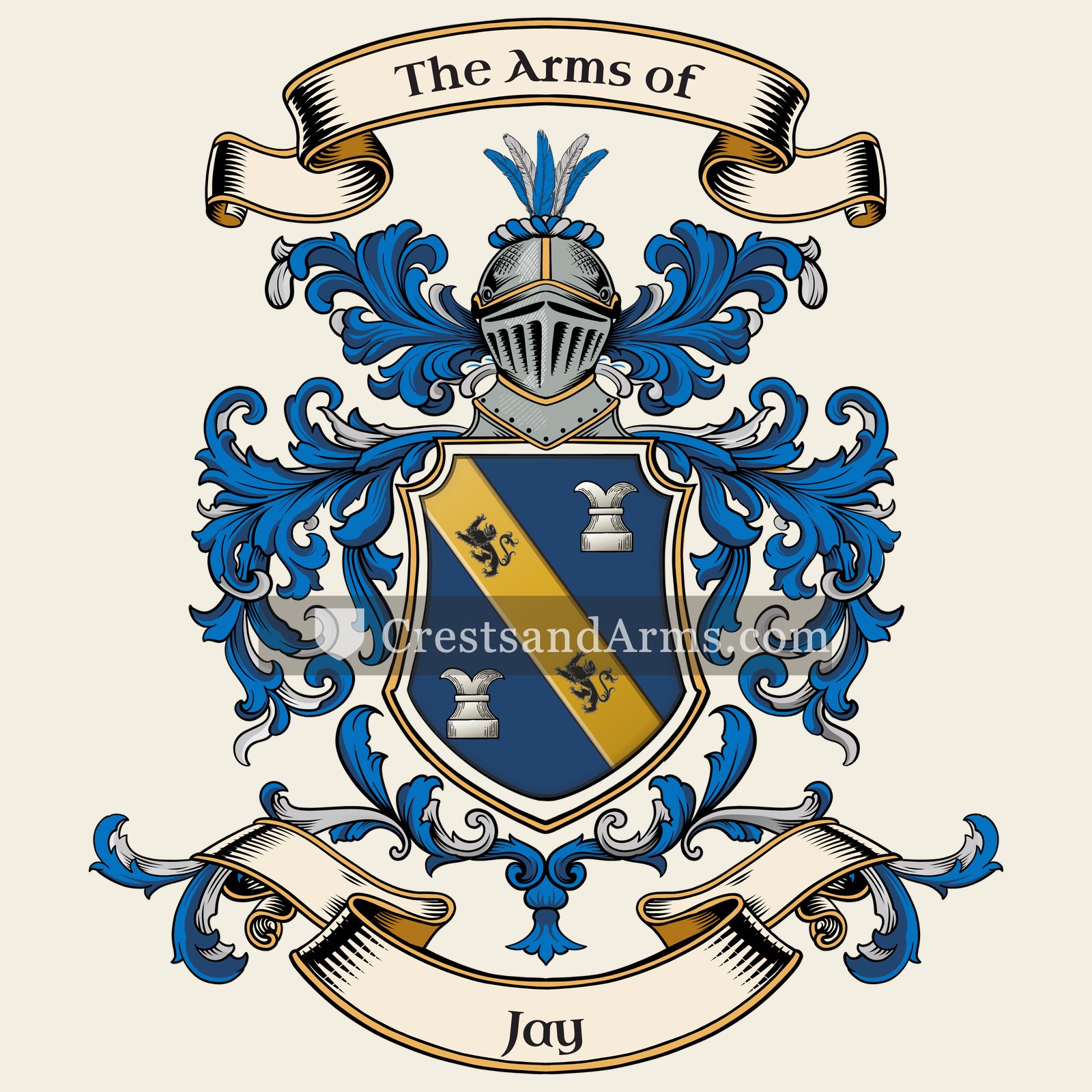
 bendDefence, and the scarf of a commander
 lionCourage, strength and royalty
 chess rookStrategy, and the defence of a position
 bendDefence, and the scarf of a commander
 lionCourage, strength and royalty
 chess rookStrategy, and the defence of a position


 chevronProtection, and faithful service completed
 martletA younger son, who must win his own land


 dolphinSwiftness, charity and love