Map of England showing where the Jee arms are recorded
The Jee arms were recorded in Warwick, c. 1620.
Warwickshire lay in the middle of England, and its landed families were spread evenly across it rather than gathered in one corner. A great many held a single manor each, and each of those holdings brought its own claim to arms.
This is where the arms were entered in the register. Families often moved to other parts of the country, so the same name can turn up in more than one region.
The body that granted and recorded arms in England in this period.
James VI and I
Sovereign of the period
James VI and I
1603–1625
Reigning in England when the Jee arms are first recorded.
How Arms Worked in England
English heraldry allowed arms to be shared by all legitimate descendants of the original owner. These symbols were treated as personal property that moved through the generations to all children. While the eldest son kept the original design, other family members could use the same shield without needing to change it or register their own unique versions.
Granting authority
The College of Arms in London has regulated the use of coats of arms throughout England and Wales since 1484.
How they got arms
Families typically obtained their coats of arms through a formal grant from the Crown or by proving their ancient right to them.
Where arms were recorded
All official coats of arms are recorded in the registers kept at the College of Arms, which date back to the fifteenth century.
The family's standing
Recorded among the armigerous families of Warwick.
Origin & History of the Jee Family in England
The family name Jee has deep roots in the English Midlands, with documented evidence placing members of the family in the town of Warwick as early as 1620. During the seventeenth century, Warwick was a bustling market town where families often established themselves through trade, craftsmanship, or local administration. The name itself is thought to be a variation of older occupational or locational surnames that evolved as spelling became more standardized in official records. By settling in a prominent town like Warwick, the early Jee family members were likely part of the growing middle class that helped shape the local economy and social structure of the era. Their presence in parish registers and legal documents from this period suggests that they were active participants in the community life of Warwickshire long before the industrial changes of the following centuries.
Jee Meaning & Related Branches
Root word
Giles
Derived from the Greek word for a young goat or shield bearer.
This name
JeeA patronymic surname originating as a diminutive form of the name Giles.
also spelled
Jey
Jeeve
Gie
Documented Sources
Sir Bernard Burke, The General Armory of England, Scotland, Ireland and Wales, London: Harrison & Sons, 1884
Warwickshire County Record Office, Parish registers of St Mary’s, Warwick (DR 296)
Warwickshire County Record Office, Quarter Sessions records of Warwickshire (QS 1620)
Digital archive packCoat of arms PNG, gold border print PDF, vector SVG and the certificate of authenticity. Sent to your email in minutes.


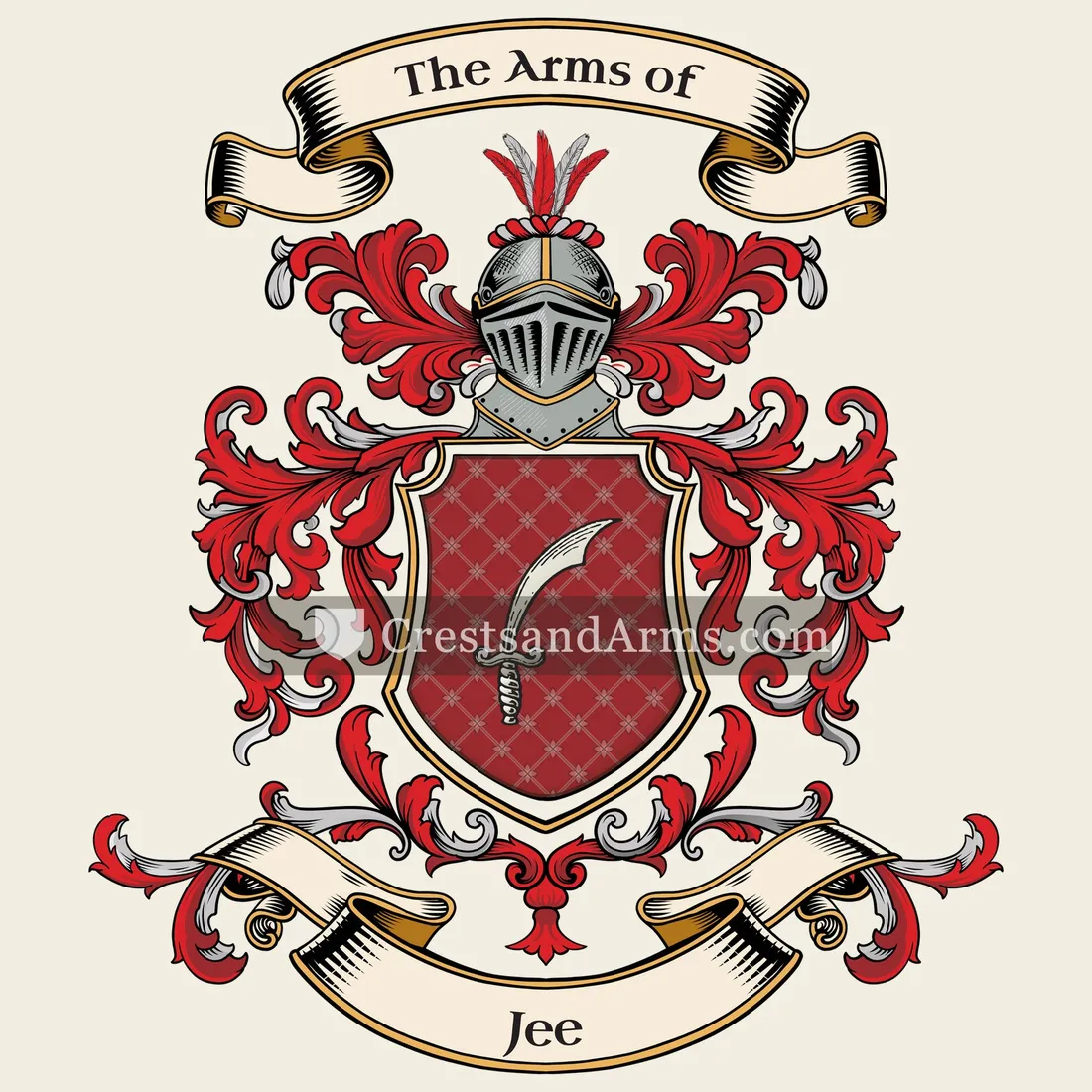
 swordJustice, and military honour
 swordJustice, and military honour