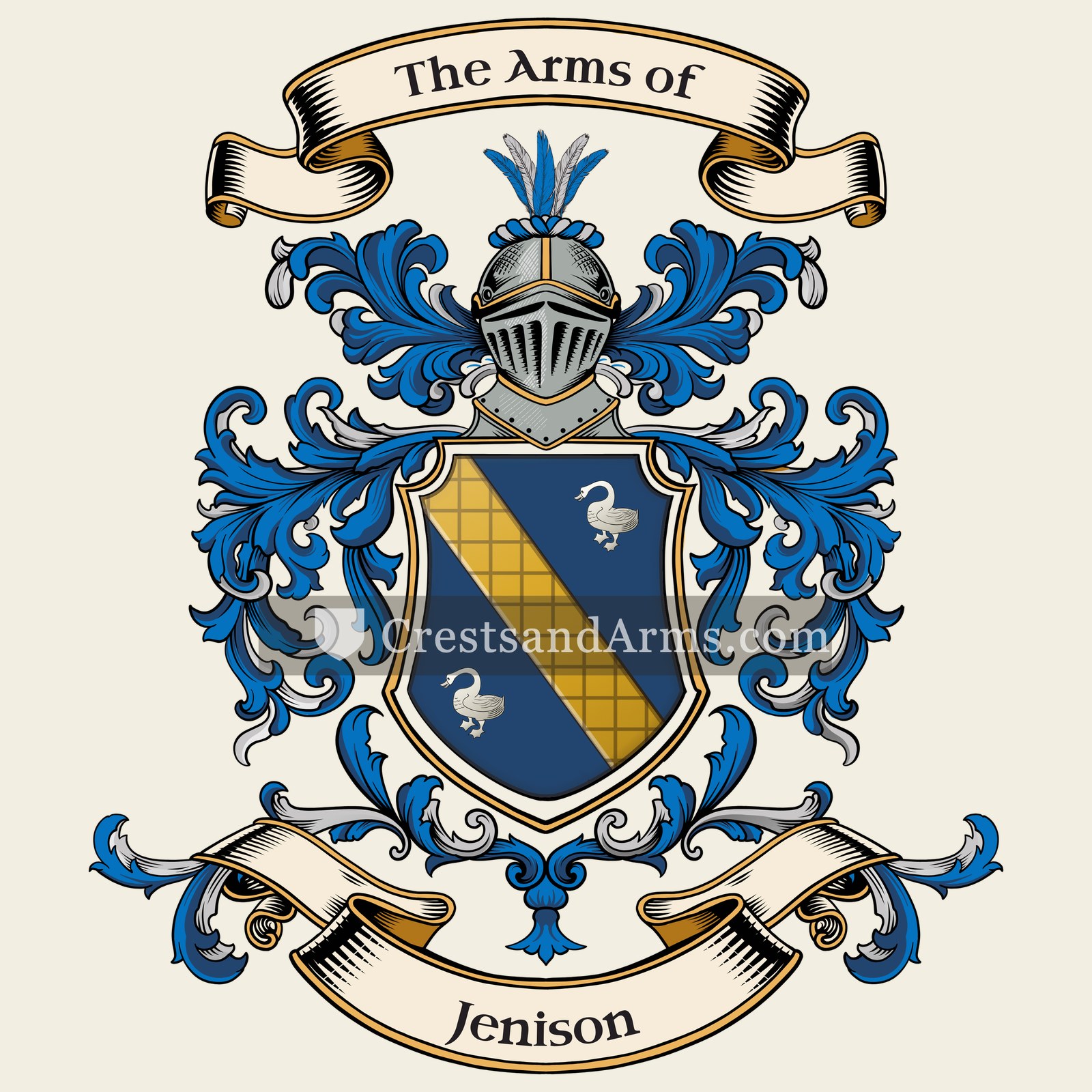
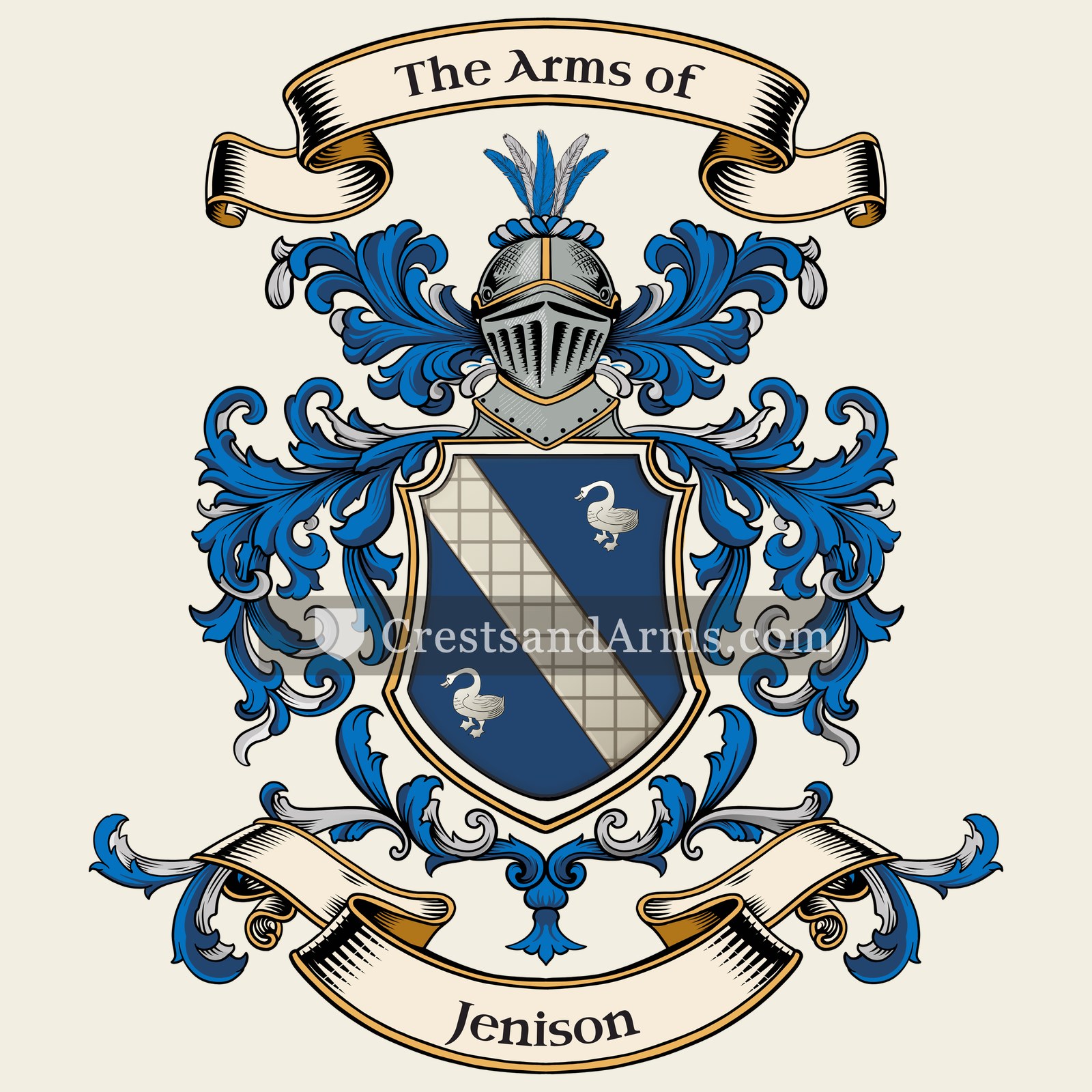
A record of documented arms, meaning and origin, researched for the Jenison family lines. Documented in 2 countries.
Reg. 1662 · French, J–L
Coat of Arms & Family Crest Details
Symbols on this shield
bendDefence, and the scarf of a commander
swanGrace, light and the poet's art
Colours
Blue (Azure)Means: Loyalty and truth
Gold (Or)Means: Generosity
Silver (Argent)Means: Peace and sincerity
Historical info
Source
J. B. Rietstap, Armorial Général, Gouda: G. B. van Goor Zonen, 1884–87
Blazon (the actual original written record)
“D'azur à la bande d'or, acc. de deux cygnes d'arg., bq. et m. de sa., les ailes ouv. Cq. cour. C.: une tête de dragon d'arg., vomissant des flammes. L. d'or et d'azur. S.: deux dragons d'arg., vomissant des flammes. D.: ESPÉREZ TOUJOURS.”
Francec. 1725
Digital archive packCoat of arms PNG, gold border print PDF, vector SVG and the certificate of authenticity. Sent to your email in minutes.
Map of France showing where the Jenison arms are recorded
The Jenison arms were recorded in France, c. 1725.
Arms such as these were typically recorded in Bretagne.
More families held coats of arms in Bretagne than anywhere else in France. The land was divided into many small estates rather than a few large ones, so far more households counted as gentry, and each needed a shield of its own to be told apart.
This is where the arms were entered in the register. Families often moved to other parts of the country, so the same name can turn up in more than one region.
The body that granted and recorded arms in France in this period.
Louis XV of France
Sovereign of the period
Louis XV of France
1715–1774
Reigning in France when the Jenison arms are first recorded.
How Arms Worked in France
In France, a coat of arms was a mark of honor that passed down through the male line to all legitimate descendants. Families often used the same shield without changes to show their shared heritage. If a branch wanted to stand out, they could add a small mark to their shield to show their specific place in the family tree.
Granting authority
The Juge d'armes de France acted as the official authority that regulated and verified coats of arms across the country.
How they got arms
Families typically inherited their arms from ancestors, though they could also receive them through royal grants or by proving their noble status.
Where arms were recorded
Coats of arms were officially recorded in the Armorial Général de France, which began its main collection in the year 1696.
The family's standing
Recorded among the armigerous families of France.
Origin & History of the Jenison Family in France
The family name Jenison carries a deep connection to the historical landscape of the Bretagne region in northwestern France. By the early eighteenth century, records confirm that members of the family were firmly established within this coastal province. During this era, Bretagne functioned as a distinct cultural territory with its own unique traditions and social structures. Families like the Jenisons often lived in rural parishes where they participated in the local agricultural economy and regional trade. Because the name appears in administrative documents from 1725, it suggests that the family was well-integrated into the local community life of the time. This period was marked by significant social stability in the region, which allowed families to maintain their presence across several generations. The history of the Jenison name in France is therefore a reflection of the enduring nature of families who built their lives within the specific traditions of the Breton people.
Coat of Arms & Family Crest Details
Symbols on this shield
bendDefence, and the scarf of a commander
swanGrace, light and the poet's art
Colours
Blue (Azure)Means: Loyalty and truth
Silver (Argent)Means: Peace and sincerity
Historical info
Source
Sir Bernard Burke, The General Armory of England, Scotland, Ireland and Wales, London: Harrison & Sons, 1884
Blazon (the actual original written record)
“Az. a bend betw. two swans ar”
DurhamWalworth · Durham, c. 1620
Digital archive packCoat of arms PNG, gold border print PDF, vector SVG and the certificate of authenticity. Sent to your email in minutes.
Map of England showing where the Jenison arms are recorded
The Jenison arms were recorded in Durham, c. 1620.
Durham was governed by its bishop rather than the crown for most of its history, with its own courts and its own landed class. That separate world produced a tight group of families, nearly all of whom held arms.
This is where the arms were entered in the register. Families often moved to other parts of the country, so the same name can turn up in more than one region.
The body that granted and recorded arms in England in this period.
James VI and I
Sovereign of the period
James VI and I
1603–1625
Reigning in France when the Jenison arms are first recorded.
How Arms Worked in England
English heraldry allowed arms to be shared by all legitimate descendants of the original owner. These symbols were treated as personal property that moved through the generations to all children. While the eldest son kept the original design, other family members could use the same shield without needing to change it or register their own unique versions.
Granting authority
The College of Arms in London has regulated the use of coats of arms throughout England and Wales since 1484.
How they got arms
Families typically obtained their coats of arms through a formal grant from the Crown or by proving their ancient right to them.
Where arms were recorded
All official coats of arms are recorded in the registers kept at the College of Arms, which date back to the fifteenth century.
The family's standing
Recorded among the armigerous families of Durham.
Origin & History of the Jenison Family in England
The Jenison family name has deep roots in the northern English county of Durham, where the family established a significant presence by the early seventeenth century. The name is considered a patronymic, meaning it likely originated as a way to identify a person as the son of someone named Jen or Jenn, which were common medieval nicknames for John. By 1620, the Jenisons were well-integrated into the local society of Durham, often serving in positions of civic leadership and managing landholdings that allowed them to influence the regional economy. Their history is closely tied to the development of the north of England, where families of similar standing often balanced agricultural interests with the growing trade and mining industries of the era. This period of stability in Durham allowed the family to build a lasting reputation that persisted for generations, marking them as a notable part of the local gentry during a time of great social change in England.
Related Branches & Arms
Root word
Johannes
God is gracious
This name
JenisonA patronymic surname derived from a diminutive form of John meaning son of little John
also spelled
Jenisson
Jenyson
Jenysonn
Related arms
Gennisonvariant spelling
Jenysonvariant spelling
Jenysonnvariant spelling
Lawsonrecorded with Jenison, same area
Documented Sources
J. B. Rietstap, Armorial Général, Gouda: G. B. van Goor Zonen, 1884–87
Archives départementales d'Ille-et-Vilaine, Registres paroissiaux et d'état civil
Archives départementales du Morbihan, Série E, État civil et registres paroissiaux
Pocquet du Haut-Jussé, Barthélemy, Histoire de Bretagne, 1937
Digital archive packCoat of arms PNG, gold border print PDF, vector SVG and the certificate of authenticity. Sent to your email in minutes.


 bendDefence, and the scarf of a commander
 swanGrace, light and the poet's art
 bendDefence, and the scarf of a commander
 swanGrace, light and the poet's art