Map of Switzerland showing where the Jennings arms are recorded
The Jennings arms were recorded in Genève, c. 1745.
This is where the arms were entered in the register. Families often moved to other parts of the country, so the same name can turn up in more than one region.
The body that granted and recorded arms in Switzerland in this period.
How Arms Worked in Switzerland
In Switzerland, coats of arms were not restricted to the nobility and were often adopted by common citizens and families. These symbols were passed down through generations to show family identity. When branches of a family grew, they often changed small details of the design to distinguish their own line from the original group.
Granting authority
Cantonal and civic authorities managed the use of coats of arms within their specific regions and local jurisdictions.
How they got arms
Families typically assumed their own coats of arms based on local custom rather than receiving them from a central monarch.
Where arms were recorded
Arms were recorded in various cantonal and civic registers starting from the fourteenth century throughout the Swiss region.
The family's standing
Recorded among the armigerous families of Switzerland.
Origin & History of the Jennings Family in Switzerland
The history of the Jennings family in Switzerland centers on their arrival in the city of Genève during the eighteenth century. While the name itself has roots in the British Isles, the branch that settled in Switzerland became deeply integrated into the local culture by 1745. During this period, Genève was a hub for international trade and intellectual exchange, which likely attracted families looking for new opportunities in banking or commerce. These early members of the Jennings family were recognized as residents who contributed to the social and economic life of the city. By establishing themselves in this influential Swiss center, they transitioned from being outsiders to becoming part of the local community. Their presence in the city records from the mid-1700s highlights how families often moved across borders to build new lives in stable, prosperous urban environments.
Coat of Arms & Family Crest Details
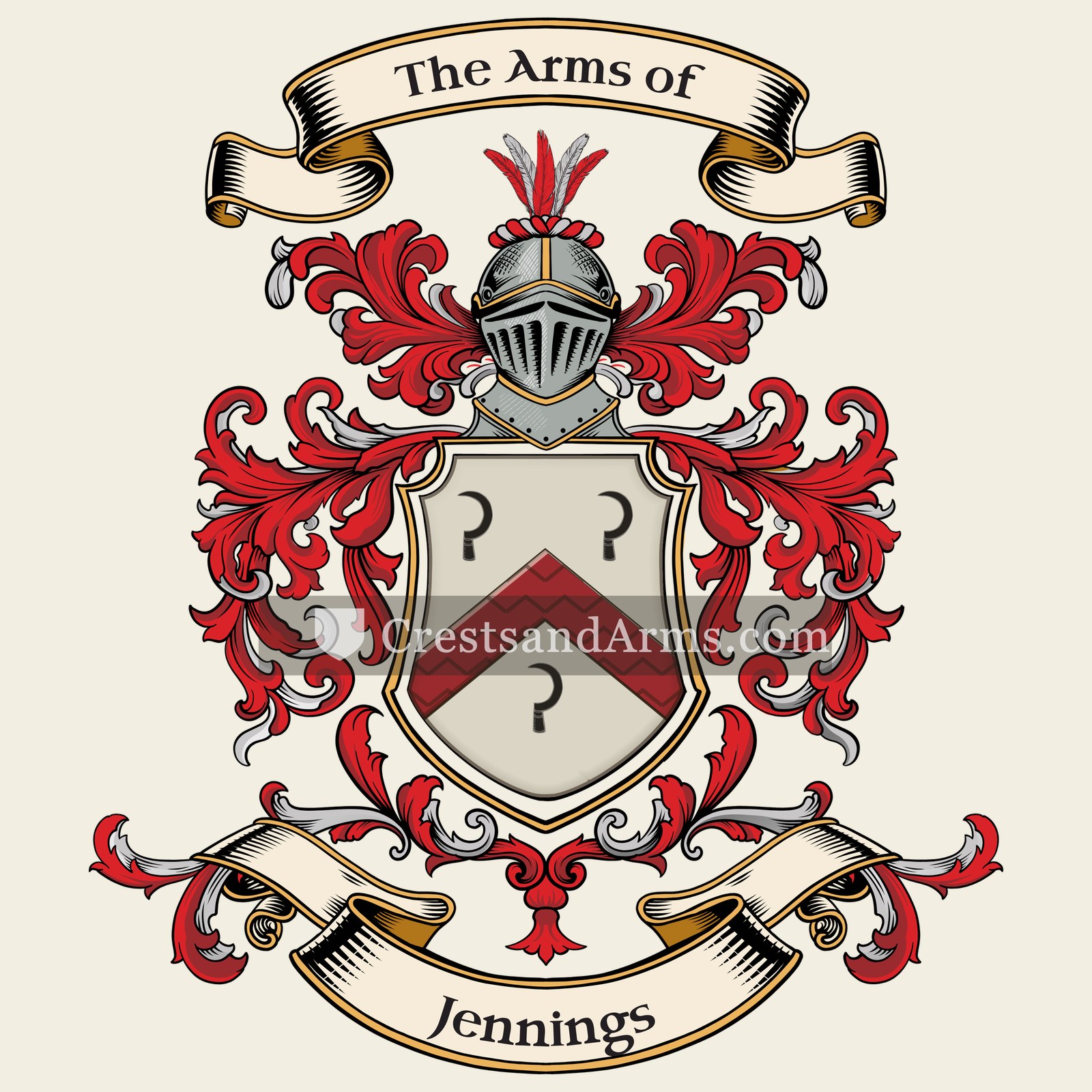
Symbols on this shield
chevronProtection, and faithful service completed
sickleThe harvest, and the reaping of what was sown
Colours
Silver (Argent)Means: Peace and sincerity
Red (Gules)Means: Military strength
Black (Sable)Means: Constancy
Historical info
Source
Sir Bernard Burke, The General Armory of England, Scotland, Ireland and Wales, London: Harrison & Sons, 1884
Blazon (the actual original written record)
“Ar. a chev. gu. betw. three plummets sa”
YorkLondon · York, c. 1508
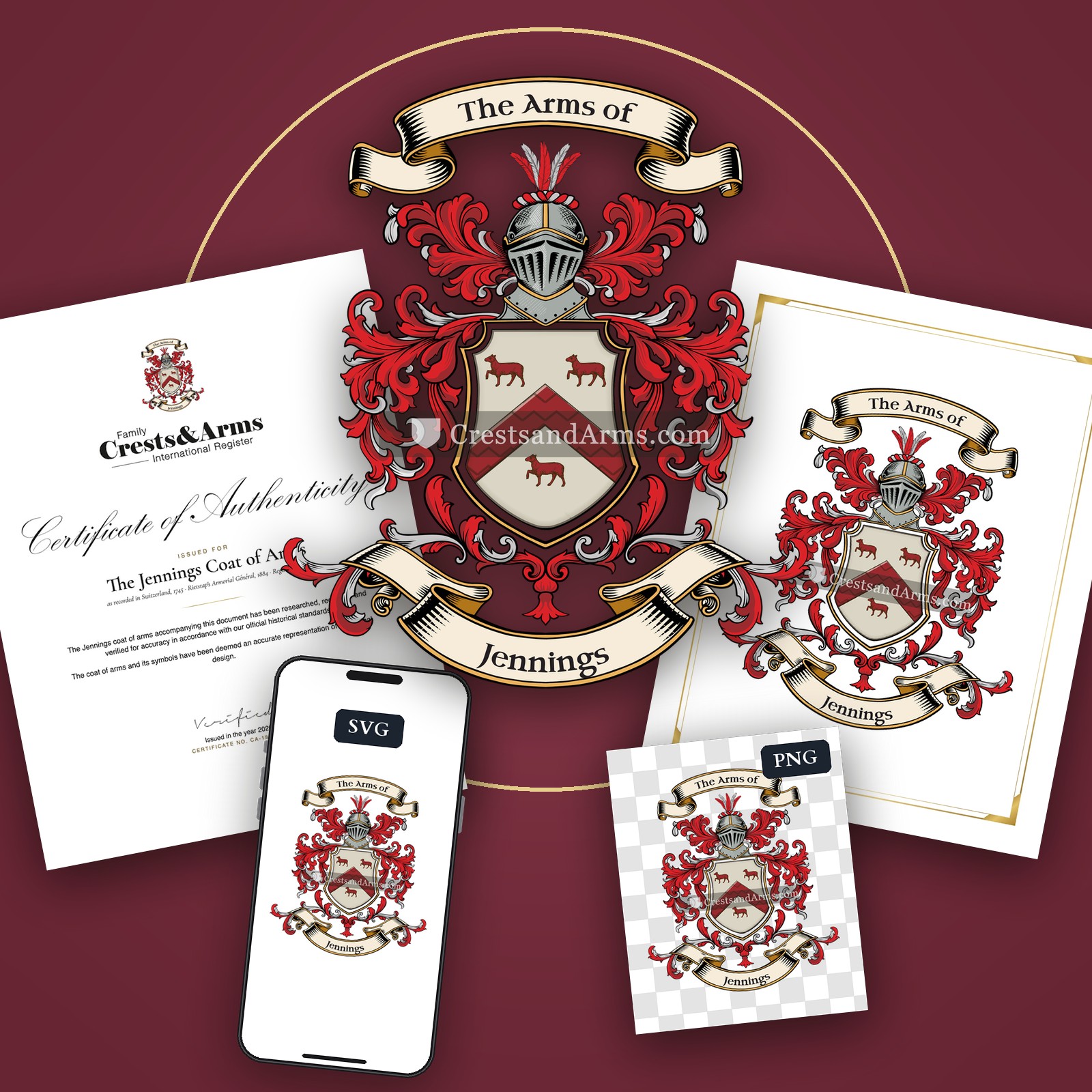
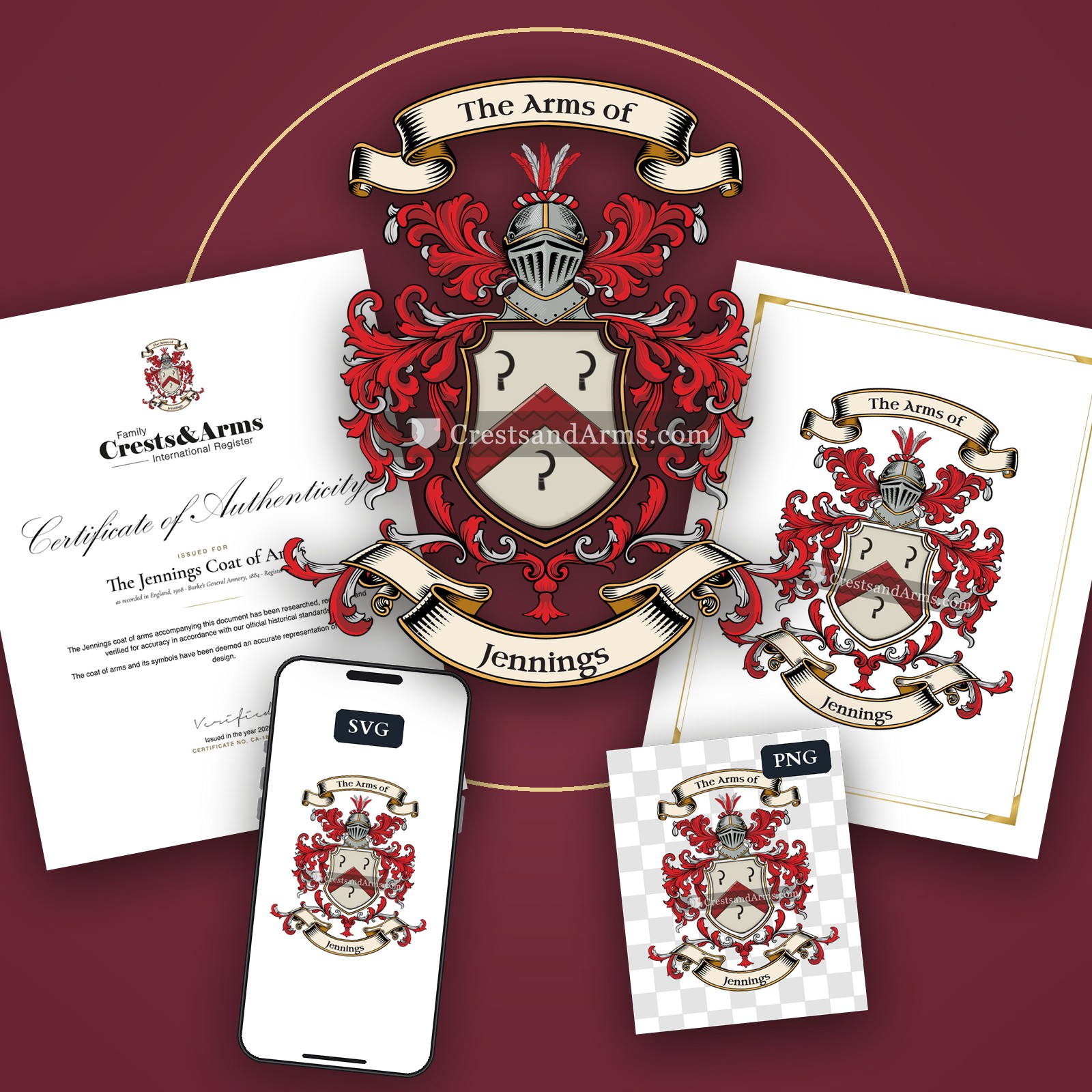
Digital archive packCoat of arms PNG, gold border print PDF, vector SVG and the certificate of authenticity. Sent to your email in minutes.
Map of England showing where the Jennings arms are recorded
The Jennings arms were recorded in York, c. 1508.
Yorkshire is the largest of the English counties, and it held more gentry families than any other. Land there was split among a great many households rather than a few, so a great many of them carried arms.
This is where the arms were entered in the register. Families often moved to other parts of the country, so the same name can turn up in more than one region.
The body that granted and recorded arms in England in this period.
Henry VII of England
Sovereign of the period
Henry VII of England
1485–1509
Reigning in Switzerland when the Jennings arms are first recorded.
How Arms Worked in England
English heraldry allowed arms to be shared by all legitimate descendants of the original owner. These symbols were treated as personal property that moved through the generations to all children. While the eldest son kept the original design, other family members could use the same shield without needing to change it or register their own unique versions.
Granting authority
The College of Arms in London has regulated the use of coats of arms throughout England and Wales since 1484.
How they got arms
Families typically obtained their coats of arms through a formal grant from the Crown or by proving their ancient right to them.
Where arms were recorded
All official coats of arms are recorded in the registers kept at the College of Arms, which date back to the fifteenth century.
The family's standing
Recorded among the armigerous families of York.
Origin & History of the Jennings Family in England
The surname Jennings originated in England as a patronymic, meaning it was derived from the name of a father or ancestor. It evolved from the medieval given name Jenin, which served as a diminutive form of John. During the Middle Ages, people often added suffixes to names to indicate a relationship, and the addition of the letter s transformed Jenin into Jennings, signifying "son of Jenin." By the early 16th century, the family had established a notable presence in the city of York. Records from 1508 confirm that members of the Jennings family were active within this northern hub, likely participating in the local trade guilds or civic life that defined the era. As the name spread across the English countryside, it became a common identifier for families who traced their lineage back to those early individuals who first adopted the name in the late medieval period.
Jennings Meaning & Related Branches
Root word
Johannes
Hebrew origin meaning God is gracious.
This name
JenningsA patronymic surname meaning son of little John.
also spelled
Jenning
Jenninges
Jenninge
Jennyng
Jenynge
Related arms
Jenninssame arms
Genningsvariant spelling
Jennence, or Jenninsvariant spelling
Jennensvariant spelling
Documented Sources
J. B. Rietstap, Armorial Général, Gouda: G. B. van Goor Zonen, 1884–87
Archives: Archives d’État de Genève, Registres du Conseil
Archives: Archives d’État de Genève, État civil et registres paroissiaux
Book: Galiffe, Jacques-Auguste, Notices généalogiques sur les familles genevoises, 1829
Digital archive packCoat of arms PNG, gold border print PDF, vector SVG and the certificate of authenticity. Sent to your email in minutes.


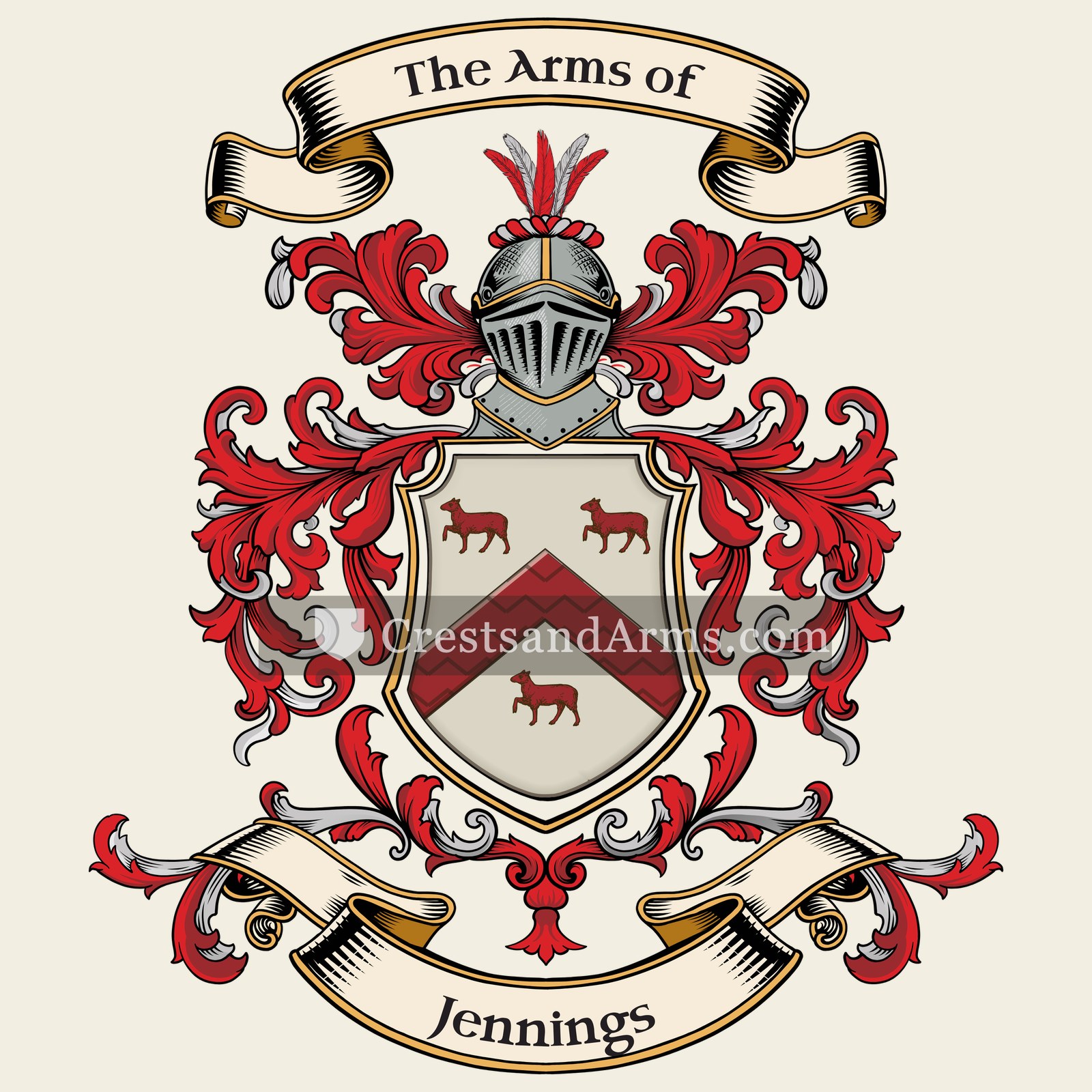
 chevronProtection, and faithful service completed
 lambGentleness, patience and faith
 chevronProtection, and faithful service completed
 lambGentleness, patience and faith

 sickleThe harvest, and the reaping of what was sown