Map of England showing where the Jewett arms are recorded
The Jewett arms were recorded in England, c. 1620.
Arms such as these were typically recorded in York.
Yorkshire is the largest of the English counties, and it held more gentry families than any other. Land there was split among a great many households rather than a few, so a great many of them carried arms.
This is where the arms were entered in the register. Families often moved to other parts of the country, so the same name can turn up in more than one region.
The body that granted and recorded arms in England in this period.
James VI and I
Sovereign of the period
James VI and I
1603–1625
Reigning in England when the Jewett arms are first recorded.
How Arms Worked in England
English heraldry allowed arms to be shared by all legitimate descendants of the original owner. These symbols were treated as personal property that moved through the generations to all children. While the eldest son kept the original design, other family members could use the same shield without needing to change it or register their own unique versions.
Granting authority
The College of Arms in London has regulated the use of coats of arms throughout England and Wales since 1484.
How they got arms
Families typically obtained their coats of arms through a formal grant from the Crown or by proving their ancient right to them.
Where arms were recorded
All official coats of arms are recorded in the registers kept at the College of Arms, which date back to the fifteenth century.
The family's standing
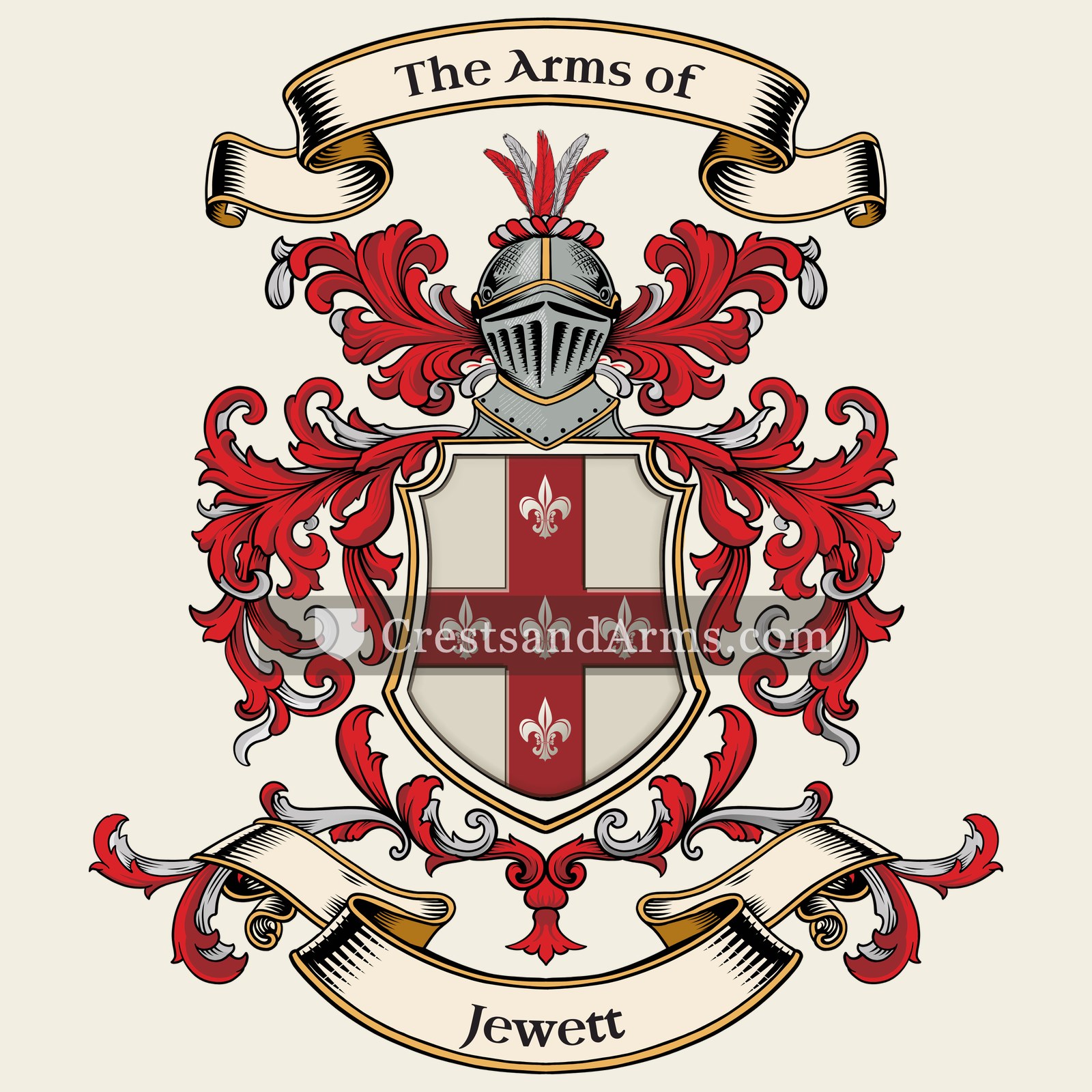
Recorded among the armigerous families of England.
Origin & History of the Jewett Family in England
The Jewett family name traces its roots back to the northern regions of England, specifically around the historic city of York. By the early 1600s, members of the family were well-established in this area, living as hardworking citizens during a time of great social change. The name itself is thought to be a variation of the French name Jouet, which likely arrived in England following the Norman Conquest. Over several centuries, the spelling evolved to fit the local English dialect. When the family eventually migrated to the American colonies in the late 1630s, they brought these deep Yorkshire traditions with them. They settled in the Massachusetts Bay Colony and helped found the town of Rowley, where they quickly became known for their skills in cloth manufacturing and their active participation in local government.
Related Branches & Arms
Root word
Jude
A Hebrew name meaning praised or let God be praised.
This name
JewettA diminutive form of Julian or Jude, historically used as a term of endearment.
also spelled
Jewett
Jowett
Documented Sources
Sir Bernard Burke, The General Armory of England, Scotland, Ireland and Wales, London: Harrison & Sons, 1884
Jewett, Frederic Clarke. History and Genealogy of the Jewetts of America. 1908
Blodgette, George Brainard and Jewett, Amos Everett. Early Settlers of Rowley, Massachusetts. 1933
Digital archive packCoat of arms PNG, gold border print PDF, vector SVG and the certificate of authenticity. Sent to your email in minutes.


 cross symbolChristian faith and service
 fleur de lisPurity, light, and the sixth son
 cross symbolChristian faith and service
 fleur de lisPurity, light, and the sixth son