Map of France showing where the Johanssen arms are recorded
The Johanssen arms were recorded in Flandre, c. 1663.
Flandre grew rich on cloth, and its towns were among the busiest in Europe. Merchant families bought land with their profits and took arms to go with it, so trade put as many names in the registers here as land did.
This is where the arms were entered in the register. Families often moved to other parts of the country, so the same name can turn up in more than one region.
The body that granted and recorded arms in France in this period.
Louis XIV of France
Sovereign of the period
Louis XIV of France
1643–1715
Reigning in France when the Johanssen arms are first recorded.
How Arms Worked in France
In France, a coat of arms was a mark of honor that passed down through the male line to all legitimate descendants. Families often used the same shield without changes to show their shared heritage. If a branch wanted to stand out, they could add a small mark to their shield to show their specific place in the family tree.
Granting authority
The Juge d'armes de France acted as the official authority that regulated and verified coats of arms across the country.
How they got arms
Families typically inherited their arms from ancestors, though they could also receive them through royal grants or by proving their noble status.
Where arms were recorded
Coats of arms were officially recorded in the Armorial Général de France, which began its main collection in the year 1696.
The family's standing
Recorded among the armigerous families of Flandre.
Origin & History of the Johanssen Family in France
The history of the Johanssen name in France begins in the northern region of Flandre, where records confirm the family was established by 1663. During this period, the borderlands between France and the Spanish Netherlands were frequently shifting, creating a unique environment where families often moved across fluid cultural and political boundaries. The name itself reflects a Germanic linguistic influence, which was common in the border towns of the seventeenth century. As the region became more integrated into the French kingdom, families like the Johanssens adapted to the local administrative systems while maintaining their distinct naming traditions. This transition suggests that the family likely worked in trade or agriculture, as these professions were the primary drivers of movement and settlement in the Flemish territories during the reign of Louis XIV. By living in this crossroads of Europe, the early Johanssens were part of a diverse population that helped shape the social fabric of northern France.
Coat of Arms & Family Crest Details
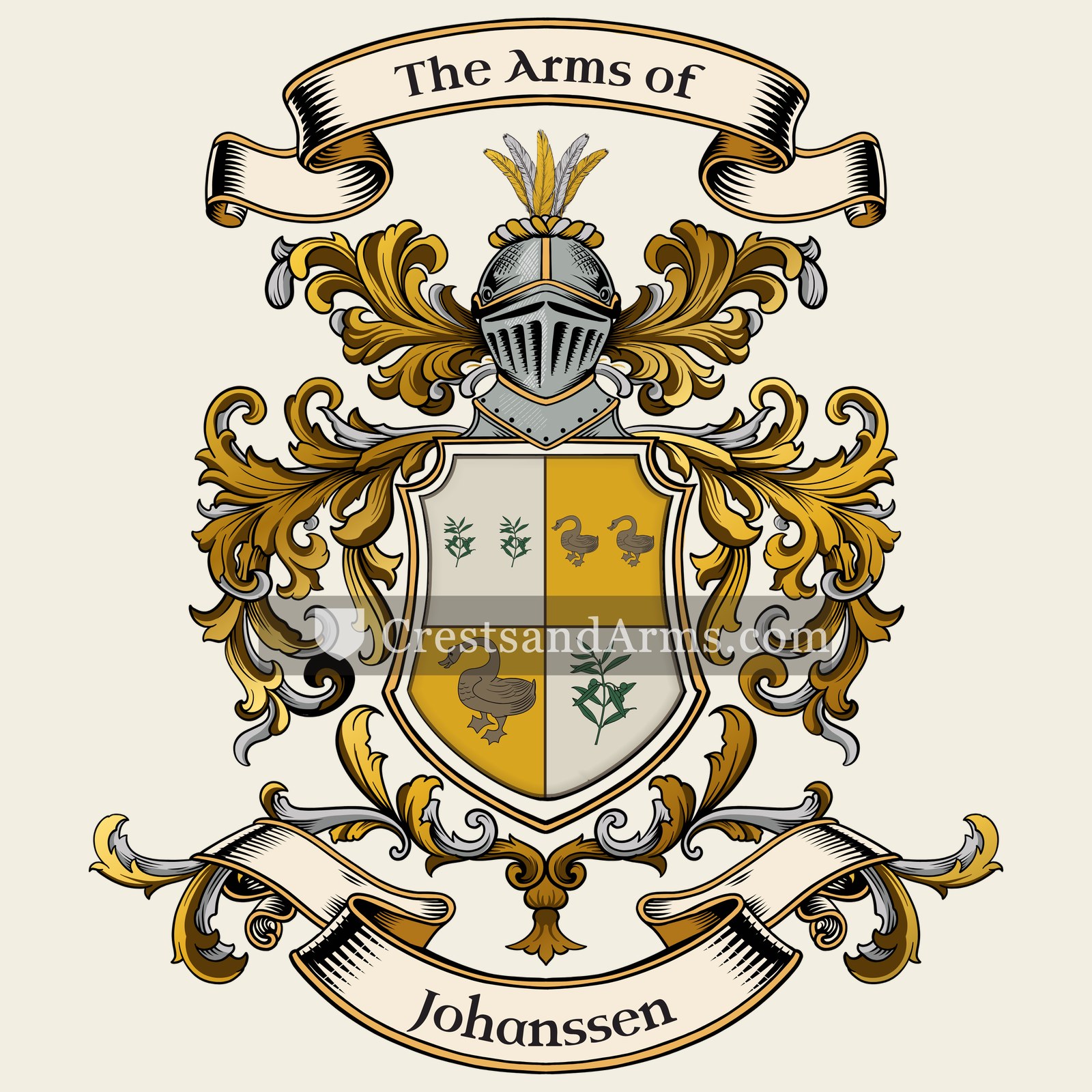
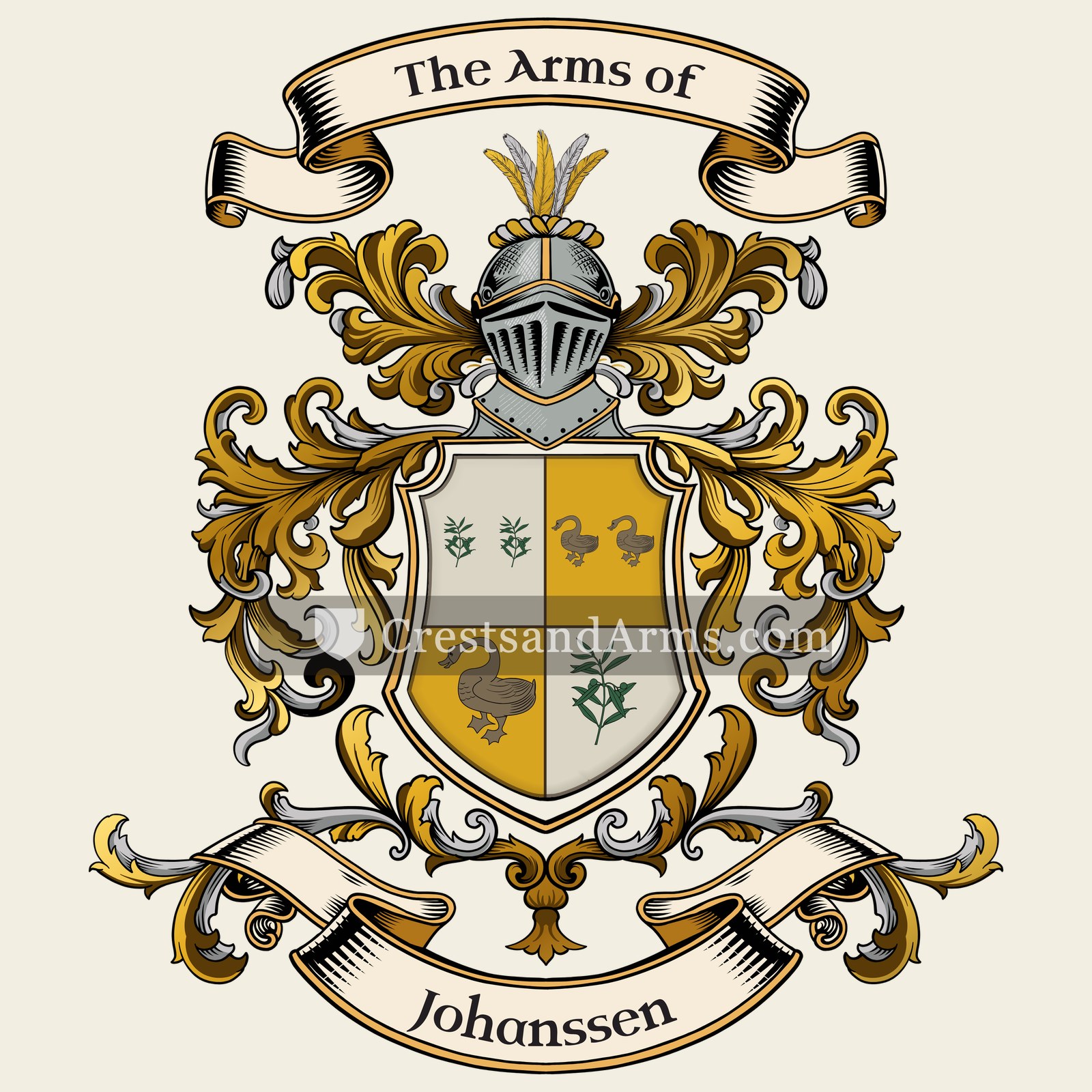
Symbols on this shield
branchPeace, and new growth
swanGrace, light and the poet's art
Colours
Silver (Argent)Means: Peace and sincerity
Gold (Or)Means: Generosity
Green (Vert)Means: Hope
Historical info
Source
J. B. Rietstap, Armorial Général, Gouda: G. B. van Goor Zonen, 1884–87
Blazon (the actual original written record)
“Ec.: au 1 d'arg. à deux faisceaux de roseaux de sin., posés et rangés en fasce; au 2 coupé d'or sur azur, l'or ch. de deux cygnes au nat., nageant sur le coupé; au 3 coupé d'or sur azur, l'or ch. d'un cygne au nat., nageant sur le coupé; au 4 d'arg. à un faisceau de roseaux de sin., posé en fasce. C.: un trèfle de sin.; ou, une quartefeuille tigée de sin.”
Britainc. 1714
Digital archive packCoat of arms PNG, gold border print PDF, vector SVG and the certificate of authenticity. Sent to your email in minutes.
Map of Britain showing where the Johanssen arms are recorded
The Johanssen arms were recorded in Britain, c. 1714.
Arms such as these were typically recorded in Kent.
Kent sits between London and the short crossing to Europe, and the trade passing through made it wealthy. Merchant families bought land with that money, and it was landowners who took coats of arms.
This is where the arms were entered in the register. Families often moved to other parts of the country, so the same name can turn up in more than one region.
The body that granted and recorded arms in Britain in this period.
Anne of Great Britain
Sovereign of the period
Anne of Great Britain
1707–1714
Reigning in France when the Johanssen arms are first recorded.
How Arms Worked in Britain
English heraldry allowed arms to be shared by all legitimate descendants of the original owner. These symbols were treated as personal property that moved through the generations to all children. While the eldest son kept the original design, other family members could use the same shield without needing to change it or register their own unique versions.
Granting authority
The College of Arms in London has regulated the use of coats of arms throughout England and Wales since 1484.
How they got arms
Families typically obtained their coats of arms through a formal grant from the Crown or by proving their ancient right to them.
Where arms were recorded
All official coats of arms are recorded in the registers kept at the College of Arms, which date back to the fifteenth century.
The family's standing
Recorded among the armigerous families of Britain.
Origin & History of the Johanssen Family in Britain
The family name Johanssen traces its roots to Northern Europe, but its presence in Britain became established during the early eighteenth century. By 1714, records confirm that members of the family had settled in the county of Kent. This period was a time of significant movement across the North Sea, as trade networks and political shifts encouraged families from Scandinavia and Northern Germany to relocate to English coastal regions. Settling in Kent allowed these early arrivals to integrate into a busy maritime economy, where they likely worked as merchants, skilled craftsmen, or sailors. Over time, the name adapted to the local phonetic style of the region, marking the beginning of the family’s long history as part of the British population.
Coat of Arms & Family Crest Details
Symbols on this shield
branchPeace, and new growth
swanGrace, light and the poet's art
Colours
Silver (Argent)Means: Peace and sincerity
Gold (Or)Means: Generosity
Green (Vert)Means: Hope
Historical info
Source
Sir Bernard Burke, The General Armory of England, Scotland, Ireland and Wales, London: Harrison & Sons, 1884
Blazon (the actual original written record)
“Quarterly, 1st, ar. two bundles of reeds in fesse vert; 2nd, per fesse or and az. two swans close in fesse ppr.; 3rd, per fesse or and az. a swan in fesse ppr.; 4th, ar. a bundle of reeds vert”
SurreyWimbledon · Surrey, c. 1714
Digital archive packCoat of arms PNG, gold border print PDF, vector SVG and the certificate of authenticity. Sent to your email in minutes.
Map of England showing where the Johanssen arms are recorded
The Johanssen arms were recorded in Surrey, c. 1714.
Surrey sat just south of London and filled up with families who had made money in the City. Buying an estate there was the usual next step, and an estate was the usual reason to take arms.
This is where the arms were entered in the register. Families often moved to other parts of the country, so the same name can turn up in more than one region.
The body that granted and recorded arms in England in this period.
Anne of Great Britain
Sovereign of the period
Anne of Great Britain
1707–1714
Reigning in France when the Johanssen arms are first recorded.
How Arms Worked in England
English heraldry allowed arms to be shared by all legitimate descendants of the original owner. These symbols were treated as personal property that moved through the generations to all children. While the eldest son kept the original design, other family members could use the same shield without needing to change it or register their own unique versions.
Granting authority
The College of Arms in London has regulated the use of coats of arms throughout England and Wales since 1484.
How they got arms
Families typically obtained their coats of arms through a formal grant from the Crown or by proving their ancient right to them.
Where arms were recorded
All official coats of arms are recorded in the registers kept at the College of Arms, which date back to the fifteenth century.
The family's standing
Recorded among the armigerous families of Surrey.
Origin & History of the Johanssen Family in England
The family name Johanssen is a patronymic surname, meaning it was originally formed by adding a suffix to the given name Johan, which is a common Scandinavian and Germanic variation of John. While the name is deeply rooted in Northern European traditions, its presence in England became more notable during the early 18th century. Historical records confirm that members of the family were established in the county of Surrey by 1714. During this period, England saw an increase in migration from across the North Sea due to trade connections and shifting political alliances. Families arriving from these regions often maintained their original naming conventions, which helped preserve their cultural identity while they integrated into local English communities. By settling in Surrey, these early ancestors became part of a growing network of families who contributed to the local economy and social fabric of the region during the reign of Queen Anne.
Related Branches & Arms
Root word
Iohannes
Hebrew origin meaning God is gracious
This name
JohanssenA patronymic surname meaning son of John
also spelled
Jansen
Johnson
Janson
Jans
Documented Sources
J. B. Rietstap, Armorial Général, Gouda: G. B. van Goor Zonen, 1884–87
Archives départementales du Nord, Série B: Cours et juridictions
Lottin, Alain, Histoire des provinces françaises du Nord, 1989
Archives nationales de France, Série G: Administration diocésaine
Digital archive packCoat of arms PNG, gold border print PDF, vector SVG and the certificate of authenticity. Sent to your email in minutes.


 chevronProtection, and faithful service completed
 mulletThe third son, and a divine quality from above
 lionCourage, strength and royalty
 chevronProtection, and faithful service completed
 mulletThe third son, and a divine quality from above
 lionCourage, strength and royalty


 branchPeace, and new growth
 swanGrace, light and the poet's art