Map of England showing where the Johansson arms are recorded
The Johansson arms were recorded in Lancaster, c. 1545.
Lancashire was divided among a great many small landed families, more than most northern counties. Estates were passed down whole rather than split up, so the same names hold the same ground for centuries in the records.
This is where the arms were entered in the register. Families often moved to other parts of the country, so the same name can turn up in more than one region.
The body that granted and recorded arms in England in this period.
Henry VIII of England
Sovereign of the period
Henry VIII of England
1509–1547
Reigning in England when the Johansson arms are first recorded.
How Arms Worked in England
English heraldry allowed arms to be shared by all legitimate descendants of the original owner. These symbols were treated as personal property that moved through the generations to all children. While the eldest son kept the original design, other family members could use the same shield without needing to change it or register their own unique versions.
Granting authority
The College of Arms in London has regulated the use of coats of arms throughout England and Wales since 1484.
How they got arms
Families typically obtained their coats of arms through a formal grant from the Crown or by proving their ancient right to them.
Where arms were recorded
All official coats of arms are recorded in the registers kept at the College of Arms, which date back to the fifteenth century.
The family's standing
Recorded among the armigerous families of Lancaster.
Origin & History of the Johansson Family in England
The surname Johansson is traditionally rooted in Scandinavian naming customs, where it functions as a patronymic meaning "son of Johan." While the name is most common in Sweden, historical records confirm that individuals bearing this name were present in Lancaster, England, as early as 1545. During the sixteenth century, England saw an increase in trade and migration across the North Sea, which likely brought Northern European families to the bustling port towns of the northwest. These early settlers often integrated into local communities by working as merchants or skilled craftsmen. Over time, the spelling of the name sometimes shifted to match English phonetic patterns, yet the presence of the Johansson family in Lancaster highlights the long-standing connections between the British Isles and the Nordic regions during the Tudor period.
Coat of Arms & Family Crest Details
Symbols on this shield
chevronProtection, and faithful service completed
fleur de lisPurity, light, and the sixth son
escallopThe pilgrim's shell, and a long journey made
Colours
Red (Gules)Means: Military strength
Silver (Argent)Means: Peace and sincerity
Historical info
Source
Sir Bernard Burke, The General Armory of England, Scotland, Ireland and Wales, London: Harrison & Sons, 1884
Blazon (the actual original written record)
“Gu. on a chev. betw. three fleurs-de-lis ar. as many escallops of the field”
Irelandc. 1645
Digital archive packCoat of arms PNG, gold border print PDF, vector SVG and the certificate of authenticity. Sent to your email in minutes.
Map of Ireland showing where the Johansson arms are recorded
The Johansson arms were recorded in Ireland, c. 1645.
Arms such as these were typically recorded in Dublin.
Dublin was the seat of government in Ireland and the place where grants were sought and recorded. Families with business at the castle or the courts settled nearby, and settling there put their arms on record.
This is where the arms were entered in the register. Families often moved to other parts of the country, so the same name can turn up in more than one region.
The body that granted and recorded arms in Ireland in this period.
Charles I of England
Sovereign of the period
Charles I of England
1625–1649
Reigning in England when the Johansson arms are first recorded.
How Arms Worked in Ireland
The Ulster King of Arms granted coats of arms to individuals who proved their social standing and good character. These symbols were typically inherited by all legitimate descendants of the original holder. If a family branch wanted a unique look, they could apply for a specific change to their design through the office to ensure their identity remained distinct.
Granting authority
The Ulster King of Arms acted as the official body that regulated and issued all coats of arms throughout Ireland.
How they got arms
Families obtained their arms through formal grants issued by the office after proving their eligibility and paying the required fees.
Where arms were recorded
All official grants were recorded in the registers held by the Ulster King of Arms starting from the year 1552.
The family's standing
Recorded among the armigerous families of Ireland.
Origin & History of the Johansson Family in Ireland
The name Johansson is fundamentally Scandinavian in origin, functioning as a patronymic that translates to "son of Johan." While the name is deeply rooted in Swedish and Nordic traditions, historical records confirm that members of the family were established in Dublin as early as 1645. During the seventeenth century, Dublin served as a bustling hub for international trade, attracting merchants and skilled laborers from across Northern Europe. The presence of the Johansson family in Ireland at this time suggests they were likely part of a small but influential network of continental settlers who moved to the city to participate in the growing maritime economy. These early settlers integrated into the local urban landscape, navigating the social and religious complexities of a changing Ireland while maintaining the linguistic heritage of their surname. Over time, the family name became a quiet but persistent thread in the city's history, representing the long-standing connections between the Baltic region and the Irish capital.
Coat of Arms & Family Crest Details
Symbols on this shield
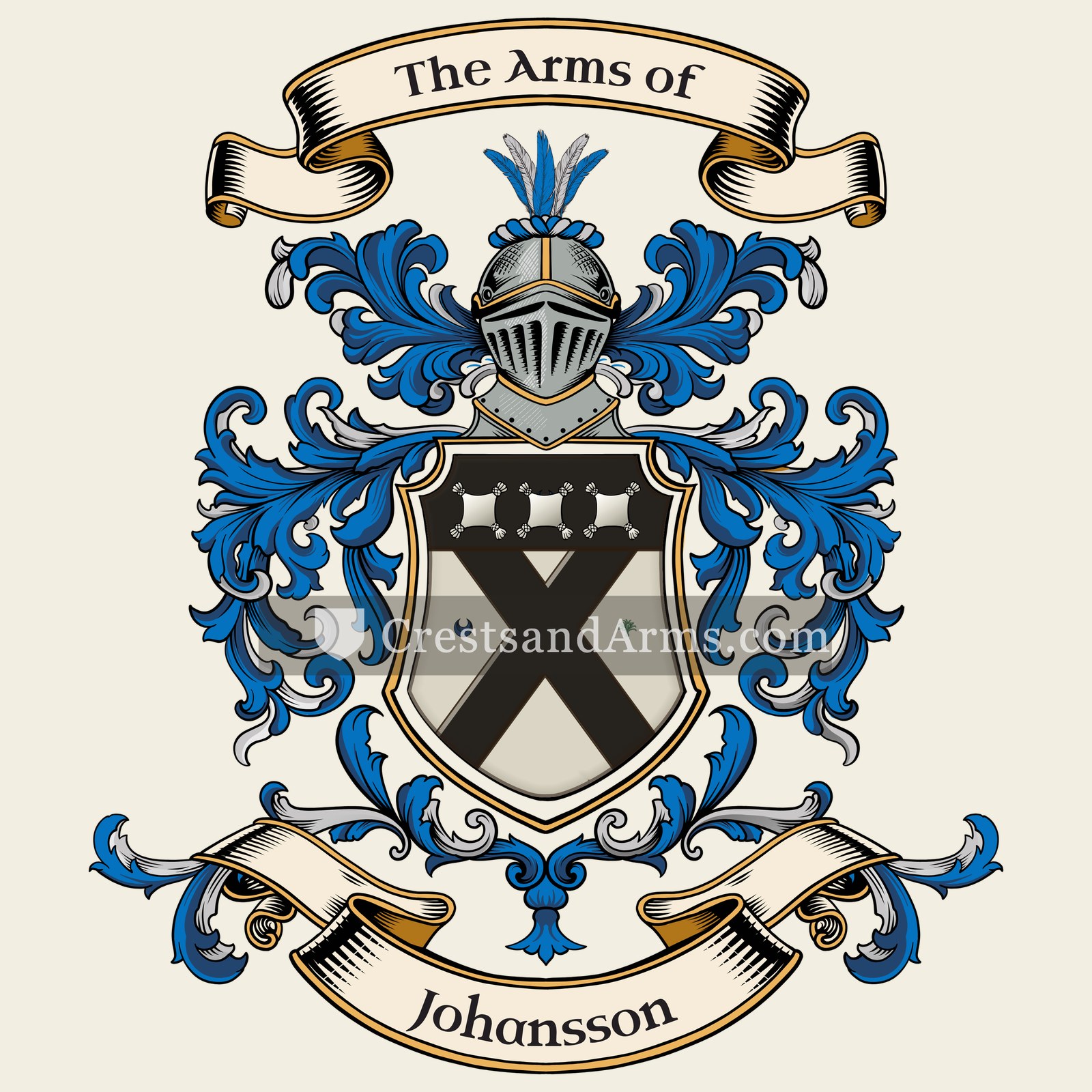
saltireResolution, and St Andrew's cross
chiefAuthority, wisdom and dominion
crescentHonour by the sovereign, and the second son
palm treeVictory, and righteousness that flourishes
pillowRest earned, and authority at ease
Colours
Silver (Argent)Means: Peace and sincerity
Black (Sable)Means: Constancy
Blue (Azure)Means: Loyalty and truth
Green (Vert)Means: Hope
Historical info
Source
Sir Bernard Burke, The General Armory of England, Scotland, Ireland and Wales, London: Harrison & Sons, 1884
Blazon (the actual original written record)
“Ar. a saltire sa. betw. an increscent and decrescent in the flanks az. and a palm branch in base vert, on a chief of the second three cushions of the first”
EdinburghEdinburgh, c. 1748
Digital archive packCoat of arms PNG, gold border print PDF, vector SVG and the certificate of authenticity. Sent to your email in minutes.
Map of Scotland showing where the Johansson arms are recorded
The Johansson arms were recorded in Edinburgh, c. 1748.
Edinburgh was the seat of Scotland's government, its courts and its heralds. Families with business there settled nearby, and being close to where arms were recorded is exactly why so many of them appear.
This is where the arms were entered in the register. Families often moved to other parts of the country, so the same name can turn up in more than one region.
The body that granted and recorded arms in Scotland in this period.
George II of Great Britain
Sovereign of the period
George II of Great Britain
1727–1760
Reigning in England when the Johansson arms are first recorded.
How Arms Worked in Scotland
Scottish heraldry is unique because it treats a coat of arms as a piece of personal property protected by law. Only one person can own a specific design at any given time. When a family grows, the head keeps the original shield while other relatives must apply for their own distinct version with slight changes to prove their specific identity.
Granting authority
The Court of the Lord Lyon acts as the official body that regulates and controls all heraldic matters throughout Scotland.
How they got arms
Individuals obtain a legal right to their arms through a formal petition process that confirms their identity and family connection.
Where arms were recorded
All valid coats of arms are officially entered into the Public Register of All Arms and Bearings starting from 1672.
The family's standing
Recorded among the armigerous families of Edinburgh.
Origin & History of the Johansson Family in Scotland
The history of the Johansson name in Scotland is a fascinating example of how Scandinavian roots integrated into the local culture of the eighteenth century. While the name is distinctly Swedish in origin, meaning son of Johan, records confirm that members of the family were firmly established in Edinburgh by 1748. During this period, Edinburgh was a hub of international trade and intellectual exchange, which likely drew merchants and skilled workers from across the North Sea. These early settlers did not simply pass through the city but became part of the local community, navigating the social and economic life of the Scottish capital. By settling in such a prominent urban center, the family contributed to the diverse demographic tapestry of the Enlightenment era. Their presence highlights the long history of migration between the Nordic countries and Scotland, showing how individuals maintained their unique heritage while adapting to life in a new land.
Related Branches & Arms
Root word
Iohannes
Hebrew origin meaning God is gracious.
This name
JohanssonA patronymic surname meaning son of John.
also spelled
Johnsen
Johnsson
Jonson
Jonsone
Documented Sources
Sir Bernard Burke, The General Armory of England, Scotland, Ireland and Wales, London: Harrison & Sons, 1884


 saltireResolution, and St Andrew's cross
 chiefAuthority, wisdom and dominion
 pillowRest earned, and authority at ease
 saltireResolution, and St Andrew's cross
 chiefAuthority, wisdom and dominion
 pillowRest earned, and authority at ease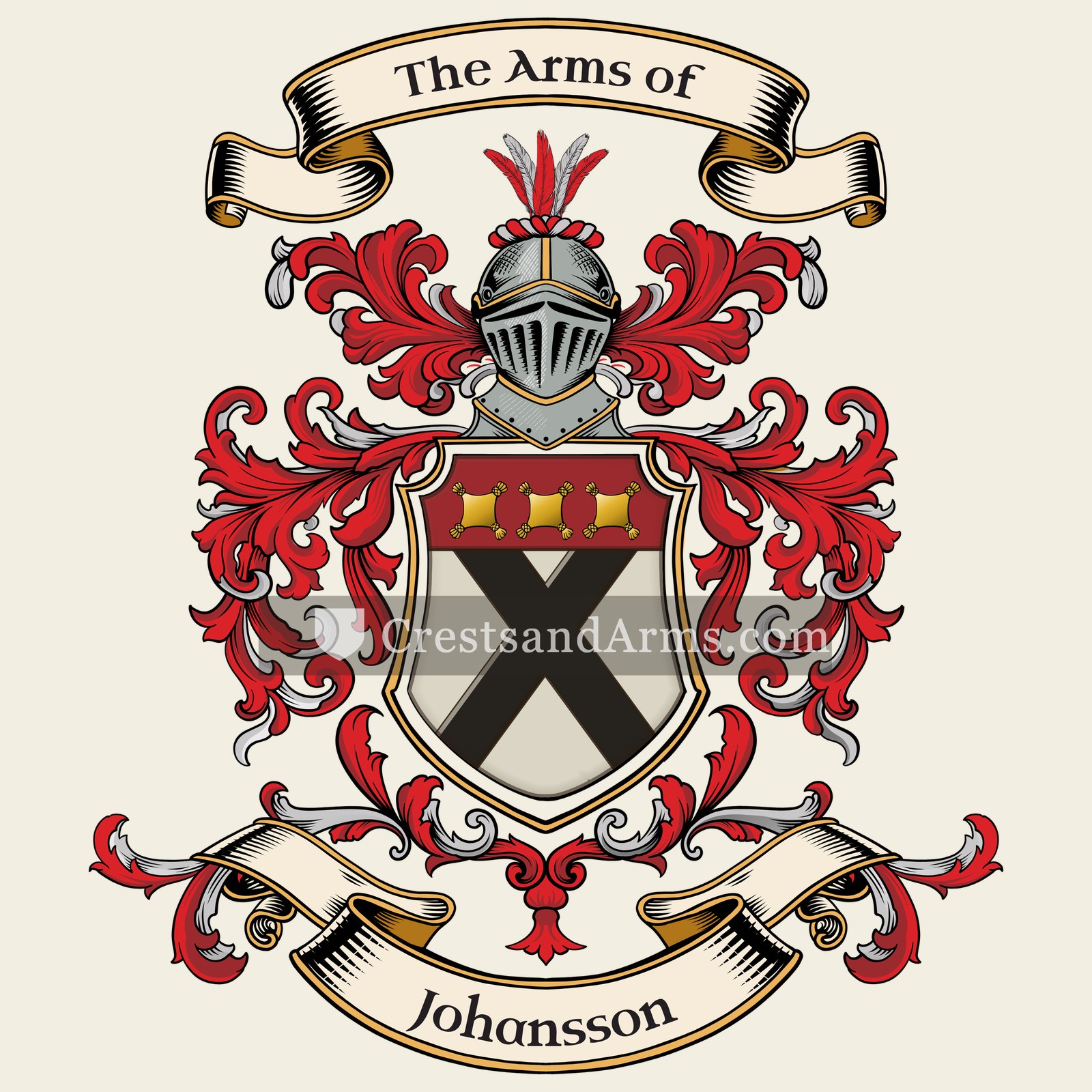


 chevronProtection, and faithful service completed
 fleur de lisPurity, light, and the sixth son
 escallopThe pilgrim's shell, and a long journey made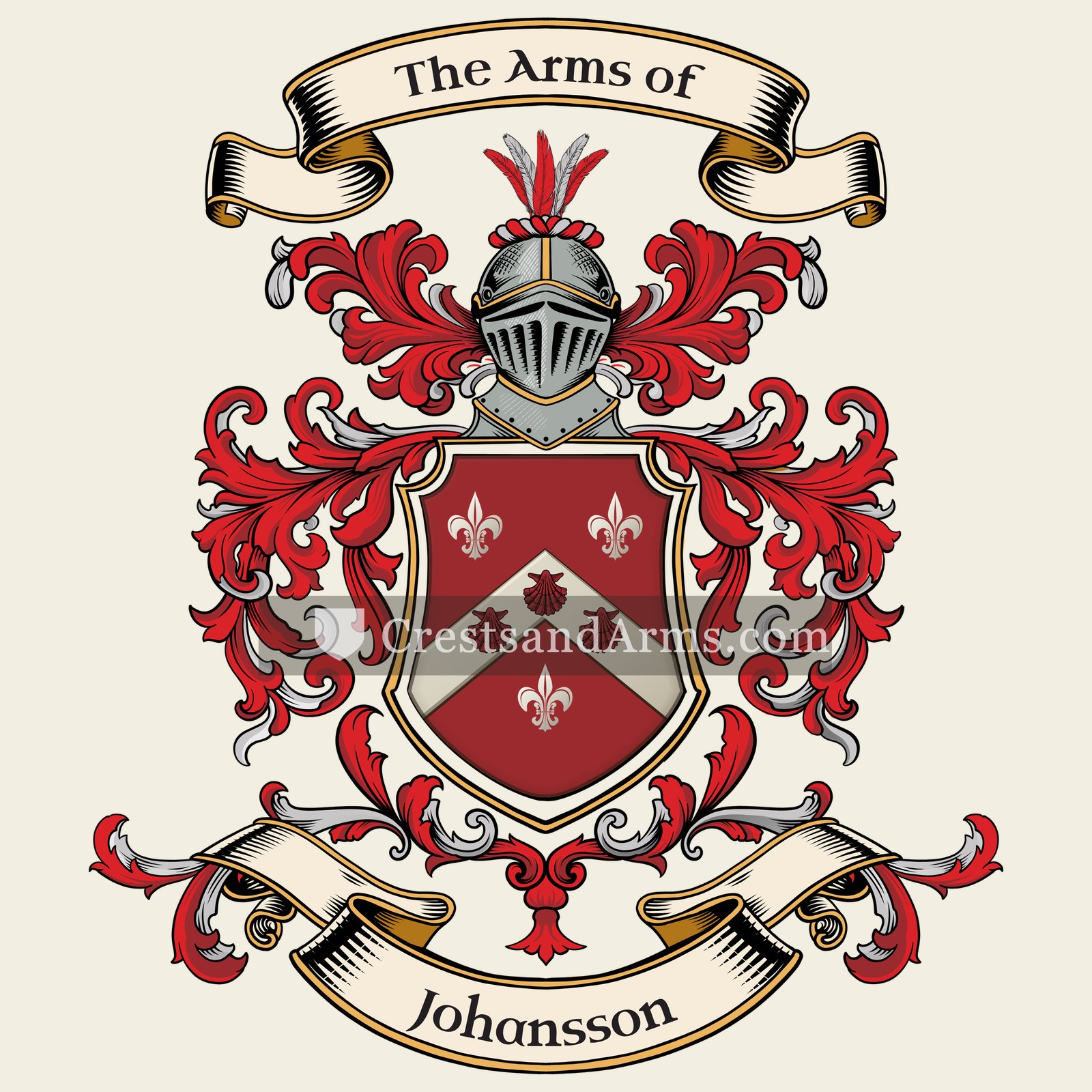


 crescentHonour by the sovereign, and the second son
 palm treeVictory, and righteousness that flourishes