A record of documented arms, meaning and origin, researched for the Johnston family lines. Documented in 3 countries.
Reg. 2300 · French, J–L
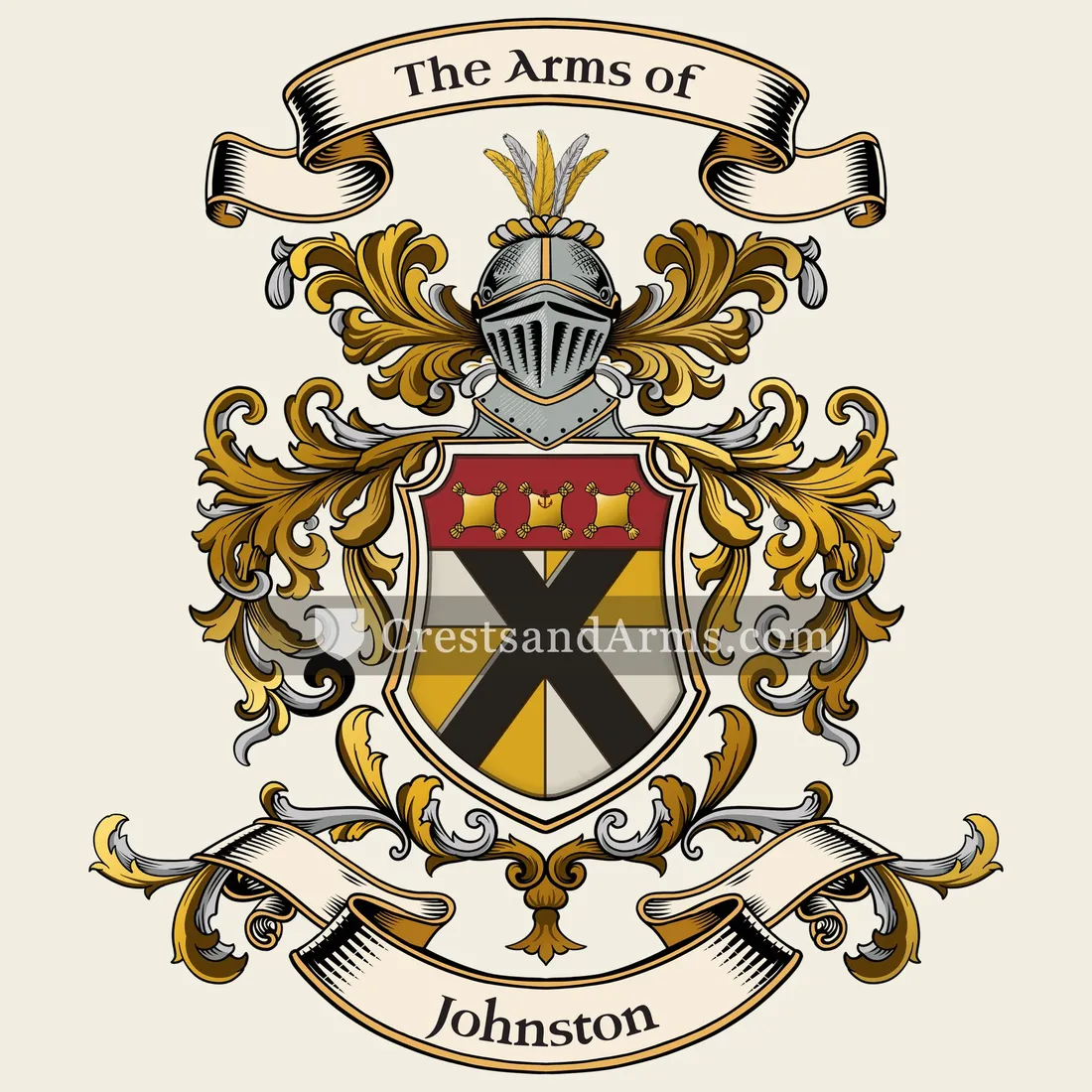
Meaning of the Johnston family crest colors & symbols
Symbols on this shield
saltireResolution, and St Andrew's cross
chiefAuthority, wisdom and dominion
pillowRest earned, and authority at ease
anchorHope, and steadfastness in trouble
Colours
Silver (Argent)Means: Peace and sincerity
Gold (Or)Means: Generosity
Black (Sable)Means: Constancy
Red (Gules)Means: Military strength
Historical info
Source
J. B. Rietstap, Armorial Général, Gouda: G. B. van Goor Zonen, 1884–87
Blazon (the actual original written record)
“Ec.: aux 1 et 4 d'arg. au saut. de sa. (Johnston); au chef de gu., ch. de trois coussins carrés d'or (Randolph); aux 2 et 3 d'or à une ancre de gu. (Fairholm). C.: un éperon d'or, la molette en haut, entre un vol d'arg. S.: à dextre un lion d'arg., arm. et lamp. d'azur, cour. d'or; à sen. un cheval d'arg., bridé, houssé et sanglé de gu. D.: NUNQUAM NON PARATUS.”
Francec. 1633
Digital archive packCoat of arms PNG, gold border print PDF, vector SVG and the certificate of authenticity. Sent to your email in minutes.
Map of France showing where the Johnston arms are recorded
The Johnston arms were recorded in France, c. 1633.
Arms such as these were typically recorded in Bretagne.
More families held coats of arms in Bretagne than anywhere else in France. The land was divided into many small estates rather than a few large ones, so far more households counted as gentry, and each needed a shield of its own to be told apart.
This is where the arms were entered in the register. Families often moved to other parts of the country, so the same name can turn up in more than one region.
The body that granted and recorded arms in France in this period.
Louis XIII of France
Sovereign of the period
Louis XIII of France
1617–1643
Reigning in France when the Johnston arms are first recorded.
How Arms Worked in France
In France, a coat of arms was a mark of honor that passed down through the male line to all legitimate descendants. Families often used the same shield without changes to show their shared heritage. If a branch wanted to stand out, they could add a small mark to their shield to show their specific place in the family tree.
Granting authority
The Juge d'armes de France acted as the official authority that regulated and verified coats of arms across the country.
How they got arms
Families typically inherited their arms from ancestors, though they could also receive them through royal grants or by proving their noble status.
Where arms were recorded
Coats of arms were officially recorded in the Armorial Général de France, which began its main collection in the year 1696.
The family's standing
Recorded among the armigerous families of France.
Origin & History of the Johnston Family in France
The history of the Johnston family within France is deeply connected to the movement of people across the English Channel during the seventeenth century. While the name is traditionally associated with Scottish origins, records confirm that members of the family were established in the region of Bretagne by 1633. During this period, the province of Bretagne served as a vital hub for trade and military cooperation between France and the British Isles. Families like the Johnstons often settled in coastal towns to facilitate commerce or to serve as intermediaries for merchants traveling between the two nations. Their presence in this specific part of France highlights the fluid nature of borders and the way families adapted to new cultural environments while maintaining their distinct ancestral identity. By integrating into the local society of Bretagne, these early family members became part of the complex social fabric of western France during a time of significant political change.
Meaning of the Johnston family crest colors & symbols
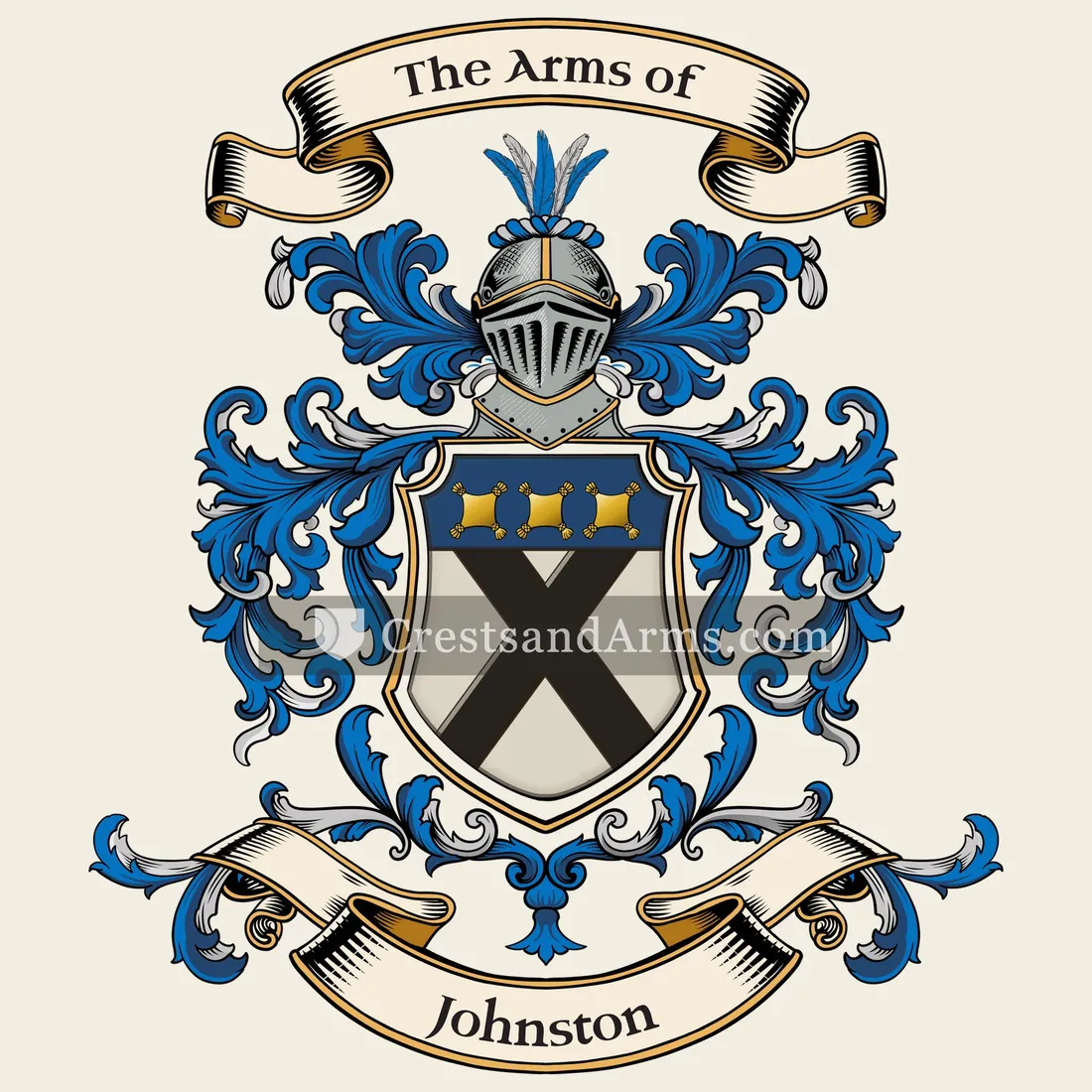
Symbols on this shield
saltireResolution, and St Andrew's cross
chiefAuthority, wisdom and dominion
pillowRest earned, and authority at ease
Colours
Silver (Argent)Means: Peace and sincerity
Black (Sable)Means: Constancy
Blue (Azure)Means: Loyalty and truth
Gold (Or)Means: Generosity
Historical info
Source
Sir Bernard Burke, The General Armory of England, Scotland, Ireland and Wales, London: Harrison & Sons, 1884
Blazon (the actual original written record)
“Ar. a saltire sa. on a chief az. three cushions or”
ArmaghKnappagh · Armagh, c. 1645
Digital archive packCoat of arms PNG, gold border print PDF, vector SVG and the certificate of authenticity. Sent to your email in minutes.
Map of Ireland showing where the Johnston arms are recorded
The Johnston arms were recorded in Armagh, c. 1645.
Armagh was the church capital of Ireland with good farmland around it. Church office and landholding both brought standing, and standing was marked with arms.
This is where the arms were entered in the register. Families often moved to other parts of the country, so the same name can turn up in more than one region.
The body that granted and recorded arms in Ireland in this period.
Charles I of England
Sovereign of the period
Charles I of England
1625–1649
Reigning in France when the Johnston arms are first recorded.
How Arms Worked in Ireland
The Ulster King of Arms granted coats of arms to individuals who proved their social standing and good character. These symbols were typically inherited by all legitimate descendants of the original holder. If a family branch wanted a unique look, they could apply for a specific change to their design through the office to ensure their identity remained distinct.
Granting authority
The Ulster King of Arms acted as the official body that regulated and issued all coats of arms throughout Ireland.
How they got arms
Families obtained their arms through formal grants issued by the office after proving their eligibility and paying the required fees.
Where arms were recorded
All official grants were recorded in the registers held by the Ulster King of Arms starting from the year 1552.
The family's standing
Recorded among the armigerous families of Armagh.
Origin & History of the Johnston Family in Ireland
The Johnston name in Ireland is deeply connected to the movement of people from the Scottish Borders to the province of Ulster during the seventeenth century. By 1645, records confirm that members of the family were established in County Armagh, a region that became a primary hub for these settlers. These families were part of a broader migration encouraged by the British Crown to develop land and stabilize the area. As they settled in Armagh, the Johnstons integrated into the local economy and social structure, often working as farmers or tradespeople. Over time, the name became firmly rooted in the landscape of the county, reflecting the transition of these families from newcomers to permanent residents of the Irish countryside.
Meaning of the Johnston family crest colors & symbols
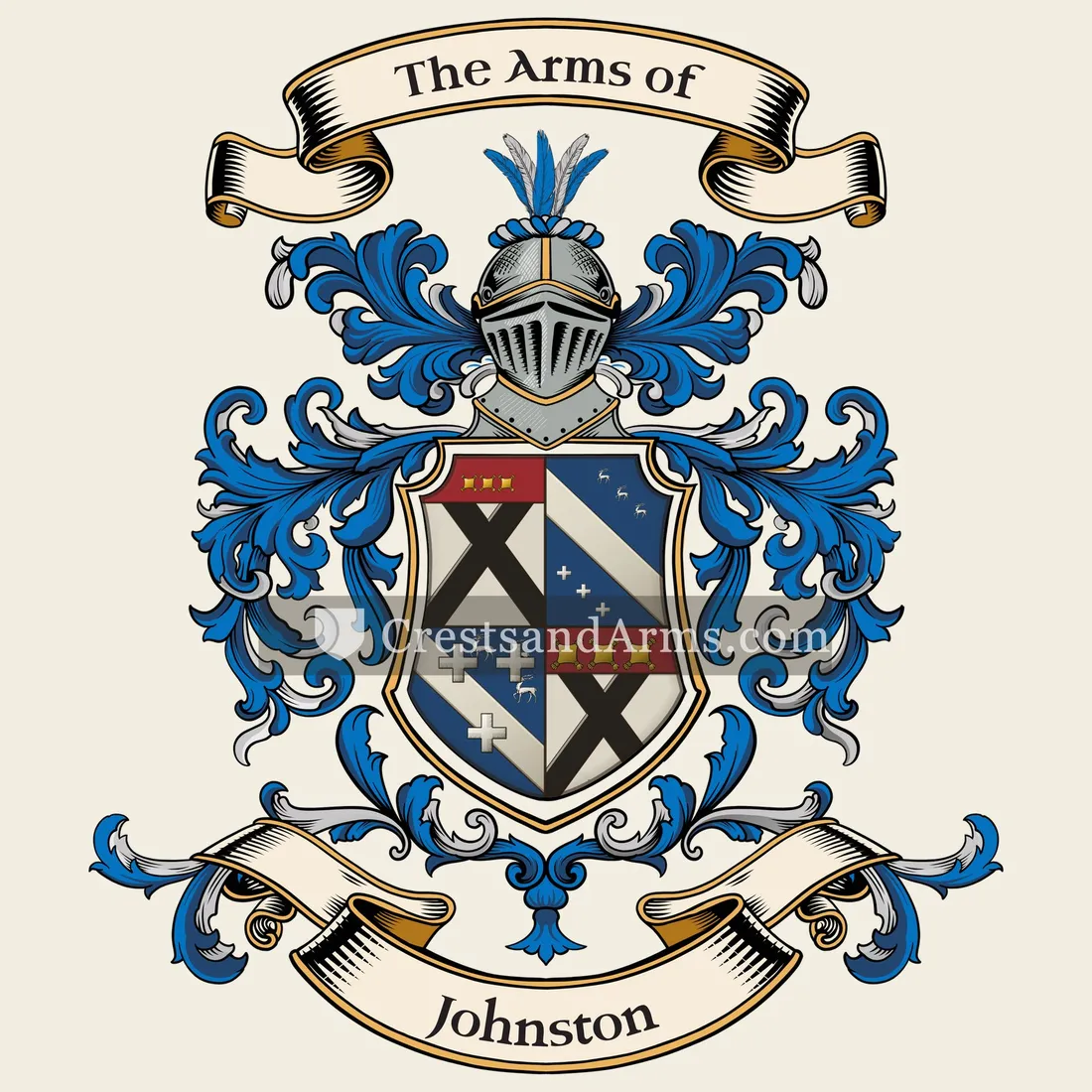
Symbols on this shield
saltireResolution, and St Andrew's cross
chiefAuthority, wisdom and dominion
bendDefence, and the scarf of a commander
cross symbolChristian faith and service
pillowRest earned, and authority at ease
stagPeace and harmony, and one who will not fight unprovoked
Colours
Silver (Argent)Means: Peace and sincerity
Blue (Azure)Means: Loyalty and truth
Black (Sable)Means: Constancy
Red (Gules)Means: Military strength
Gold (Or)Means: Generosity
Historical info
Source
Sir Bernard Burke, The General Armory of England, Scotland, Ireland and Wales, London: Harrison & Sons, 1884
Blazon (the actual original written record)
“Quarterly, 1st and 4th, ar. a saltire sa. and on a chief gu. three cushions or, for JOHNSTON; 2nd and 3rd, az. on a bend betw. three harts' heads erased ar. attired or, in chief, and as many crosses crosslet fitchée of the second in base”
AberdeenJohnston · Aberdeen, c. 1625
Digital archive packCoat of arms PNG, gold border print PDF, vector SVG and the certificate of authenticity. Sent to your email in minutes.
Map of Scotland showing where the Johnston arms are recorded
The Johnston arms were recorded in Aberdeen, c. 1625.
Aberdeen was a granite trading town on the north-east coast with farming country behind it. Merchants who prospered bought estates inland, and buying an estate was what brought a family its arms.
This is where the arms were entered in the register. Families often moved to other parts of the country, so the same name can turn up in more than one region.
The body that granted and recorded arms in Scotland in this period.
James VI and I
Sovereign of the period
James VI and I
1587–1625
Reigning in France when the Johnston arms are first recorded.
How Arms Worked in Scotland
Scottish heraldry is unique because it treats a coat of arms as a piece of personal property protected by law. Only one person can own a specific design at any given time. When a family grows, the head keeps the original shield while other relatives must apply for their own distinct version with slight changes to prove their specific identity.
Granting authority
The Court of the Lord Lyon acts as the official body that regulates and controls all heraldic matters throughout Scotland.
How they got arms
Individuals obtain a legal right to their arms through a formal petition process that confirms their identity and family connection.
Where arms were recorded
All valid coats of arms are officially entered into the Public Register of All Arms and Bearings starting from 1672.
The family's standing
Recorded among the armigerous families of Aberdeen.
Origin & History of the Johnston Family in Scotland
The name Johnston is a classic example of a patronymic surname, which means it was created by taking a father’s given name and adding a suffix to indicate descent. In this case, the name simply means the son of John. While the name appears across the British Isles, its roots in Scotland are deeply tied to the northern regions and the bustling port city of Aberdeen. By the early 17th century, families bearing this name were well-established members of the local community. Records from 1625 show that Johnstons were active participants in the civic and economic life of Aberdeen, often working as merchants or tradesmen during a period of significant urban growth. Because the name was common, it was adopted by many different families who were not necessarily related by blood. This makes the history of the name a reflection of the widespread popularity of the name John throughout Scottish history rather than a single family line.
Johnston Meaning & Related Branches
Root word
Johannes
God is gracious
This name
JohnstonA patronymic surname indicating descent from a person named John.
also spelled
Johnstoun
Jonston
Johnstone
Johnson
Related arms
Johnsonvariant spelling
Hillrecorded with Johnston, same area
Slingsbyrecorded with Johnston, same area
Documented Sources
J. B. Rietstap, Armorial Général, Gouda: G. B. van Goor Zonen, 1884–87
Archives départementales d'Ille-et-Vilaine, Série B, Fonds de la juridiction de Rennes
Augris, Patrick, Les relations entre la Bretagne et les îles Britanniques au XVIIe siècle, 1998
Le Gall, Jean-Marie, Les étrangers en Bretagne sous l'Ancien Régime, 2005
Digital archive packCoat of arms PNG, gold border print PDF, vector SVG and the certificate of authenticity. Sent to your email in minutes.


 saltireResolution, and St Andrew's cross
 chiefAuthority, wisdom and dominion
 pillowRest earned, and authority at ease
 anchorHope, and steadfastness in trouble
 saltireResolution, and St Andrew's cross
 chiefAuthority, wisdom and dominion
 pillowRest earned, and authority at ease
 anchorHope, and steadfastness in trouble




 bendDefence, and the scarf of a commander
 cross symbolChristian faith and service
 stagPeace and harmony, and one who will not fight unprovoked