Map of England showing where the Joines arms are recorded
The Joines arms were recorded in Oxford, c. 1465.
Oxfordshire was farming country with the university at its centre, and both produced families of standing. Scholars and lawyers who did well bought manors nearby, and holding a manor was the ordinary route to a coat of arms.
This is where the arms were entered in the register. Families often moved to other parts of the country, so the same name can turn up in more than one region.
The body that granted and recorded arms in England in this period.
Edward IV of England
Sovereign of the period
Edward IV of England
1461–1470
Reigning in England when the Joines arms are first recorded.
How Arms Worked in England
English heraldry allowed arms to be shared by all legitimate descendants of the original owner. These symbols were treated as personal property that moved through the generations to all children. While the eldest son kept the original design, other family members could use the same shield without needing to change it or register their own unique versions.
Granting authority
The College of Arms in London has regulated the use of coats of arms throughout England and Wales since 1484.
How they got arms
Families typically obtained their coats of arms through a formal grant from the Crown or by proving their ancient right to them.
Where arms were recorded
All official coats of arms are recorded in the registers kept at the College of Arms, which date back to the fifteenth century.
The family's standing
Recorded among the armigerous families of Oxford.
Origin & History of the Joines Family in England
The surname Joines traces its roots back to the medieval period in England, where it emerged as a variation of names derived from the personal name John. By the year 1465, records confirm that members of the family were well-established in the city of Oxford. During this era, Oxford was a thriving center of trade and scholarship, suggesting that early ancestors likely engaged in the local guild systems or provided essential services to the growing university community. As a patronymic name, Joines likely evolved as a way to identify individuals as the sons or descendants of a man named John. Over several generations, the spelling shifted from early forms into the version recognized today. This stability in the Oxford region indicates that the family was part of the settled middle class, contributing to the social and economic life of one of England’s most historic cities.
Meaning of the Joines family crest colors & symbols
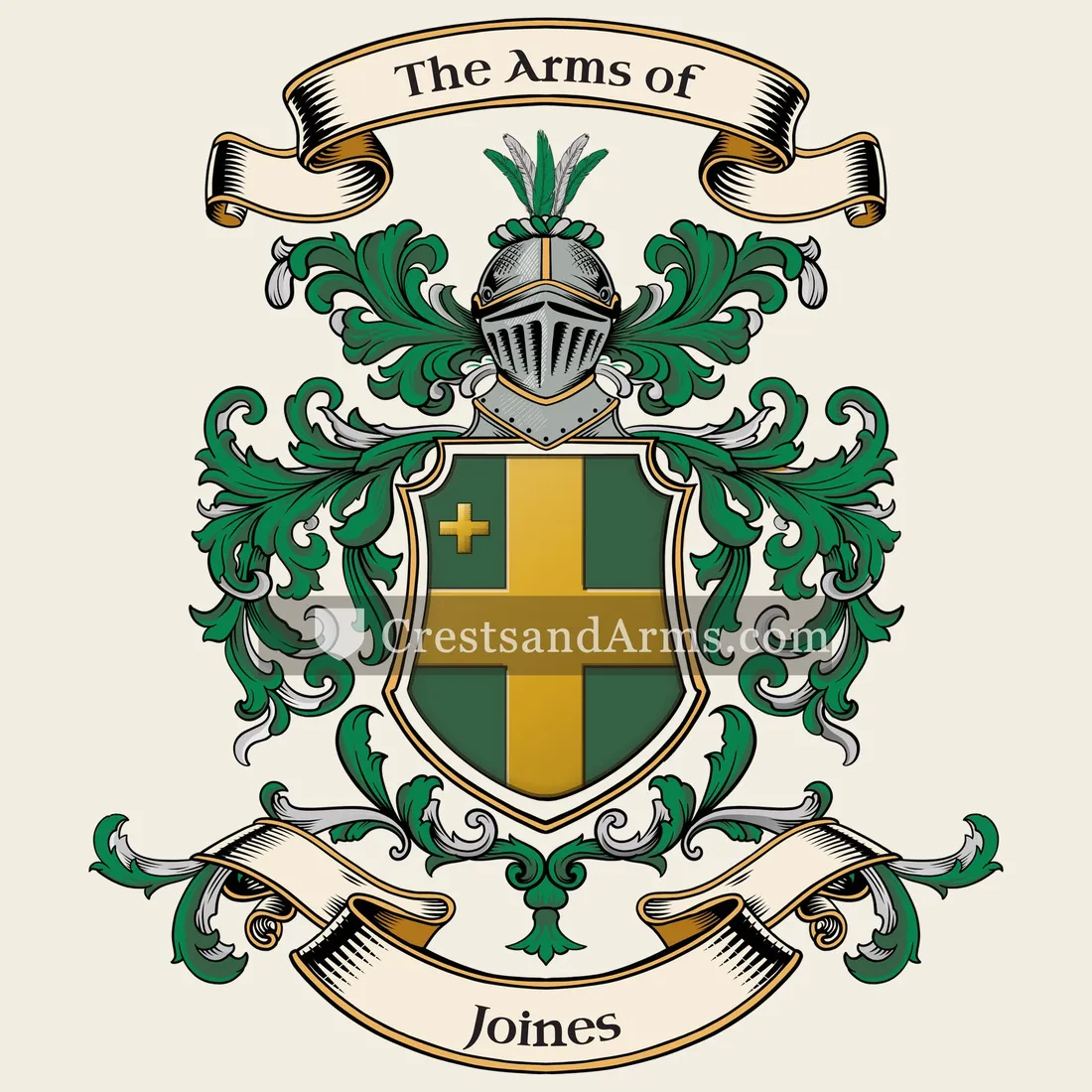
Symbols on this shield
chevronProtection, and faithful service completed
wolfReward from long service and hard work
Colours
Green (Vert)Means: Hope
Gold (Or)Means: Generosity
Historical info
Source
Sir Bernard Burke, The General Armory of England, Scotland, Ireland and Wales, London: Harrison & Sons, 1884
Blazon (the actual original written record)
“Vert a chev. betw. three wolves' heads or”
BreconBuckland · Brecon, c. 1647
Digital archive packCoat of arms PNG, gold border print PDF, vector SVG and the certificate of authenticity. Sent to your email in minutes.
Map of Wales showing where the Joines arms are recorded
The Joines arms were recorded in Brecon, c. 1647.
Brecon was mid-Welsh hill country, held in small estates by families who stayed for generations. Land was worth less than in the lowlands, but holding it still brought arms.
This is where the arms were entered in the register. Families often moved to other parts of the country, so the same name can turn up in more than one region.
The body that granted and recorded arms in Wales in this period.
Charles I of England
Sovereign of the period
Charles I of England
1625–1649
Reigning in England when the Joines arms are first recorded.
How Arms Worked in Wales
English heraldry allowed arms to be shared by all legitimate descendants of the original owner. These symbols were treated as personal property that moved through the generations to all children. While the eldest son kept the original design, other family members could use the same shield without needing to change it or register their own unique versions.
Granting authority
The College of Arms in London has regulated the use of coats of arms throughout England and Wales since 1484.
How they got arms
Families typically obtained their coats of arms through a formal grant from the Crown or by proving their ancient right to them.
Where arms were recorded
All official coats of arms are recorded in the registers kept at the College of Arms, which date back to the fifteenth century.
The family's standing
Recorded among the armigerous families of Brecon.
Origin & History of the Joines Family in Wales
The family name Joines likely emerged as a localized variation of the common Welsh patronymic naming system, which often evolved from the name John or Jones. By the mid-seventeenth century, the name was firmly established in the historic county of Breconshire. Records from 1647 confirm that members of the family were living in the town of Brecon during a period of significant political and social transition in Wales. At this time, families in the region were deeply connected to the local landscape and the agricultural economy of the Usk Valley. The transition from traditional Welsh naming customs to the more rigid English style of fixed surnames helped solidify the spelling of Joines as a distinct branch of the broader Jones lineage. This evolution reflects the broader integration of Welsh families into the administrative and legal structures of the seventeenth century.
Meaning of the Joines family crest colors & symbols
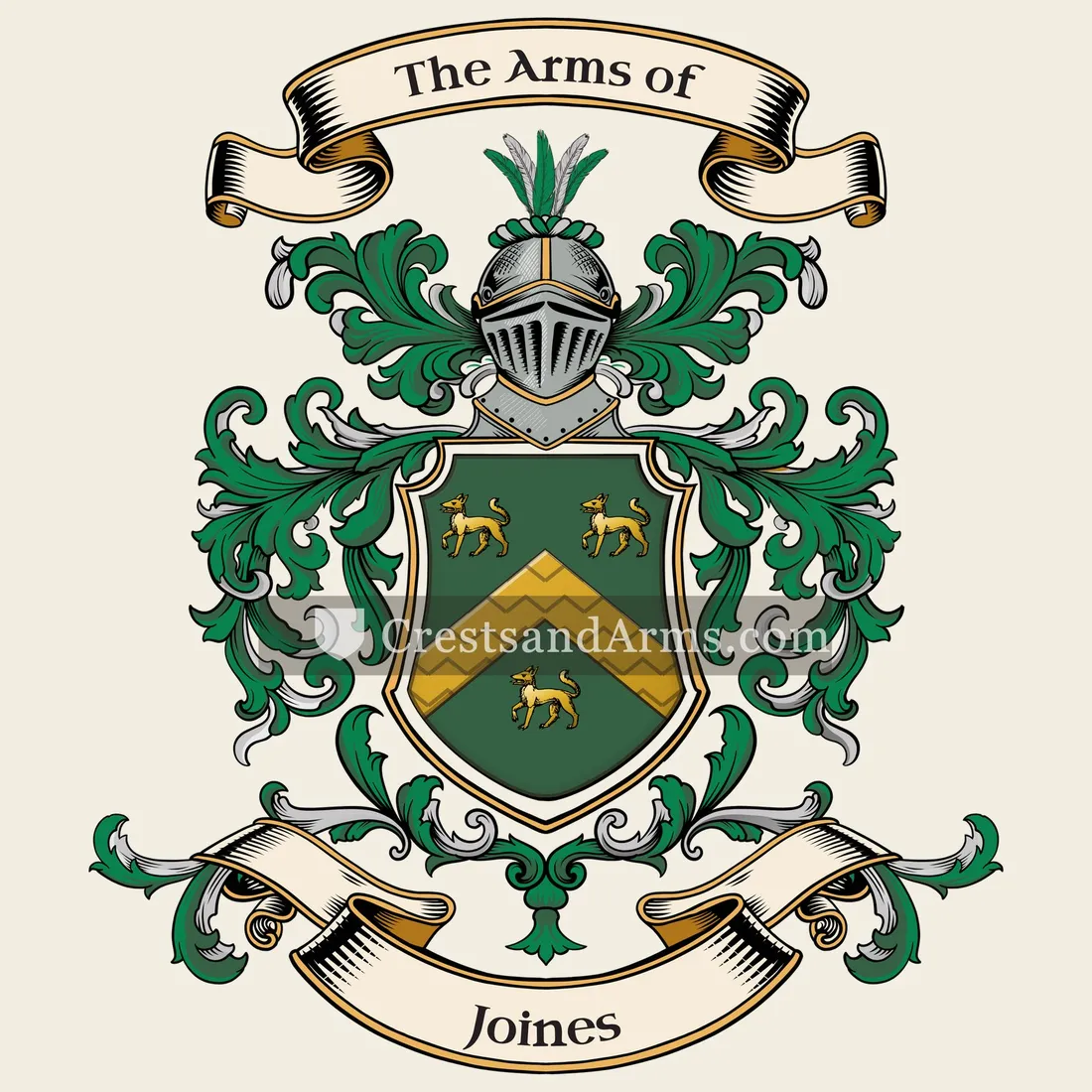
Symbols on this shield
cross symbolChristian faith and service
Colours
Green (Vert)Means: Hope
Gold (Or)Means: Generosity
Historical info
Source
Sir Bernard Burke, The General Armory of England, Scotland, Ireland and Wales, London: Harrison & Sons, 1884
Blazon (the actual original written record)
“Vert a cross crosslet or”
KildareKildare, c. 1603
Digital archive packCoat of arms PNG, gold border print PDF, vector SVG and the certificate of authenticity. Sent to your email in minutes.
Map of Ireland showing where the Joines arms are recorded
The Joines arms were recorded in Kildare, c. 1603.
Kildare was flat grazing country close to Dublin, taken early by Norman families. Being near the seat of government meant being near where arms were recorded, which is why so many Kildare names appear.
This is where the arms were entered in the register. Families often moved to other parts of the country, so the same name can turn up in more than one region.
The body that granted and recorded arms in Ireland in this period.
Elizabeth I of England
Sovereign of the period
Elizabeth I of England
1558–1603
Reigning in England when the Joines arms are first recorded.
How Arms Worked in Ireland
The Ulster King of Arms granted coats of arms to individuals who proved their social standing and good character. These symbols were typically inherited by all legitimate descendants of the original holder. If a family branch wanted a unique look, they could apply for a specific change to their design through the office to ensure their identity remained distinct.
Granting authority
The Ulster King of Arms acted as the official body that regulated and issued all coats of arms throughout Ireland.
How they got arms
Families obtained their arms through formal grants issued by the office after proving their eligibility and paying the required fees.
Where arms were recorded
All official grants were recorded in the registers held by the Ulster King of Arms starting from the year 1552.
The family's standing
Recorded among the armigerous families of Kildare.
Origin & History of the Joines Family in Ireland
The surname Joines carries a long history that is deeply rooted in the social landscape of seventeenth-century Ireland. Records confirm that members of the family were established in County Kildare by 1603, a period marked by significant political transition and the movement of settlers across the island. During this time, the name likely emerged as a variation of common English or Welsh occupational or descriptive surnames that were brought to the region. As these families settled into the fertile lands of Kildare, they became part of the local agricultural and administrative life of the province of Leinster. Over the following generations, the Joines family integrated into the local community, navigating the complex shifts in land ownership and social structures that defined early modern Irish history. Their presence in the region reflects the broader patterns of migration and settlement that shaped the demographic makeup of eastern Ireland during the early seventeenth century.
Joines Meaning & Related Branches
Root word
John
Derived from the Hebrew name Yochanan meaning God is gracious.
This name
JoinesA patronymic surname indicating descent from a person named John.
also spelled
Jons
Jonez
Jonses
Johnes
Joanes
Documented Sources
Sir Bernard Burke, The General Armory of England, Scotland, Ireland and Wales, London: Harrison & Sons, 1884
Reaney, P.H. and Wilson, R.M., A Dictionary of English Surnames, 1991
Oxford City Archives, Oxford City Council Records: Records of the Mayor’s Court, 1465
Digital archive packCoat of arms PNG, gold border print PDF, vector SVG and the certificate of authenticity. Sent to your email in minutes.


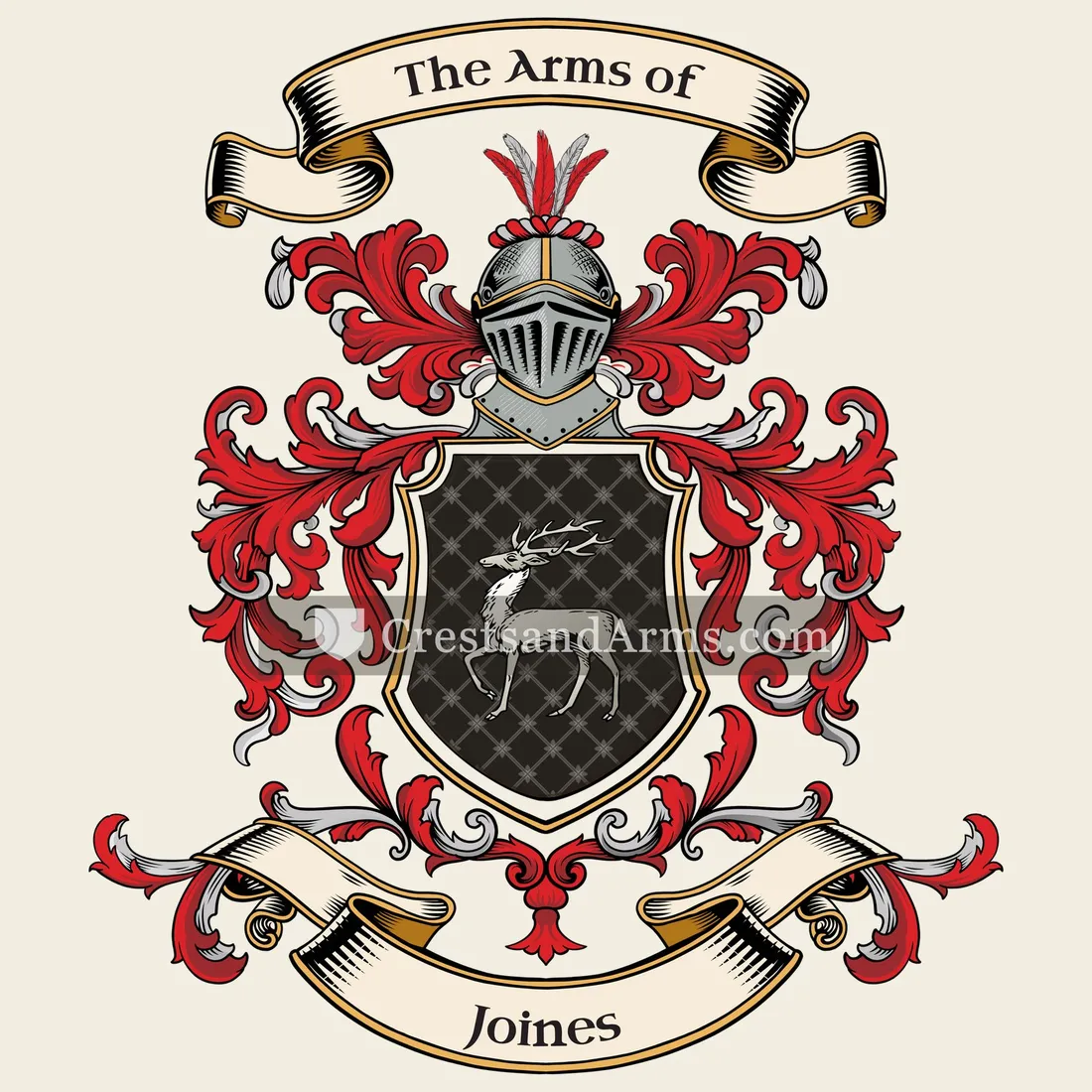
 stagPeace and harmony, and one who will not fight unprovoked
 stagPeace and harmony, and one who will not fight unprovoked


 chevronProtection, and faithful service completed
 wolfReward from long service and hard work

 cross symbolChristian faith and service