Map of France showing where the Joly arms are recorded
The Joly arms were recorded in Maine, c. 1663.
Maine was quiet farming country in western France, held in small manors by families who stayed for generations. Nothing about it was grand, but steady landholding is exactly what puts a name in the registers.
This is where the arms were entered in the register. Families often moved to other parts of the country, so the same name can turn up in more than one region.
The body that granted and recorded arms in France in this period.
Louis XIV of France
Sovereign of the period
Louis XIV of France
1643–1715
Reigning in France when the Joly arms are first recorded.
How Arms Worked in France
In France, a coat of arms was a mark of honor that passed down through the male line to all legitimate descendants. Families often used the same shield without changes to show their shared heritage. If a branch wanted to stand out, they could add a small mark to their shield to show their specific place in the family tree.
Granting authority
The Juge d'armes de France acted as the official authority that regulated and verified coats of arms across the country.
How they got arms
Families typically inherited their arms from ancestors, though they could also receive them through royal grants or by proving their noble status.
Where arms were recorded
Coats of arms were officially recorded in the Armorial Général de France, which began its main collection in the year 1696.
The family's standing
Recorded among the armigerous families of Maine.
Origin & History of the Joly Family in France
The surname Joly traces its roots back to medieval France, where it originated as a descriptive nickname. In Old French, the word *joli* meant joyful, lively, or pleasant, and it was likely given to someone with a cheerful personality or a bright disposition. As surnames became more common, this descriptor evolved into a hereditary family name. By the mid-17th century, the Joly family had established a presence in the historical province of Maine, located in the northwestern part of France. Records confirm that members of this family were living in the region by 1663, during a time when many French families were beginning to document their lineages more formally. These early ancestors were part of the rural society of Maine, likely working as farmers or tradespeople who helped shape the local culture of the region before some eventually sought new lives across the Atlantic.
Meaning of the Joly family crest colors & symbols
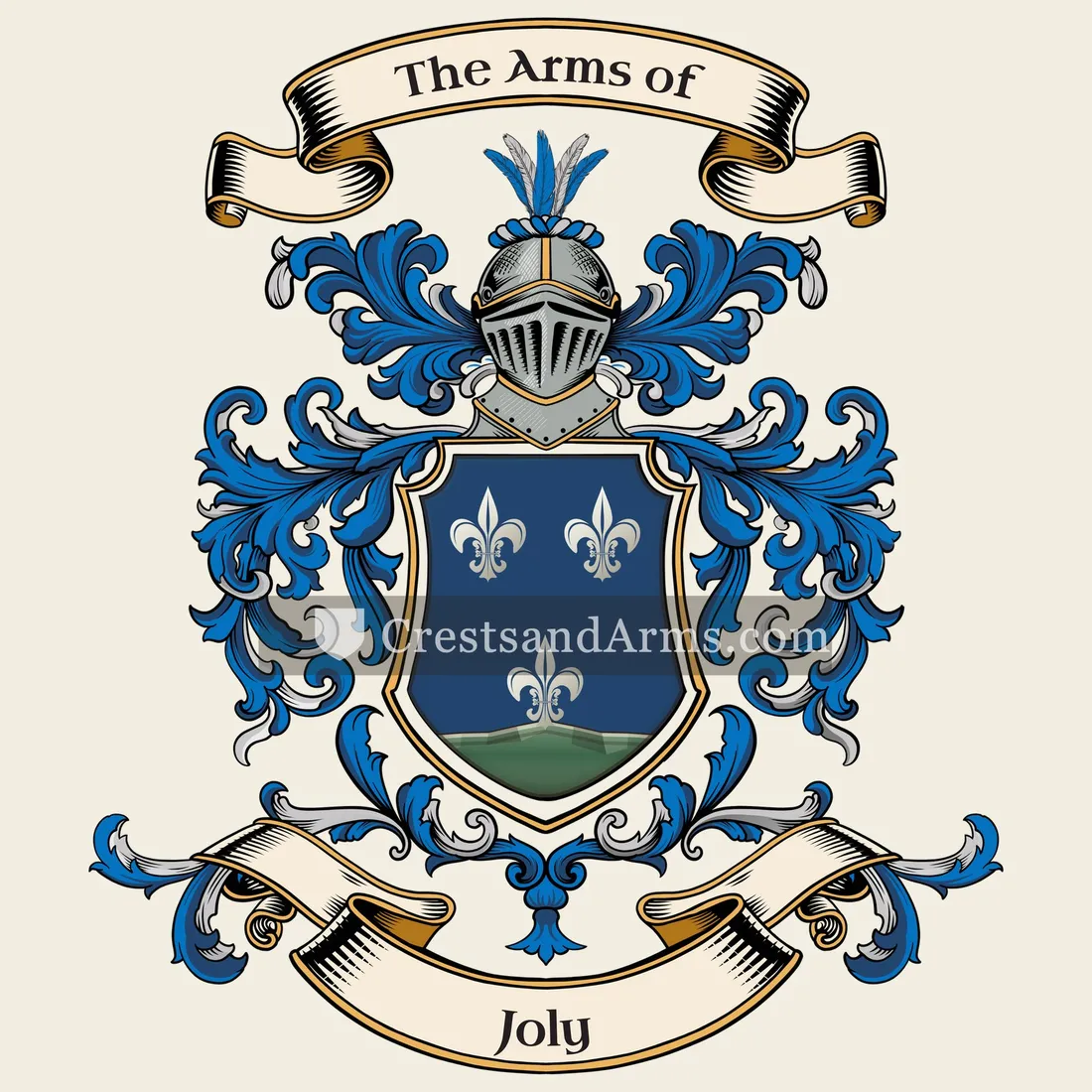
Symbols on this shield
mountThe ground held, and steadfastness upon it
fleur de lisPurity, light, and the sixth son
Colours
Blue (Azure)Means: Loyalty and truth
Green (Vert)Means: Hope
Silver (Argent)Means: Peace and sincerity
Historical info
Source
J. B. Rietstap, Armorial Général, Gouda: G. B. van Goor Zonen, 1884–87
Blazon (the actual original written record)
“D'azur à trois fleurs-de-lis héraldiques d'arg., tigées et feuillées du même, posées sur les trois coupeaux d'un tertre de sin.”
Switzerlandc. 1745
Digital archive packCoat of arms PNG, gold border print PDF, vector SVG and the certificate of authenticity. Sent to your email in minutes.
Map of Switzerland showing where the Joly arms are recorded
The Joly arms were recorded in Switzerland, c. 1745.
Arms such as these were typically recorded in Bern.
Bern was the largest of the Swiss cantons and ran itself, with its own council and its own courts. Its governing families held office for generations, and office of that kind carried a shield with it.
This is where the arms were entered in the register. Families often moved to other parts of the country, so the same name can turn up in more than one region.
The body that granted and recorded arms in Switzerland in this period.
How Arms Worked in Switzerland
In Switzerland, coats of arms were not restricted to the nobility and were often adopted by common citizens and families. These symbols were passed down through generations to show family identity. When branches of a family grew, they often changed small details of the design to distinguish their own line from the original group.
Granting authority
Cantonal and civic authorities managed the use of coats of arms within their specific regions and local jurisdictions.
How they got arms
Families typically assumed their own coats of arms based on local custom rather than receiving them from a central monarch.
Where arms were recorded
Arms were recorded in various cantonal and civic registers starting from the fourteenth century throughout the Swiss region.
The family's standing
Recorded among the armigerous families of Switzerland.
Origin & History of the Joly Family in Switzerland
The surname Joly has deep roots in the French-speaking regions of Switzerland, where it functioned as a descriptive nickname for a person with a cheerful or pleasant personality. While the name is widely associated with Francophone culture, its presence in the city of Bern by 1745 highlights the movement of families across linguistic borders within the Swiss Confederation. During the eighteenth century, Bern served as a central hub for trade and administration, attracting individuals from the Vaud and Neuchâtel regions who sought new opportunities in the capital. Families bearing this name often integrated into the local economy as skilled tradespeople or merchants, contributing to the steady growth of the urban population. By establishing themselves in a German-speaking stronghold, these early Joly settlers demonstrated the adaptability and interconnected nature of Swiss society during the late Enlightenment period.
Meaning of the Joly family crest colors & symbols
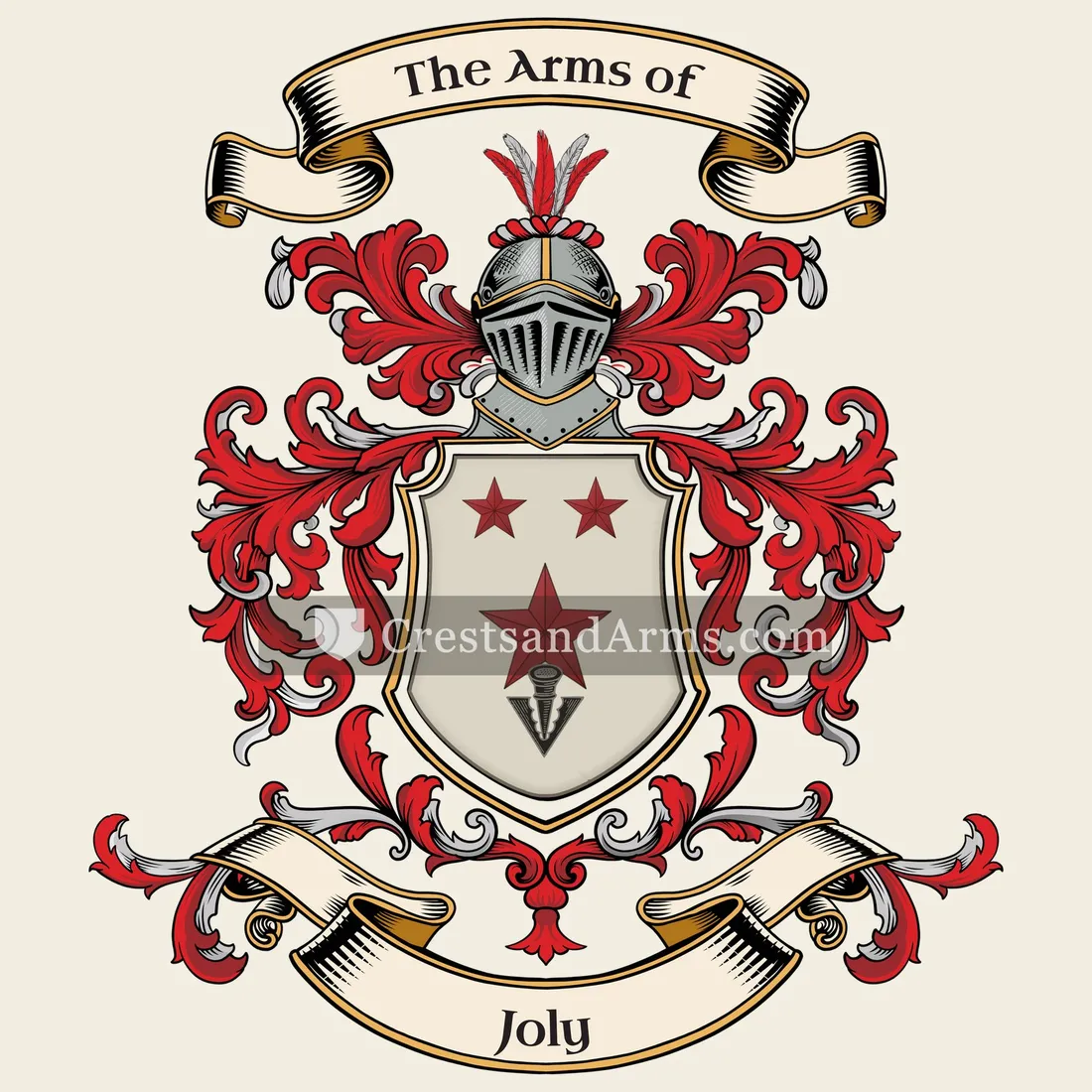
Symbols on this shield
mulletThe third son, and a divine quality from above
arms pheon arrowheadReadiness for battle, and the broad arrow of the sovereign
Colours
Silver (Argent)Means: Peace and sincerity
Red (Gules)Means: Military strength
Black (Sable)Means: Constancy
Historical info
Source
Sir Bernard Burke, The General Armory of England, Scotland, Ireland and Wales, London: Harrison & Sons, 1884
Blazon (the actual original written record)
“Ar. a mullet gu. betw. two mullets in chief and a pheon in base sa”
Englandc. 1620
Digital archive packCoat of arms PNG, gold border print PDF, vector SVG and the certificate of authenticity. Sent to your email in minutes.
Map of England showing where the Joly arms are recorded
The Joly arms were recorded in England, c. 1620.
Arms such as these were typically recorded in York.
Yorkshire is the largest of the English counties, and it held more gentry families than any other. Land there was split among a great many households rather than a few, so a great many of them carried arms.
This is where the arms were entered in the register. Families often moved to other parts of the country, so the same name can turn up in more than one region.
The body that granted and recorded arms in England in this period.
James VI and I
Sovereign of the period
James VI and I
1603–1625
Reigning in France when the Joly arms are first recorded.
How Arms Worked in England
English heraldry allowed arms to be shared by all legitimate descendants of the original owner. These symbols were treated as personal property that moved through the generations to all children. While the eldest son kept the original design, other family members could use the same shield without needing to change it or register their own unique versions.
Granting authority
The College of Arms in London has regulated the use of coats of arms throughout England and Wales since 1484.
How they got arms
Families typically obtained their coats of arms through a formal grant from the Crown or by proving their ancient right to them.
Where arms were recorded
All official coats of arms are recorded in the registers kept at the College of Arms, which date back to the fifteenth century.
The family's standing
Recorded among the armigerous families of England.
Origin & History of the Joly Family in England
The surname Joly has roots that stretch back to medieval France, where it originated as a descriptive nickname for a person with a cheerful or lively personality. By the early 17th century, the name had crossed the English Channel and established a presence in the historic city of York. Records from 1620 confirm that members of the Joly family were living in this northern hub during a time of significant social and religious change in England. As these early settlers integrated into the local community, they transitioned from being seen as outsiders to becoming part of the fabric of York’s urban life. Their presence in the city suggests they were likely involved in the local trades or merchant guilds that defined the economy of the region during the reign of King James I. Over the following decades, the family name evolved alongside the English language, maintaining its connection to its lighthearted origins while becoming firmly rooted in the history of Northern England.
Joly Meaning & Related Branches
Root word
Jolif
Old French term meaning pretty, pleasant, or merry.
This name
JolyA nickname for a cheerful, attractive, or lively person.
also spelled
Jolie
Jolley
Jolly
Joley
Jollie
Related arms
Genevièressame arms
Hunésame arms
Chenu de Thuetsimilar arms
Joleyvariant spelling
Documented Sources
J. B. Rietstap, Armorial Général, Gouda: G. B. van Goor Zonen, 1884–87
Dauzat, Albert. Dictionnaire étymologique des noms de famille et prénoms de France, 1951
Archives départementales de la Sarthe, Registres paroissiaux et d'état civil de la province du Maine, 1663
Digital archive packCoat of arms PNG, gold border print PDF, vector SVG and the certificate of authenticity. Sent to your email in minutes.


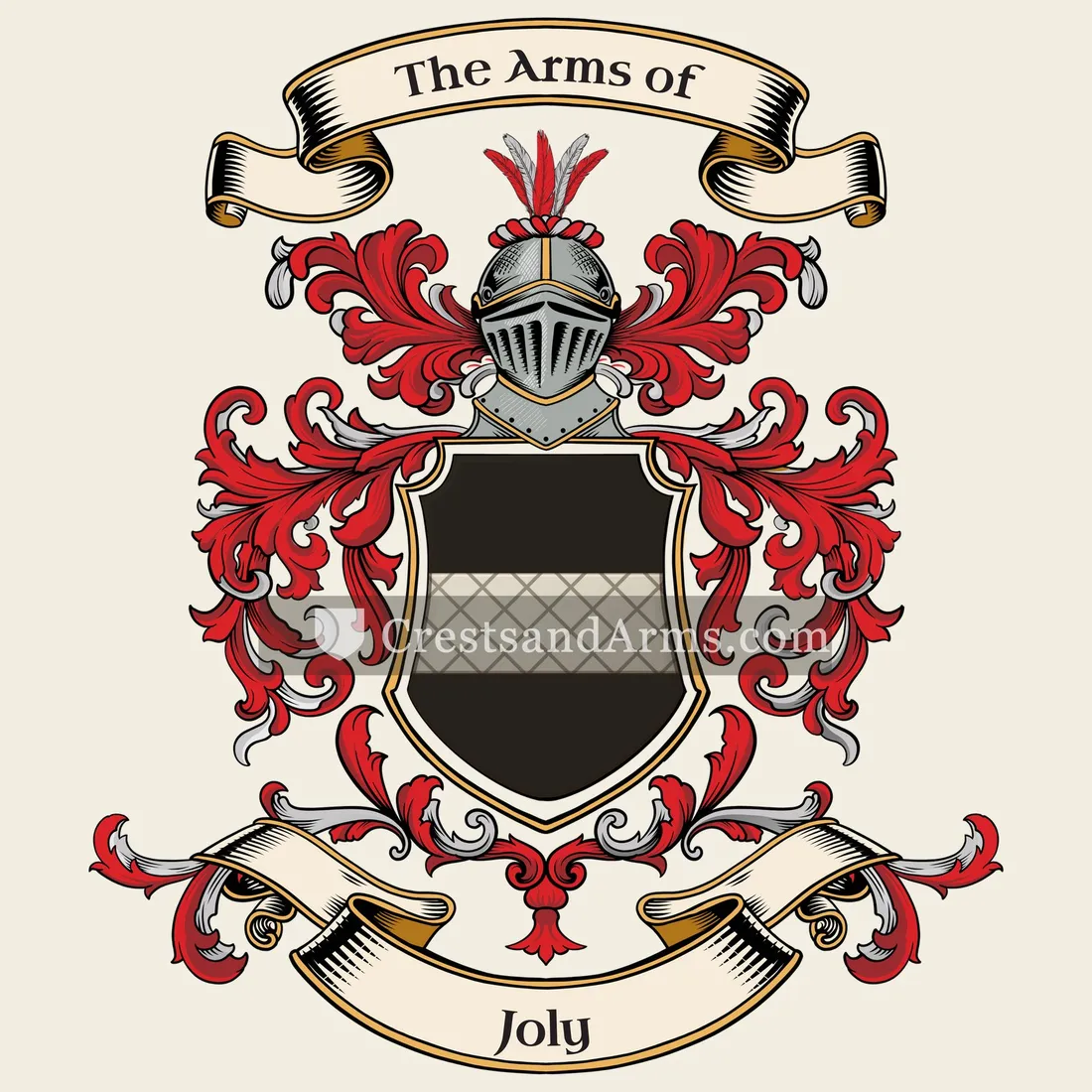
 fessThe military belt, and readiness to serve
 fessThe military belt, and readiness to serve


 mountThe ground held, and steadfastness upon it
 fleur de lisPurity, light, and the sixth son

 mulletThe third son, and a divine quality from above
 arms pheon arrowheadReadiness for battle, and the broad arrow of the sovereign