Map of England showing where the Joyner arms are recorded
The Joyner arms were recorded in Sussex, c. 1591.
Sussex had ironworks in its woods and good farmland on its downs. Both made money, and families who made it bought manors, which is what put their names in the heraldic records.
This is where the arms were entered in the register. Families often moved to other parts of the country, so the same name can turn up in more than one region.
The body that granted and recorded arms in England in this period.
Elizabeth I of England
Sovereign of the period
Elizabeth I of England
1558–1603
Reigning in England when the Joyner arms are first recorded.
How Arms Worked in England
English heraldry allowed arms to be shared by all legitimate descendants of the original owner. These symbols were treated as personal property that moved through the generations to all children. While the eldest son kept the original design, other family members could use the same shield without needing to change it or register their own unique versions.
Granting authority
The College of Arms in London has regulated the use of coats of arms throughout England and Wales since 1484.
How they got arms
Families typically obtained their coats of arms through a formal grant from the Crown or by proving their ancient right to them.
Where arms were recorded
All official coats of arms are recorded in the registers kept at the College of Arms, which date back to the fifteenth century.
The family's standing
Recorded among the armigerous families of Sussex.
Origin & History of the Joyner Family in England
The surname Joyner is an occupational name that emerged in medieval England to describe a skilled woodworker. During this period, a joiner was a craftsman who specialized in fine woodwork, such as furniture making and interior paneling, which required joining pieces of wood together using complex joints rather than just nails. By the late sixteenth century, the family had established a notable presence in the county of Sussex. Historical records confirm that members of the Joyner family were living in this region by 1591, likely working as tradespeople within the local communities. As the name was tied to a specific profession, it was common for families to adopt it as they moved between villages and towns to find work. This connection to the craft of joinery highlights how early surnames often served as a permanent record of a family’s primary trade and contribution to the local economy.
Coat of Arms & Family Crest Details
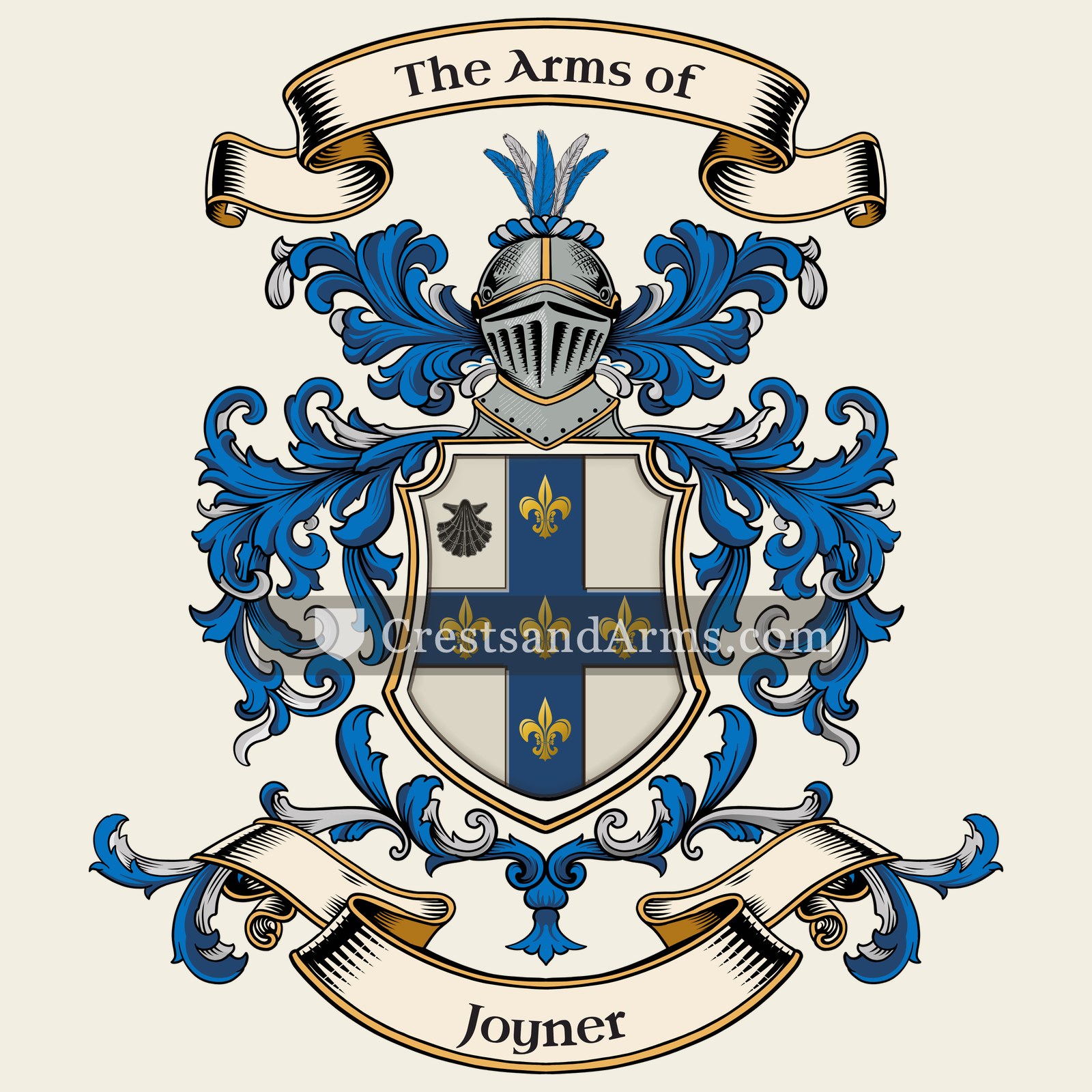
Symbols on this shield
cross symbolChristian faith and service
fleur de lisPurity, light, and the sixth son
escallopThe pilgrim's shell, and a long journey made
Colours
Silver (Argent)Means: Peace and sincerity
Blue (Azure)Means: Loyalty and truth
Gold (Or)Means: Generosity
Historical info
Source
Sir Bernard Burke, The General Armory of England, Scotland, Ireland and Wales, London: Harrison & Sons, 1884
Blazon (the actual original written record)
“Ar. on a cross engr. az. five fleurs-de-lis or, in the 1st quarter an escallop charged with a mullet for diff”
IrelandDeputy Vice-Treasurer, c. 1607
Digital archive packCoat of arms PNG, gold border print PDF, vector SVG and the certificate of authenticity. Sent to your email in minutes.
Map of Ireland showing where the Joyner arms are recorded
The Joyner arms were recorded in Deputy Vice-Treasurer, c. 1607.
Arms such as these were typically recorded in Dublin.
Dublin was the seat of government in Ireland and the place where grants were sought and recorded. Families with business at the castle or the courts settled nearby, and settling there put their arms on record.
This is where the arms were entered in the register. Families often moved to other parts of the country, so the same name can turn up in more than one region.
The body that granted and recorded arms in Ireland in this period.
James VI and I
Sovereign of the period
James VI and I
1603–1625
Reigning in England when the Joyner arms are first recorded.
How Arms Worked in Ireland
The Ulster King of Arms granted coats of arms to individuals who proved their social standing and good character. These symbols were typically inherited by all legitimate descendants of the original holder. If a family branch wanted a unique look, they could apply for a specific change to their design through the office to ensure their identity remained distinct.
Granting authority
The Ulster King of Arms acted as the official body that regulated and issued all coats of arms throughout Ireland.
How they got arms
Families obtained their arms through formal grants issued by the office after proving their eligibility and paying the required fees.
Where arms were recorded
All official grants were recorded in the registers held by the Ulster King of Arms starting from the year 1552.
The family's standing
Recorded among the armigerous families of Ireland.
Origin & History of the Joyner Family in Ireland
The Joyner family name carries a history deeply connected to the trade of woodworking, as the name itself is an occupational surname derived from the Middle English word for a carpenter. By the early seventeenth century, members of the family were firmly established in Dublin, appearing in official records as early as 1607. During this period, Dublin was a bustling center of commerce and administration where skilled craftsmen were essential for the city's ongoing expansion. Families like the Joyners often played a vital role in the urban economy by constructing furniture and interior woodwork for the growing population of merchants and officials. Their presence in the city during this time suggests they were part of a rising class of artisans who helped shape the physical landscape of early modern Dublin. As the family became more integrated into Irish society, they moved beyond their original trade to participate in the broader social and economic life of the region.
Related Branches & Arms
Root word
joiner
A skilled woodworker who constructs furniture and interior fittings.
This name
JoynerAn occupational surname for a carpenter or craftsman who joins pieces of wood together.
also spelled
Joiner
Joynour
Related arms
Fellowesrecorded with Joyner, same area
Knightrecorded with Joyner, same area
Documented Sources
Sir Bernard Burke, The General Armory of England, Scotland, Ireland and Wales, London: Harrison & Sons, 1884
Bardsley, Charles Wareing, A Dictionary of English and Welsh Surnames, 1901
Reaney, P.H., A Dictionary of British Surnames, 1958
The National Archives, Sussex Probate Records, 1591
Digital archive packCoat of arms PNG, gold border print PDF, vector SVG and the certificate of authenticity. Sent to your email in minutes.


 bendDefence, and the scarf of a commander
 eagleNobility, strength and a keen mind
 bendDefence, and the scarf of a commander
 eagleNobility, strength and a keen mind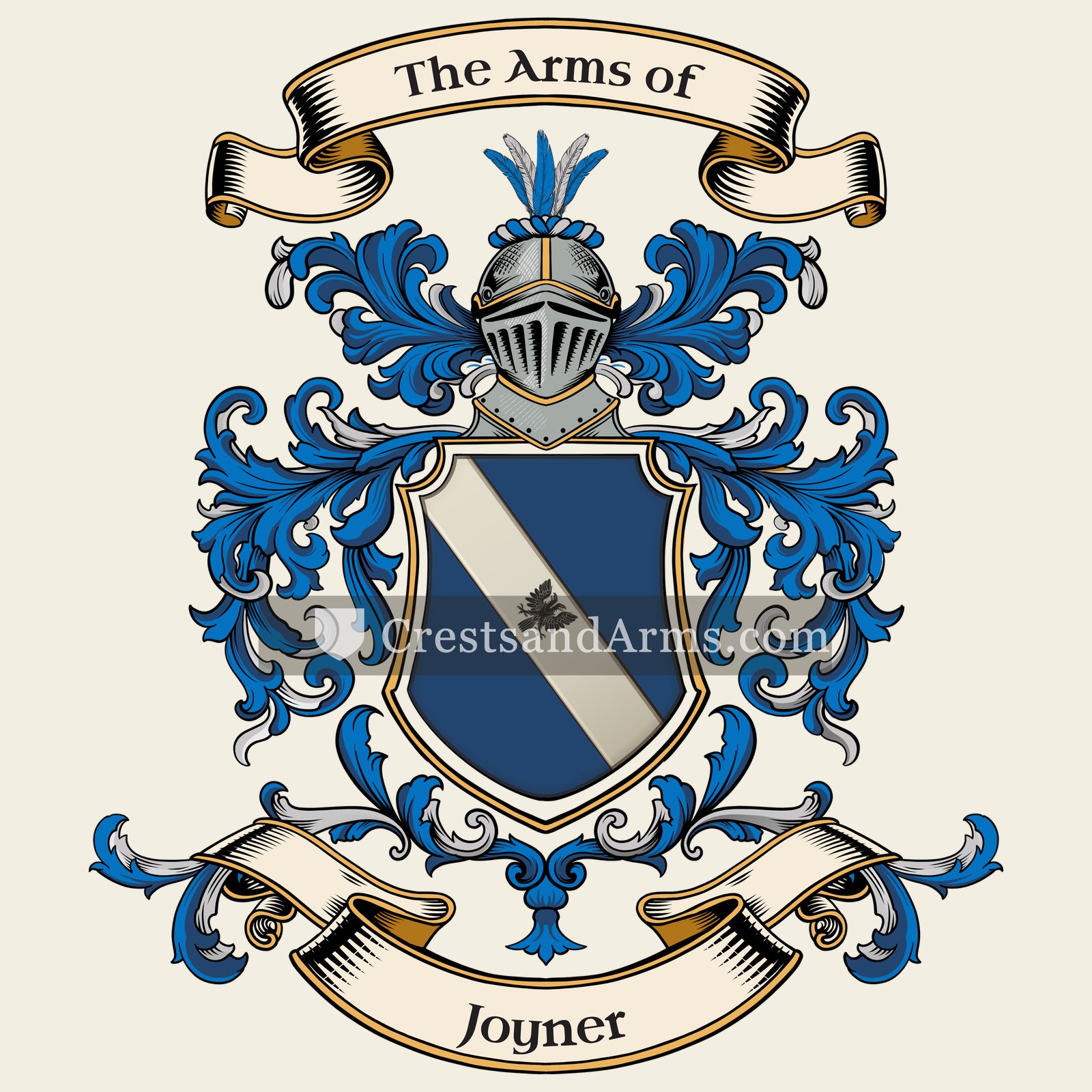


 cross symbolChristian faith and service
 fleur de lisPurity, light, and the sixth son
 escallopThe pilgrim's shell, and a long journey made