Map of France showing where the Juhlin arms are recorded
The Juhlin arms were recorded in Provence, c. 1663.
Provence was old country, with towns dating to the Romans and families who traced their land back nearly as far. Its gentry were many and long-settled, and long settlement is what fills a register.
This is where the arms were entered in the register. Families often moved to other parts of the country, so the same name can turn up in more than one region.
The body that granted and recorded arms in France in this period.
Louis XIV of France
Sovereign of the period
Louis XIV of France
1643–1715
Reigning in France when the Juhlin arms are first recorded.
How Arms Worked in France
In France, a coat of arms was a mark of honor that passed down through the male line to all legitimate descendants. Families often used the same shield without changes to show their shared heritage. If a branch wanted to stand out, they could add a small mark to their shield to show their specific place in the family tree.
Granting authority
The Juge d'armes de France acted as the official authority that regulated and verified coats of arms across the country.
How they got arms
Families typically inherited their arms from ancestors, though they could also receive them through royal grants or by proving their noble status.
Where arms were recorded
Coats of arms were officially recorded in the Armorial Général de France, which began its main collection in the year 1696.
The family's standing
Recorded among the armigerous families of Provence.
Origin & History of the Juhlin Family in France
The history of the Juhlin name in France begins in the sun-drenched region of Provence during the mid-seventeenth century. Records confirm that family members were established there by 1663, living in a time when the region was a vibrant center of trade and cultural exchange. During this period, Provence was transitioning under the absolute rule of King Louis XIV, which brought significant changes to local administration and social life. Families like the Juhlins often navigated these shifts by integrating into the local economy, likely working in agriculture or the growing artisanal industries that defined southern French life. While the name itself carries roots that suggest a connection to northern European linguistic traditions, its presence in Provence highlights the movement of people across borders during an era of religious and political transformation. By settling in this Mediterranean landscape, the early Juhlins became part of the complex social fabric of seventeenth-century France, contributing to the development of their local communities long before the name spread further across the continent.
Coat of Arms & Family Crest Details
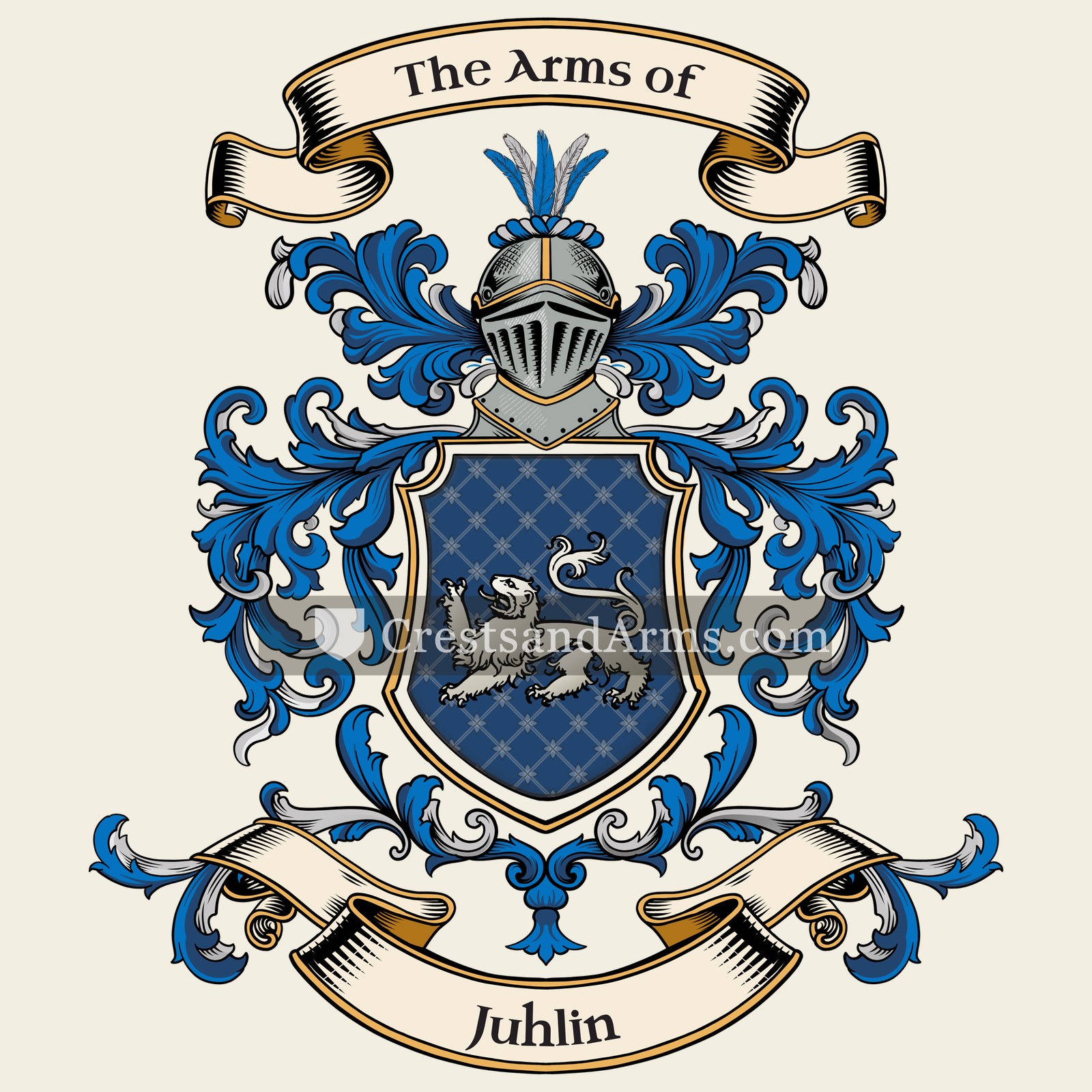
Symbols on this shield
lionCourage, strength and royalty
Colours
Blue (Azure)Means: Loyalty and truth
Silver (Argent)Means: Peace and sincerity
Historical info
Source
Sir Bernard Burke, The General Armory of England, Scotland, Ireland and Wales, London: Harrison & Sons, 1884
Blazon (the actual original written record)
“Az. a lion ramp. ar. wielding a sword ppr”
Englandc. 1620
Digital archive packCoat of arms PNG, gold border print PDF, vector SVG and the certificate of authenticity. Sent to your email in minutes.
Map of England showing where the Juhlin arms are recorded
The Juhlin arms were recorded in England, c. 1620.
Arms such as these were typically recorded in York.
Yorkshire is the largest of the English counties, and it held more gentry families than any other. Land there was split among a great many households rather than a few, so a great many of them carried arms.
This is where the arms were entered in the register. Families often moved to other parts of the country, so the same name can turn up in more than one region.
The body that granted and recorded arms in England in this period.
James VI and I
Sovereign of the period
James VI and I
1603–1625
Reigning in France when the Juhlin arms are first recorded.
How Arms Worked in England
English heraldry allowed arms to be shared by all legitimate descendants of the original owner. These symbols were treated as personal property that moved through the generations to all children. While the eldest son kept the original design, other family members could use the same shield without needing to change it or register their own unique versions.
Granting authority
The College of Arms in London has regulated the use of coats of arms throughout England and Wales since 1484.
How they got arms
Families typically obtained their coats of arms through a formal grant from the Crown or by proving their ancient right to them.
Where arms were recorded
All official coats of arms are recorded in the registers kept at the College of Arms, which date back to the fifteenth century.
The family's standing
Recorded among the armigerous families of England.
Origin & History of the Juhlin Family in England
The family name Juhlin carries a distinct history that traces back to the early seventeenth century in the city of York. By 1620, records confirm that members of the family were already established within this northern English hub, a time when York served as a vital center for trade and regional governance. During this era, families often settled in such cities to participate in the growing merchant guilds or to support the administrative needs of the local church and state. Because the name Juhlin is rooted in linguistic traditions from Northern Europe, its presence in York suggests that these early ancestors may have arrived as part of the steady movement of skilled workers and traders crossing the North Sea. These individuals integrated into the local community, contributing to the social and economic fabric of York while maintaining the unique identity of their name across generations.
Related Branches & Arms
Root word
Julius
Derived from the Roman family name Iulius meaning downy-bearded.
This name
JuhlinA locative or patronymic surname likely referring to a descendant of someone named Jules.
also spelled
Julian
Documented Sources
J. B. Rietstap, Armorial Général, Gouda: G. B. van Goor Zonen, 1884–87
Archives départementales des Bouches-du-Rhône, Registres paroissiaux et d'état civil
Benoît, Fernand, La Provence et le Comtat Venaissin, 1949
Le Roy Ladurie, Emmanuel, Histoire de la France des régions: La Provence, 2001
Digital archive packCoat of arms PNG, gold border print PDF, vector SVG and the certificate of authenticity. Sent to your email in minutes.


 saltireResolution, and St Andrew's cross
 chiefAuthority, wisdom and dominion
 mulletThe third son, and a divine quality from above
 saltireResolution, and St Andrew's cross
 chiefAuthority, wisdom and dominion
 mulletThe third son, and a divine quality from above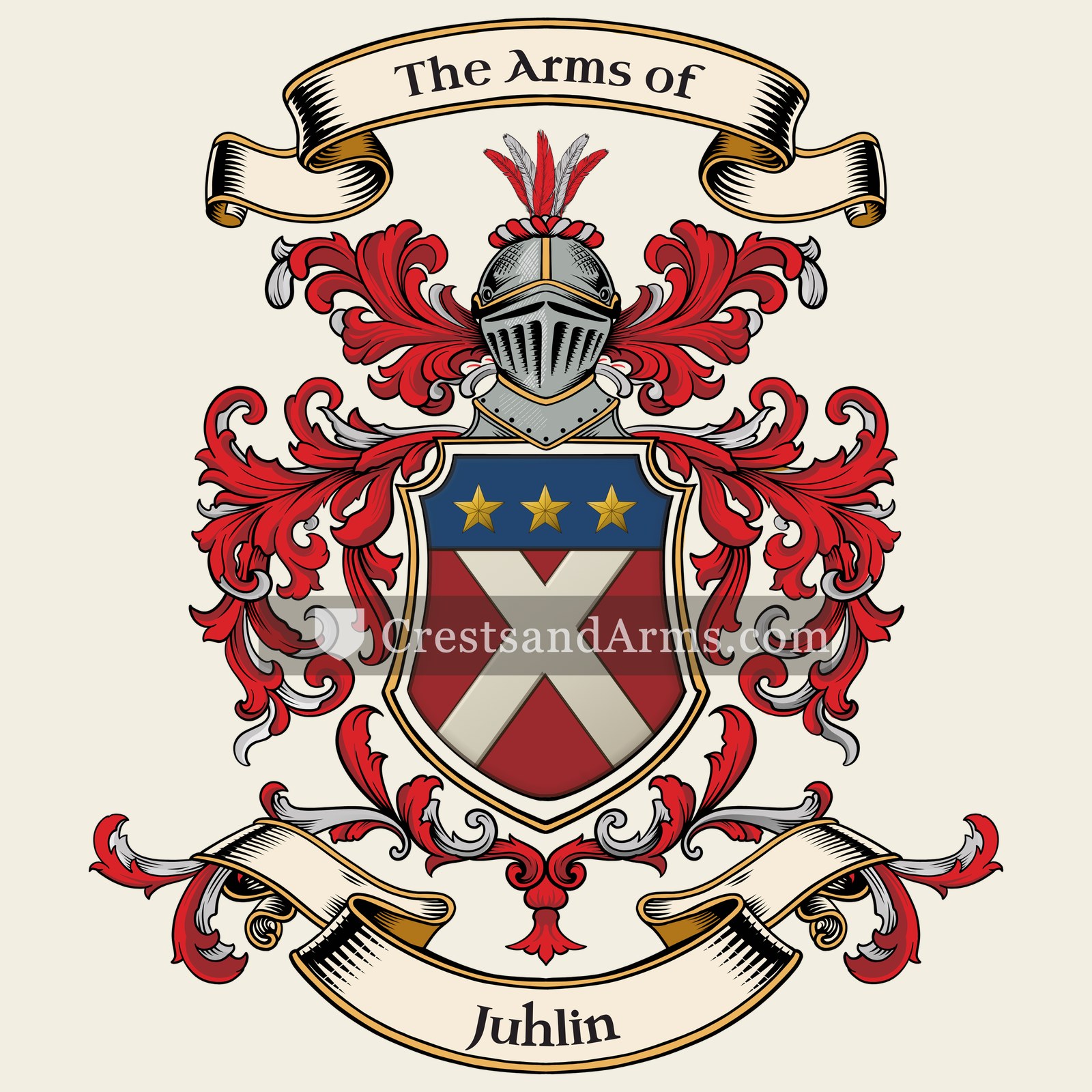


 lionCourage, strength and royalty