A record of documented arms, meaning and origin, researched for the Junek family lines. Documented in 2 countries.
Reg. 1953 · Danish, J–L
Coat of Arms & Family Crest Details
Symbols on this shield
arrowReadiness for battle, and affliction endured
bowReadiness, and the strength held in reserve
Colours
Red (Gules)Means: Military strength
Blue (Azure)Means: Loyalty and truth
Silver (Argent)Means: Peace and sincerity
Gold (Or)Means: Generosity
Historical info
Source
J. B. Rietstap, Armorial Général, Gouda: G. B. van Goor Zonen, 1884–87
Blazon (the actual original written record)
“Ec.: aux 1 et 4 de gu. à trois flèches d'arg., deux passées en saut. et la troisième br. en pal; aux 2 et 3 d'azur à trois arcs d'or, posés en fasces, l'un sur l'autre. C.: trois flèches d'arg., posées en éventail, entre un vol de sa.”
Denmarkc. 1731
Digital archive packCoat of arms PNG, gold border print PDF, vector SVG and the certificate of authenticity. Sent to your email in minutes.
Map of Denmark showing where the Junek arms are recorded
The Junek arms were recorded in Denmark, c. 1731.
Arms such as these were typically recorded in Sjaælland.
Zealand held the Danish court, the crown's offices and Copenhagen itself. Families who served the king kept estates within reach of it, and royal service was the ordinary route to a coat of arms.
This is where the arms were entered in the register. Families often moved to other parts of the country, so the same name can turn up in more than one region.
The body that granted and recorded arms in Denmark in this period.
Christian VI of Denmark
Sovereign of the period
Christian VI of Denmark
1730–1746
Reigning in Denmark when the Junek arms are first recorded.
How Arms Worked in Denmark
Danish heraldry during this period was closely tied to noble status and royal favor rather than being open to all citizens. Arms were typically granted by the monarch to individuals, and these symbols were then shared by all members of the noble house. If a family line died out, the right to use those specific arms ended with them.
Granting authority
The Danish royal chancery held the power to issue and regulate official coats of arms for the kingdom.
How they got arms
Families usually received their arms through a formal royal grant that confirmed their noble status and rights.
Where arms were recorded
These grants were officially recorded in the Danish Royal Chancery records starting in the sixteenth century.
The family's standing
Recorded among the armigerous families of Denmark.
Origin & History of the Junek Family in Denmark
The history of the Junek family in Denmark begins with documented records of individuals living on the island of Sjælland as early as 1731. During the eighteenth century, the name appeared within local parish registers, which served as the primary method for tracking families in rural Danish communities. At this time, the name was often associated with families working in agriculture or skilled trades, reflecting the common social structures of the Danish countryside. Because surnames were still evolving in many parts of Scandinavia during this period, the presence of the Junek name in Sjælland suggests a stable lineage that maintained its identity through generations of church records. These early ancestors lived through a time of significant transition in Denmark, as the country moved toward the agricultural reforms that would eventually reshape the lives of all rural families. By remaining in the region of Sjælland, the early members of the family helped establish a lasting connection to the local history and community records of the island.
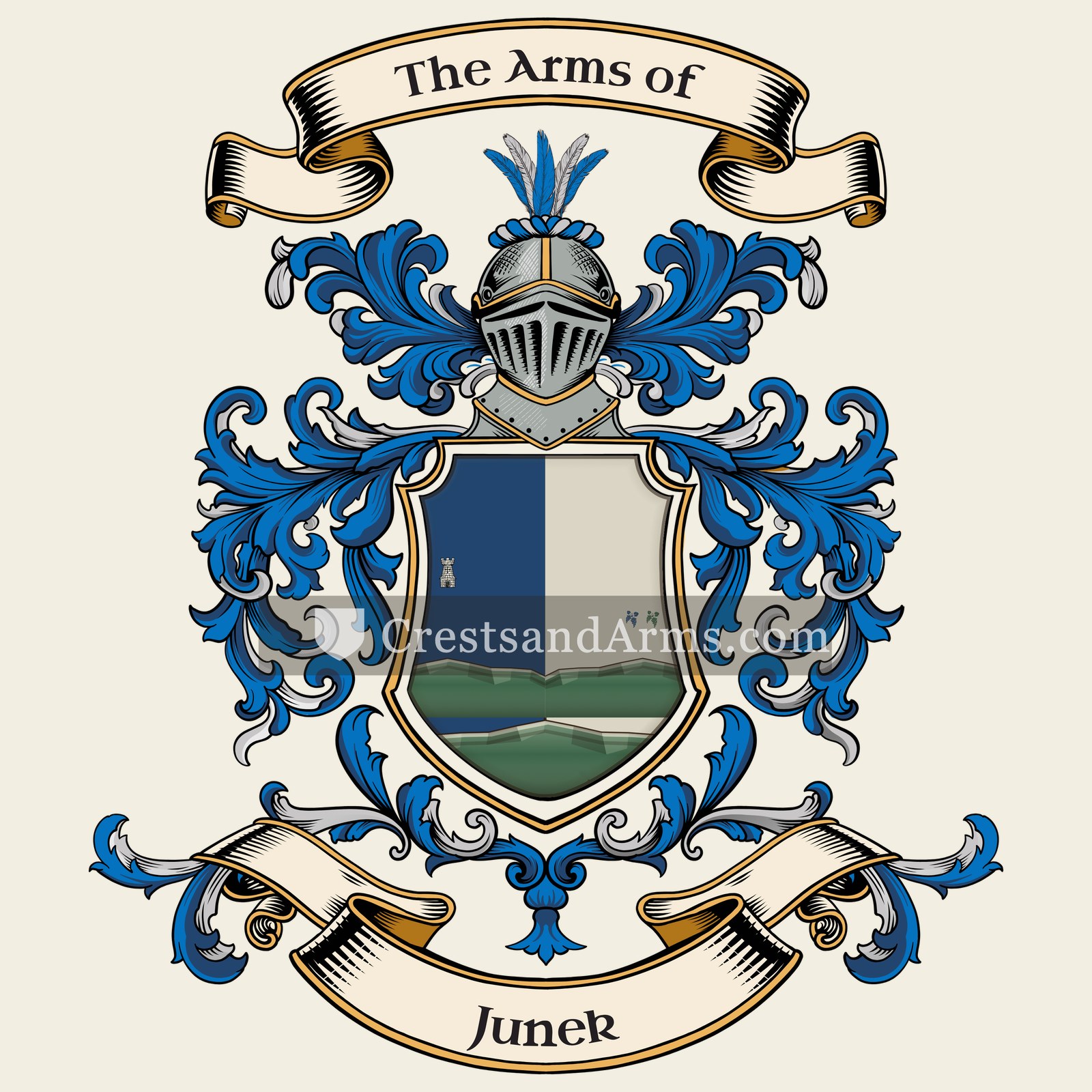
Coat of Arms & Family Crest Details
Symbols on this shield
mountThe ground held, and steadfastness upon it
towerGrandeur and solidity, and a stronghold defended
grapesPlenty, and the labour of the vine
Colours
Blue (Azure)Means: Loyalty and truth
Silver (Argent)Means: Peace and sincerity
Green (Vert)Means: Hope
Historical info
Source
J. B. Rietstap, Armorial Général, Gouda: G. B. van Goor Zonen, 1884–87
Blazon (the actual original written record)
“Parti: au 1 d'azur à un mur d'arg., maçonné de sa., soutenu d'une terrasse de sin. et sommé d'un pélican avec ses petits d'arg.; au 2 d'arg. à un cep de vigne de sin., accolé à son échalas au nat., fruité d'une grappe de raisins d'azur, sur une terrasse de sin. Brl. d'azur et d'arg. C.: un bras de carn., la manche de gu. retroussée, tenant une serpette d'arg., emm. d'or; entre un vol coupé, à dextre d'azur sur arg., à sen. de gu. sur or. L.: à dextre d'arg. et d'azur, à sen. d'or et d'azur.”
SaxonySaxony, c. 1721
Digital archive packCoat of arms PNG, gold border print PDF, vector SVG and the certificate of authenticity. Sent to your email in minutes.
Map of Germany showing where the Junek arms are recorded
The Junek arms were recorded in Saxony, c. 1721.
Saxony had mines, trade and old landed families all at once. Silver made some fortunes and land held others, and both sorts of family kept arms, which is why Saxon names appear so often in the registers.
This is where the arms were entered in the register. Families often moved to other parts of the country, so the same name can turn up in more than one region.
The body that granted and recorded arms in Germany in this period.
Charles VI, Holy Roman Emperor
Sovereign of the period
Charles VI, Holy Roman Emperor
1711–1740
Reigning in Denmark when the Junek arms are first recorded.
How Arms Worked in Germany
In the Holy Roman Empire, coats of arms were often granted to individuals by the Emperor or his representatives. These arms were then passed down through the generations to all legitimate descendants of the original holder. Younger branches of a family usually kept the same shield design without needing to change it, as the arms belonged to the entire lineage.
Granting authority
The Holy Roman Emperor held the sole power to grant new coats of arms throughout his vast imperial territories.
How they got arms
Families typically obtained their coats of arms through a formal imperial grant or by proving their noble status to the authorities.
Where arms were recorded
These grants were officially recorded in the Imperial Chancery registers, which began keeping formal records of such honors during the Middle Ages.
The family's standing
Recorded among the armigerous families of Saxony.
Origin & History of the Junek Family in Germany
The family name Junek is deeply rooted in the historical landscape of Saxony, where records confirm the presence of family members as early as 1721. The name is considered a diminutive form of the Slavic name Jan, which translates to John. During the eighteenth century, Saxony served as a cultural and economic crossroads in Central Europe, and families with this name were often integrated into the local agrarian or artisan communities. Because Saxony was a region defined by shifting borders and frequent migration, the Junek name likely moved through these territories as families sought new opportunities in trade or farming. By establishing themselves in the region during the early 1700s, the ancestors of the Junek family became part of the long-standing demographic history of the German-speaking lands, contributing to the local social fabric through their work and community involvement.
Related Branches & Arms
Root word
Iohannes
Hebrew origin meaning Yahweh is gracious.
This name
JunekA diminutive form of John, historically used to denote a young person or a junior family member.
also spelled
Yunge
Yunga
Documented Sources
J. B. Rietstap, Armorial Général, Gouda: G. B. van Goor Zonen, 1884–87
Rigsarkivet (The Danish National Archives), Kirkebøger (Parish Registers), Sjælland Stift


 arrowReadiness for battle, and affliction endured
 bowReadiness, and the strength held in reserve
 arrowReadiness for battle, and affliction endured
 bowReadiness, and the strength held in reserve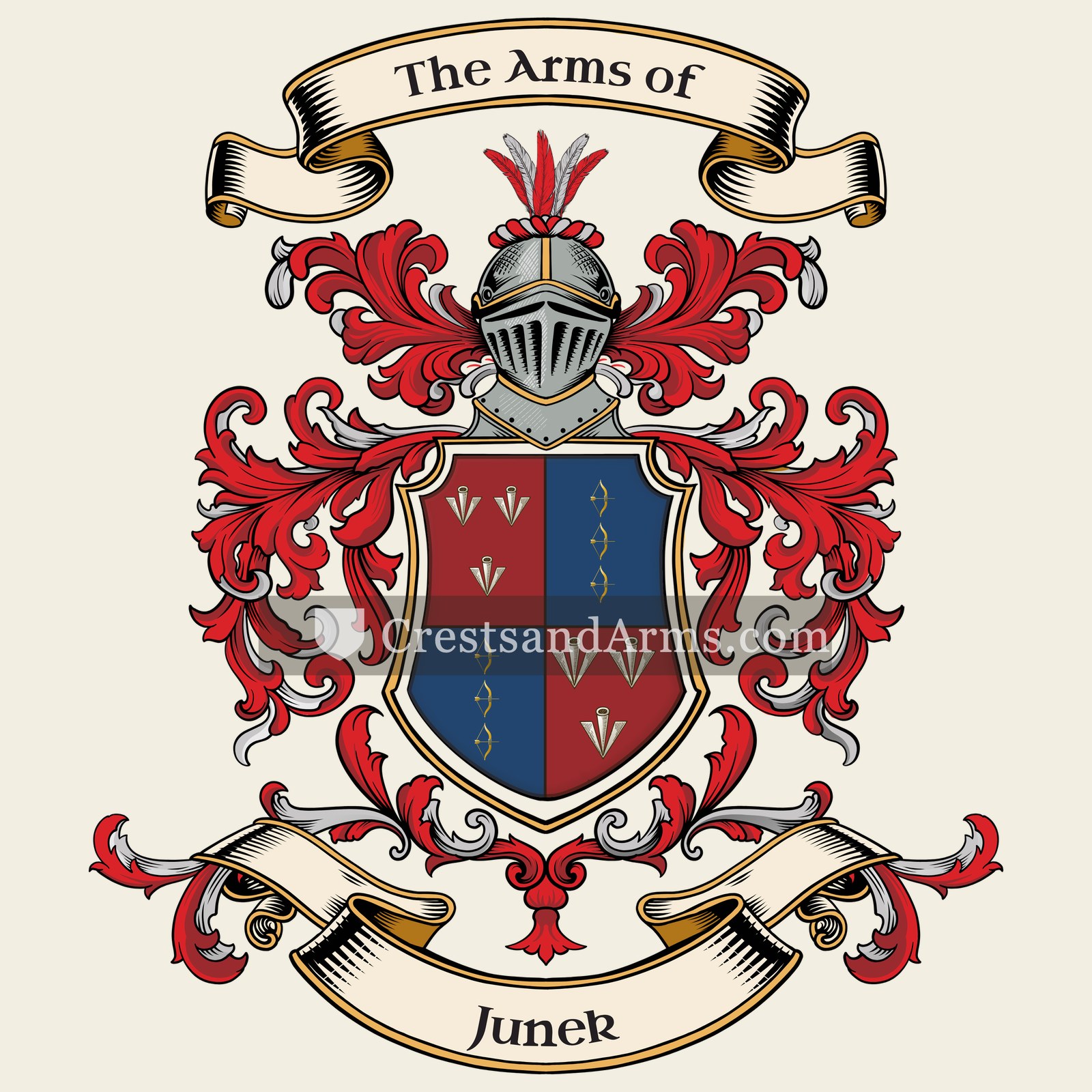


 mountThe ground held, and steadfastness upon it
 towerGrandeur and solidity, and a stronghold defended
 grapesPlenty, and the labour of the vine