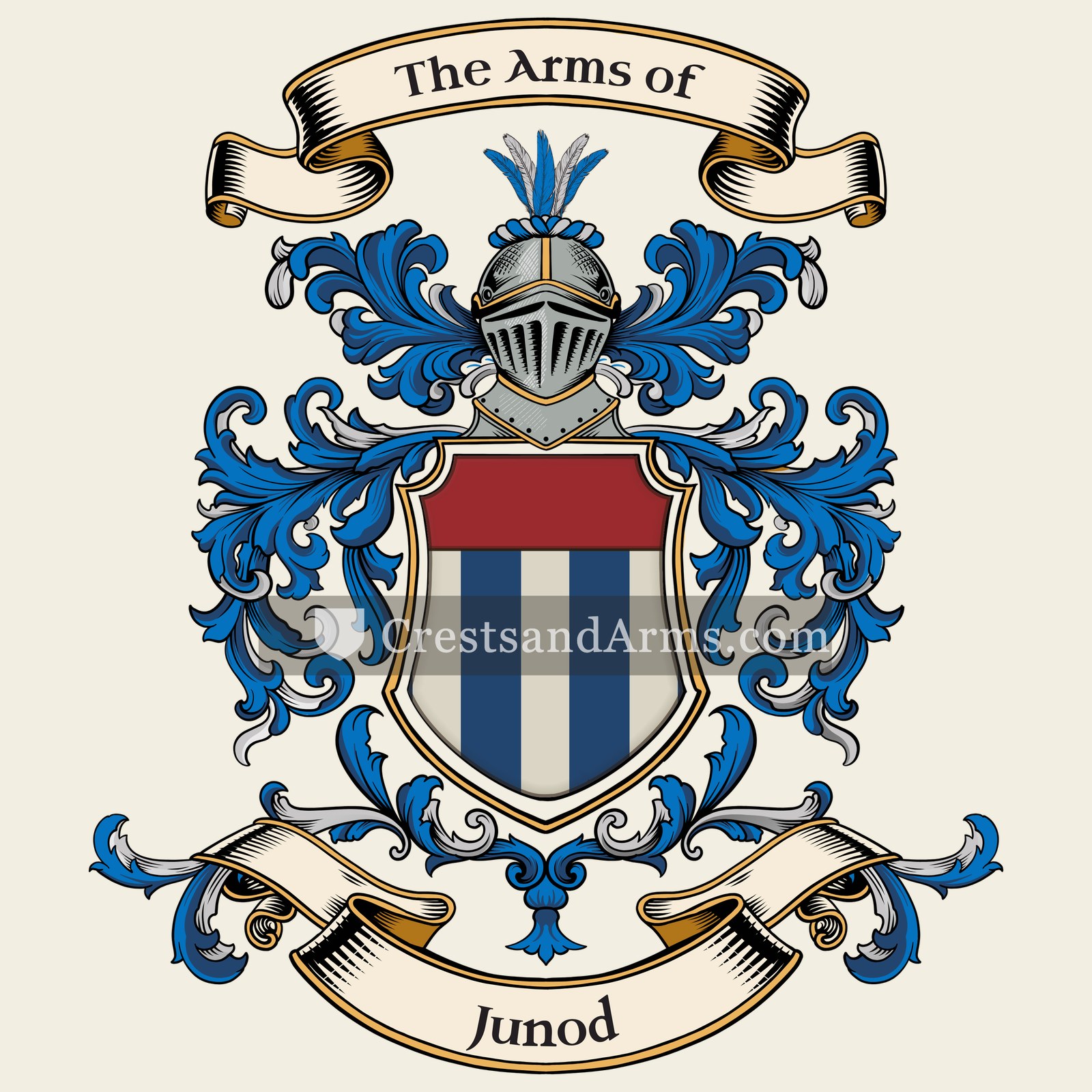
A record of documented arms, meaning and origin, researched for the Junod family of Switzerland.
Reg. 7995 · Swiss, J–L
Coat of Arms & Family Crest Details
Symbols on this shield
paleMilitary strength, and a fortified defence
chiefAuthority, wisdom and dominion
fessThe military belt, and readiness to serve
Colours
Blue (Azure)Means: Loyalty and truth
Silver (Argent)Means: Peace and sincerity
Red (Gules)Means: Military strength
Historical info
Source
J. B. Rietstap, Armorial Général, Gouda: G. B. van Goor Zonen, 1884–87
Blazon (the actual original written record)
“D'azur à trois pals d'arg.: au chef de gu. C.: un bonnet d'azur, retr. de gu., houppé d'or; le bonnet senestré d'un demi-vol d'azur, ch. d'une fasce de gu. L.: à dextre d'arg. et de gu., à sen. d'arg. et d'azur.)”
SwitzerlandNeufchâtel, c. 1745
Digital archive packCoat of arms PNG, gold border print PDF, vector SVG and the certificate of authenticity. Sent to your email in minutes.
Map of Switzerland showing where the Junod arms are recorded
The Junod arms were recorded in Neufchâtel, c. 1745.
This is where the arms were entered in the register. Families often moved to other parts of the country, so the same name can turn up in more than one region.
The body that granted and recorded arms in Switzerland in this period.
How Arms Worked in Switzerland
In Switzerland, coats of arms were not restricted to the nobility and were often adopted by common citizens and families. These symbols were passed down through generations to show family identity. When branches of a family grew, they often changed small details of the design to distinguish their own line from the original group.
Granting authority
Cantonal and civic authorities managed the use of coats of arms within their specific regions and local jurisdictions.
How they got arms
Families typically assumed their own coats of arms based on local custom rather than receiving them from a central monarch.
Where arms were recorded
Arms were recorded in various cantonal and civic registers starting from the fourteenth century throughout the Swiss region.
The family's standing
Recorded among the armigerous families of Switzerland.
Origin & History of the Junod Family in Switzerland
The Junod family name has deep roots in the Jura region of Switzerland, particularly within the canton of Neuchâtel. By the mid-18th century, the family was well-established in this area, with records confirming their presence in the region by 1745. The name is believed to be a diminutive form of the name Jean, which suggests that early ancestors were likely known as the little Johns or the sons of John. During this period, families in Neuchâtel often lived in small, tight-knit mountain communities where they worked in agriculture or early watchmaking trades. As the family grew, they became a recognized part of the local social fabric, contributing to the development of the region’s unique culture and industry. Their history reflects the broader movement of families who settled in the high valleys of the Jura Mountains, where they maintained a strong connection to their local heritage for generations.
Related Branches & Arms
Root word
Iunius
Latin term referring to the month of June or youthfulness.
This name
JunodA patronymic derivative indicating a descendant of someone named Jean or John.
also spelled
Junod
Junot
Junod Shovilyer
Documented Sources
J. B. Rietstap, Armorial Général, Gouda: G. B. van Goor Zonen, 1884–87
Godet, Philippe, Histoire littéraire et sociale de la Suisse, 1895


 paleMilitary strength, and a fortified defence
 chiefAuthority, wisdom and dominion
 fessThe military belt, and readiness to serve
 paleMilitary strength, and a fortified defence
 chiefAuthority, wisdom and dominion
 fessThe military belt, and readiness to serve