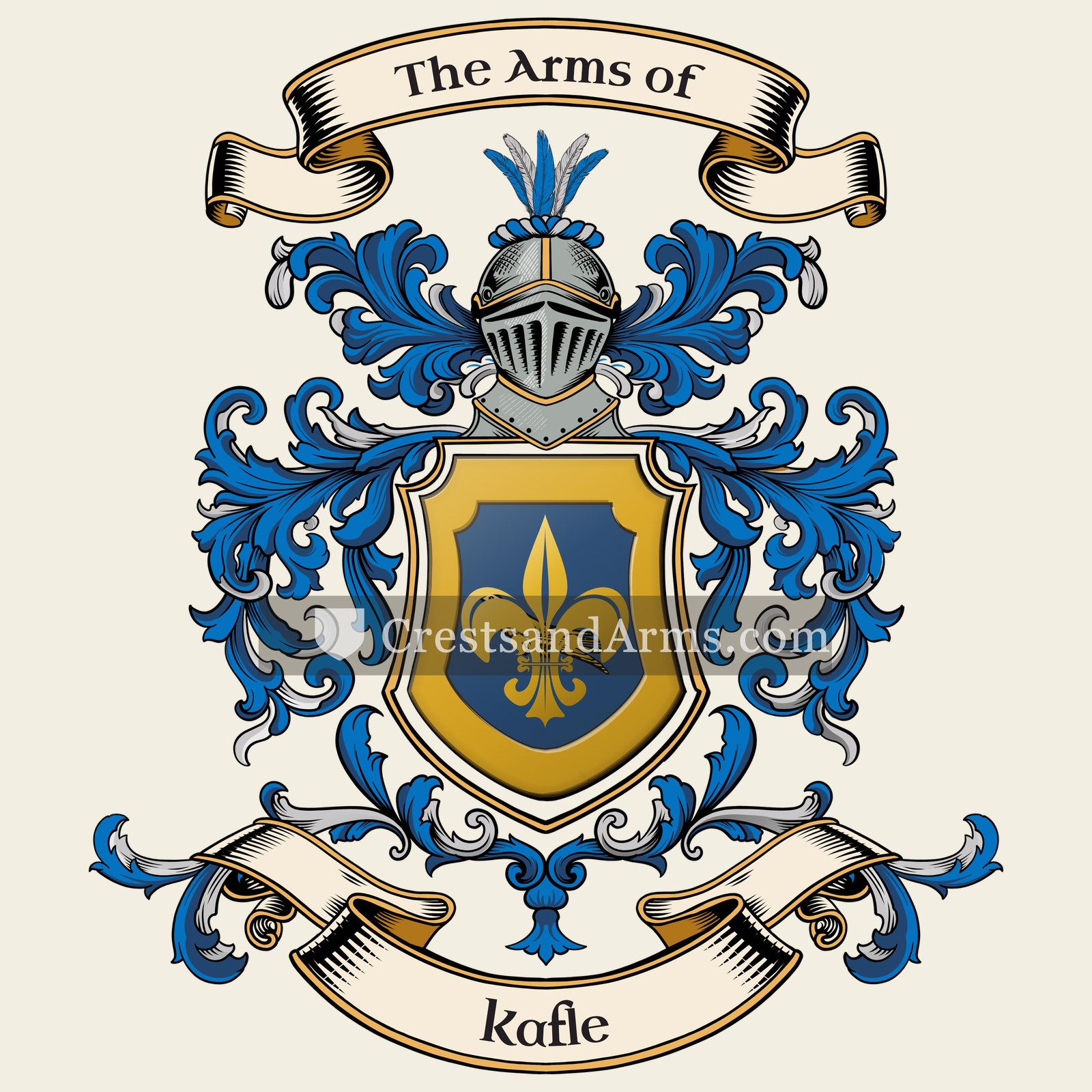
A record of documented arms, meaning and origin, researched for the Kafle family of Sweden.
Reg. 9017 · Swedish, J–L
Coat of Arms & Family Crest Details
Symbols on this shield
martletA younger son, who must win his own land
fleur de lisPurity, light, and the sixth son
Colours
Blue (Azure)Means: Loyalty and truth
Gold (Or)Means: Generosity
Historical info
Source
J. B. Rietstap, Armorial Général, Gouda: G. B. van Goor Zonen, 1884–87
Blazon (the actual original written record)
“Tranché: au 1 d'azur à un oiseau d'or, le vol levé, posé sur le tranché; au 2 d'azur à une demi-fleur-de-lis d'or, posée en bande, mouv. du tranché. A la cotice d'or, br. sur le tranché. L'écu bordé d'or. C.: un serpent au nat., accolant un bâton d'or, la partie supérieure fourchetée; entre quatre guidons d'azur, les hampes d'or, armées du même.”
Swedenc. 1700
Digital archive packCoat of arms PNG, gold border print PDF, vector SVG and the certificate of authenticity. Sent to your email in minutes.
Map of Sweden showing where the Kafle arms are recorded
The Kafle arms were recorded in Sweden, c. 1700.
Arms such as these were typically recorded in Stockholm.
Stockholm held the Swedish court and the House of Nobility, where every noble family's arms were entered and kept. Families ennobled for service registered there, which is why so many are recorded around the city.
This is where the arms were entered in the register. Families often moved to other parts of the country, so the same name can turn up in more than one region.
The body that granted and recorded arms in Sweden in this period.
Carl XII of Sweden
Sovereign of the period
Carl XII of Sweden
1697–1718
Reigning in Sweden when the Kafle arms are first recorded.
How Arms Worked in Sweden
In Sweden, a coat of arms belonged to a noble family as a whole rather than just one individual. These arms were passed down through the generations to all legitimate descendants. Younger branches of the family used the same shield without needing to change it. This system ensured that the entire lineage shared the same identity and status under the law.
Granting authority
The Riddarhuset, or House of Nobility, regulated all noble coats of arms in Sweden under royal authority.
How they got arms
Families received their coats of arms through royal grants of nobility which were then officially registered with the House.
Where arms were recorded
Coats of arms were officially recorded in the Swedish House of Nobility register starting in the year 1626.
The family's standing
Recorded among the armigerous families of Sweden.
Origin & History of the Kafle Family in Sweden
The Kafle family name has deep roots in the Nordic region, with historical documentation confirming their presence in Stockholm by the early 1700s. During this era, the family was closely connected to the administrative and social life of the Swedish capital. Members of the family often served in professional or civic roles, which helped them establish a lasting reputation within the city. As the eighteenth century progressed, the family name became associated with the evolving urban landscape of Stockholm. By maintaining records of their residence and activities, the family left a clear mark on the historical narrative of the region. Their early history reflects the broader patterns of migration and social development that defined Swedish life during the Enlightenment period.
Related Branches & Arms
Root word
Kavle
A wooden peg, bolt, or a cylindrical piece of wood.
This name
KafleDerived from a topographic or occupational descriptor referring to someone living near or working with wooden pegs.
also spelled
Kaflee
Kafleh
Kafleee
Documented Sources
J. B. Rietstap, Armorial Général, Gouda: G. B. van Goor Zonen, 1884–87
Elgenstierna, Gustaf. Den introducerade svenska adelns ättartavlor. 1925
Riksarkivet. Stockholms rådhusrätts arkiv, Bouppteckningar. 1700–1750
Anrep, Gabriel. Svenska adelns ättar-taflor. 1861
Digital archive packCoat of arms PNG, gold border print PDF, vector SVG and the certificate of authenticity. Sent to your email in minutes.


 martletA younger son, who must win his own land
 fleur de lisPurity, light, and the sixth son
 martletA younger son, who must win his own land
 fleur de lisPurity, light, and the sixth son