Map of Germany showing where the Kahlenberg arms are recorded
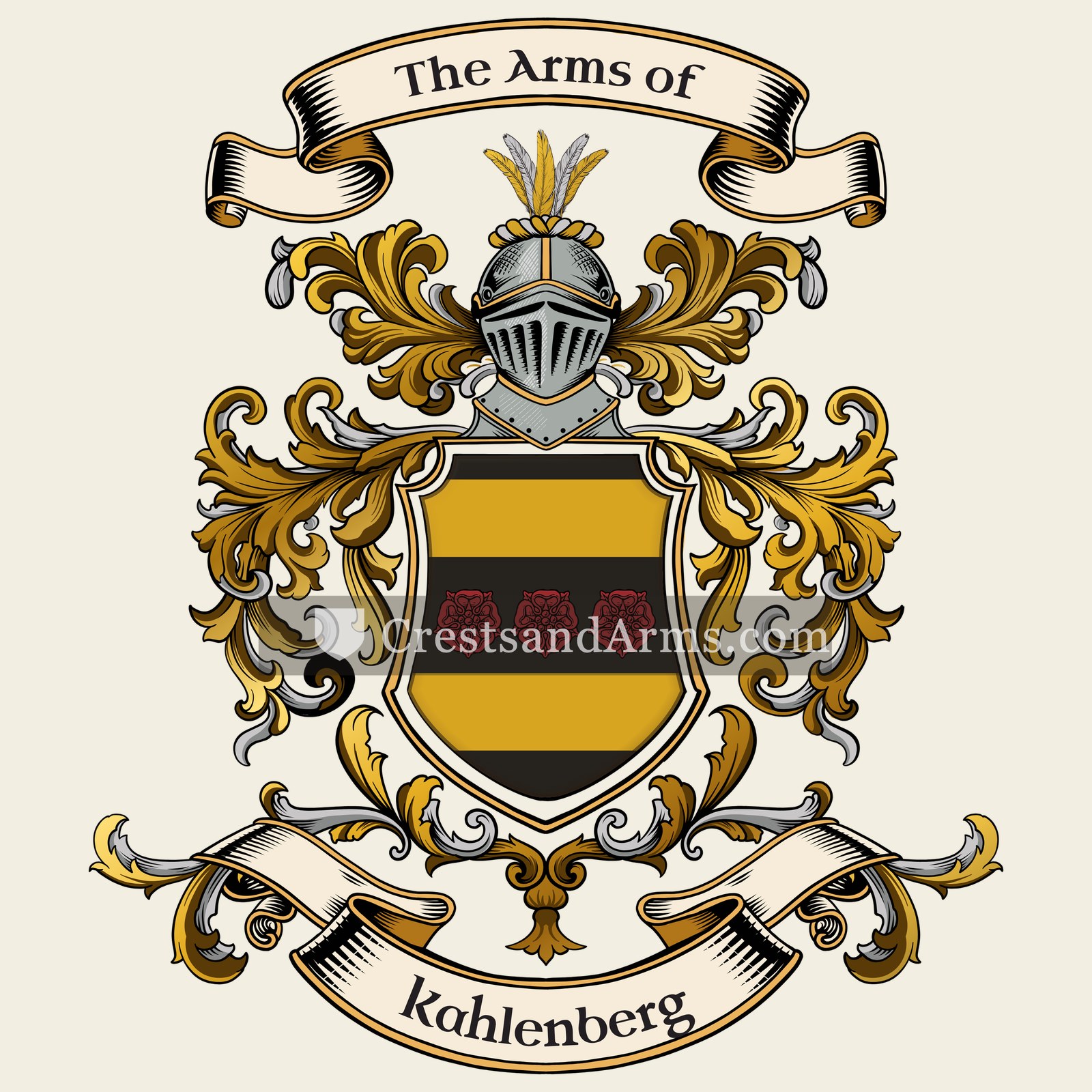
The Kahlenberg arms were recorded in Brandenburg, c. 1765.
Brandenburg was sandy farming country around Berlin, held in large estates by families who served as officers. Land and military service each brought arms, and most families there had both.
This is where the arms were entered in the register. Families often moved to other parts of the country, so the same name can turn up in more than one region.
The body that granted and recorded arms in Germany in this period.
Francis I, Holy Roman Emperor
Sovereign of the period
Francis I, Holy Roman Emperor
1745–1765
Reigning in Germany when the Kahlenberg arms are first recorded.
How Arms Worked in Germany
In the Holy Roman Empire, coats of arms were often granted to individuals by the Emperor or his representatives. These arms were then passed down through the generations to all legitimate descendants of the original holder. Younger branches of a family usually kept the same shield design without needing to change it, as the arms belonged to the entire lineage.
Granting authority
The Holy Roman Emperor held the sole power to grant new coats of arms throughout his vast imperial territories.
How they got arms
Families typically obtained their coats of arms through a formal imperial grant or by proving their noble status to the authorities.
Where arms were recorded
These grants were officially recorded in the Imperial Chancery registers, which began keeping formal records of such honors during the Middle Ages.
The family's standing
Recorded among the armigerous families of Brandenburg.
Origin & History of the Kahlenberg Family in Germany
The surname Kahlenberg is a topographic name that originated in the German-speaking regions of Europe. It is composed of the words "kahl," meaning bare or bald, and "berg," meaning mountain or hill. This suggests that the earliest ancestors to carry the name likely lived near a prominent, treeless hill or a ridge that lacked vegetation. By 1765, records confirm that families bearing this name were established in the Brandenburg region. During this era, Brandenburg was a central part of the Kingdom of Prussia, and families in this area were often tied to agricultural life or local trade. As the family grew, they became part of the social fabric of the Prussian countryside, living through a time of significant political and territorial expansion in Central Europe.
Related Branches & Arms
Root word
Kahl and Berg
Bare or bald and a mountain or hill.
This name
KahlenbergRefers to someone who lived near a bare or treeless hill or mountain.
also spelled
Kahlenbergg
Kahlenberge
Kahlenbergh
Kalenberg
Documented Sources
J. B. Rietstap, Armorial Général, Gouda: G. B. van Goor Zonen, 1884–87
Bahlow, Hans, Deutsches Namenlexikon: Familien- und Vornamen nach Ursprung und Sinn erklärt, 1967
Heintze, Albert, Die deutschen Familiennamen: geschichtlich, geographisch, sprachlich, 1903


 fessThe military belt, and readiness to serve
 roseThe seventh son, and beauty with grace
 fessThe military belt, and readiness to serve
 roseThe seventh son, and beauty with grace