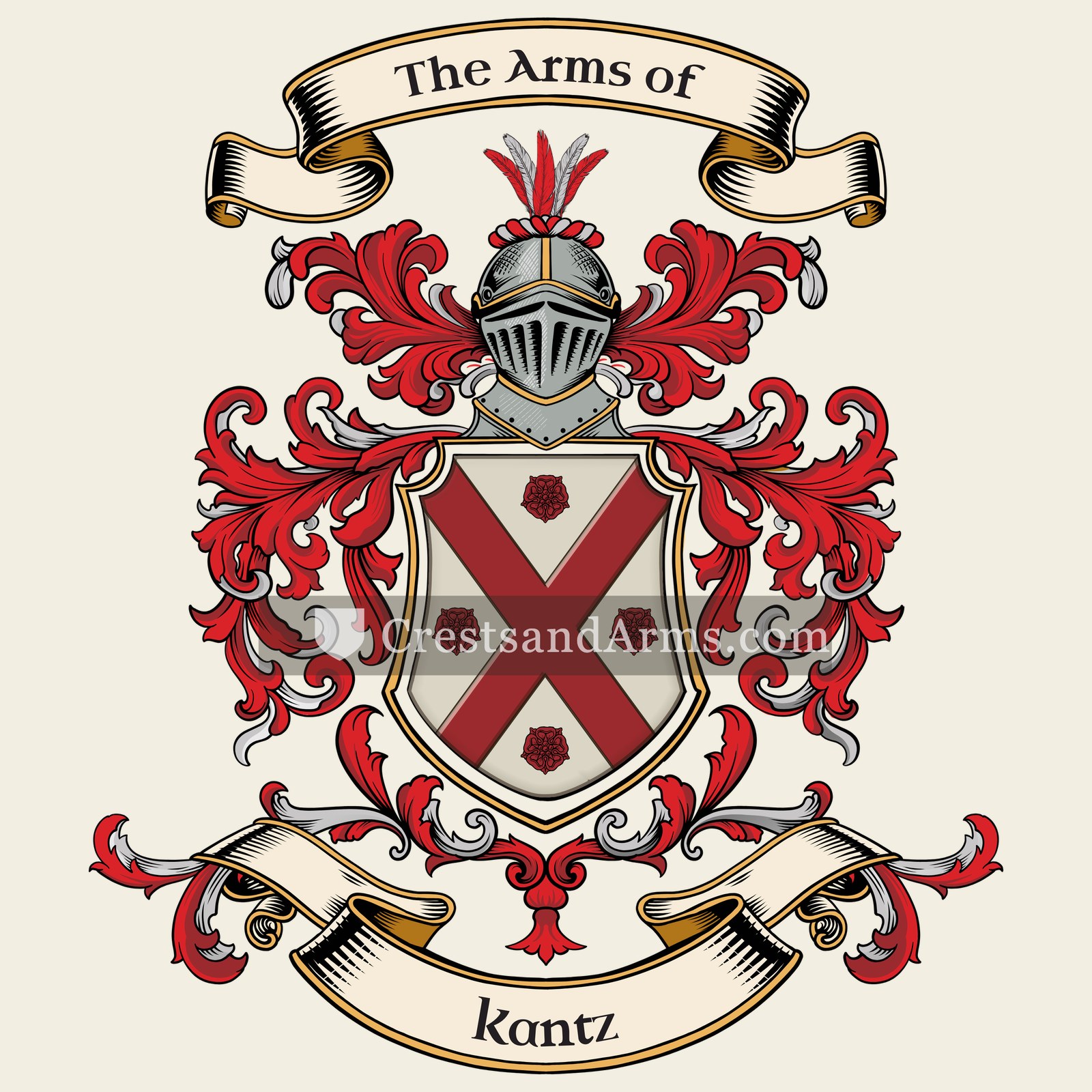
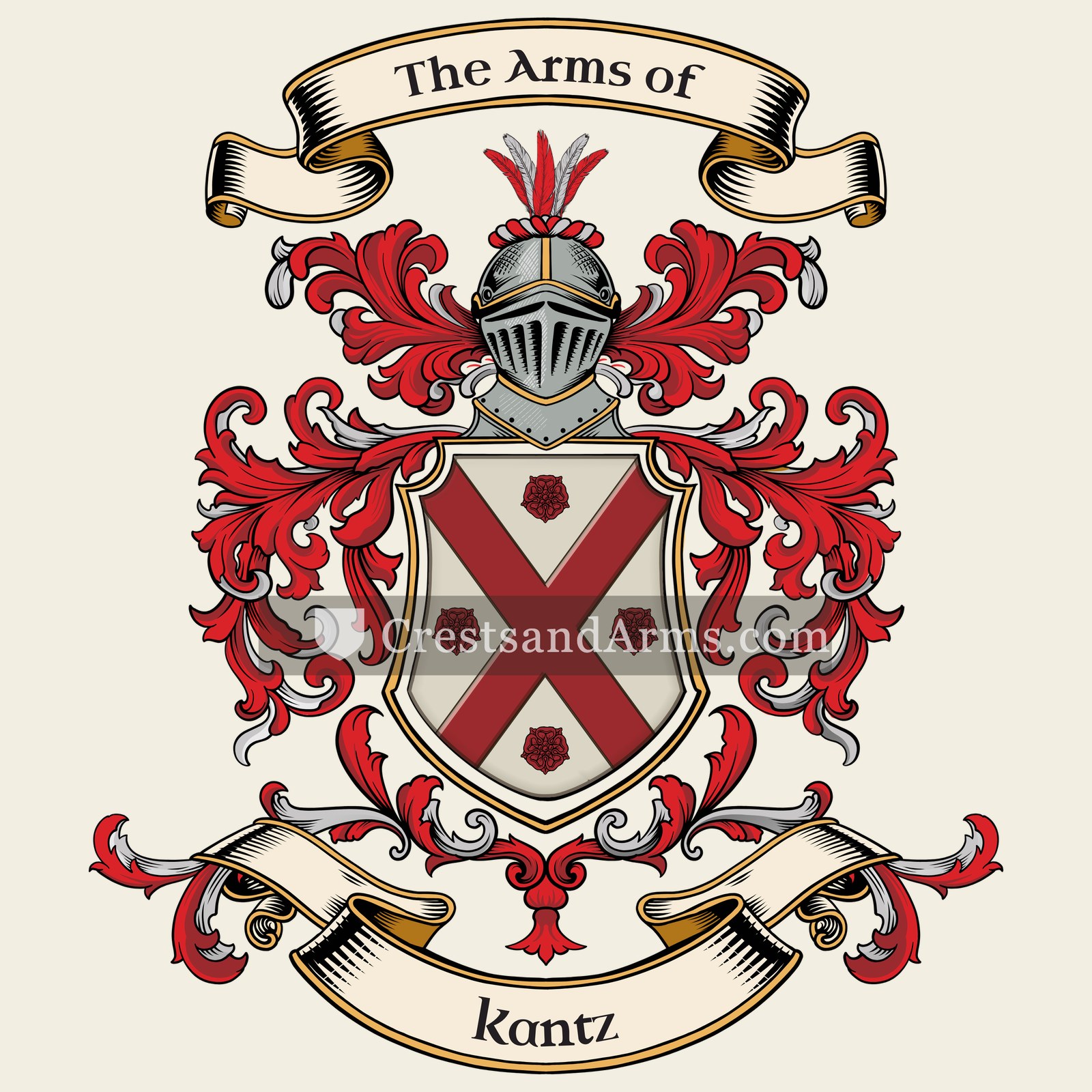
A record of documented arms, meaning and origin, researched for the Kantz family lines. Documented in 2 countries.
Reg. 7535 · Polish, J–L
Coat of Arms & Family Crest Details
Symbols on this shield
saltireResolution, and St Andrew's cross
chequyConstancy, and the counting-board
roseThe seventh son, and beauty with grace
Colours
Silver (Argent)Means: Peace and sincerity
Red (Gules)Means: Military strength
Historical info
Source
J. B. Rietstap, Armorial Général, Gouda: G. B. van Goor Zonen, 1884–87
Blazon (the actual original written record)
“D'arg. au saut. alésé de gu., cant. de quatre roses du même. Deux cq., le 1 sommé d'un bonnet de gu., retr. d'herm., le 2 cour. C.: 1° huit flambeaux d'or, allumés de gu., réunis en bas dans une roue d'or; 2° un chapeau pyramidal échiq. de gu. et d'arg., retr. d'arg., sommé de trois pl. d'aut. du même, réunis dans une boule d'or.”
CourlandCourland, c. 1772
Digital archive packCoat of arms PNG, gold border print PDF, vector SVG and the certificate of authenticity. Sent to your email in minutes.
Map of Poland showing where the Kantz arms are recorded
The Kantz arms were recorded in Courland, c. 1772.
Courland was Baltic coast country held in large estates by a small number of families. They kept their land for generations and served as officers abroad, and both landholding and service brought arms with them.
This is where the arms were entered in the register. Families often moved to other parts of the country, so the same name can turn up in more than one region.
Region
Courland
First recorded
1772
Granting Authority for the Kantz Arms
Ennoblement by the Sejm
Author: Olek Remesz · CC BY-SA 3.0
The body that granted and recorded arms in Poland in this period.
Stanisław August Poniatowski
Sovereign of the period
Stanisław August Poniatowski
1764–1795
Reigning in Poland when the Kantz arms are first recorded.
How Arms Worked in Poland
Polish noble families shared a single coat of arms across many different surnames, creating large clans rather than individual designs. These symbols were held collectively by all members of the clan regardless of their specific family name. When a new family joined the nobility, they were adopted into an existing clan and began using that group's established shield.
Granting authority
The Sejm, which was the Polish parliament, held the power to grant noble status and the right to bear arms.
How they got arms
Families typically received their coat of arms through a formal act of ennoblement granted by the Sejm for distinguished service.
Where arms were recorded
These grants were officially recorded in the Crown Metrica, which served as the central archive for state documents starting in the sixteenth century.
The family's standing
Recorded among the armigerous families of Courland.
Origin & History of the Kantz Family in Poland
The family name Kantz has deep roots tied to the complex history of the Baltic region and the Polish-Lithuanian Commonwealth. By the year 1772, records confirm that members of the family were established in Courland, a territory that maintained strong political and cultural ties to the Polish crown. During this era, families with Germanic names often lived alongside Polish, Latvian, and Baltic German populations in a diverse social landscape. The name likely evolved from regional dialects, reflecting the movement of people across the borders of the Baltic Sea and the Polish interior. As the political map shifted during the partitions of Poland, the Kantz family remained part of a distinct administrative and social class that navigated the transition between local autonomy and the growing influence of the Russian Empire. Their presence in Courland during this pivotal time suggests they were part of the professional or landholding networks that defined the region before the nineteenth century.
Coat of Arms & Family Crest Details
Symbols on this shield
saltireResolution, and St Andrew's cross
chequyConstancy, and the counting-board
roseThe seventh son, and beauty with grace
Colours
Silver (Argent)Means: Peace and sincerity
Red (Gules)Means: Military strength
Historical info
Source
J. B. Rietstap, Armorial Général, Gouda: G. B. van Goor Zonen, 1884–87
Blazon (the actual original written record)
“D'arg. au saut. de gu., cant. de quatre roses du même, barbées et bout. d'or. Trois cq., le 1 timbré d'une couronne de prince du St.-Empire, les deux autres cour. à l'ordinaire. C.: 1° huit flambeaux d'or, allumés de gu., réunis en bas dans une roue d'or; 2° une aigle de Prusse; 3° un chapeau pyramidal échiq. de gu. et d'arg., retr. d'herm., sommé de trois plumes de paon. T.: deux chevaliers, arm. de toutes pièces, la visière levée, le casque panaché d'arg. et de gu., tenant chacun une lance de tournoi [V. Canitz.]”
Germanyc. 1798
Digital archive packCoat of arms PNG, gold border print PDF, vector SVG and the certificate of authenticity. Sent to your email in minutes.
Map of Germany showing where the Kantz arms are recorded
The Kantz arms were recorded in Germany, c. 1798.
Arms such as these were typically recorded in Bavaria.
Bavaria was a country of old landed families and walled market towns. Estates passed down the same line for centuries, and both the landowners and the leading townsmen kept arms, which is why so many Bavarian names sit in the registers.
This is where the arms were entered in the register. Families often moved to other parts of the country, so the same name can turn up in more than one region.
The body that granted and recorded arms in Germany in this period.
Francis II, Holy Roman Emperor
Sovereign of the period
Francis II, Holy Roman Emperor
1792–1806
Reigning in Poland when the Kantz arms are first recorded.
How Arms Worked in Germany
In the Holy Roman Empire, coats of arms were often granted to individuals by the Emperor or his representatives. These arms were then passed down through the generations to all legitimate descendants of the original holder. Younger branches of a family usually kept the same shield design without needing to change it, as the arms belonged to the entire lineage.
Granting authority
The Holy Roman Emperor held the sole power to grant new coats of arms throughout his vast imperial territories.
How they got arms
Families typically obtained their coats of arms through a formal imperial grant or by proving their noble status to the authorities.
Where arms were recorded
These grants were officially recorded in the Imperial Chancery registers, which began keeping formal records of such honors during the Middle Ages.
The family's standing
Recorded among the armigerous families of Germany.
Origin & History of the Kantz Family in Germany
The surname Kantz is deeply rooted in the historical landscape of southern Germany, particularly within the region of Bavaria. By the late 18th century, families bearing this name were well-established members of the local community, living through a period of significant political and social transition. The name itself likely originated as a descriptive term or a nickname linked to the specific occupations or physical traits of early ancestors living in rural German villages. During the year 1798, when records confirm the presence of the Kantz family in Bavaria, the region was experiencing the pressures of the Napoleonic Wars and the slow decline of the Holy Roman Empire. Families like the Kantz clan often served as the backbone of these agrarian societies, working the land and participating in the local parish life that defined the era. As the 19th century approached, these families were part of a stable social structure that relied on trade, craftsmanship, and deep ties to their ancestral home.
Related Branches & Arms
Root word
Kantz
Derived from the German word Kante meaning edge or border.
This name
KantzA topographic name for someone who lived near a boundary or edge of a settlement.
also spelled
Kanitze
Kanitzer
Kanitzke
Kanits
Documented Sources
J. B. Rietstap, Armorial Général, Gouda: G. B. van Goor Zonen, 1884–87
Dunsdorfs, Edgars. Der große schwedische Kataster in Livland 1681–1710. 1974
Latvian State Historical Archives (Latvijas Valsts vēstures arhīvs), Kurzemes un Zemgales hercogistes muižu un iedzīvotāju reģistri (Records of the Duchy of Courland and Semigallia)
Seraphim, August. Die Geschichte des Herzogtums Kurland 1561–1795. 1904
Digital archive packCoat of arms PNG, gold border print PDF, vector SVG and the certificate of authenticity. Sent to your email in minutes.


 saltireResolution, and St Andrew's cross
 chequyConstancy, and the counting-board
 roseThe seventh son, and beauty with grace
 saltireResolution, and St Andrew's cross
 chequyConstancy, and the counting-board
 roseThe seventh son, and beauty with grace