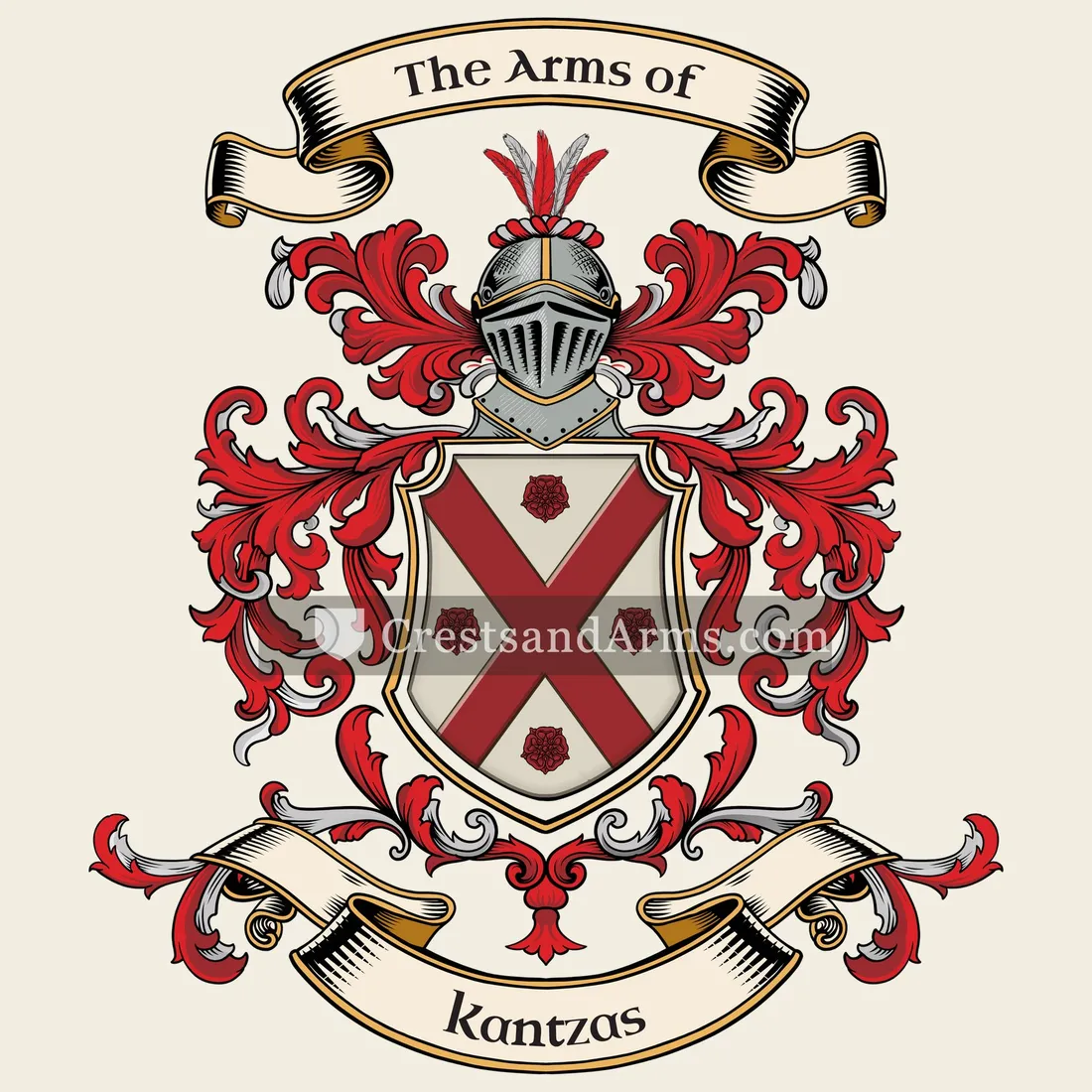
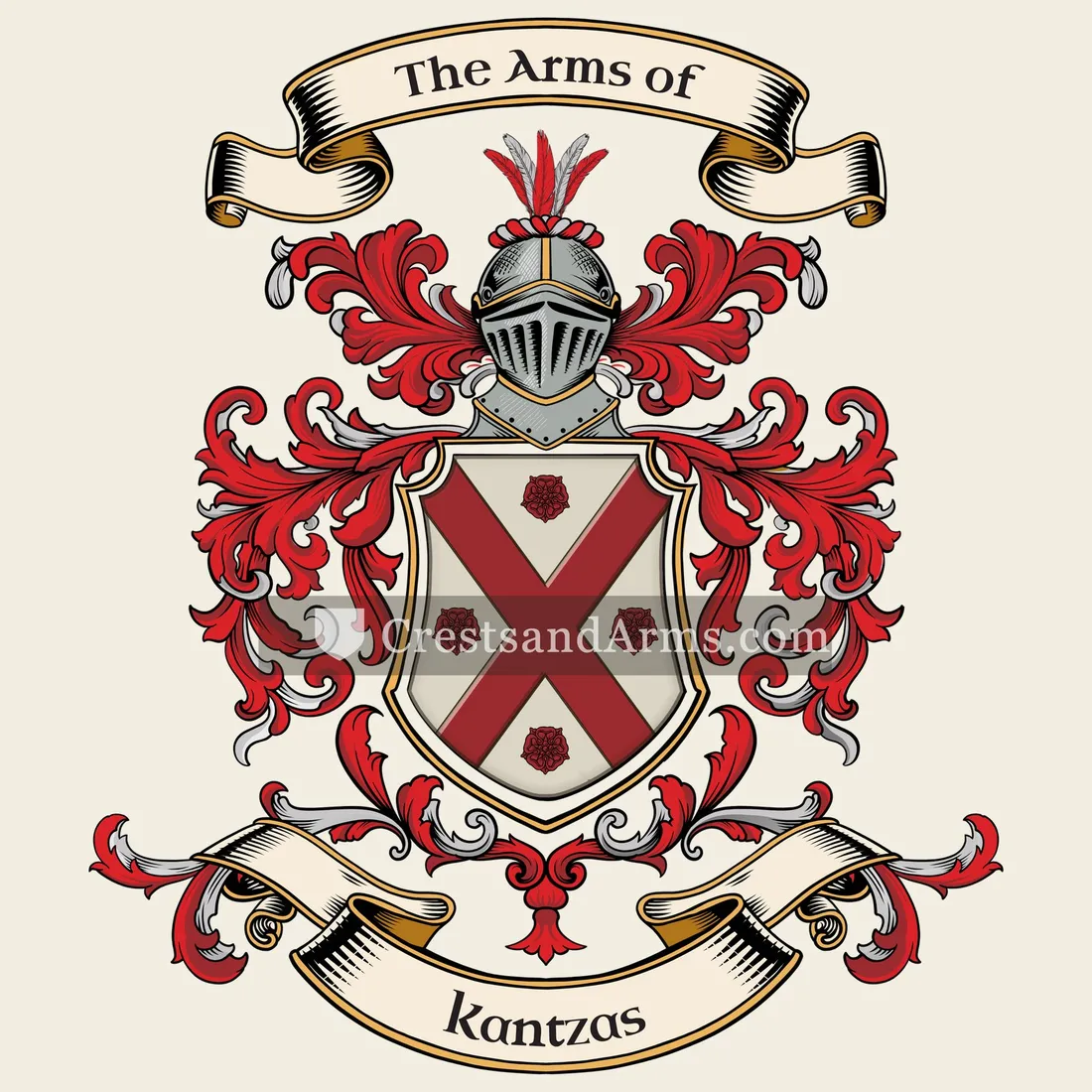
A record of documented arms, meaning and origin, researched for the Kantzas family lines. Documented in 2 countries.
Reg. 9168 · Polish, J–L
Meaning of the Kantzas family crest colors & symbols
Symbols on this shield
saltireResolution, and St Andrew's cross
roseThe seventh son, and beauty with grace
Colours
Silver (Argent)Means: Peace and sincerity
Red (Gules)Means: Military strength
Historical info
Source
J. B. Rietstap, Armorial Général, Gouda: G. B. van Goor Zonen, 1884–87
Blazon (the actual original written record)
“D'arg. au saut. alésé de gu., cant. de quatre roses du même. Deux cq., le 1 sommé d'un bonnet de gu., retr. d'herm., le 2 cour. C.: 1° huit flambeaux d'or, allumés de gu., réunis en bas dans une roue d'or; 2° un chapeau pyramidal échiq. de gu. et d'arg., retr. d'arg., sommé de trois pl. d'aut. du même, réunis dans une boule d'or.”
CourlandCourland, c. 1772
Digital archive packCoat of arms PNG, gold border print PDF, vector SVG and the certificate of authenticity. Sent to your email in minutes.
Map of Poland showing where the Kantzas arms are recorded
The Kantzas arms were recorded in Courland, c. 1772.
Courland was Baltic coast country held in large estates by a small number of families. They kept their land for generations and served as officers abroad, and both landholding and service brought arms with them.
This is where the arms were entered in the register. Families often moved to other parts of the country, so the same name can turn up in more than one region.
Region
Courland
First recorded
1772
Granting Authority for the Kantzas Arms
Ennoblement by the Sejm
Author: Olek Remesz · CC BY-SA 3.0
The body that granted and recorded arms in Poland in this period.
Stanisław August Poniatowski
Sovereign of the period
Stanisław August Poniatowski
1764–1795
Reigning in Poland when the Kantzas arms are first recorded.
How Arms Worked in Poland
Polish noble families shared a single coat of arms across many different surnames, creating large clans rather than individual designs. These symbols were held collectively by all members of the clan regardless of their specific family name. When a new family joined the nobility, they were adopted into an existing clan and began using that group's established shield.
Granting authority
The Sejm, which was the Polish parliament, held the power to grant noble status and the right to bear arms.
How they got arms
Families typically received their coat of arms through a formal act of ennoblement granted by the Sejm for distinguished service.
Where arms were recorded
These grants were officially recorded in the Crown Metrica, which served as the central archive for state documents starting in the sixteenth century.
The family's standing
Recorded among the armigerous families of Courland.
Origin & History of the Kantzas Family in Poland
The history of the Kantzas family in the Polish-Lithuanian Commonwealth is deeply connected to the shifting borders of the eighteenth century. By 1772, family members were established in the Duchy of Courland, which was a fiefdom of the Polish Crown at that time. This region served as a vital crossroads for trade and cultural exchange between Baltic, German, and Polish influences. Families living in Courland during this period often navigated complex social structures as the region transitioned from a semi-independent state into the expanding Russian Empire. The presence of the Kantzas name in these records suggests that the family was part of a mobile class of landowners or administrators who moved through the territories of the former Commonwealth. Their survival and integration into the local records of the late 1700s reflect the broader story of families who maintained their identity during a time of intense political upheaval and the eventual partitions of Poland.
Meaning of the Kantzas family crest colors & symbols
Symbols on this shield
saltireResolution, and St Andrew's cross
roseThe seventh son, and beauty with grace
Colours
Silver (Argent)Means: Peace and sincerity
Red (Gules)Means: Military strength
Historical info
Source
J. B. Rietstap, Armorial Général, Gouda: G. B. van Goor Zonen, 1884–87
Blazon (the actual original written record)
“D'arg. au saut. de gu., cant. de quatre roses du même, barbées et bout. d'or. Trois cq., le 1 timbré d'une couronne de prince du St.-Empire, les deux autres cour. à l'ordinaire. C.: 1° huit flambeaux d'or, allumés de gu., réunis en bas dans une roue d'or; 2° une aigle de Prusse; 3° un chapeau pyramidal échiq. de gu. et d'arg., retr. d'herm., sommé de trois plumes de paon. T.: deux chevaliers, arm. de toutes pièces, la visière levée, le casque panaché d'arg. et de gu., tenant chacun une lance de tournoi [V. Canitz.]”
Germanyc. 1798
Digital archive packCoat of arms PNG, gold border print PDF, vector SVG and the certificate of authenticity. Sent to your email in minutes.
Map of Germany showing where the Kantzas arms are recorded
The Kantzas arms were recorded in Germany, c. 1798.
Arms such as these were typically recorded in Bavaria.
Bavaria was a country of old landed families and walled market towns. Estates passed down the same line for centuries, and both the landowners and the leading townsmen kept arms, which is why so many Bavarian names sit in the registers.
This is where the arms were entered in the register. Families often moved to other parts of the country, so the same name can turn up in more than one region.
The body that granted and recorded arms in Germany in this period.
Francis II, Holy Roman Emperor
Sovereign of the period
Francis II, Holy Roman Emperor
1792–1806
Reigning in Poland when the Kantzas arms are first recorded.
How Arms Worked in Germany
In the Holy Roman Empire, coats of arms were often granted to individuals by the Emperor or his representatives. These arms were then passed down through the generations to all legitimate descendants of the original holder. Younger branches of a family usually kept the same shield design without needing to change it, as the arms belonged to the entire lineage.
Granting authority
The Holy Roman Emperor held the sole power to grant new coats of arms throughout his vast imperial territories.
How they got arms
Families typically obtained their coats of arms through a formal imperial grant or by proving their noble status to the authorities.
Where arms were recorded
These grants were officially recorded in the Imperial Chancery registers, which began keeping formal records of such honors during the Middle Ages.
The family's standing
Recorded among the armigerous families of Germany.
Origin & History of the Kantzas Family in Germany
The history of the Kantzas family in Germany is rooted in the social and regional shifts of the late eighteenth century. By 1798, records confirm that family members were established in the Bavarian region, a time when the area was undergoing significant political change under the influence of the Holy Roman Empire and the looming Napoleonic Wars. The name itself suggests a connection to the linguistic traditions of southern Germany, where surnames often evolved from local occupations or geographic identifiers. During this period, families in Bavaria were typically tied to the land through agriculture or small-scale trade, and the presence of the Kantzas name in official documents indicates that they were integrated into the local community structure. As the region transitioned from a collection of smaller territories into a unified kingdom, the family likely navigated the challenges of military conscription and shifting tax laws. Their documented presence in 1798 serves as a starting point for understanding how the family adapted to the rigid social hierarchies of the time while maintaining their identity within the Bavarian landscape.
Kantzas Meaning & Related Branches
Root word
Kantz
A German occupational term referring to a border or edge official.
This name
KantzasA surname derived from a border guard or someone living near a boundary.
also spelled
Kanitze
Kanitzer
Kanitzke
Kanits
Documented Sources
J. B. Rietstap, Armorial Général, Gouda: G. B. van Goor Zonen, 1884–87
Dunsdorfs, Edgars. Der große schwedische Kataster in Livland 1681–1710. 1974
Latvian State Historical Archives (Latvijas Valsts vēstures arhīvs). Courland Nobility and Landowner Records, Fond 142
Seraphim, Ernst. Geschichte Liv-, Est- und Kurlands. 1895
Digital archive packCoat of arms PNG, gold border print PDF, vector SVG and the certificate of authenticity. Sent to your email in minutes.


 saltireResolution, and St Andrew's cross
 roseThe seventh son, and beauty with grace
 saltireResolution, and St Andrew's cross
 roseThe seventh son, and beauty with grace