A record of documented arms, meaning and origin, researched for the Karon family lines. Documented in 2 countries.
Reg. 1238 · French, J–L
Coat of Arms & Family Crest Details
Symbols on this shield
saltireResolution, and St Andrew's cross
keyGuardianship, and the office of a steward
sickleThe harvest, and the reaping of what was sown
feathersWilling obedience and serenity
wheelFortune's turning, and the carter's trade
Colours
Silver (Argent)Means: Peace and sincerity
Gold (Or)Means: Generosity
Black (Sable)Means: Constancy
Red (Gules)Means: Military strength
Historical info
Source
J. B. Rietstap, Armorial Général, Gouda: G. B. van Goor Zonen, 1884–87
Blazon (the actual original written record)
“Ec.: aux 1 et 4 parti d'arg. et d'azur; à deux clés d'or, passées en saut., br. sur le parti; aux 2 et 3 coupé: a de gu. à une faucille d'arg., posée en fasce, le dos vers le chef et orné de trois touffes de plumes de coq de sa.; b. d'or à une demi-roue de moulin de gu., mouv. du coupé. Sur le tout les armes de famille comme ci-dessus. Trois cq. cour. C.: 1° une aigle de Prusse, iss., la poitrine ch. du chiffre F. R. d'or, surm. d'une couronne royale du même; 2° trois pl. d'aut., une d'azur entre deux d'arg.; 3° deux cornes de buffle, coupées alt. d'azur et d'arg. L. d'arg. et d'azur. S.: deux griffons reg. de gu. [V. Haxthausen-Carnitz.]”
Francec. 1663
Digital archive packCoat of arms PNG, gold border print PDF, vector SVG and the certificate of authenticity. Sent to your email in minutes.
Map of France showing where the Karon arms are recorded
The Karon arms were recorded in France, c. 1663.
Arms such as these were typically recorded in Bretagne.
More families held coats of arms in Bretagne than anywhere else in France. The land was divided into many small estates rather than a few large ones, so far more households counted as gentry, and each needed a shield of its own to be told apart.
This is where the arms were entered in the register. Families often moved to other parts of the country, so the same name can turn up in more than one region.
The body that granted and recorded arms in France in this period.
Louis XIV of France
Sovereign of the period
Louis XIV of France
1643–1715
Reigning in France when the Karon arms are first recorded.
How Arms Worked in France
In France, a coat of arms was a mark of honor that passed down through the male line to all legitimate descendants. Families often used the same shield without changes to show their shared heritage. If a branch wanted to stand out, they could add a small mark to their shield to show their specific place in the family tree.
Granting authority
The Juge d'armes de France acted as the official authority that regulated and verified coats of arms across the country.
How they got arms
Families typically inherited their arms from ancestors, though they could also receive them through royal grants or by proving their noble status.
Where arms were recorded
Coats of arms were officially recorded in the Armorial Général de France, which began its main collection in the year 1696.
The family's standing
Recorded among the armigerous families of France.
Origin & History of the Karon Family in France
The Karon family name finds its historical roots in the rugged landscape of Bretagne, where records confirm the presence of family members as early as 1663. During the seventeenth century, this region of France was a distinct province with its own unique customs and social structures. Families living in Bretagne at this time were often tied closely to the land and the local parish system, which served as the primary way of recording births, marriages, and deaths. The name Karon likely emerged from the linguistic traditions of the Breton language, which was the dominant tongue for many rural inhabitants of the area. As the family established their roots in the coastal or inland villages of the province, they became part of the local fabric of life, navigating the economic shifts and agricultural demands of the era. By settling in this specific part of France, the early Karon family helped contribute to the enduring cultural identity of the Breton people during a period of significant regional development.
Coat of Arms & Family Crest Details
Symbols on this shield
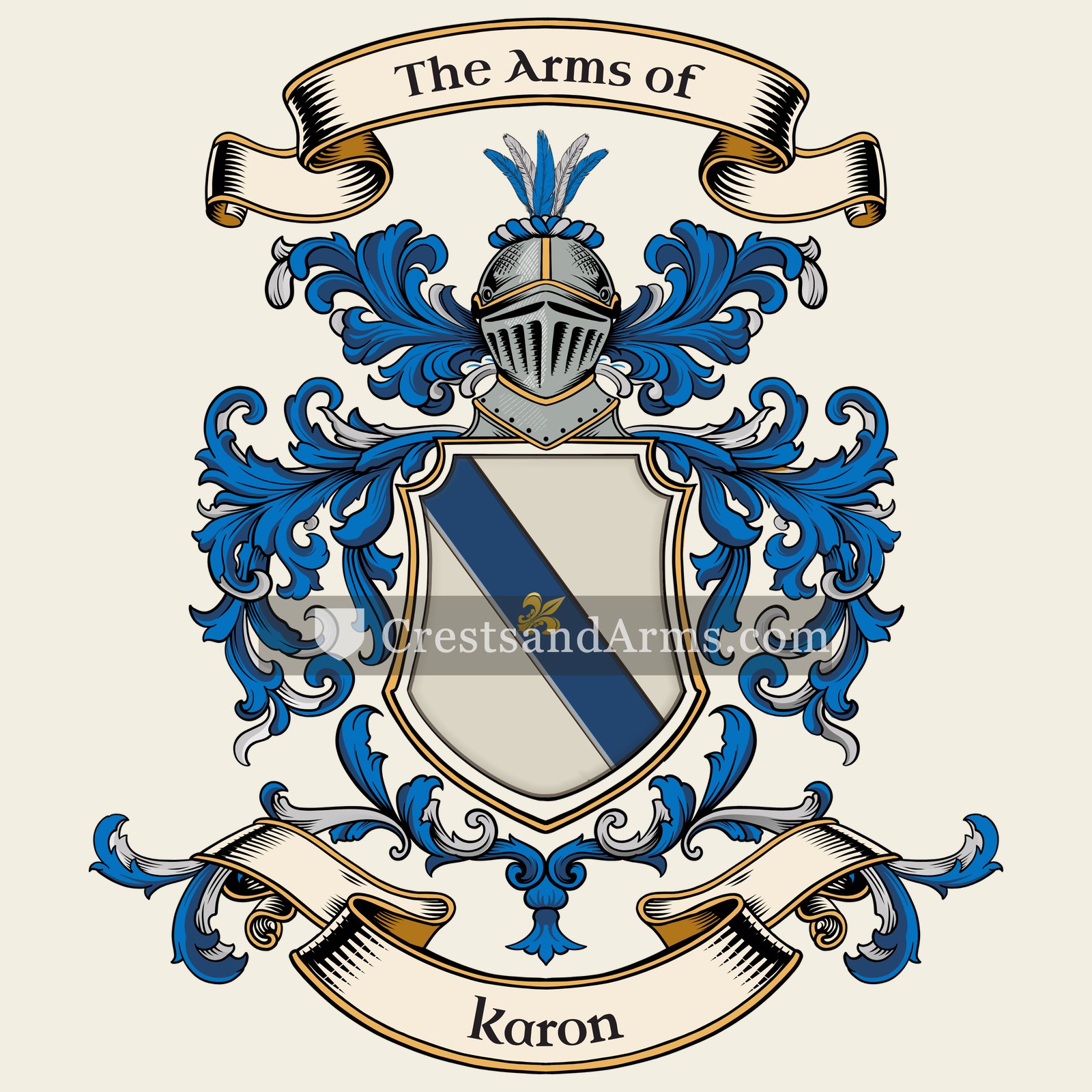
bendDefence, and the scarf of a commander
fleur de lisPurity, light, and the sixth son
Colours
Silver (Argent)Means: Peace and sincerity
Blue (Azure)Means: Loyalty and truth
Gold (Or)Means: Generosity
Historical info
Source
J. B. Rietstap, Armorial Général, Gouda: G. B. van Goor Zonen, 1884–87
Blazon (the actual original written record)
“D'arg. à la bande d'azur, semée de fleurs-de-lis d'or. C.: un vol-banneret, chaque aile aux armes de l'écu.”
BrabantBrabant, c. 1737
Digital archive packCoat of arms PNG, gold border print PDF, vector SVG and the certificate of authenticity. Sent to your email in minutes.
Map of Belgium showing where the Karon arms are recorded
The Karon arms were recorded in Brabant, c. 1737.
Brabant lay at the heart of the Low Countries, where the trade routes met. Its towns were wealthy and its landowners many, and both kinds of family kept arms, which is why the region is so heavily represented.
This is where the arms were entered in the register. Families often moved to other parts of the country, so the same name can turn up in more than one region.
The body that granted and recorded arms in Belgium in this period.
Charles VI, Holy Roman Emperor
Sovereign of the period
Charles VI, Holy Roman Emperor
1711–1740
Reigning in France when the Karon arms are first recorded.
How Arms Worked in Belgium
In Belgium, a coat of arms is considered personal property that is passed down through the male line to legitimate descendants. Families often use the same shield design across generations to show their shared heritage. If a branch of the family wants to change the design, they must apply for an official update to their specific version of the arms.
Granting authority
The Conseil héraldique is the official body that regulates and approves all coats of arms in Belgium.
How they got arms
Families obtain their coats of arms through formal royal grants or by confirming their historical right to use existing designs.
Where arms were recorded
All approved coats of arms are officially recorded in the public registers of the Conseil héraldique since 1844.
The family's standing
Recorded among the armigerous families of Brabant.
Origin & History of the Karon Family in Belgium
The history of the Karon family in Belgium finds its earliest documented roots in the historic region of Brabant during the year 1737. During this period, the name appeared in local administrative records, suggesting that the family was well-integrated into the social and economic fabric of the area. Brabant was a bustling center of trade and agriculture at the time, and families like the Karons often participated in the local craft guilds or farming communities that defined the region. Because the name appears in official registers from the mid-18th century, it is likely that the family lived as established residents who contributed to the growth of their local parishes. Over time, these early ancestors helped shape the identity of the name by maintaining a consistent presence in the towns and villages surrounding the Brabant countryside. Their survival in these records provides a clear window into the lives of ordinary citizens who helped build the foundations of the region.
Related Branches & Arms
Root word
Caron
Derived from the Old French word for a cart or carriage.
This name
KaronAn occupational surname for a cartwright or someone who transported goods by cart.
also spelled
Karon
Carron
Caronn
Caroun
Caroune
Documented Sources
J. B. Rietstap, Armorial Général, Gouda: G. B. van Goor Zonen, 1884–87
Archives Départementales du Finistère, Registres paroissiaux et d'état civil, 1663
Gautier, Hervé, Histoire de la Bretagne, 1993
Le Goff, Yves, Les noms de famille en Bretagne, 1985
Digital archive packCoat of arms PNG, gold border print PDF, vector SVG and the certificate of authenticity. Sent to your email in minutes.


 saltireResolution, and St Andrew's cross
 keyGuardianship, and the office of a steward
 sickleThe harvest, and the reaping of what was sown
 feathersWilling obedience and serenity
 wheelFortune's turning, and the carter's trade
 saltireResolution, and St Andrew's cross
 keyGuardianship, and the office of a steward
 sickleThe harvest, and the reaping of what was sown
 feathersWilling obedience and serenity
 wheelFortune's turning, and the carter's trade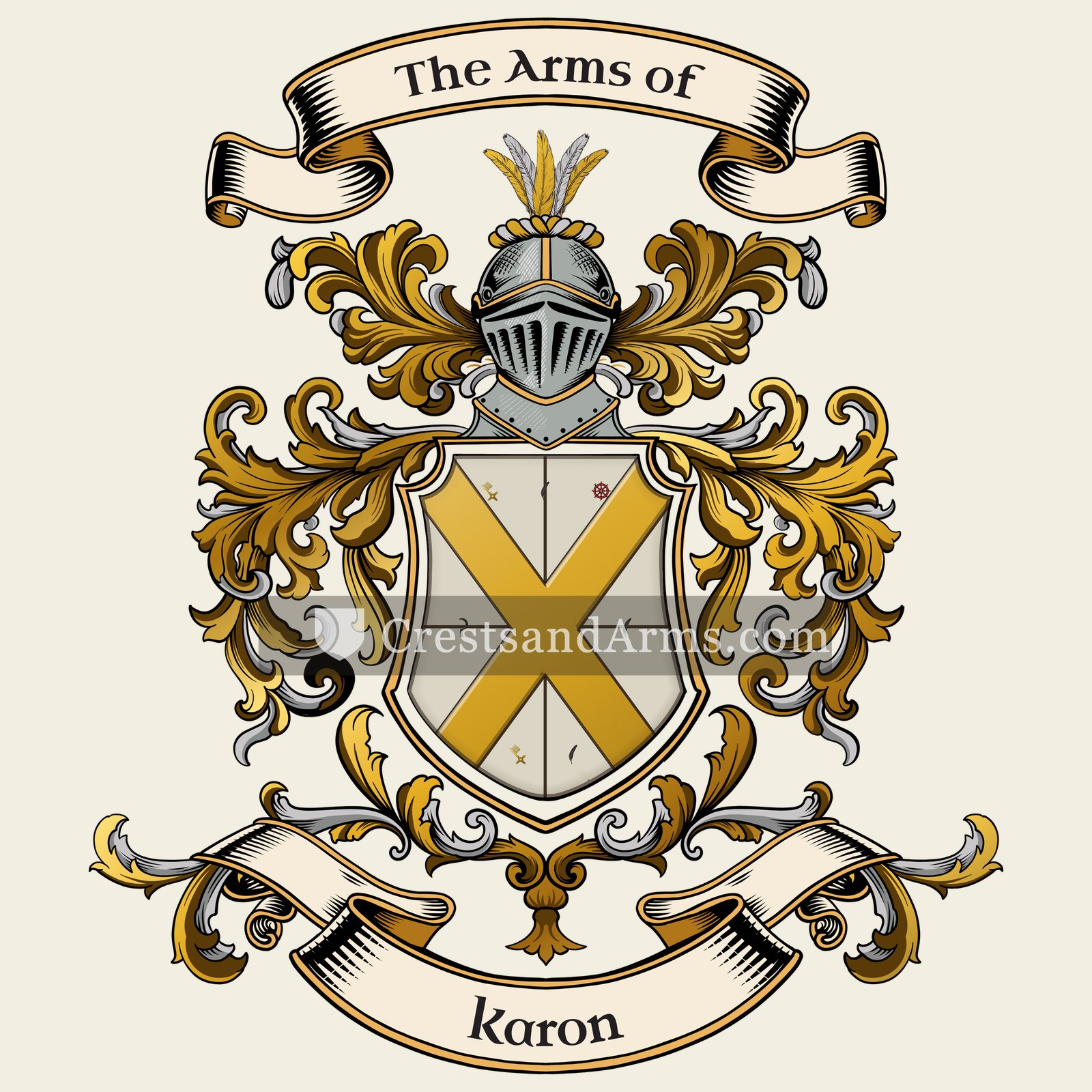


 bendDefence, and the scarf of a commander
 fleur de lisPurity, light, and the sixth son