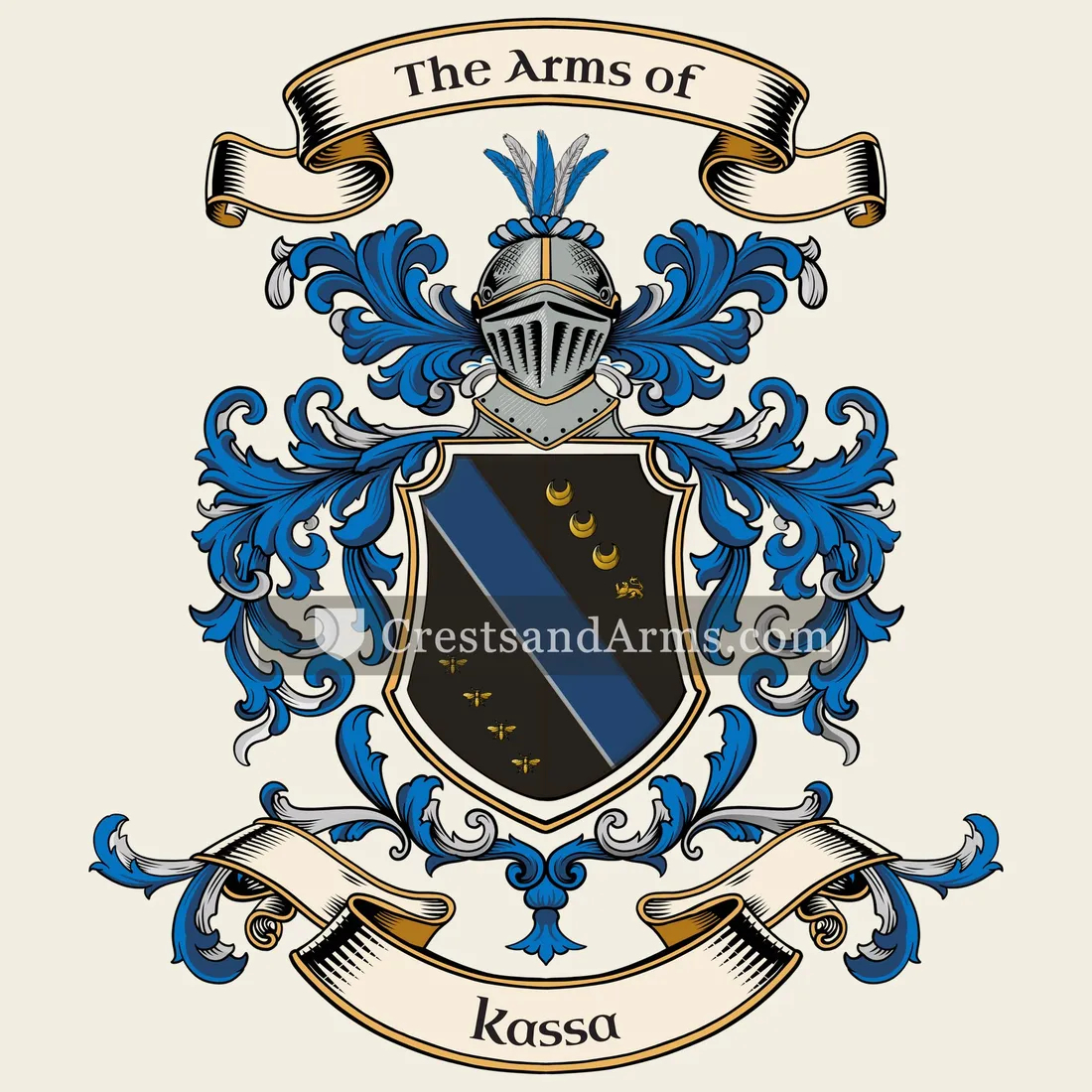
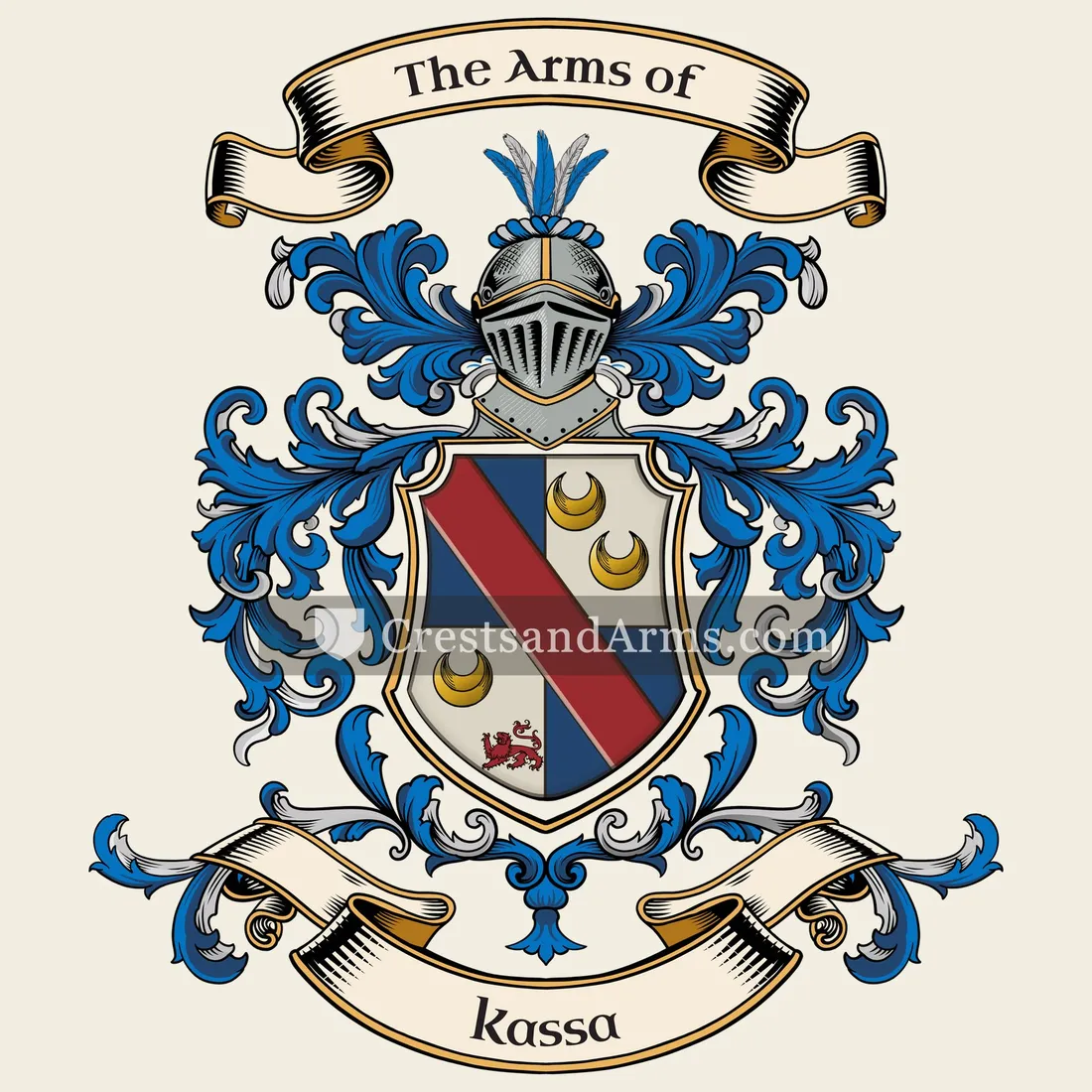
A record of documented arms, meaning and origin, researched for the Kassa family lines. Documented in 2 countries.
Reg. 8962 · Dutch, J–L
Meaning of the Kassa family crest colors & symbols
Symbols on this shield
bendDefence, and the scarf of a commander
crescentHonour by the sovereign, and the second son
lionCourage, strength and royalty
beeIndustry, order and tireless work
Colours
Black (Sable)Means: Constancy
Blue (Azure)Means: Loyalty and truth
Gold (Or)Means: Generosity
Historical info
Source
J. B. Rietstap, Armorial Général, Gouda: G. B. van Goor Zonen, 1884–87
Blazon (the actual original written record)
“Ec.: aux 1 et 4 de sa. à trois croiss. d'or; au 2 d'arg. au lion d'or; au 3 d'arg. à deux bandes d'azur, acc. de huit mouches d'or, 2 accostées en chef à sen., chacune en pal, 3 rangées entre les bandes dans le sens desdites bandes, et 3 posées en pals, rangées en bande, côtoyant la seconde bande.”
NetherlandsNimègue, c. 1815
Digital archive packCoat of arms PNG, gold border print PDF, vector SVG and the certificate of authenticity. Sent to your email in minutes.
Map of Netherlands showing where the Kassa arms are recorded
The Kassa arms were recorded in Nimègue, c. 1815.
This is where the arms were entered in the register. Families often moved to other parts of the country, so the same name can turn up in more than one region.
Region
Nimègue
Town
Nimègue
First recorded
1815
Granting Authority for the Kassa Arms
Hoge Raad van Adel
Photograph made by me · CC BY-SA 3.0
The body that granted and recorded arms in Netherlands in this period.
William I of the Netherlands
Sovereign of the period
William I of the Netherlands
1815–1840
Reigning in Netherlands when the Kassa arms are first recorded.
How Arms Worked in Netherlands
In the Netherlands, coats of arms were often used by noble families and those who held specific public offices. These arms were passed down through the generations to legitimate descendants. Younger branches of a family usually kept the original design without needing to add special marks. This system ensured that the family identity remained clear and consistent over many years.
Granting authority
The Hoge Raad van Adel is the official body that regulates and manages noble titles and coats of arms in the Netherlands.
How they got arms
Families typically obtained their coats of arms through official royal grants or by proving their long-standing historical use of the symbols.
Where arms were recorded
Coats of arms are officially recorded in the registers held by the Hoge Raad van Adel, which began its work in 1814.
The family's standing
Recorded among the armigerous families of Netherlands.
Origin & History of the Kassa Family in Netherlands
The history of the Kassa family in the Netherlands centers on the city of Nijmegen, where records confirm their presence by 1815. During this period, Nijmegen served as a vital gateway between the Netherlands and the German border, making it a hub for families moving across regional lines. The name Kassa likely arrived in the region as part of these shifting populations, as the Napoleonic era brought new requirements for citizens to register their surnames officially. By settling in a prominent city like Nijmegen, the family became part of the local urban fabric during a time of significant national transition. While the name remains rare, its early appearance in official Dutch civil records suggests that the family integrated into the local community during the formation of the modern Dutch state. These early ancestors were likely tradespeople or laborers who helped shape the city as it recovered from the political instability of the early nineteenth century.
Meaning of the Kassa family crest colors & symbols
Symbols on this shield
bendDefence, and the scarf of a commander
crescentHonour by the sovereign, and the second son
lionCourage, strength and royalty
Colours
Blue (Azure)Means: Loyalty and truth
Silver (Argent)Means: Peace and sincerity
Red (Gules)Means: Military strength
Gold (Or)Means: Generosity
Historical info
Source
J. B. Rietstap, Armorial Général, Gouda: G. B. van Goor Zonen, 1884–87
Blazon (the actual original written record)
“Ec.: aux 1 et 4 d'azur à trois croiss. d'or; au 2 d'arg. au lion de gu.; au 3 d'herm. à la bande de gu.”
SwitzerlandBerne, c. 1745
Digital archive packCoat of arms PNG, gold border print PDF, vector SVG and the certificate of authenticity. Sent to your email in minutes.
Map of Switzerland showing where the Kassa arms are recorded
The Kassa arms were recorded in Berne, c. 1745.
This is where the arms were entered in the register. Families often moved to other parts of the country, so the same name can turn up in more than one region.
The body that granted and recorded arms in Switzerland in this period.
How Arms Worked in Switzerland
In Switzerland, coats of arms were not restricted to the nobility and were often adopted by common citizens and families. These symbols were passed down through generations to show family identity. When branches of a family grew, they often changed small details of the design to distinguish their own line from the original group.
Granting authority
Cantonal and civic authorities managed the use of coats of arms within their specific regions and local jurisdictions.
How they got arms
Families typically assumed their own coats of arms based on local custom rather than receiving them from a central monarch.
Where arms were recorded
Arms were recorded in various cantonal and civic registers starting from the fourteenth century throughout the Swiss region.
The family's standing
Recorded among the armigerous families of Switzerland.
Origin & History of the Kassa Family in Switzerland
The history of the Kassa family in Switzerland is rooted in the social and economic landscape of eighteenth-century Berne. By 1745, records confirm that members of the family were established residents within this influential city-state. During this period, Berne functioned as a powerful center of trade and governance, and families like the Kassas often integrated into the local urban structure through skilled labor or merchant activities. Because Switzerland relied heavily on local citizenship rights known as *Heimatort*, the presence of the family in official registers suggests they were recognized members of the community with specific legal standing. Their life in Berne during the mid-1700s placed them in a society defined by strict social hierarchies and a growing focus on civic documentation. As the family navigated the complexities of life in a major Swiss canton, they contributed to the steady development of the region’s population during a time of significant transition in European history.
Kassa Meaning & Related Branches
Root word
Cassius
Latin name derived from the word for hollow or empty.
This name
KassaA Dutch topographic surname referring to someone living near a hollow or valley.
also spelled
Kassa
Casse
Cassah
Kasa
Documented Sources
J. B. Rietstap, Armorial Général, Gouda: G. B. van Goor Zonen, 1884–87
Gelders Archief, Burgerlijke Stand Gelderland, Geboorteakten Nijmegen 1815


 bendDefence, and the scarf of a commander
 crescentHonour by the sovereign, and the second son
 lionCourage, strength and royalty
 beeIndustry, order and tireless work
 bendDefence, and the scarf of a commander
 crescentHonour by the sovereign, and the second son
 lionCourage, strength and royalty
 beeIndustry, order and tireless work