Map of Netherlands showing where the Kate arms are recorded
The Kate arms were recorded in Netherlands, c. 1815.
Arms such as these were typically recorded in Friesland.
Friesland was low, wet country on the northern coast of the Netherlands, farmed by families who had held the same land for centuries. Free landholders were unusually common there, and a free landholder could carry arms.
This is where the arms were entered in the register. Families often moved to other parts of the country, so the same name can turn up in more than one region.
Region
Friesland
First recorded
1815
Granting Authority for the Kate Arms
Hoge Raad van Adel
Photograph made by me · CC BY-SA 3.0
The body that granted and recorded arms in Netherlands in this period.
William I of the Netherlands
Sovereign of the period
William I of the Netherlands
1815–1840
Reigning in Netherlands when the Kate arms are first recorded.
How Arms Worked in Netherlands
In the Netherlands, coats of arms were often used by noble families and those who held specific public offices. These arms were passed down through the generations to legitimate descendants. Younger branches of a family usually kept the original design without needing to add special marks. This system ensured that the family identity remained clear and consistent over many years.
Granting authority
The Hoge Raad van Adel is the official body that regulates and manages noble titles and coats of arms in the Netherlands.
How they got arms
Families typically obtained their coats of arms through official royal grants or by proving their long-standing historical use of the symbols.
Where arms were recorded
Coats of arms are officially recorded in the registers held by the Hoge Raad van Adel, which began its work in 1814.
The family's standing
Recorded among the armigerous families of Netherlands.
Origin & History of the Kate Family in Netherlands
The surname Kate finds its historical roots in the northern regions of the Netherlands, specifically within the province of Friesland. By the early nineteenth century, families carrying this name were well-established in Frisian communities, where they often integrated into the local agricultural and maritime economies. The name itself likely evolved as a shortened form of longer given names or as a descriptive nickname used to identify individuals within small, tight-knit villages. Because Friesland maintained a unique cultural and linguistic identity during this period, the family name reflects the distinct naming traditions of the region. As these families grew throughout the 1800s, they became a recognized part of the local population, contributing to the social and economic development of their home province.
Kate Meaning & Related Branches
Root word
Aikaterine
Greek name derived from the word for pure or clear.
This name
KateA diminutive form of Katherine, signifying purity and clarity of character.
Documented Sources
J. B. Rietstap, Armorial Général, Gouda: G. B. van Goor Zonen, 1884–87
Tresoar (Frysk Histoarysk en Letterkundich Sintrum), Bevolkingsregisters van de provincie Friesland (1811-1900)
Tresoar (Frysk Histoarysk en Letterkundich Sintrum), Burgerlijke Stand van de provincie Friesland (1811-1950)
Meertens Instituut, Nederlandse Familienamenbank, 2010
Digital archive packCoat of arms PNG, gold border print PDF, vector SVG and the certificate of authenticity. Sent to your email in minutes.


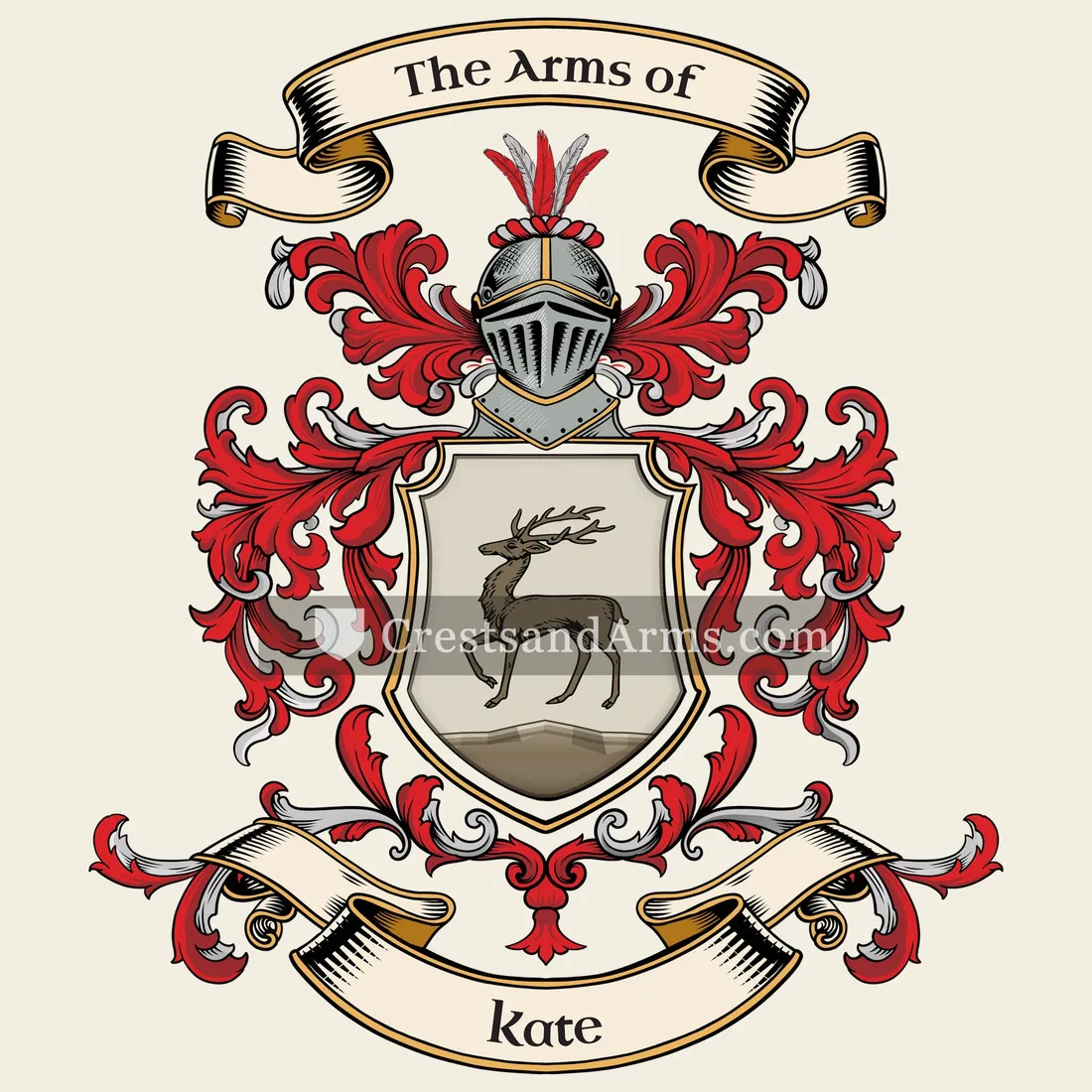
 mountThe ground held, and steadfastness upon it
 stagPeace and harmony, and one who will not fight unprovoked
 mountThe ground held, and steadfastness upon it
 stagPeace and harmony, and one who will not fight unprovoked