A record of documented arms, meaning and origin, researched for the Kaufman family lines. Documented in 3 countries.
Reg. 2622 · Danish, J–L
Coat of Arms & Family Crest Details
Symbols on this shield
armA person of action, industrious and laborious
hammerHonest labour, and the smith's craft
ringFidelity, and a promise kept
lozengeHonour and nobility, and the arms of a woman
Colours
Red (Gules)Means: Military strength
Gold (Or)Means: Generosity
Silver (Argent)Means: Peace and sincerity
Historical info
Source
J. B. Rietstap, Armorial Général, Gouda: G. B. van Goor Zonen, 1884–87
Blazon (the actual original written record)
“Ec.: au 1 de gu. à un dextrochère, mouv. du flanc, et au 4 de gu. à un senestrochère, mouv. du flanc, parés d'arg., les mains de carn. tenant chacune un marteau d'arg.; aux 2 et 3 coupé: a. de gu. à une bague d'or, châtonnée d'un rubis; b. losangé d'or et de gu., coupé de l'un en l'autre. Deux cq., le 1 cour. C.: 1° un demi-vol, aux armes du 1; l. d'arg. et de gu.; 2° un lion iss. de gu., tenant de sa patte dextre un marteau d'arg. et de sa sen. la bague du 2; l. d'or et de gu.”
HolsteinHolstein, c. 1784
Digital archive packCoat of arms PNG, gold border print PDF, vector SVG and the certificate of authenticity. Sent to your email in minutes.
Map of Denmark showing where the Kaufman arms are recorded
The Kaufman arms were recorded in Holstein, c. 1784.
Holstein was farming country between the North Sea and the Baltic, held in large estates. The same families kept the same land for generations, and generations of holding is what fills a register.
This is where the arms were entered in the register. Families often moved to other parts of the country, so the same name can turn up in more than one region.
The body that granted and recorded arms in Denmark in this period.
Christian VII of Denmark
Sovereign of the period
Christian VII of Denmark
1766–1808
Reigning in Denmark when the Kaufman arms are first recorded.
How Arms Worked in Denmark
Danish heraldry during this period was closely tied to noble status and royal favor rather than being open to all citizens. Arms were typically granted by the monarch to individuals, and these symbols were then shared by all members of the noble house. If a family line died out, the right to use those specific arms ended with them.
Granting authority
The Danish royal chancery held the power to issue and regulate official coats of arms for the kingdom.
How they got arms
Families usually received their arms through a formal royal grant that confirmed their noble status and rights.
Where arms were recorded
These grants were officially recorded in the Danish Royal Chancery records starting in the sixteenth century.
The family's standing
Recorded among the armigerous families of Holstein.
Origin & History of the Kaufman Family in Denmark
The family name Kaufman traces its roots to the German word for merchant, which suggests that early ancestors were likely involved in trade or commerce. By 1784, members of the family were established in the region of Holstein. At that time, Holstein was under the control of the Danish crown, which created a strong connection between the family and the Kingdom of Denmark. Because of this political link, many families in the area moved between German-speaking lands and Danish territories for work or military service. This environment allowed the Kaufman family to integrate into the broader cultural landscape of the Danish realm during the late eighteenth century. As merchants or skilled workers, they navigated the complex borders of the era, helping to shape the family history within the northern European region.
Coat of Arms & Family Crest Details
Symbols on this shield
eagleNobility, strength and a keen mind
Colours
Blue (Azure)Means: Loyalty and truth
Gold (Or)Means: Generosity
Historical info
Source
J. B. Rietstap, Armorial Général, Gouda: G. B. van Goor Zonen, 1884–87
Blazon (the actual original written record)
“D'azur à trois aigles d'or, cour. du même. Cq. cour. C.: un vol à l'antique, aux armes de l'écu.”
Germanyc. 1765
Digital archive packCoat of arms PNG, gold border print PDF, vector SVG and the certificate of authenticity. Sent to your email in minutes.
Map of Germany showing where the Kaufman arms are recorded
The Kaufman arms were recorded in Germany, c. 1765.
Arms such as these were typically recorded in Bavaria.
Bavaria was a country of old landed families and walled market towns. Estates passed down the same line for centuries, and both the landowners and the leading townsmen kept arms, which is why so many Bavarian names sit in the registers.
This is where the arms were entered in the register. Families often moved to other parts of the country, so the same name can turn up in more than one region.
The body that granted and recorded arms in Germany in this period.
Francis I, Holy Roman Emperor
Sovereign of the period
Francis I, Holy Roman Emperor
1745–1765
Reigning in Denmark when the Kaufman arms are first recorded.
How Arms Worked in Germany
In the Holy Roman Empire, coats of arms were often granted to individuals by the Emperor or his representatives. These arms were then passed down through the generations to all legitimate descendants of the original holder. Younger branches of a family usually kept the same shield design without needing to change it, as the arms belonged to the entire lineage.
Granting authority
The Holy Roman Emperor held the sole power to grant new coats of arms throughout his vast imperial territories.
How they got arms
Families typically obtained their coats of arms through a formal imperial grant or by proving their noble status to the authorities.
Where arms were recorded
These grants were officially recorded in the Imperial Chancery registers, which began keeping formal records of such honors during the Middle Ages.
The family's standing
Recorded among the armigerous families of Germany.
Origin & History of the Kaufman Family in Germany
The surname Kaufman is an occupational name that originated in the German-speaking regions of Europe, derived from the Middle High German word *koufman*, which translates to merchant or trader. During the medieval period, surnames were often adopted to describe a person’s trade, and those who traveled between towns to sell goods or manage markets were frequently identified by this title. By the time records place the family in Bavaria in 1765, the name was already well-established among the middle class of the region. Families bearing this name were often integrated into the local economy, serving as vital links in the trade networks that connected Bavarian towns to the broader European market. Because these individuals were essential to the movement of goods and currency, they often held respected positions within their local communities, contributing to the development of the commercial infrastructure that defined the era.
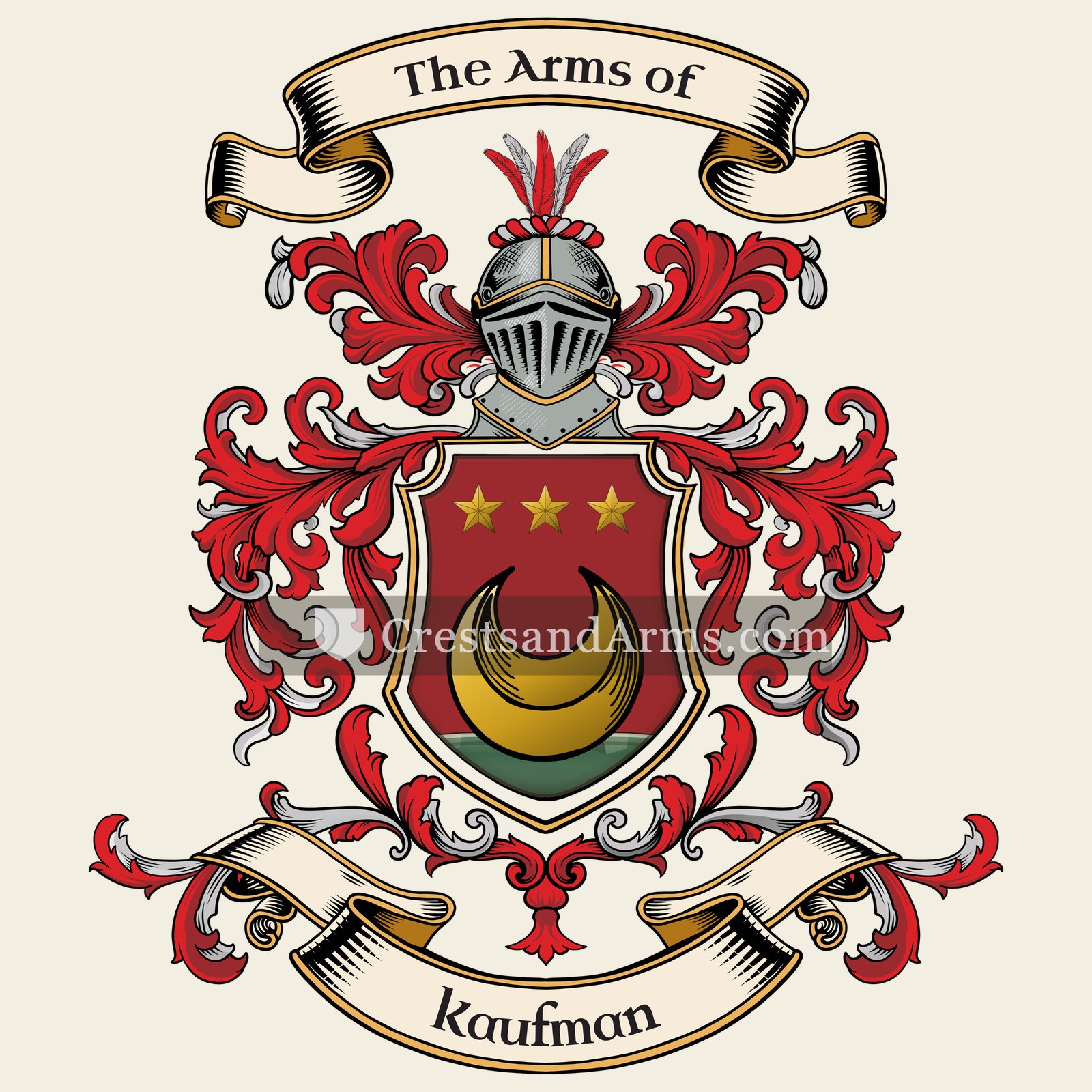
Coat of Arms & Family Crest Details
Symbols on this shield
mountThe ground held, and steadfastness upon it
crescentHonour by the sovereign, and the second son
mulletThe third son, and a divine quality from above
Colours
Red (Gules)Means: Military strength
Green (Vert)Means: Hope
Gold (Or)Means: Generosity
Historical info
Source
J. B. Rietstap, Armorial Général, Gouda: G. B. van Goor Zonen, 1884–87
Blazon (the actual original written record)
“De gu. à un croiss. versé d'or, acc. en chef de trois étoiles rangées du même et en p. d'un tertre de sin. C.: une étoile d'or.”
SwitzerlandBerne, c. 1745
Digital archive packCoat of arms PNG, gold border print PDF, vector SVG and the certificate of authenticity. Sent to your email in minutes.
Map of Switzerland showing where the Kaufman arms are recorded
The Kaufman arms were recorded in Berne, c. 1745.
This is where the arms were entered in the register. Families often moved to other parts of the country, so the same name can turn up in more than one region.
The body that granted and recorded arms in Switzerland in this period.
How Arms Worked in Switzerland
In Switzerland, coats of arms were not restricted to the nobility and were often adopted by common citizens and families. These symbols were passed down through generations to show family identity. When branches of a family grew, they often changed small details of the design to distinguish their own line from the original group.
Granting authority
Cantonal and civic authorities managed the use of coats of arms within their specific regions and local jurisdictions.
How they got arms
Families typically assumed their own coats of arms based on local custom rather than receiving them from a central monarch.
Where arms were recorded
Arms were recorded in various cantonal and civic registers starting from the fourteenth century throughout the Swiss region.
The family's standing
Recorded among the armigerous families of Switzerland.
Origin & History of the Kaufman Family in Switzerland
The surname Kaufman originated as an occupational name derived from the Middle High German word *koufman*, which translates to merchant or trader. In the context of Switzerland, the name reflects the vital role that traveling tradespeople played in the economic development of medieval and early modern towns. By the time members of the family were documented in the city of Berne in 1745, the name had become well-established among the local citizenry. These early ancestors likely operated within the complex guild systems that governed Swiss commerce, moving goods across the alpine trade routes that connected northern and southern Europe. Their presence in the historical records of Berne suggests that they were integrated into the urban fabric of the city, participating in the civic and professional life that defined the Swiss Confederation during the eighteenth century.
Related Branches & Arms
Root word
Kaufmann
Germanic term for a merchant or trader.
This name
KaufmanAn occupational surname for a person who worked as a merchant.
also spelled
Kaufman
Kauffman
Documented Sources
J. B. Rietstap, Armorial Général, Gouda: G. B. van Goor Zonen, 1884–87
Dansk Demografisk Database, Folketælling 1787 (Census of 1787)
Degn, Ole, "Danmarks byer i 1700-tallet: En byhistorisk undersøgelse" (1984)
Rigsarkivet (Danish National Archives), Danske Kancelli, Sjællandske registre
Digital archive packCoat of arms PNG, gold border print PDF, vector SVG and the certificate of authenticity. Sent to your email in minutes.


 armA person of action, industrious and laborious
 hammerHonest labour, and the smith's craft
 ringFidelity, and a promise kept
 lozengeHonour and nobility, and the arms of a woman
 armA person of action, industrious and laborious
 hammerHonest labour, and the smith's craft
 ringFidelity, and a promise kept
 lozengeHonour and nobility, and the arms of a woman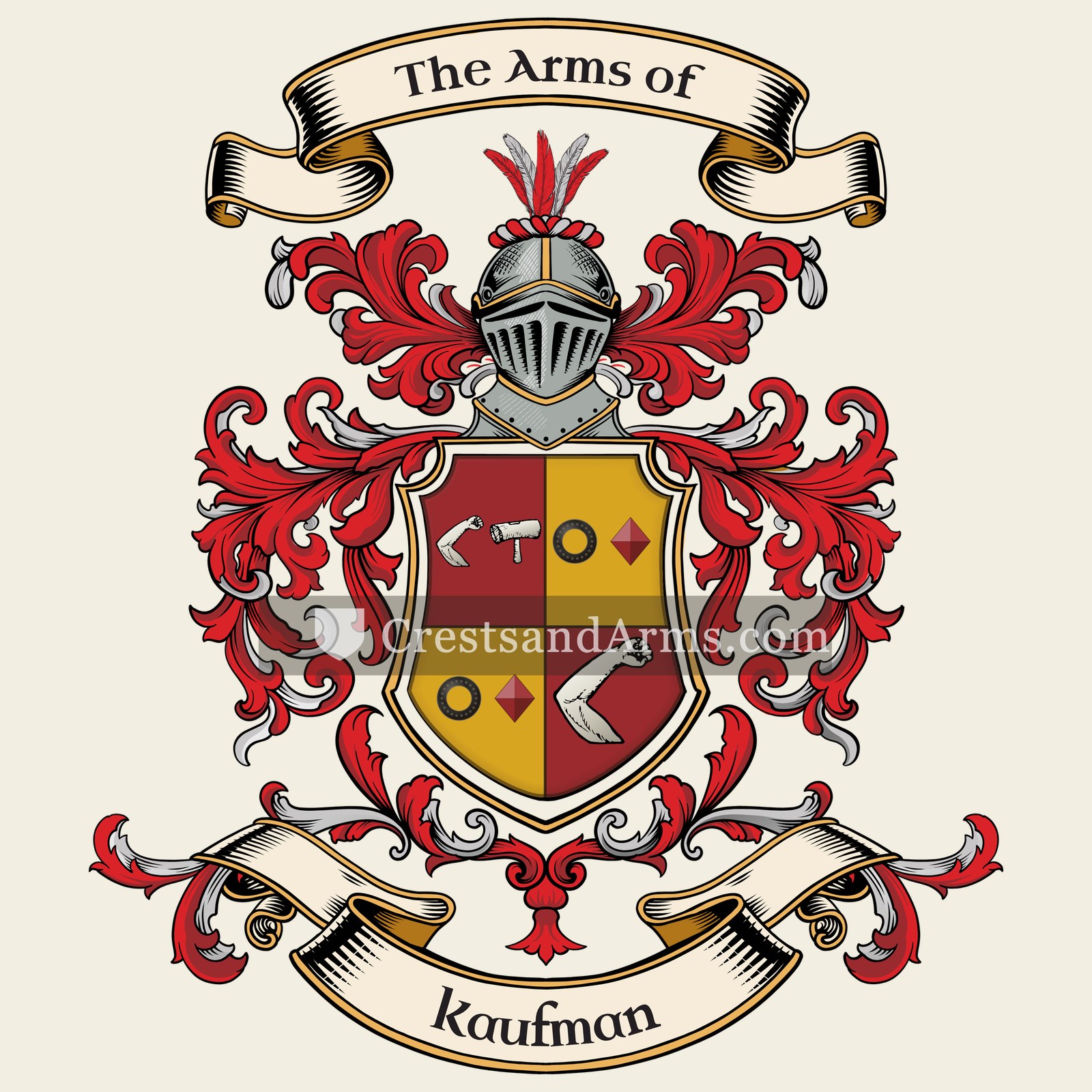


 eagleNobility, strength and a keen mind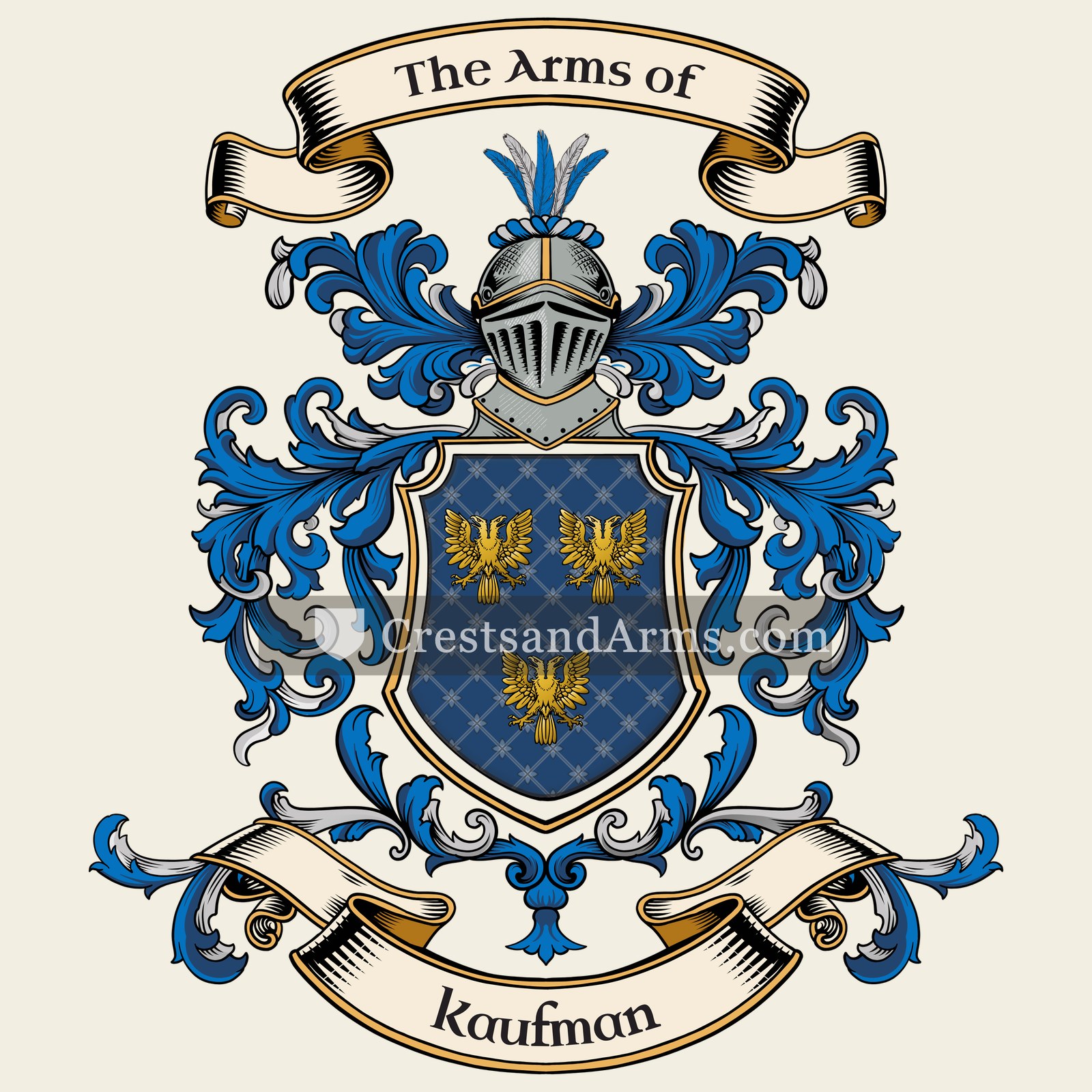


 mountThe ground held, and steadfastness upon it
 crescentHonour by the sovereign, and the second son
 mulletThe third son, and a divine quality from above