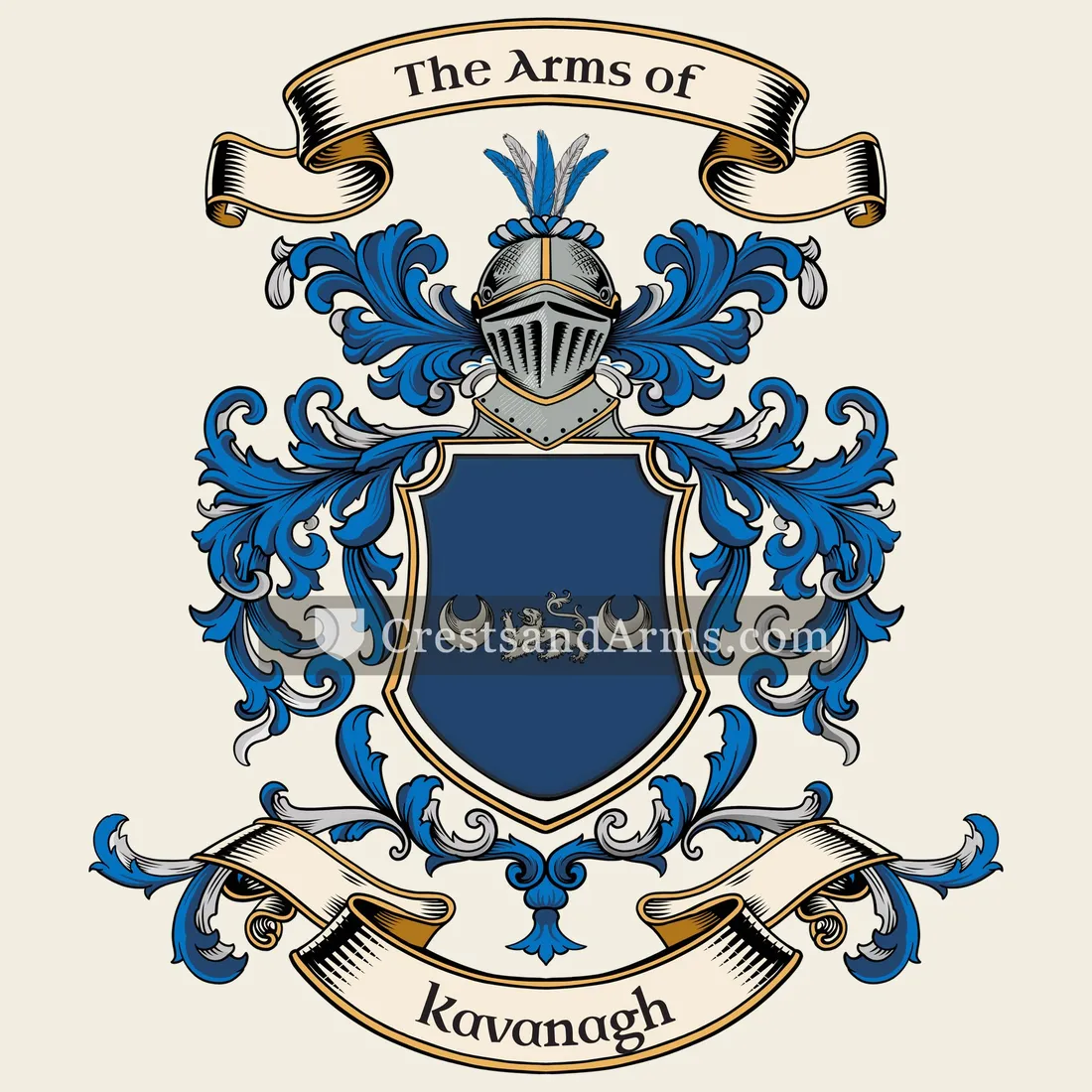
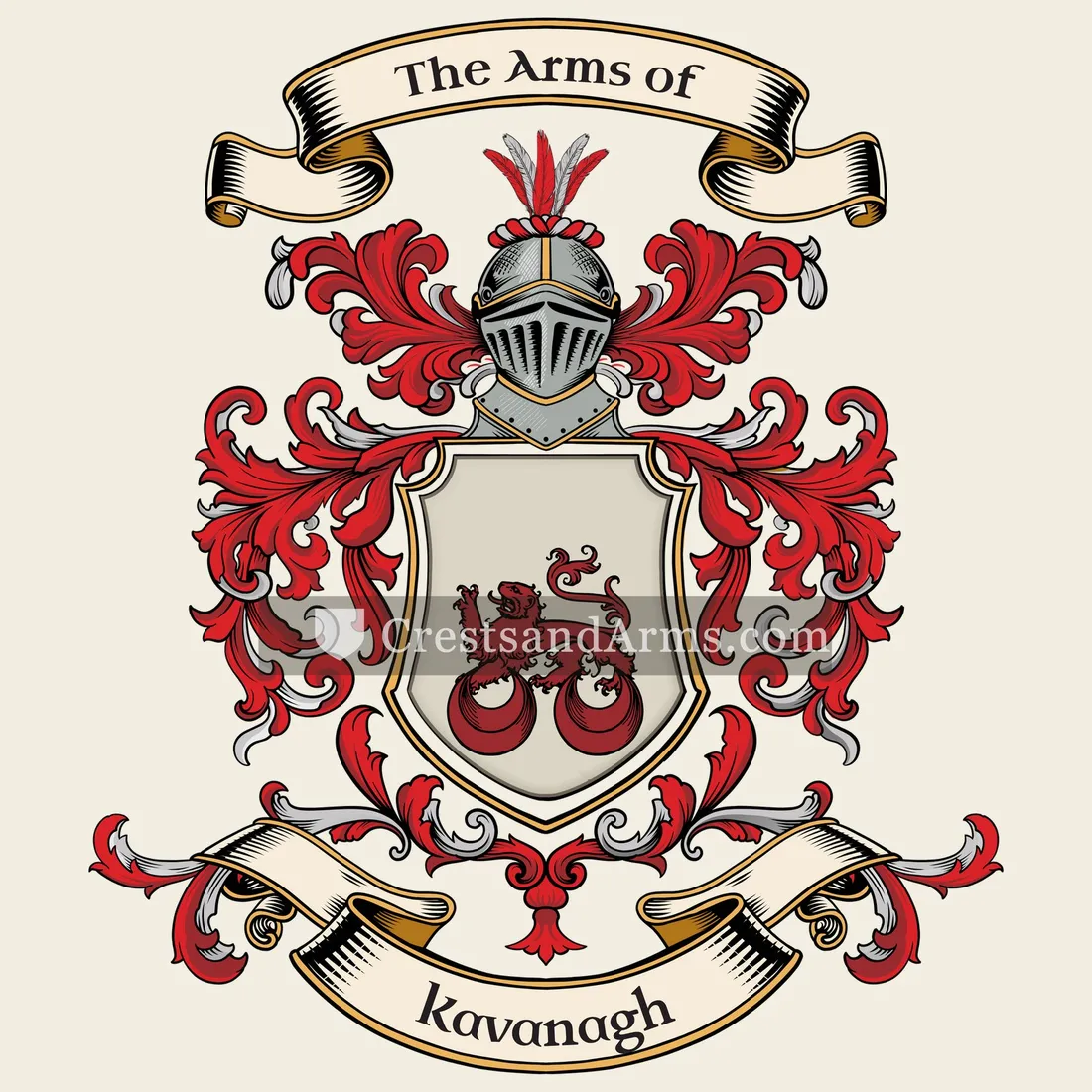
A record of documented arms, meaning and origin, researched for the Kavanagh family lines. Documented in 2 countries.
Reg. 7560 · French, J–L
Meaning of the Kavanagh family crest colors & symbols
Symbols on this shield
lionCourage, strength and royalty
crescentHonour by the sovereign, and the second son
Colours
Blue (Azure)Means: Loyalty and truth
Silver (Argent)Means: Peace and sincerity
Historical info
Source
J. B. Rietstap, Armorial Général, Gouda: G. B. van Goor Zonen, 1884–87
Blazon (the actual original written record)
“D'azur au lion léopardé d'arg., arm. et lamp de gu., soutenu de deux croiss. figurés montants du sec. Trois cq. cour. C.: 1° un bras, arm. d'arg., la main de carn. tenant une épée d'arg., garnie d'or; 2° une gerbe d'or, soutenu d'un croiss. de l'écu; 3° une piramide d'arg., maçonnée de sa., supp. un serpent plié en rond et orné à l'ext. de huit palmes de sin. S.: deux lions reg. d'or, arm. et lamp. de gu. D.: MEA GLORIA FIDES.”
Francec. 1725
Digital archive packCoat of arms PNG, gold border print PDF, vector SVG and the certificate of authenticity. Sent to your email in minutes.
Map of France showing where the Kavanagh arms are recorded
The Kavanagh arms were recorded in France, c. 1725.
Arms such as these were typically recorded in Bretagne.
More families held coats of arms in Bretagne than anywhere else in France. The land was divided into many small estates rather than a few large ones, so far more households counted as gentry, and each needed a shield of its own to be told apart.
This is where the arms were entered in the register. Families often moved to other parts of the country, so the same name can turn up in more than one region.
The body that granted and recorded arms in France in this period.
Louis XV of France
Sovereign of the period
Louis XV of France
1715–1774
Reigning in France when the Kavanagh arms are first recorded.
How Arms Worked in France
In France, a coat of arms was a mark of honor that passed down through the male line to all legitimate descendants. Families often used the same shield without changes to show their shared heritage. If a branch wanted to stand out, they could add a small mark to their shield to show their specific place in the family tree.
Granting authority
The Juge d'armes de France acted as the official authority that regulated and verified coats of arms across the country.
How they got arms
Families typically inherited their arms from ancestors, though they could also receive them through royal grants or by proving their noble status.
Where arms were recorded
Coats of arms were officially recorded in the Armorial Général de France, which began its main collection in the year 1696.
The family's standing
Recorded among the armigerous families of France.
Origin & History of the Kavanagh Family in France
The family name Kavanagh, which is traditionally associated with Irish roots, established a notable presence in the Brittany region of France by 1725. During the eighteenth century, many families from the British Isles moved to French ports to participate in trade or to serve in the military. In Brittany, these settlers often integrated into the local merchant class or joined the ranks of the French administration. Living in a maritime hub allowed members of the Kavanagh family to maintain connections across the sea while adapting to the social and legal structures of their new home. This period of migration highlights how families moved across borders to seek new opportunities, blending their ancestral heritage with the unique cultural life of the French coast.
Meaning of the Kavanagh family crest colors & symbols
Symbols on this shield
lionCourage, strength and royalty
crescentHonour by the sovereign, and the second son
Colours
Silver (Argent)Means: Peace and sincerity
Red (Gules)Means: Military strength
Historical info
Source
Sir Bernard Burke, The General Armory of England, Scotland, Ireland and Wales, London: Harrison & Sons, 1884
Blazon (the actual original written record)
“Ar. a lion pass. gu. in base two crescents of the last”
CarlowBorris · Carlow, c. 1431
Digital archive packCoat of arms PNG, gold border print PDF, vector SVG and the certificate of authenticity. Sent to your email in minutes.
Map of Ireland showing where the Kavanagh arms are recorded
The Kavanagh arms were recorded in Carlow, c. 1431.
Carlow was small, rich farming country in south-eastern Ireland, taken early by Norman families. Good land kept the same families on it, and staying put is what puts a name in the records.
This is where the arms were entered in the register. Families often moved to other parts of the country, so the same name can turn up in more than one region.
The body that granted and recorded arms in Ireland in this period.
Henry VI of England
Sovereign of the period
Henry VI of England
1422–1461
Reigning in France when the Kavanagh arms are first recorded.
How Arms Worked in Ireland
The Ulster King of Arms granted coats of arms to individuals who proved their social standing and good character. These symbols were typically inherited by all legitimate descendants of the original holder. If a family branch wanted a unique look, they could apply for a specific change to their design through the office to ensure their identity remained distinct.
Granting authority
The Ulster King of Arms acted as the official body that regulated and issued all coats of arms throughout Ireland.
How they got arms
Families obtained their arms through formal grants issued by the office after proving their eligibility and paying the required fees.
Where arms were recorded
All official grants were recorded in the registers held by the Ulster King of Arms starting from the year 1552.
The family's standing
Recorded among the armigerous families of Carlow.
Origin & History of the Kavanagh Family in Ireland
The Kavanagh family name originates from the Irish Gaelic name Caomhánach, which means a follower of Saint Caomhán. The family rose to prominence as a powerful branch of the Mac Murchadha dynasty, who served as the Kings of Leinster. By the early 15th century, the Kavanaghs had established themselves as a dominant political and military force in the region of Carlow. Historical records confirm their presence in this area by 1431, where they maintained control over vast territories and defended their influence against both rival Irish clans and the expanding English administration. As leaders of their people, they played a crucial role in the complex power struggles of medieval Ireland, often acting as independent rulers who negotiated their own treaties and alliances. Their legacy remains deeply tied to the landscape of County Carlow, where they held significant strongholds and shaped the local history for generations.
Kavanagh Meaning & Related Branches
Root word
Caomhanach
Derived from the Irish saint name Caomhan meaning gentle or comely.
This name
KavanaghA surname of Irish origin denoting a follower or student of Saint Caomhan.
also spelled
Kavanah
Kavanaugh
Related arms
Cavanaghvariant spelling
Cavenaghvariant spelling
Fitz-Patrickrecorded with Kavanagh, same area
Forderecorded with Kavanagh, same area
Documented Sources
J. B. Rietstap, Armorial Général, Gouda: G. B. van Goor Zonen, 1884–87
Archives départementales du Finistère, Série B, Fonds de l'Amirauté de Brest
Archives départementales d'Ille-et-Vilaine, Série E, État civil et registres paroissiaux
Le Nabour, Éric, Les Irlandais en Bretagne, 1998
Loez, André, Les migrations étrangères en France au XVIIIe siècle, 2005
Digital archive packCoat of arms PNG, gold border print PDF, vector SVG and the certificate of authenticity. Sent to your email in minutes.


 lionCourage, strength and royalty
 crescentHonour by the sovereign, and the second son
 lionCourage, strength and royalty
 crescentHonour by the sovereign, and the second son