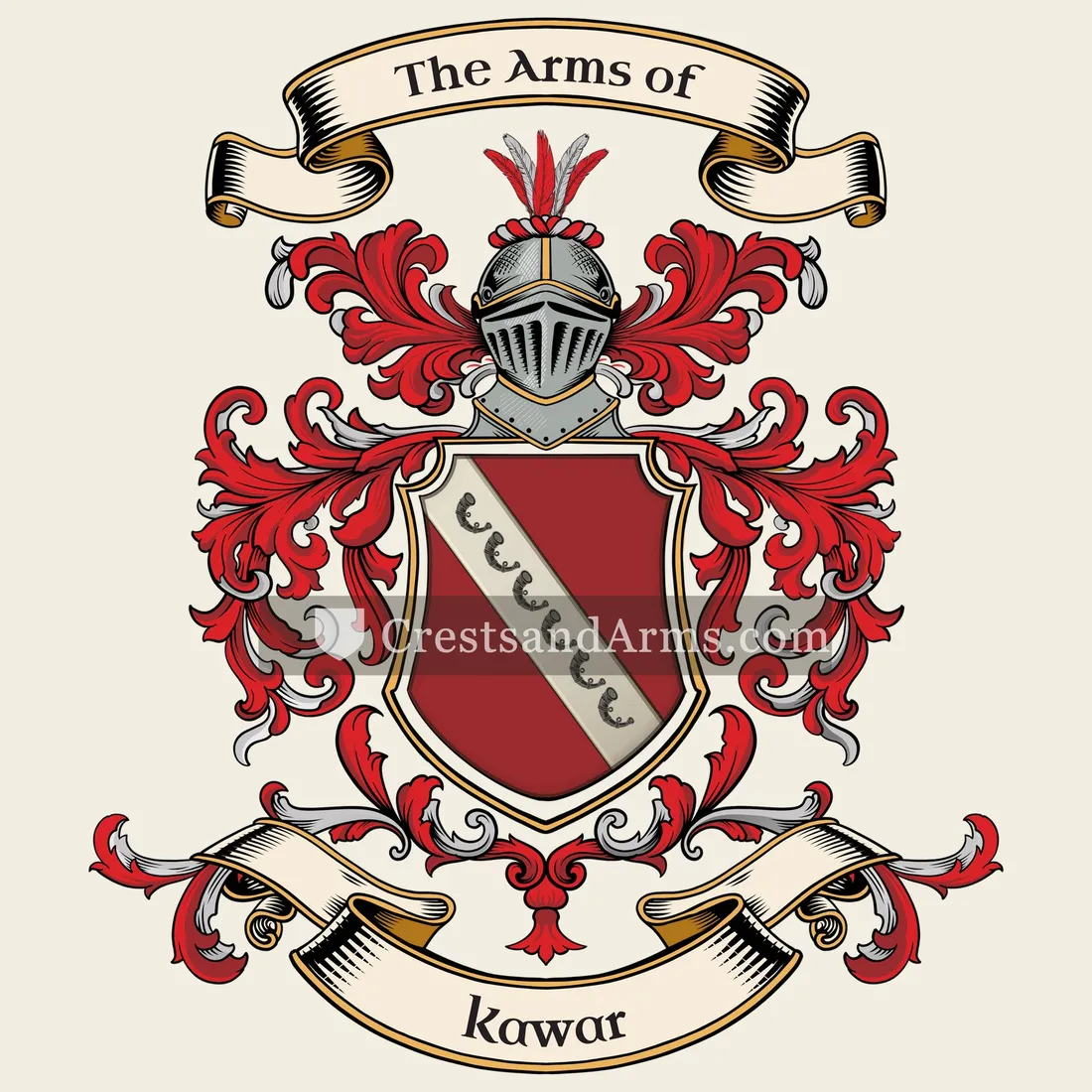
A record of documented arms, meaning and origin, researched for the Kawar family of Poland.
Reg. 4250 · Polish, J–L
Meaning of the Kawar family crest colors & symbols
Symbols on this shield
bendDefence, and the scarf of a commander
hunting horn stringedOne who delights in the chase
Colours
Red (Gules)Means: Military strength
Silver (Argent)Means: Peace and sincerity
Black (Sable)Means: Constancy
Historical info
Source
J. B. Rietstap, Armorial Général, Gouda: G. B. van Goor Zonen, 1884–87
Blazon (the actual original written record)
“De gu. à la bande d'arg., ch de trois paires de cornes de bouquetin de sa., mouv. en barres de la ligne inférieure de la bande. Cq. cour. C.: un femme iss., les cheveux épars, hab. d'arg., les bras nus, tenant de sa main dextre un sceptre d'or et de sa sen. une bague du même. L. d'arg. et de gu.”
LivoniaLivonia, c. 1772
Digital archive packCoat of arms PNG, gold border print PDF, vector SVG and the certificate of authenticity. Sent to your email in minutes.
Map of Poland showing where the Kawar arms are recorded
The Kawar arms were recorded in Livonia, c. 1772.
Livonia was Baltic country held by a small number of landed families who kept their estates for centuries. Land there passed down whole rather than being divided, and long unbroken tenure is what fills a register.
This is where the arms were entered in the register. Families often moved to other parts of the country, so the same name can turn up in more than one region.
Region
Livonia
First recorded
1772
Granting Authority for the Kawar Arms
Ennoblement by the Sejm
Author: Olek Remesz · CC BY-SA 3.0
The body that granted and recorded arms in Poland in this period.
Stanisław August Poniatowski
Sovereign of the period
Stanisław August Poniatowski
1764–1795
Reigning in Poland when the Kawar arms are first recorded.
How Arms Worked in Poland
Polish noble families shared a single coat of arms across many different surnames, creating large clans rather than individual designs. These symbols were held collectively by all members of the clan regardless of their specific family name. When a new family joined the nobility, they were adopted into an existing clan and began using that group's established shield.
Granting authority
The Sejm, which was the Polish parliament, held the power to grant noble status and the right to bear arms.
How they got arms
Families typically received their coat of arms through a formal act of ennoblement granted by the Sejm for distinguished service.
Where arms were recorded
These grants were officially recorded in the Crown Metrica, which served as the central archive for state documents starting in the sixteenth century.
The family's standing
Recorded among the armigerous families of Livonia.
Origin & History of the Kawar Family in Poland
The history of the Kawar family is deeply rooted in the historical region of Livonia, where records confirm their presence as early as 1772. During this period, Livonia was a territory defined by a complex mix of Baltic, German, and Russian cultural influences. Families living in this area often navigated shifting political borders and changing social structures. The name itself likely evolved through the local linguistic traditions of the Baltic provinces, reflecting the diverse origins of the people who settled there. By the late eighteenth century, the Kawar family was established within this landscape, living through a time of significant administrative reforms under the Russian Empire. Their presence in these historical records provides a clear window into the lives of families who helped shape the social fabric of the Baltic region during the eighteenth century.
Kawar Meaning & Related Branches
Root word
Kowar
Derived from the Slavic word for a blacksmith or metal worker.
This name
KawarA topographic or occupational surname referring to a person who works with iron or metal.
also spelled
Kauer
Documented Sources
J. B. Rietstap, Armorial Général, Gouda: G. B. van Goor Zonen, 1884–87
Latvian State Historical Archives (Latvijas Valsts vēstures arhīvs), Vidzemes draudžu reģistri (Livonian Parish Registers), 1772
Estonian Historical Archives (Eesti Ajalooarhiiv), Eestimaa ja Liivimaa hingeloendid (Estonian and Livonian Soul Revision Records), 1772
Digital archive packCoat of arms PNG, gold border print PDF, vector SVG and the certificate of authenticity. Sent to your email in minutes.


 bendDefence, and the scarf of a commander
 hunting horn stringedOne who delights in the chase
 bendDefence, and the scarf of a commander
 hunting horn stringedOne who delights in the chase