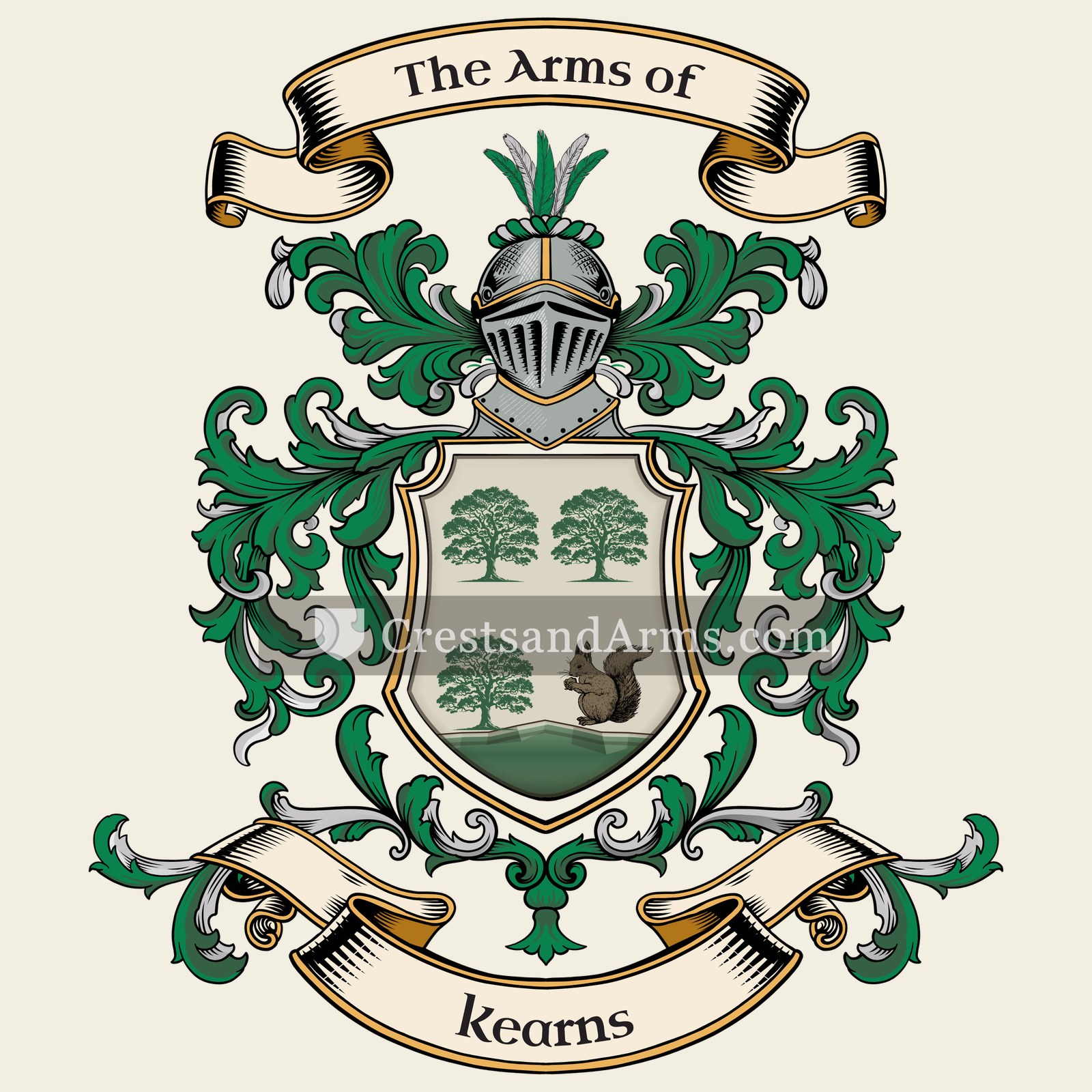
A record of documented arms, meaning and origin, researched for the Kearns family of Belgium.
Reg. 9664 · Belgian, J–L
Coat of Arms & Family Crest Details
Symbols on this shield
mountThe ground held, and steadfastness upon it
treeLife, endurance and deep roots
squirrelPatience and foresight in gathering
Colours
Silver (Argent)Means: Peace and sincerity
Green (Vert)Means: Hope
Historical info
Source
J. B. Rietstap, Armorial Général, Gouda: G. B. van Goor Zonen, 1884–87
Blazon (the actual original written record)
“D'arg. à trois arbres de sin., rangés sur une terrasse du même; entre les deux derniers arbres un écureuil assis au nat., croquant une noix. Cq. cour. C.: un arbre de sin. L. d'arg. et de sin.”
LimburgLimburg, c. 1816
Digital archive packCoat of arms PNG, gold border print PDF, vector SVG and the certificate of authenticity. Sent to your email in minutes.
Map of Belgium showing where the Kearns arms are recorded
The Kearns arms were recorded in Limburg, c. 1816.
Limburg was small country where the Netherlands, Belgium and Germany meet. Its families held land under whichever ruler held the ground, and landholding brought arms whoever the ruler was.
This is where the arms were entered in the register. Families often moved to other parts of the country, so the same name can turn up in more than one region.
The body that granted and recorded arms in Belgium in this period.
William I of the Netherlands
Sovereign of the period
William I of the Netherlands
1815–1840
Reigning in Belgium when the Kearns arms are first recorded.
How Arms Worked in Belgium
In Belgium, a coat of arms is considered personal property that is passed down through the male line to legitimate descendants. Families often use the same shield design across generations to show their shared heritage. If a branch of the family wants to change the design, they must apply for an official update to their specific version of the arms.
Granting authority
The Conseil héraldique is the official body that regulates and approves all coats of arms in Belgium.
How they got arms
Families obtain their coats of arms through formal royal grants or by confirming their historical right to use existing designs.
Where arms were recorded
All approved coats of arms are officially recorded in the public registers of the Conseil héraldique since 1844.
The family's standing
Recorded among the armigerous families of Limburg.
Origin & History of the Kearns Family in Belgium
The family name Kearns is primarily rooted in Irish history, originating from the Gaelic name Ó Céirín, which translates to descendant of the dark or swarthy one. While the name is most famously associated with County Mayo in Ireland, the movement of families across Europe led to various branches establishing themselves in new regions during the nineteenth century. By 1816, records confirm that members of the family were living in the Limburg region. This area, which spans parts of modern-day Belgium and the Netherlands, was a significant crossroads for trade and migration during the post-Napoleonic era. Families like the Kearns often settled in these areas to pursue opportunities in agriculture or local industry, integrating into the local culture while maintaining their distinct ancestral identity. This transition from their Irish origins to the heart of Europe reflects the broader patterns of mobility that defined the lives of many families during that period.
Related Branches & Arms
Root word
Ceann
An Irish Gaelic term referring to a head or leader.
This name
KearnsA patronymic surname derived from a nickname meaning child of the dark-headed one.
also spelled
Kerense
Kerenss
Kerenh
Documented Sources
J. B. Rietstap, Armorial Général, Gouda: G. B. van Goor Zonen, 1884–87
MacLysaght, Edward, The Surnames of Ireland, 1985
State Archives in Limburg (Rijksarchief in Limburg), Burgerlijke Stand: Geboorte-, huwelijks- en overlijdensakten, 1816
Digital archive packCoat of arms PNG, gold border print PDF, vector SVG and the certificate of authenticity. Sent to your email in minutes.


 mountThe ground held, and steadfastness upon it
 treeLife, endurance and deep roots
 squirrelPatience and foresight in gathering
 mountThe ground held, and steadfastness upon it
 treeLife, endurance and deep roots
 squirrelPatience and foresight in gathering