A record of documented arms, meaning and origin, researched for the Keck family lines. Documented in 2 countries.
Reg. 7964 · German, J–L
Coat of Arms & Family Crest Details
Symbols on this shield
fessThe military belt, and readiness to serve
eagleNobility, strength and a keen mind
lambGentleness, patience and faith
Colours
Silver (Argent)Means: Peace and sincerity
Red (Gules)Means: Military strength
Historical info
Source
J. B. Rietstap, Armorial Général, Gouda: G. B. van Goor Zonen, 1884–87
Blazon (the actual original written record)
“coupé d'arg. sur gu., à une roue de moulin de quatre rayons de l'un en l'autre. Sur le tout d'azur à une aigle ess. de profil d'arg., cour. d'or, empiétant un agneau du sec. Quatre cq. cour. C.: 1o trois pennons, le premier d'azur à quatre barres d'or, la hampe d'arg.; le deuxième de gu. à la fasce d'arg., la hampe de gu.; le troisième de gu. à une tour d'or, la hampe du même; le premier pennon flottant à dextre, les deux autres à sen.; 1. d'or et de sa.; 2o le chat du 1, iss.; 1. d'arg. et de gu.; 3o les meubles du surtout; 1. d'arg. et de sa.; 4o un vol, l'aile dextre aux armes du 5, l'aile sen. d'or ch. d'une barre de sa. surch. d'une flèche d'or; 1. d'or et de sa.”
Germanyc. 1765
Digital archive packCoat of arms PNG, gold border print PDF, vector SVG and the certificate of authenticity. Sent to your email in minutes.
Map of Germany showing where the Keck arms are recorded
The Keck arms were recorded in Germany, c. 1765.
Arms such as these were typically recorded in Bavaria.
Bavaria was a country of old landed families and walled market towns. Estates passed down the same line for centuries, and both the landowners and the leading townsmen kept arms, which is why so many Bavarian names sit in the registers.
This is where the arms were entered in the register. Families often moved to other parts of the country, so the same name can turn up in more than one region.
The body that granted and recorded arms in Germany in this period.
Francis I, Holy Roman Emperor
Sovereign of the period
Francis I, Holy Roman Emperor
1745–1765
Reigning in Germany when the Keck arms are first recorded.
How Arms Worked in Germany
In the Holy Roman Empire, coats of arms were often granted to individuals by the Emperor or his representatives. These arms were then passed down through the generations to all legitimate descendants of the original holder. Younger branches of a family usually kept the same shield design without needing to change it, as the arms belonged to the entire lineage.
Granting authority
The Holy Roman Emperor held the sole power to grant new coats of arms throughout his vast imperial territories.
How they got arms
Families typically obtained their coats of arms through a formal imperial grant or by proving their noble status to the authorities.
Where arms were recorded
These grants were officially recorded in the Imperial Chancery registers, which began keeping formal records of such honors during the Middle Ages.
The family's standing
Recorded among the armigerous families of Germany.
Origin & History of the Keck Family in Germany
The surname Keck traces its roots back to the Germanic regions, where it originated as a descriptive nickname. In the Middle High German language, the word *keck* meant bold, lively, or spirited. It was common for people in medieval Germany to receive names based on their personality traits or physical demeanor, and this name likely identified an ancestor who was known for being particularly brave or energetic. By the time members of the family were documented in Bavaria in 1765, the name had become a well-established hereditary surname passed down through generations. These early families were often part of the agrarian society that defined the Bavarian landscape, living in small communities where the name served as a link to their ancestors' reputations for courage and vigor.
Coat of Arms & Family Crest Details
Symbols on this shield
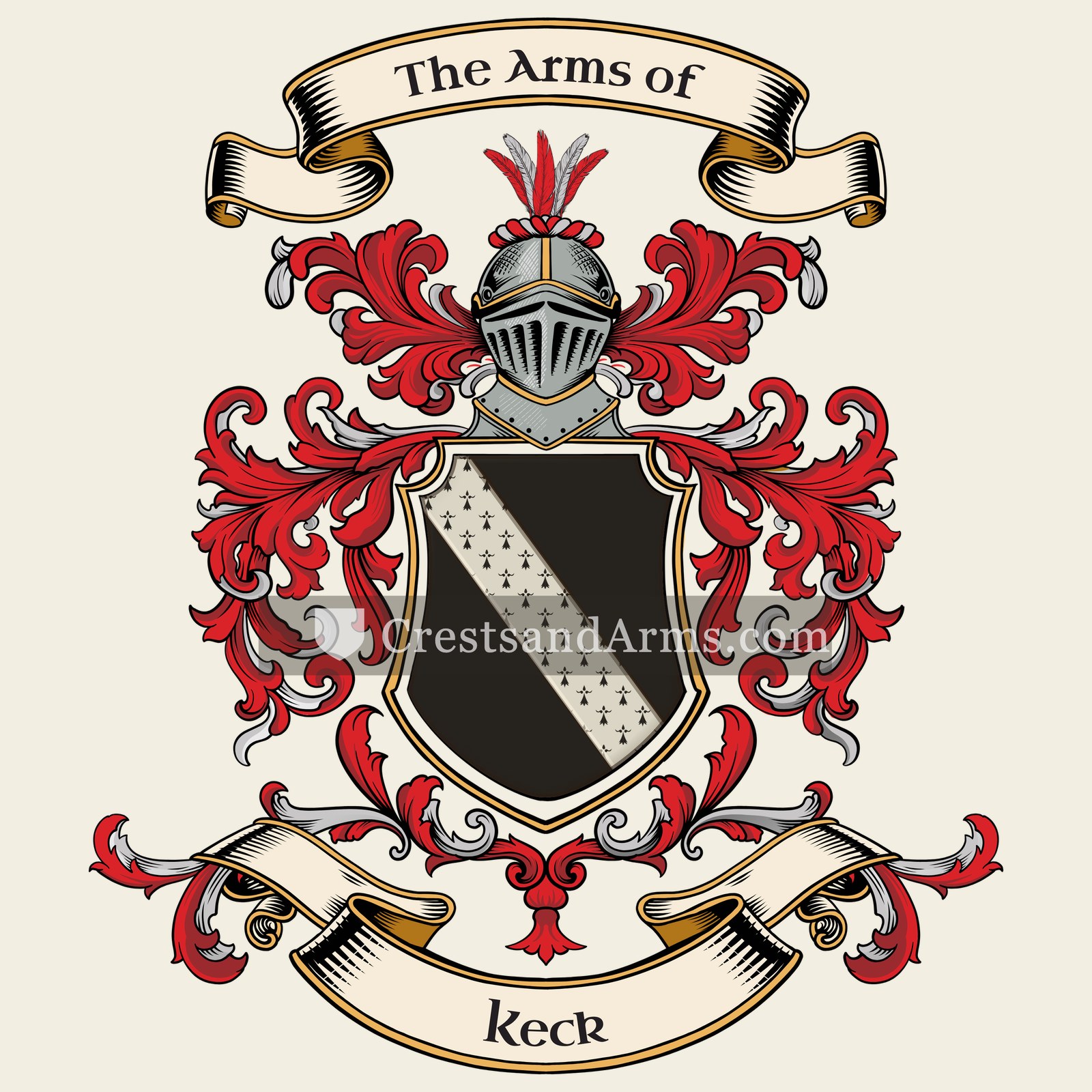
bendDefence, and the scarf of a commander
Colours
Black (Sable)Means: Constancy
ErmineMeans: Dignity
Historical info
Source
Sir Bernard Burke, The General Armory of England, Scotland, Ireland and Wales, London: Harrison & Sons, 1884
Blazon (the actual original written record)
“Sa. a bend erm. betw. two cotises flory counterflory or”
LeicesterStaughton Grange · Leicester, c. 1737
Digital archive packCoat of arms PNG, gold border print PDF, vector SVG and the certificate of authenticity. Sent to your email in minutes.
Map of England showing where the Keck arms are recorded
The Keck arms were recorded in Leicester, c. 1737.
Leicestershire was grazing country, and wool and cattle made steady money rather than spectacular fortunes. Steady money bought manors, and manors are what brought families into the registers.
This is where the arms were entered in the register. Families often moved to other parts of the country, so the same name can turn up in more than one region.
The body that granted and recorded arms in England in this period.
George II of Great Britain
Sovereign of the period
George II of Great Britain
1727–1760
Reigning in Germany when the Keck arms are first recorded.
How Arms Worked in England
English heraldry allowed arms to be shared by all legitimate descendants of the original owner. These symbols were treated as personal property that moved through the generations to all children. While the eldest son kept the original design, other family members could use the same shield without needing to change it or register their own unique versions.
Granting authority
The College of Arms in London has regulated the use of coats of arms throughout England and Wales since 1484.
How they got arms
Families typically obtained their coats of arms through a formal grant from the Crown or by proving their ancient right to them.
Where arms were recorded
All official coats of arms are recorded in the registers kept at the College of Arms, which date back to the fifteenth century.
The family's standing
Recorded among the armigerous families of Leicester.
Origin & History of the Keck Family in England
The family name Keck is rooted in the linguistic traditions of medieval England, where it likely originated as a descriptive nickname. In Middle English, the term was often associated with someone who was perceived as brisk, lively, or sharp in their manner. By the time the name appears in formal records in Leicester in 1737, the family had established itself as part of the local social fabric during a period of significant agricultural and industrial growth in the East Midlands. While many families during this era were tied to specific trades or landholdings, the Kecks in Leicester were part of a broader movement of families settling into stable urban environments. This transition allowed them to participate in the civic and economic life of the town as it expanded throughout the eighteenth century. The persistence of the name in parish registers and local administrative documents from this time reflects a family that was well-integrated into the community, contributing to the steady development of Leicester’s local history.
Related Branches & Arms
Root word
këck
Middle High German term meaning bold, brisk, or lively.
This name
KeckA descriptive nickname for a person who was perceived as courageous, spirited, or audacious.
also spelled
Kek
Keke
Related arms
Goldenbergsimilar arms
Manettisimilar arms
Plaggasimilar arms
Documented Sources
J. B. Rietstap, Armorial Général, Gouda: G. B. van Goor Zonen, 1884–87
Bahlow, Hans. Deutsches Namenlexikon: Familien- und Vornamen nach Ursprung und Sinn erklärt. 1967
Heintze, Albert. Die deutschen Familien-Namen: geschichtlich, geographisch, sprachlich. 1903


 fessThe military belt, and readiness to serve
 eagleNobility, strength and a keen mind
 lambGentleness, patience and faith
 fessThe military belt, and readiness to serve
 eagleNobility, strength and a keen mind
 lambGentleness, patience and faith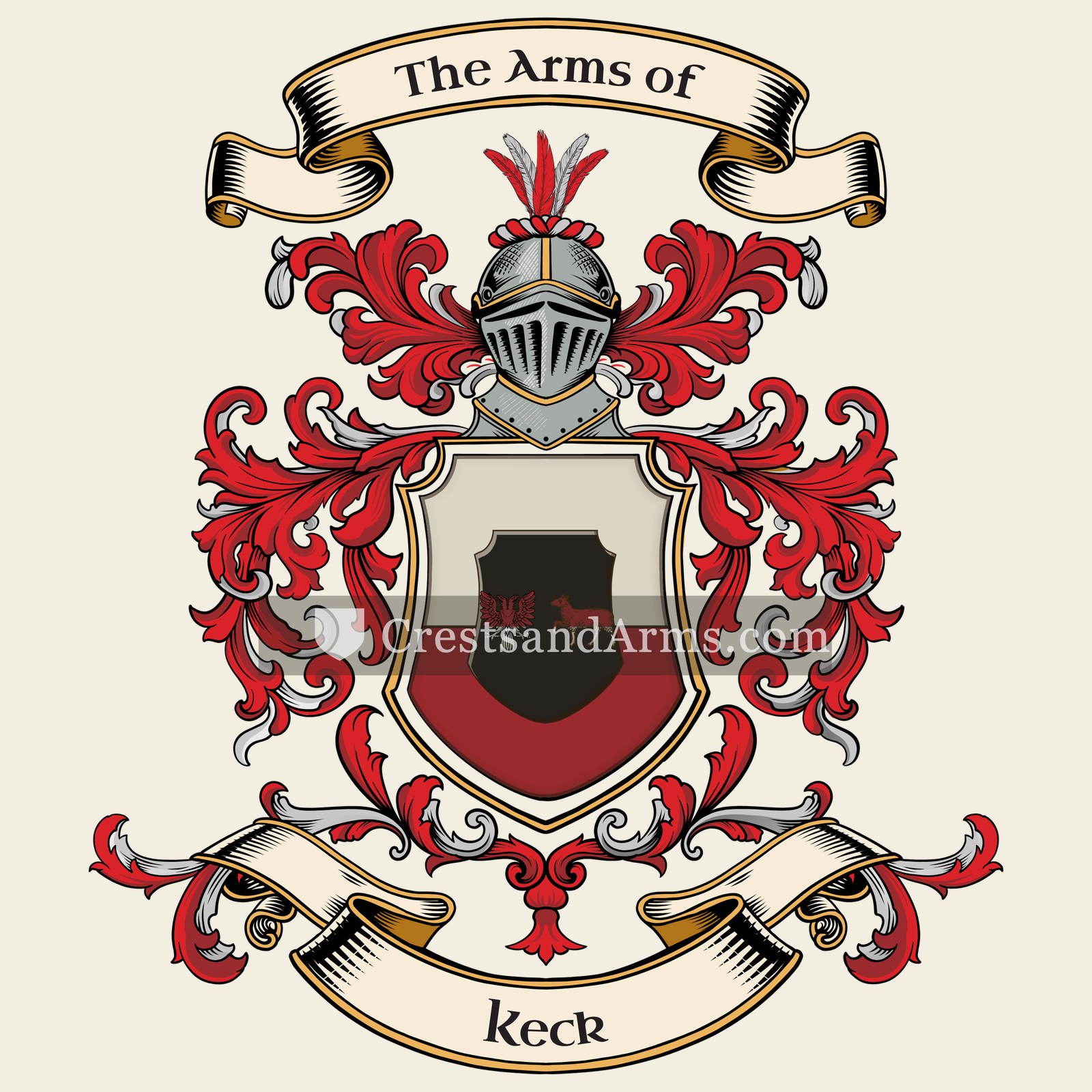


 bendDefence, and the scarf of a commander