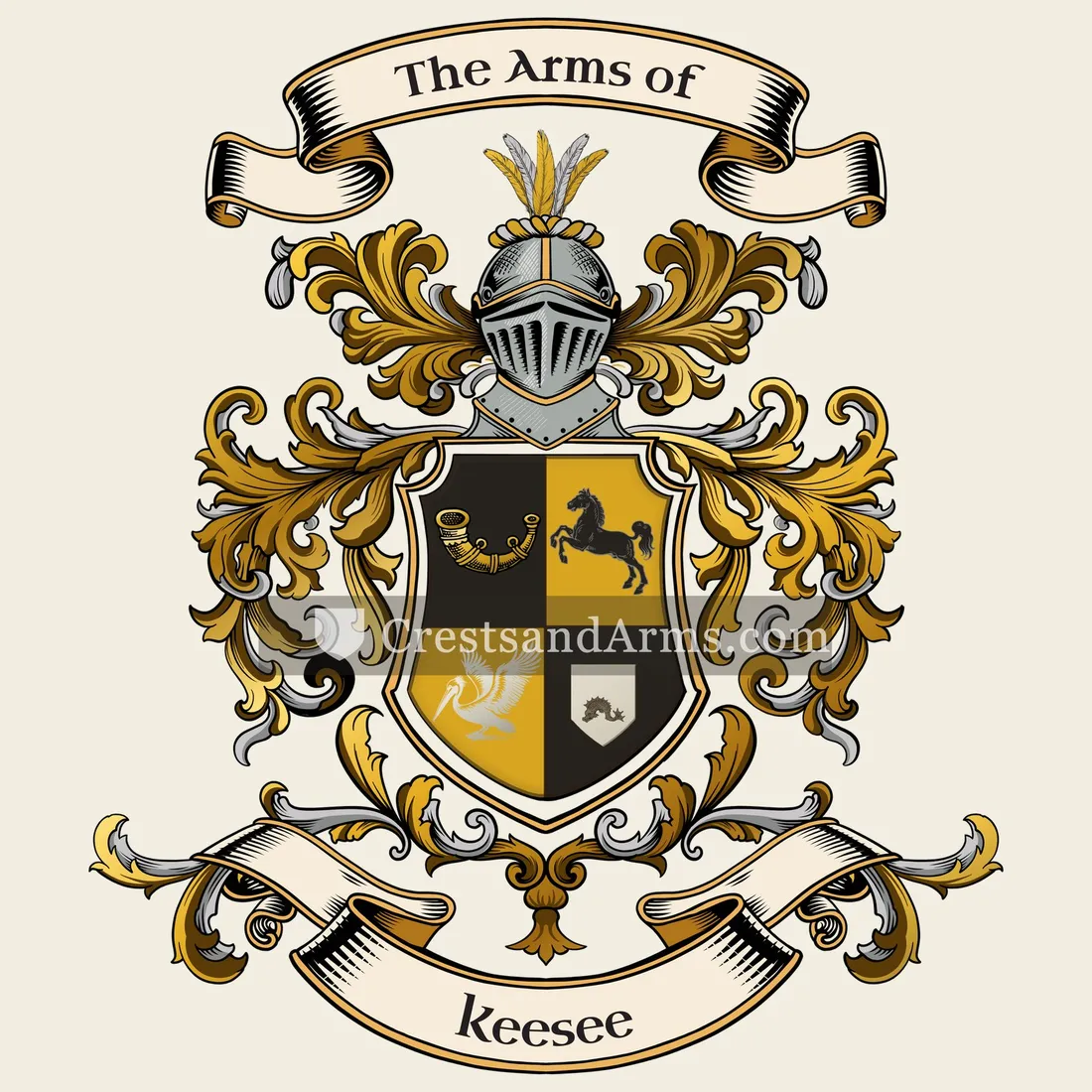
A record of documented arms, meaning and origin, researched for the Keesee family lines. Documented in 2 countries.
Reg. 6884 · German, J–L
Meaning of the Keesee family crest colors & symbols
Symbols on this shield
hunting horn stringedOne who delights in the chase
horseReadiness to serve king and country
pelicanSelf-sacrifice and devotion to one's children
dolphinSwiftness, charity and love
Colours
Black (Sable)Means: Constancy
Gold (Or)Means: Generosity
Silver (Argent)Means: Peace and sincerity
Historical info
Source
J. B. Rietstap, Armorial Général, Gouda: G. B. van Goor Zonen, 1884–87
Blazon (the actual original written record)
“Coupé: au 1 parti: a. de sa. à un cor-de-chasse d'or; b. d'or à un cheval cabré de sa.; au 2 de gu. à un pélican avec ses petits dans son aire d'arg. Sur le tout d'arg. à un dauphin au nat. en pal, la tête en bas. C.: une rose d'arg., tigée et feuillée de sin., entre deux prob. de sa., ornées chacune dans son embouchure d'une rose d'or.”
GermanyLeipzig, c. 1765
Digital archive packCoat of arms PNG, gold border print PDF, vector SVG and the certificate of authenticity. Sent to your email in minutes.
Map of Germany showing where the Keesee arms are recorded
The Keesee arms were recorded in Leipzig, c. 1765.
This is where the arms were entered in the register. Families often moved to other parts of the country, so the same name can turn up in more than one region.
The body that granted and recorded arms in Germany in this period.
Francis I, Holy Roman Emperor
Sovereign of the period
Francis I, Holy Roman Emperor
1745–1765
Reigning in Germany when the Keesee arms are first recorded.
How Arms Worked in Germany
In the Holy Roman Empire, coats of arms were often granted to individuals by the Emperor or his representatives. These arms were then passed down through the generations to all legitimate descendants of the original holder. Younger branches of a family usually kept the same shield design without needing to change it, as the arms belonged to the entire lineage.
Granting authority
The Holy Roman Emperor held the sole power to grant new coats of arms throughout his vast imperial territories.
How they got arms
Families typically obtained their coats of arms through a formal imperial grant or by proving their noble status to the authorities.
Where arms were recorded
These grants were officially recorded in the Imperial Chancery registers, which began keeping formal records of such honors during the Middle Ages.
The family's standing
Recorded among the armigerous families of Germany.
Origin & History of the Keesee Family in Germany
The family name Keesee traces its roots to the cultural landscape of Saxony, where records confirm the presence of family members in the city of Leipzig by 1765. During this period, Leipzig served as a major European hub for trade, printing, and intellectual exchange, placing the family at the center of a rapidly modernizing German society. The name likely evolved from regional dialects common to the area, reflecting the linguistic shifts that occurred as local populations interacted through the city's famous trade fairs. As residents of a prominent urban center, the early members of the Keesee family were part of a growing middle class that contributed to the city's reputation for scholarship and commerce. This history suggests that the family was well-positioned to participate in the significant social and economic changes that defined eighteenth-century Germany.
Meaning of the Keesee family crest colors & symbols
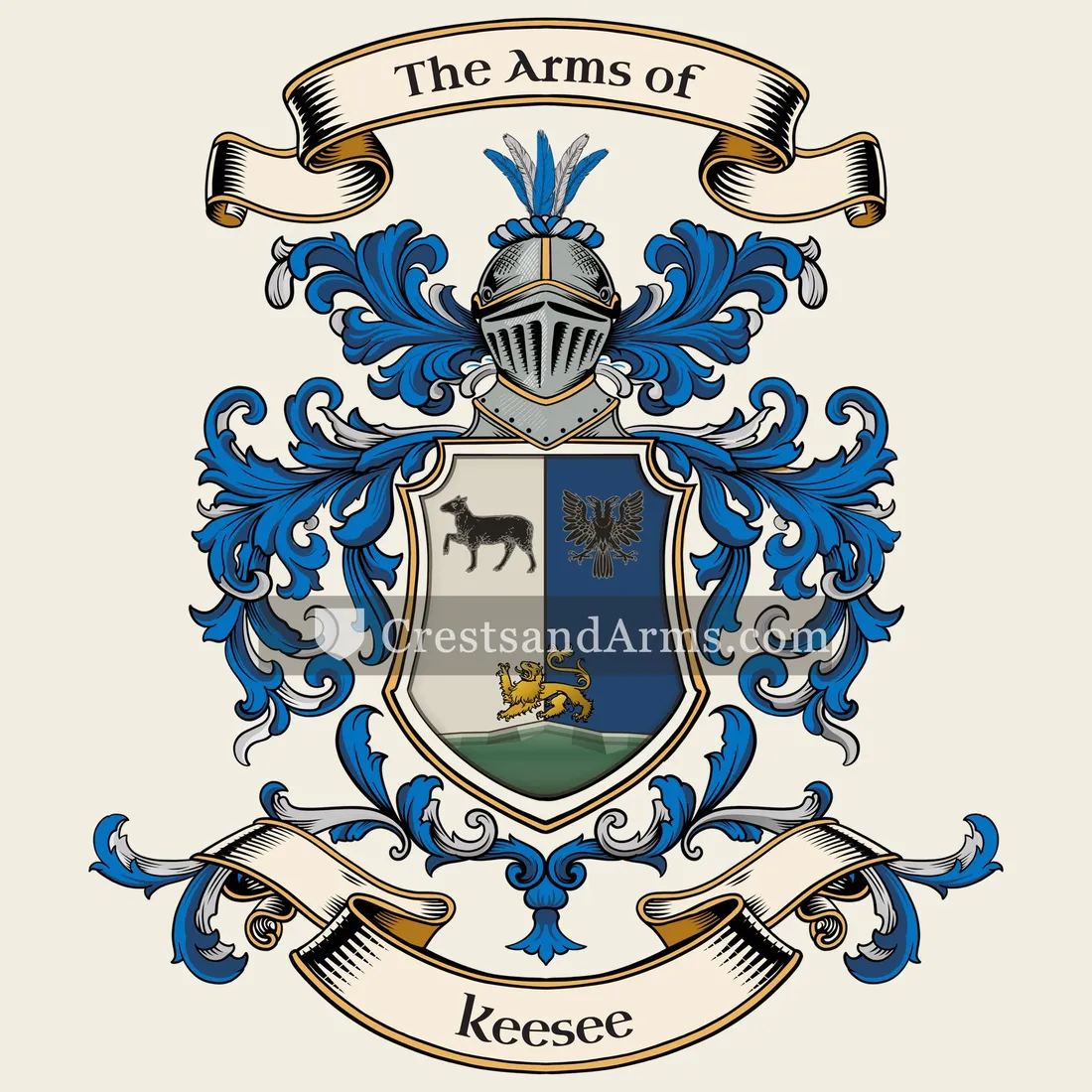
Symbols on this shield
mountThe ground held, and steadfastness upon it
lambGentleness, patience and faith
eagleNobility, strength and a keen mind
lionCourage, strength and royalty
Colours
Silver (Argent)Means: Peace and sincerity
Blue (Azure)Means: Loyalty and truth
Green (Vert)Means: Hope
Black (Sable)Means: Constancy
Gold (Or)Means: Generosity
Historical info
Source
J. B. Rietstap, Armorial Général, Gouda: G. B. van Goor Zonen, 1884–87
Blazon (the actual original written record)
“d'arg. à un agneau de sa., posé sur une terrasse de sin., et une aigle de profil de sa., cour. d'or, perchée sur le dos de l'agneau; aux 2 et 3 d'azur au lion d'or. tenant une grappe de raisins du même. Deux cq. cour. C.: 1° les meubles du 1, entre deux prob. coupées, à dextre d'or sur azur, à sen. de sa. sur arg.; 1. d'arg. et de sa.; 2° le lion du 2, entre un vol coupé, à dextre de sa. sur arg., à sen. d'or sur sa.; 1. d'or et d'azur.”
Austriac. 1753
Digital archive packCoat of arms PNG, gold border print PDF, vector SVG and the certificate of authenticity. Sent to your email in minutes.
Map of Austria showing where the Keesee arms are recorded
The Keesee arms were recorded in Austria, c. 1753.
Arms such as these were typically recorded in Tyrol.
Tyrol was mountain country in western Austria, where the valleys were held by families who had been there a very long time. Old tenure counted for more than money, and old families carried arms.
This is where the arms were entered in the register. Families often moved to other parts of the country, so the same name can turn up in more than one region.
Region
Tyrol
First recorded
1753
Granting Authority for the Keesee Arms
Imperial and Royal chancery
Sodacan · CC BY-SA 3.0
The body that granted and recorded arms in Austria in this period.
Francis I, Holy Roman Emperor
Sovereign of the period
Francis I, Holy Roman Emperor
1745–1765
Reigning in Germany when the Keesee arms are first recorded.
How Arms Worked in Austria
Austrian coats of arms were often linked directly to noble titles granted by the Emperor. These symbols belonged to the entire family line rather than just one individual. When a family grew, new branches kept the original design without needing to change it. This system allowed all members of a noble house to share the same identity across many generations.
Granting authority
The Imperial and Royal chancery managed all heraldic matters and controlled the official granting of arms throughout the Austrian lands.
How they got arms
Families typically received their arms through a formal imperial decree that often accompanied the elevation of a person to noble status.
Where arms were recorded
Official records of these grants were kept in the Imperial Register of Nobility which began its formal documentation process in 1453.
The family's standing
Recorded among the armigerous families of Austria.
Origin & History of the Keesee Family in Austria
The history of the Keesee family in the Austrian region of Tyrol dates back to at least 1753, a time when the area was a rugged and mountainous province within the Habsburg Monarchy. During this period, the name likely emerged as a localized variation of Germanic or Alpine surnames, often tied to the specific geography or the trade of the family members living in the high valleys. Life in eighteenth-century Tyrol was defined by deep connections to the land, as families were frequently involved in alpine agriculture, forestry, or the regional mining industries that fueled the local economy. Because Tyrol served as a vital crossroads between the German-speaking north and the Italian-speaking south, the Keesee family lived in a region characterized by significant cultural exchange and movement. While the name remained rooted in the traditions of the Tyrolean Alps, the economic pressures of the era eventually encouraged some family members to look beyond the mountain passes for new opportunities. This early presence in Tyrol establishes the family as part of the resilient population that helped shape the social and cultural identity of the Austrian highlands during the mid-1700s.
Keesee Meaning & Related Branches
Root word
Kies
A German term referring to gravel or small pebbles.
This name
KeeseeA topographic name for someone who lived on or near a gravelly area.
also spelled
Kase
Documented Sources
J. B. Rietstap, Armorial Général, Gouda: G. B. van Goor Zonen, 1884–87
Stadtarchiv Leipzig, Bürgerbücher der Stadt Leipzig, 1765
Friedrich, Ernst, Leipzig: Eine Stadtgeschichte, 1985


 hunting horn stringedOne who delights in the chase
 horseReadiness to serve king and country
 pelicanSelf-sacrifice and devotion to one's children
 dolphinSwiftness, charity and love
 hunting horn stringedOne who delights in the chase
 horseReadiness to serve king and country
 pelicanSelf-sacrifice and devotion to one's children
 dolphinSwiftness, charity and love


 mountThe ground held, and steadfastness upon it
 lambGentleness, patience and faith
 eagleNobility, strength and a keen mind
 lionCourage, strength and royalty